CHAPTER 2
Utility and Choice
A. Summary
Chapter 2 introduces many new concepts to the student and for that reason it
is one of the more difficult chapters in the text. The central concept of the
chapter is the indifference curve and its slope, the Marginal Rate of Substitu-
tion (MRS). The MRS formalizes the notion of trade-off and is (in principle)
because the MRS does indeed diminish for movements in that direction.
Students’ primary difficulty with the material in Chapter 2 is in confus-
ing the MRS (a slope concept) with the ratio of the amounts of two goods.
Unfortunately, that confusion is increased by some examples based on the
The soft drink-hamburger example that runs throughout Chapter 2 is in-
tended to provide an easy, mildly amusing introduction to the subject for stu-
dents. In general, the example seems to work well and is, we believe,
B. Lecture and Discussion Suggestions
The challenge in lecturing on Chapter 2 is to avoid mere repetition of the
text. One way to do that is to offer a somewhat more mathematical treatment.
Chapter 2: Utility and Choice
18
problems. Once a single indifference curve has been traced out, a second can
be constructed to the northeast of the first by using the “more is better” as-
sumption and proceeding with an identical construction. Utility maximization
can be approached in the same way by starting at the Y-intercept on the
budget constraint and inquiring whether the individual would make various
trades along the constraint.
Discussions of Chapter 2 material might focus on real world illustrations
C. Glossary Entries in the Chapter
• Budget Constraint
• Ceteris Paribus Assumption
• Complete Preferences
SOLUTIONS TO CHAPTER 2 PROBLEMS
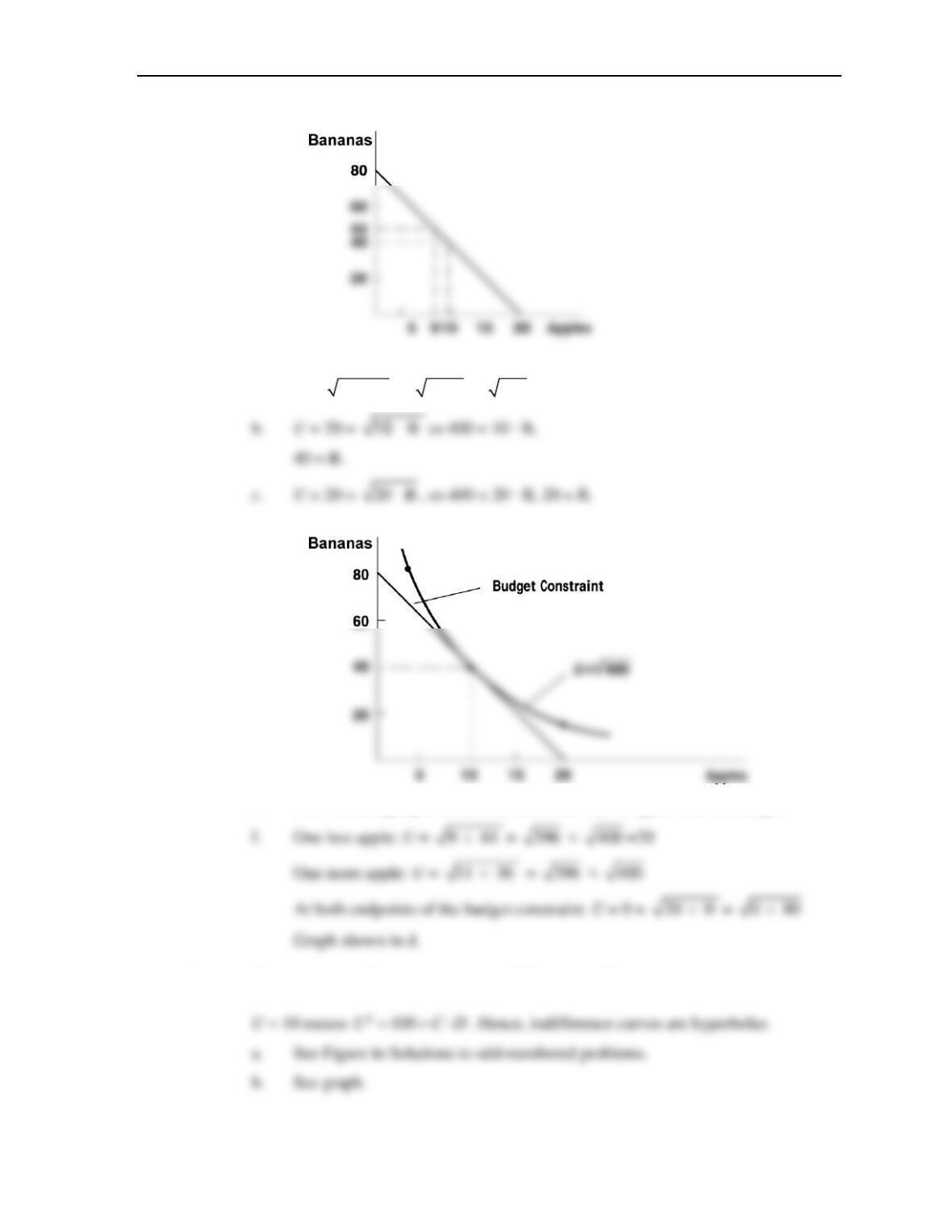
2.1 a.
$8.00 = 20 apples can be bought.
$.40/apple
d. One less apple frees $.40 to be spent on bananas, so
Chapter 2: Utility and Choice
19
2.2 a. U =
• AB
=
5• 80
=
400
= 20.
d.
e. From the budget part d, an individual can buy 10 apples and 40 oranges.
2.3 To graph the indifference curves, use
2
U
instead of U.
Chapter 2: Utility and Choice
20
c. D=10,
10 0 0U= =
2.4 a. Tangency is the same in either case.
b. Costs are:
i. $520
ii. $290
2.5
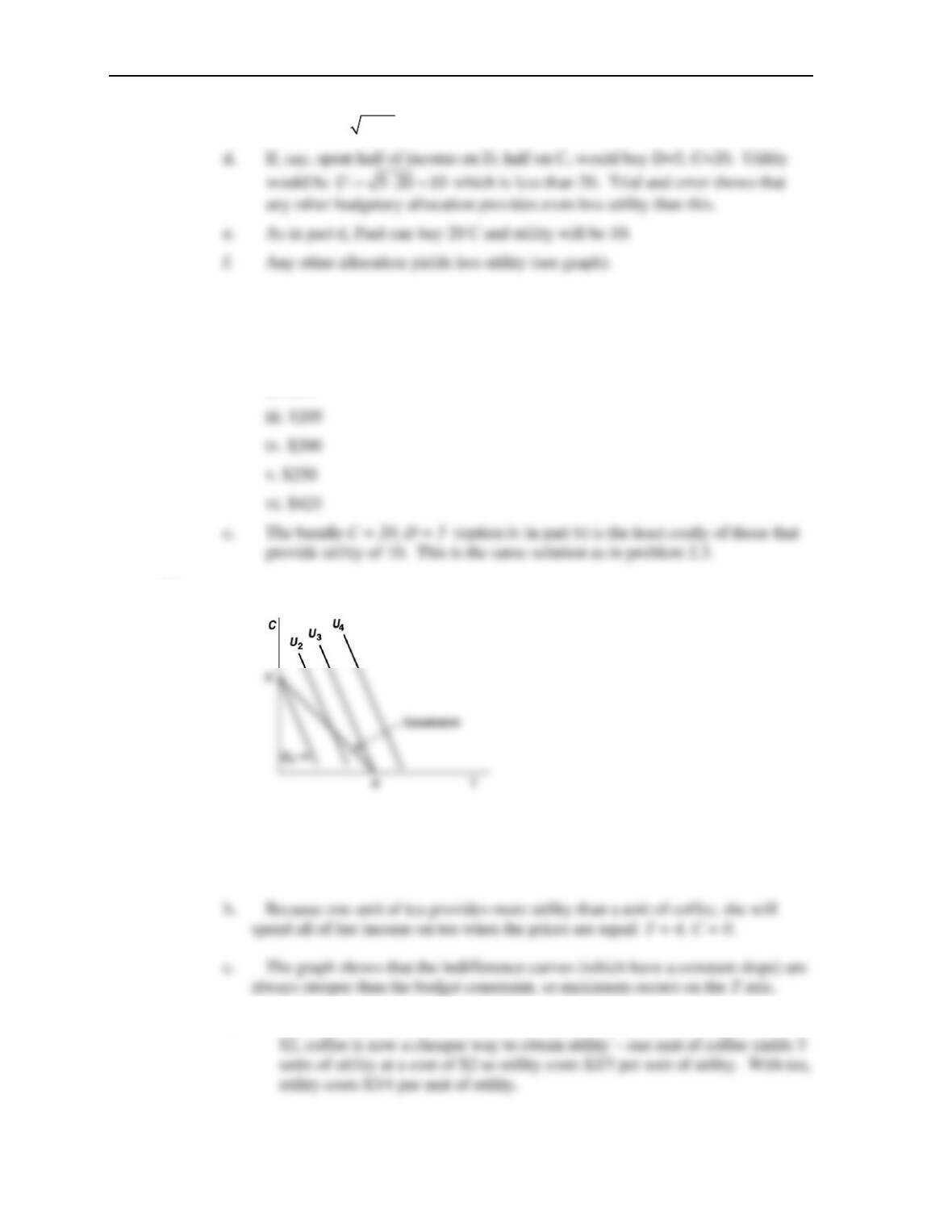
a. The indifference curves here are straight lines with slope -4/3. Hence, the
MRS is a constant 4/3. The goods are perfect substitutes
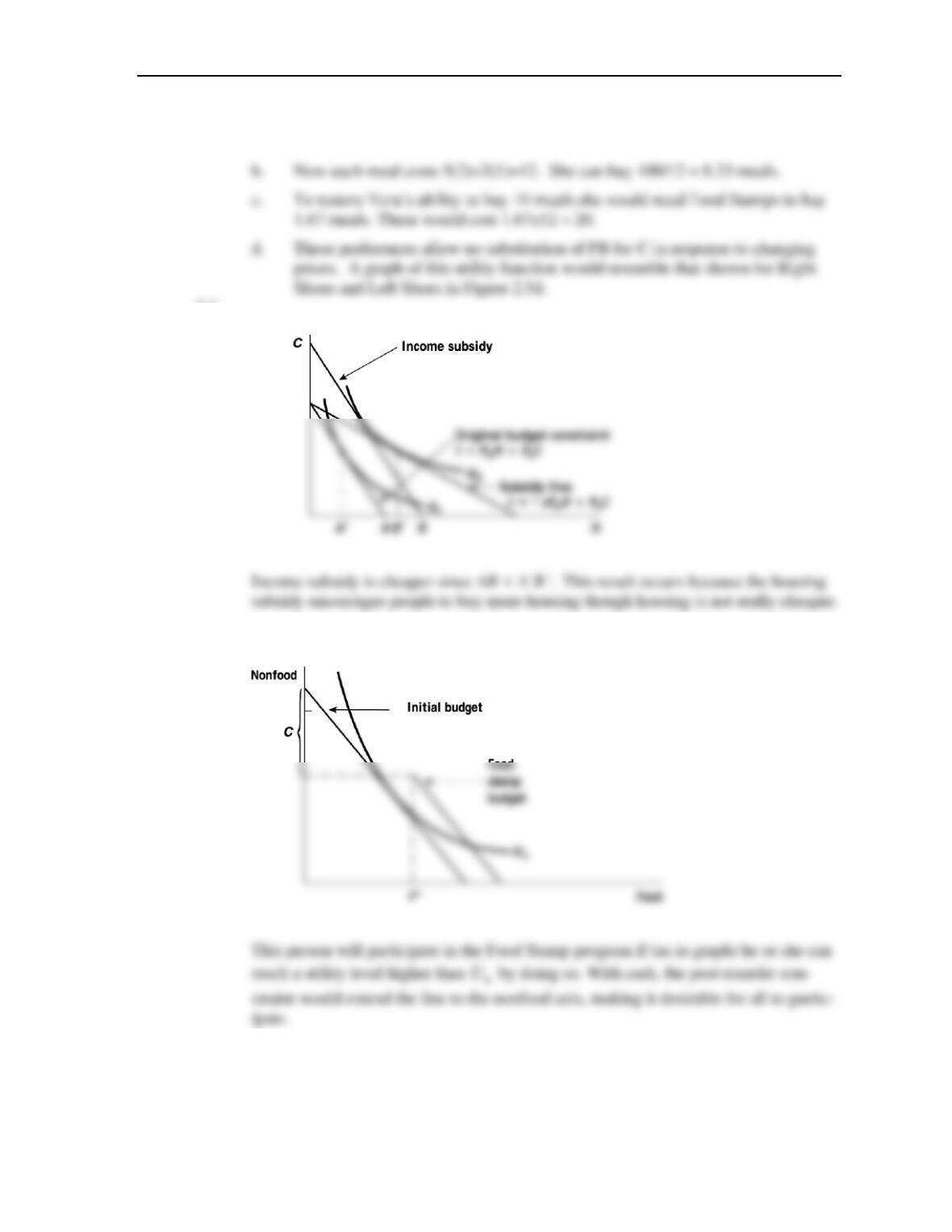
d. With more income she would continue to buy only tea. If coffee prices fall to
Chapter 2: Utility and Choice
21
2.6 a. Each meal consists of PB=2, C=1. This costs 4(2)+2(1)=10. With an income
of $100 she can buy 10 meals per month – or PB=20, C=10.
2.7
2.8
2.9 a, b.
Chapter 2: Utility and Choice
22
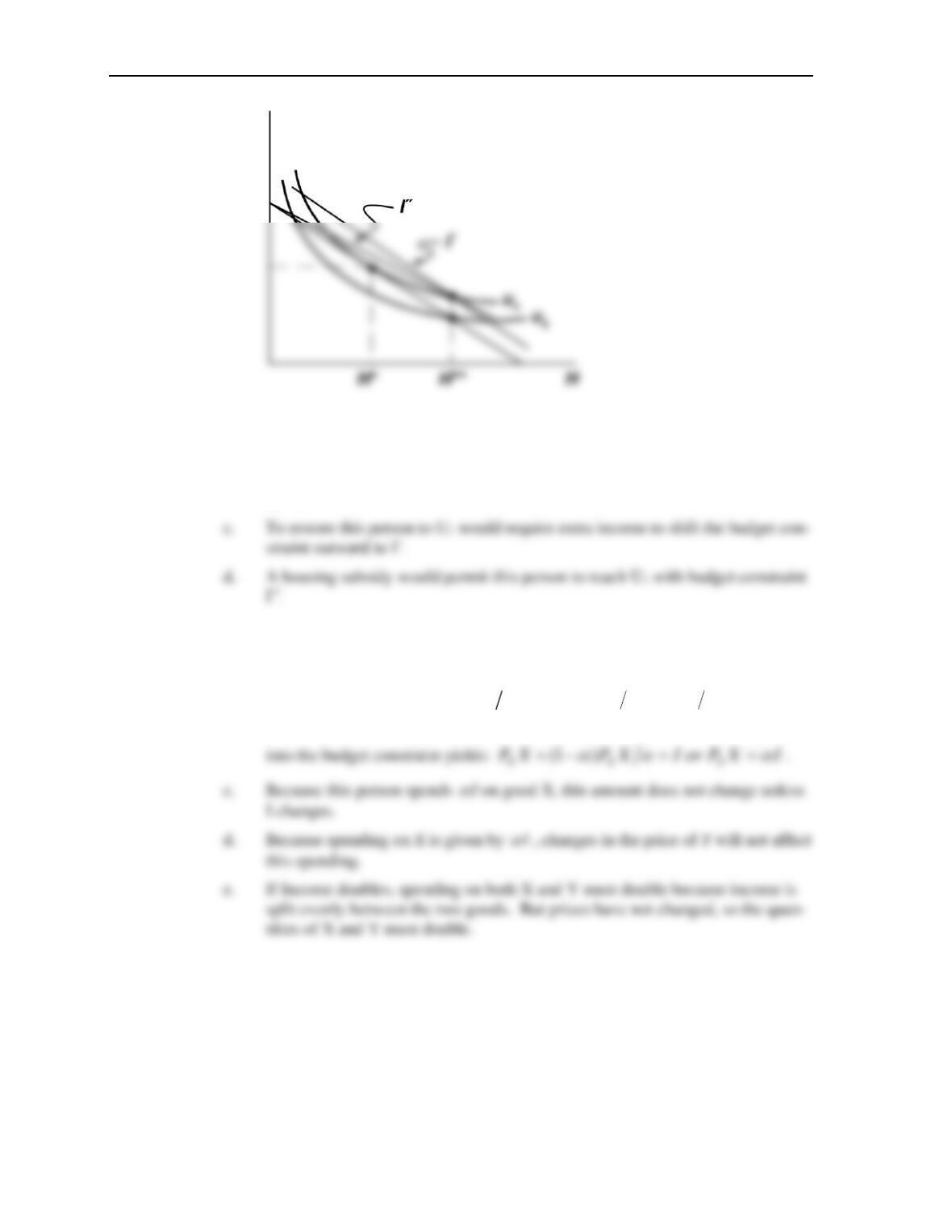
The figure shows that an unconstrained choice will yield utility level U1 with
choices of C*, H*. If the government requires purchase of H**, utility would
fall to U0. Low-income consumers are most likely to be constrained by H
H**.
2.10
a. In problems 2.2 and 2.3
0.5
==
.
b. Utility maximization requires
(1 )
XY
P P MRS Y X Y X
= = = −
.
Some algebraic manipulation yields:
(1 ) XY
P X P Y
−=
. Substituting this

Chapter 2: Utility and Choice
23