
1. Consider a two-good production economy in which both goods are produced with fixed proportions production
functions. Then, some efficient allocations will exhibit unemployment of some factor providing
a.
the firms use the inputs in different proportions.
b.
the firms exhibit diminishing returns to scale.
c.
the firms exhibit increasing returns to scale.
d.
production can never be efficient if there are unemployed inputs.
2. Suppose two goods (X and Y ) are being produced efficiently and that the production of X is always more labor
intensive than the production of Y. Production depends only on two factors (capital and labor); these may be smoothly
substituted for each other. The total quantities of these inputs are fixed. An increase in the production of X and a decrease
in the production of Y will
a.
increase the capital-labor ratio in each firm.
b.
decrease the capital-labor ratio in each firm.
c.
leave the capital-labor ratio for each firm unchanged.
d.
increase the capital-labor ratio in Y production and decrease the capital-labor ratio in X production.
1
3. The slope of the production possibility frontier shows
a.
the marginal rate of substitution between the two goods.
b.
the relative marginal costs of the two goods.
c.
the efficient combination of outputs possible using fixed amounts of input.
d.
the relative marginal productivities of the two goods.
b
1
4. The rate of product transformation refers to
a.
how a consumer can trade one good for another while still maximizing his or her utility.
b.
how a firm can substitute one input for another and still maintain the same production level.
c.
how production of one good can be substituted for another while still using a fixed supply of inputs efficiently.
d.
how quickly a firm can produce a final good while starting with only natural resources.
1
5. In an economy consisting of only two goods, corn and cloth, the amount of extra cloth that can be produced efficiently
if corn output is reduced by one unit is equal to
a.
the rate of technical substitution for corn divided by the rate of technical substitution for cloth.
b.
the rate of technical substitution for cloth divided by the rate of technical substitution for corn.
c.
the marginal cost of producing cloth divided by the marginal cost of producing corn.
d.
the marginal cost of producing corn divided by the marginal cost of producing cloth.
d
1
6. Each of the following factors might interfere with the efficiency of perfect competition except:
a.
increasing returns to scale.
1

b.
imperfect price information.
c.
externalities.
d.
diminishing returns to scale.
7. The reason externalities distort the allocation of resources is that
a.
too few goods are usually produced.
b.
firms often go out of business because of the externality.
c.
a firm’s private costs do not reflect the social cost of production.
d.
regulating externalities uses scarce resources.
c
1
8. Under a perfectly competitive price system
a.
an equitable allocation of the available resources will always result.
b.
there is no opportunity for individuals to trade amongst themselves.
c.
there is no reason to expect that voluntary trading will result in an equitable allocation of the available
resources.
d.
None of the above will result.
c
1
9. Consider three ways of allocating two goods in a two-person exchange economy.
I.
Both individuals take prices as given and equilibrium prices are established by an impartial
auctioneer.
II.
One individual can act as a perfect price discriminator and force the other individual to pay
a different price for each unit of a good that is traded.
III.
One individual is a monopolist and can charge the other individual a single, utility-
maximizing price.
Which of these situations is efficient?
a.
None of them.
b.
Only I.
c.
I and II, but not III.
d.
I and III, but not II.
c
1
10. In free exchange among two individuals the position on the contract curve finally arrived at will, among other things,
depend on:
I.
The bargaining strength of each individual.
II.
The initial endowments of the individuals.
III.
The individuals’ preferences.
Which of these correctly completes the statement?
a.
Only III.
b.
Only II.
c.
I and III, but not II.
d.
II and III, but not I.
d
1

e.
I, II, and III.
11. Markets can fail to achieve efficiency when
a.
there are prices consumers do not think are fair.
b.
there are wages workers do not think are fair.
c.
trade puts people out of work.
d.
there are public goods.
d
1
12. Markets can fail to achieve efficiency when
a.
there are prices consumers do not think are fair.
b.
there are wages workers do not think are fair.
c.
trade puts people out of work.
d.
there are markets with imperfect competition.
d
1
13. Markets can fail to achieve efficiency when
a.
there are prices consumers do not think are fair.
b.
there are wages workers do not think are fair.
c.
trade puts people out of work.
d.
there are buyers or sellers without adequate information about the quality of goods.
d
1
14. Suppose the Economics Department has a graduation party for its students but as a final test they must show they have
learned something about trade. The men are given food when they walk in and the women are given drink. Suppose they
have identical preferences where food and drink provide utility U = FαDβ. The contract curve in the Edgeworth box using
a representative man and woman would be
a.
a right angle connecting the lower left corner with the upper right corner.
b.
a curve (not necessarily a line) connecting the lower left corner with the upper right corner.
c.
a line connecting the lower left corner with the upper right corner.
d.
a right angle connecting the upper left corner with the lower right corner.
b
1
15. Suppose the Economics Department has a graduation party for its students but as a final test they must show they have
learned something about trade. The men are given food when they walk in and the women are given drink. Suppose they
have identical preferences where food and drink provide utility U = FαDβ. The exchange would be such that
a.
both would be guaranteed to be better off than when they entered.
b.
both would be guaranteed to be at least as well off as when they entered.
c.
the men would end up with more.
d.
the women would end up with more.
b
1
16. Suppose the Economics Department has a graduation party for its students but as a final test they must show they have
learned something about trade. The men are given food when they walk in and the women are given drink. Suppose they
have very different preferences where food and drink provide utility. For men U = FαDβ. For women U=min(F,D) The
contract curve in the Edgeworth box using a representative man and woman would be
a.
a right angle connecting the lower left corner with the upper right corner.
b.
a curve (not necessarily a line) connecting the lower left corner with the upper right corner.
c.
a line connecting the lower left corner with the upper right corner.
d.
a right angle connecting the upper left corner with the lower right corner.
1
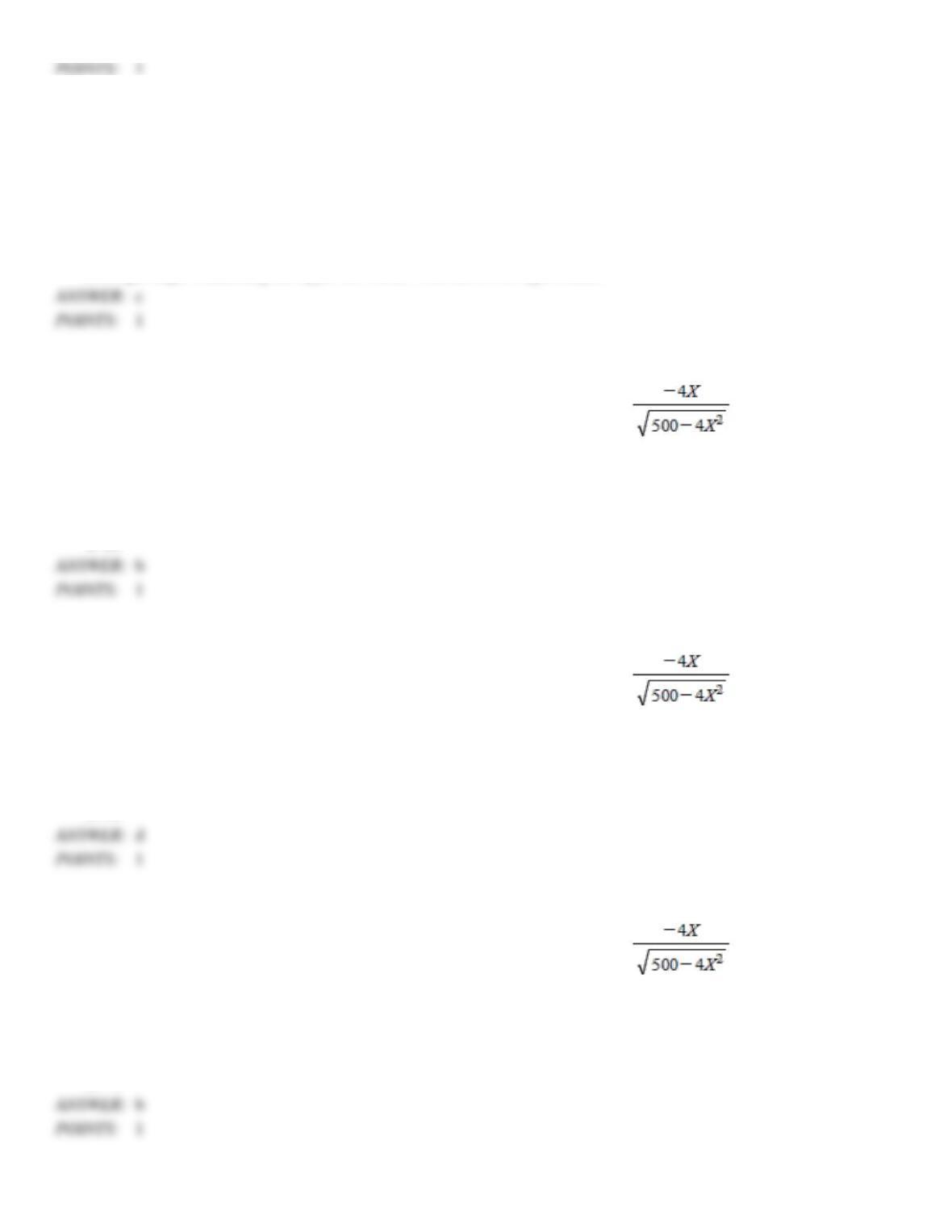
17. Suppose goods X and Y are produced along a production possibilities frontier 4X2 + Y2 = 500 and they are perfect
substitutes such that U = X + Y. The slope of the production possibilities frontier is . How much X should
be produced?
a.
0
b.
5
c.
10
d.
20
b
1
18. Suppose goods X and Y are produced along a production possibilities frontier 4X2 + Y2 = 500 and they are perfect
substitutes such that U = X + Y. The slope of the production possibilities frontier is . How much Y should
be produced?
a.
0
b.
5
c.
10
d.
20
d
1
19. Suppose goods X and Y are produced along a production possibilities frontier 4X2 + Y2 = 500 and they are perfect
substitutes such that U = X + Y. The slope of the production possibilities frontier is . What is this slope at
the utility-maximizing point?
a.
0
b.
−1
c.
−4
d.
−5
b
1
1
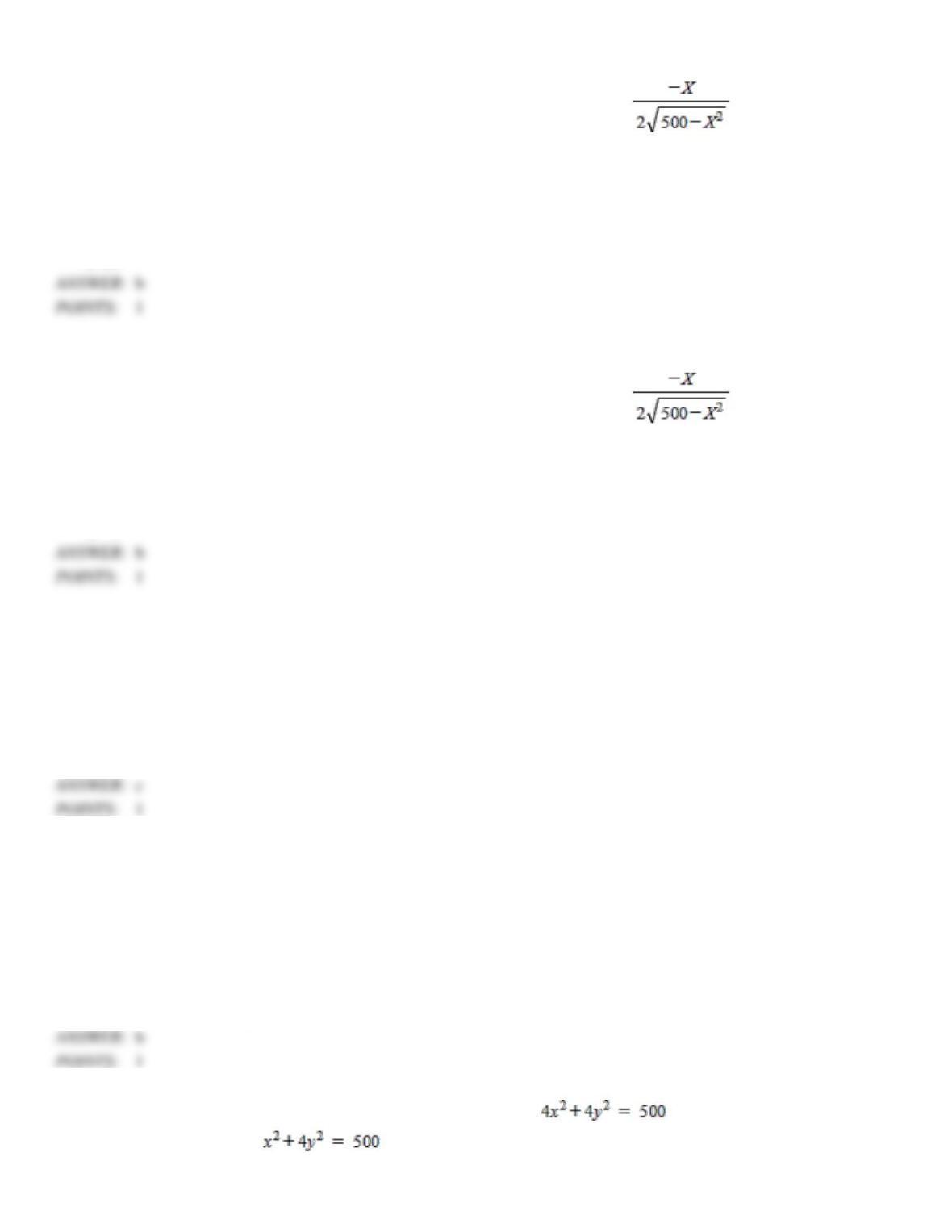
20. Suppose goods X and Y are produced along a production possibilities frontier 4X2 + Y2 = 500 and they are perfect
substitutes such that U = X + Y. The slope of the production possibilities frontier is . How much Y should
be produced?
a.
0
b.
5
c.
10
d.
20
21. Suppose goods X and Y are produced along a production possibilities frontier 4X2 + Y2 = 500 and they are perfect
substitutes such that U = X + Y. The slope of the production possibilities frontier is . What is this slope at
the utility-maximizing point?
a.
0
b.
−1
c.
−4
d.
−5
b
1
22. Suppose two coffee snobs who must have their coffee and cream in exact proportions (each cup is 10 coffee per 1 unit
cream) are invited to a weekend long event (during which they can easily consume 8 cups of coffee). Suppose Snob A is
given 8 units of cream and Snob B is given 80 units of coffee. The contract curve in the Edgeworth box would be
a.
a right angle connecting the lower left corner with the upper right corner.
b.
a curve (not a line) connecting the lower left corner with the upper right corner.
c.
a line connecting the lower left corner with the upper right corner.
d.
a right angle connecting the upper left corner with the lower right corner.
c
1
23. Suppose two coffee snobs who must have their coffee and cream in exact proportions (each cup is 10 coffee per 1 unit
cream) are invited to a weekend long event (during which they can easily consume 8 cups of coffee). Suppose Snob A is
given 8 units of cream and Snob B is given 80 units of coffee. The post trading result (one in which any trade that makes
both parties better off than their initial allocation) will guarantee each person
a.
nothing
b.
at least 1 cup of properly made coffee.
c.
at least 2 cups of properly made coffee.
d.
exactly 4 cups of properly made coffee.
b
1
24. Suppose country A has a production possibilities frontier such that and country B has a production
possibilities frontier such that and consumers in each country view x and y as perfect substitutes.
b
1

Country B will produce
a.
only x (= ) and trade for y.
b.
only y (= ) and trade for x.
c.
both x (= 20) and y (= 5) and trade x to get y.
d.
both x (= 20) and y (= 5) and trade y to get x.
25. Suppose a man and a woman are in love and care for the other’s happiness as well as their own consumption.
Suppose they have 100 units of consumption to distribute, they will maximize the joint happiness (UM + UW) where
a.
CM = 100; CW = 0
b.
CW = 100; CM = 100
c.
CM = 67; CW = 33
d.
CW = 50; CM = 50
d
1
26. Suppose a man and a woman are in love and care for the other’s happiness as well as their own consumption. Suppose
the man is more selfish than the woman
UM = CM2/3 UW1/3
UW = CW1/2 UM1/2
They will maximize the joint happiness (UM + UW) where
a.
CM = 100; CW = 0
b.
CW = 100; CM = 100
c.
50 < CM < 100; 0 < CW < 50
d.
50 < CW < 100; 0 < CM < 50
1
27. Suppose a man and a woman are in love and care for the other’s happiness as well as their own consumption. Suppose
the woman is more selfish than the woman
UM = CM1/2 UW1/2
UW = CW2/3 UM1/3
1

They will maximize the joint happiness (UM + UW) where
a.
CM = 100; CW = 0
b.
CW = 100; CM = 100
c.
50 < CM < 100; 0 < CW < 50
d.
50 < CW < 100; 0 < CM < 50