1. Indifference curves
a.
are nonintersecting.
b.
are contour lines of a utility function.
c.
are negatively sloped.
d.
All of the above.
2. For an individual who consumes only two goods, X and Y, the opportunity cost of consuming one unit of X in terms of
how much Y must be given up is reflected in
a.
the individual’s marginal rate of substitution.
b.
the slope of the individual’s budget constraint.
c.
the slope of the individual’s indifference curve.
d.
None of the above.
b
1
3. If bundles of goods A and B lie on the same indifference curve, one can assume the individual
a.
prefers bundle A to bundle B.
b.
prefers bundle B to bundle A.
c.
enjoys bundle A and B equally.
d.
bundle A contains the same goods as bundle B.
1
4. If bundle A lies on an indifference curve and bundle B lies to the right of the curve, the individual
a.
prefers bundle A to bundle B.
b.
prefers bundle B to bundle A.
c.
enjoys bundle A and B equally.
d.
must receive more of both—with bundle B.
b
1
5. “If an individual is to maximize the utility received from consumption, he or she should spend all available income. . .
.” This statement assumes
a.
that saving is impossible.
b.
that the individual is not satiated in all goods.
c.
that no goods are “inferior.”
d.
Both a and b.
d
1
6. Suppose an individual’s MRS (of steak for beer) is 2:1. That is, at the current consumption choices he or she is willing
to give up 2 beers to get an extra steak. Suppose also that the price of a steak is $1 and a beer is 25¢. Then in order to
increase utility the individual should
a.
buy more steak and less beer.
b.
buy more beer and less steak.
d

c.
continue with current consumption plans.
d.
Not enough information to answer the question.
7. Suppose that at current consumption levels an individual’s marginal utility of consuming an extra hot dog is 10 whereas
the marginal utility of consuming an extra soft drink is 2. Then the MRS (of soft drinks for hot dogs)—that is, the number
of hot dogs the individual is willing to give up to get one more soft drink is
a.
5
b.
2
c.
1/2
d.
1/5
d
1
8. If an individual’s indifference curve map does not obey the assumption of a diminishing MRS, then
a.
the individual will not maximize utility.
b.
the individual will buy none of good X.
c.
tangencies of indifference curves to the budget constraint may not be points of utility maximization.
d.
the budget constraint cannot be tangent to an appropriate indifference curve.
c
1
9. As an individual moves northwest along an indifference curve substituting more and more Y for X, his or her MRS of X
for Y
a.
increases.
b.
decreases.
c.
stays the same.
d.
changes in a way that cannot be determined.
a
1
10. The X-intercept of the budget constraint represents
a.
how much of good Y can be purchased if no good X is purchased and all income is spent.
b.
how much of good X can be purchased if no good Y is purchased and all income is spent.
c.
total income divided by the price of X.
d.
b and c.
d
1
11. The point of tangency between a consumer’s budget constraint and his or her indifference curve represents
a.
complete satisfaction for the consumer.
b.
the equivalence of prices the consumer pays.
c.
constrained utility maximization for the consumer.
d.
the least he or she can spend.
c
b
1
12. An increase in an individual’s income without changing relative prices will
a.
rotate the budget constraint about the X-axis.
b.
shift the indifference curves outward.
c.
shift the budget constraint outward in a parallel way.
d.
rotate the budget constraint about the Y axis.
1
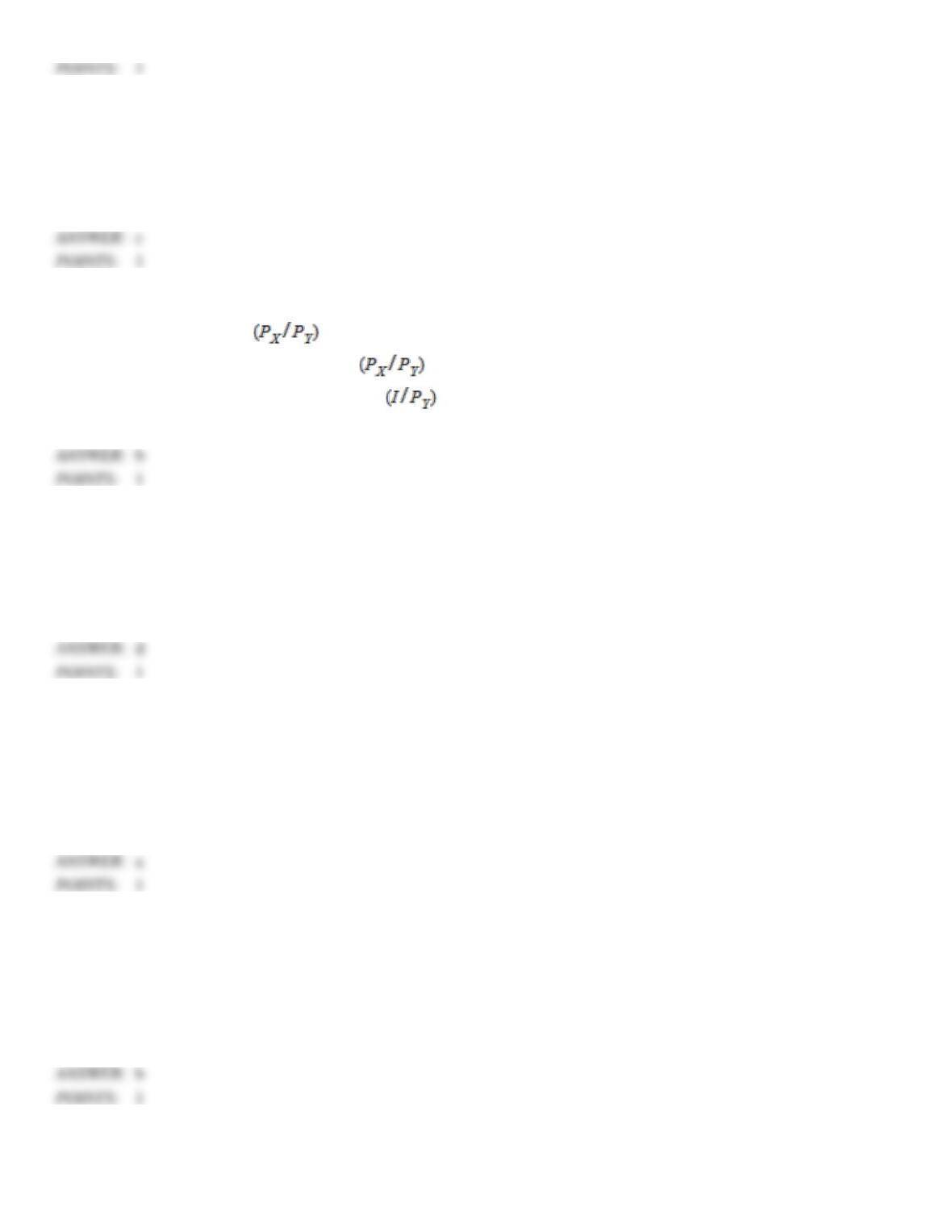
13. The slope of the budget constraint line is
a.
the ratio of the prices .
b.
the negative of the ratio of the prices .
c.
the ratio of income divided by price of Y .
d.
none of the above.
b
1
14. If the price of X falls, the budget constraint
a.
shifts outward in a parallel fashion.
b.
shifts inward in a parallel fashion.
c.
rotates outward about the X-intercept.
d.
rotates outward about the Y-intercept.
d
1
15. If an individual has a constant MRS of shoes for sneakers of 3/4 (that is, he or she is always willing to give up 3 pairs
of sneakers to get 4 pairs of shoes) then, if sneakers and shoes are equally costly, he or she will
a.
buy only sneakers.
b.
buy only shoes.
c.
spend his or her income equally on sneakers and shoes.
d.
wear sneakers only 3/4 of the time.
1
16. Suppose a cup of coffee at the campus coffee shop is $2.50 and a cup of hot tea is $1.25 and that a student’s beverage
budget is $20 per week. What is the most cups of tea the student could buy?
a.
20
b.
16
c.
10
d.
8
b
1
17. Suppose a cup of coffee at the campus coffee shop is $2.50 and a cup of hot tea is $1.25 and that a student’s beverage
1
budget is $20 per week. What is the market tradeoff between coffee and tea?
a.
1 coffee to 1 tea
b.
2 coffee to 1 tea
c.
1 coffee to 2 tea
d.
2 coffee to 2 tea
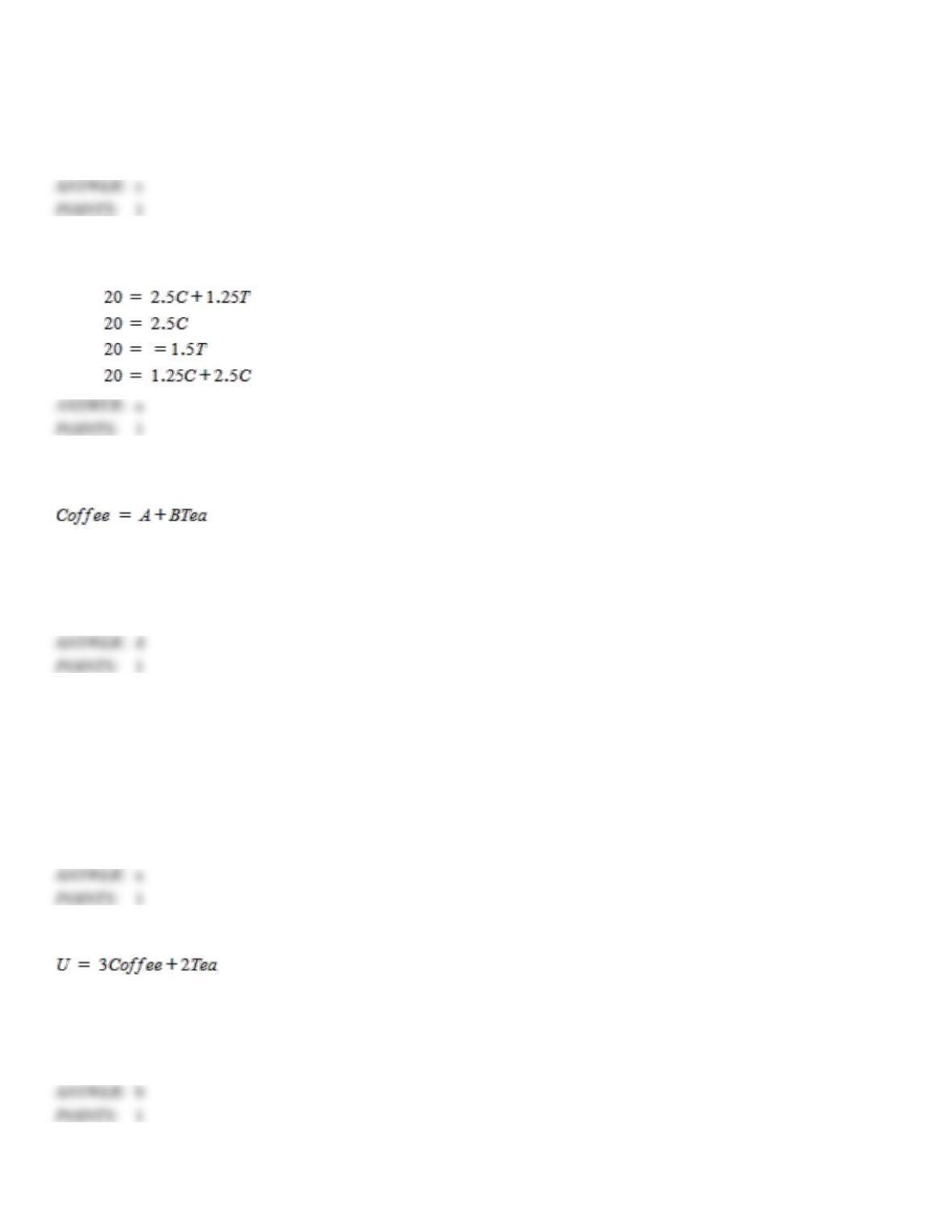
18. Suppose a cup of coffee at the campus coffee shop is $2.50 and a cup of hot tea is $1.25 and that a student’s beverage
budget is $20 per week. What is the algebraic expression of the budget?
a.
b.
c.
d.
a
1
19. Suppose a cup of coffee at the campus coffee shop is $2.50 and a cup of hot tea is $1.25 and that a student’s beverage
budget is $20 per week. If you were going to write an algebraic expression of this budget line of the form
. B would be
a.
16
b.
2
c.
-2
d.
-1/2
1
20. Suppose a cup of coffee at the campus coffee shop is $2.50 and a cup of hot tea is $1.25. Suppose a student’s beverage
budget is $20 per week. Suppose the student simply prefers more caffeine to less and that the tea sold has the same
amount of caffeine as the coffee. The student will buy
a.
all tea.
b.
all coffee.
c.
a mix of coffee and tea.
d.
quantities that cannot be determined from the information given here.
a
1
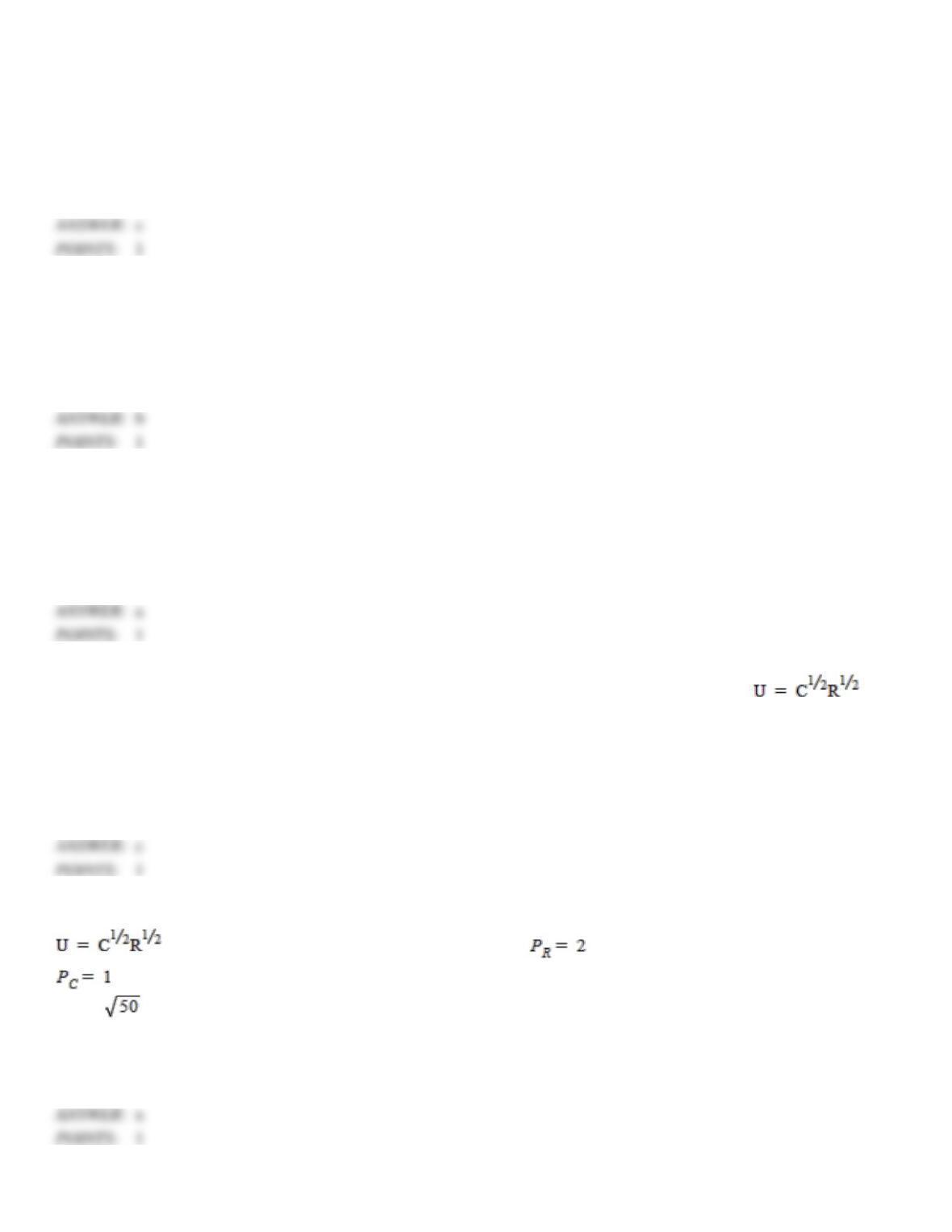
21. Suppose a caffeine-deprived man needs to wake up. Suppose his preferences can be described by
. If the price of coffee is $4 and the price of tea is $1, he will buy
a.
all coffee.
b.
all tea.
c.
some of both, but more coffee.
d.
some of both, but more tea.
b
1
22. Suppose a little girl likes peanut butter and jelly sandwiches with exactly 2T of jelly and 1T of peanut butter. Suppose
c
further that her mom agrees to make sandwiches to those exact specifications and the price of peanut butter is $.25/T and
the price of jelly is $.10/T. If she has $1.80 to spend on peanut butter and jelly ingredients (ignore the bread) in a week,
how many sandwiches will she make?
a.
1
b.
2
c.
4
d.
8
23. If people like their goods in fixed proportions, the two goods are
a.
perfect substitutes
b.
perfect complements
c.
complements (but not perfect)
d.
substitutes (but not perfect)
b
1
24. If a person’s indifference curves can be represented as a straight line, the person views the goods as
a.
perfect substitutes
b.
perfect complements
c.
complements (but not perfect)
d.
substitutes (but not perfect)
1
25. Suppose a person likes both rap music (R) and country music (C) with a set of preferences so that .
Which point (C, R) makes this person the happiest?
a.
4, 16
b.
25, 1
c.
9, 9
d.
16, 4
1
26. Suppose a person has $20 and likes both rap music (R) and country music (C) with a set of preferences so that
. Suppose that the iTunes price of a rap music song is and the price of a country music song is
. Which level of utility is affordable?
a.
b.
9
c.
16
d.
25
1
1
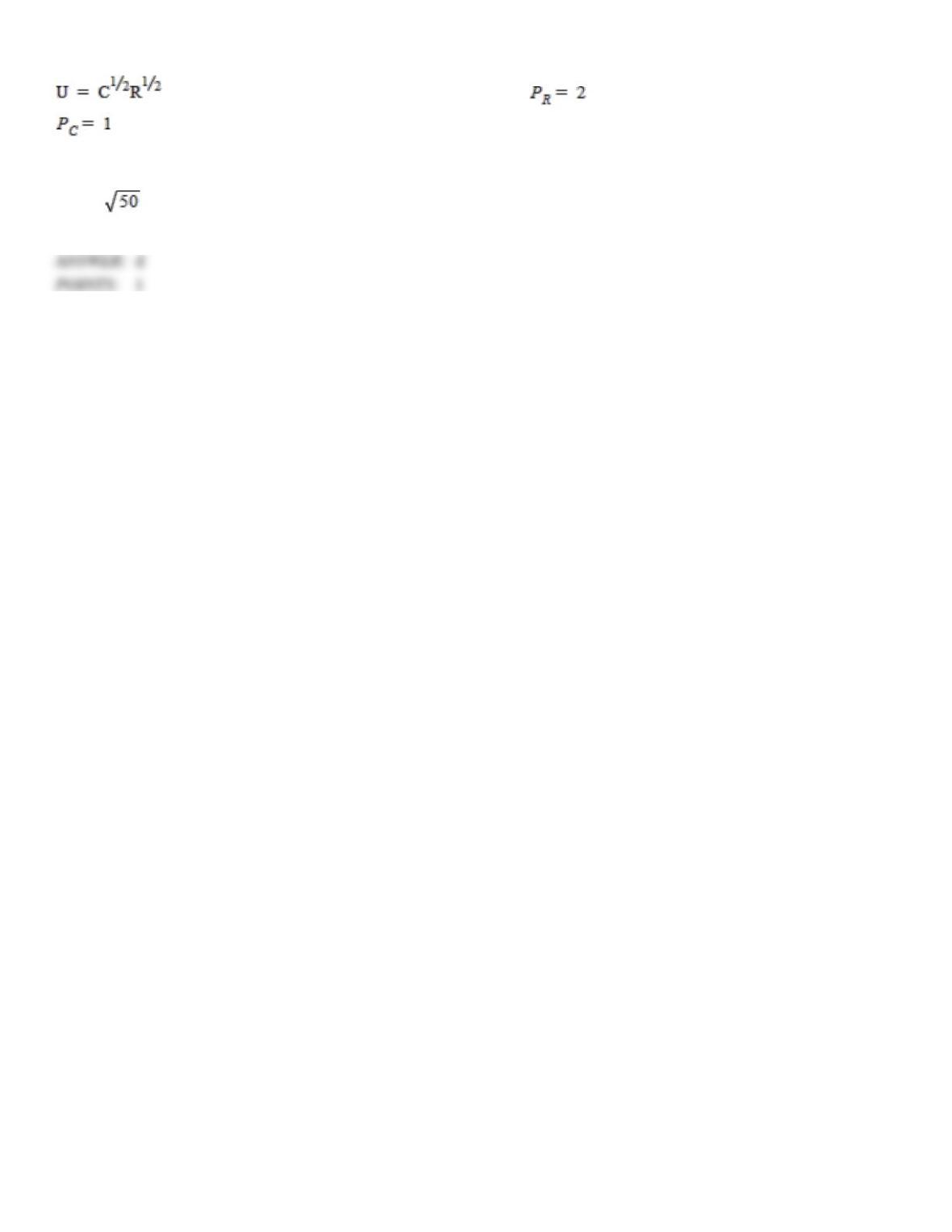
27. Suppose a person has $20 and likes both rap music (R) and country music (C) with a set of preferences so that
. Suppose that the iTunes price of a rap music song is and the price of a country music song is
. What is the lowest level of utility that is unaffordable?
a.
6
b.
7
c.
d.
8
d
1