216
CHAPTER 14
Capital and Time
A. Summary
The general purpose of this chapter is to provide students with some basic
tools for looking at economic activity in a dynamic context, with a particular
focus on capital markets. The chapter starts with a discussion of the why time
is important for capital decisions and then turns to the examination of a sim-
ple two period model of consumer behavior. The contrasting income and
substitution effects of a change in the real interest rate on current consump-
tion are highlighted. At this point students may need reminding that, because
current period income is fixed, any change in current consumption also
shows up in current savings decisions. Savings are treated here as providing
the “supply of loans” in the interest rate determination process.
The final sections of the chapter illustrate how the real interest rate pro-
vides a “price” that ties together present and future periods. The concept of
present discounted value is briefly described (the Appendix to Chapter 14
goes into more detail) and this is then used to discuss pricing of finite re-
sources.
B. Lecture and Discussion Suggestions
A complete coverage of this chapter probably requires two lectures (assum-
ing that students can read all of the material on interest rates on their own).
The first would focus on the two period model of consumption choices. Two
features of that model might be stressed: (1) Why the real interest rate is the
Chapter 16: Capital and Time
217
A second lecture for this chapter might involve the interest rate determi-
nation process. Students will probably have some trouble seeing how the
simplified model of interest rate determination in Figure 14.3 applies to the
real world—especially since their macro courses may provide a different
view. Indeed, we believe it is for this very reason that this graph should be
C. Glossary Entries in the Chapter and Appendix
• Compound Interest
• Interest
SOLUTIONS TO CHAPTER 14 PROBLEMS
14.1 a. The budget constraint shows that spending must equal income in present value
terms, but income and consumption are not constrained to be equal in either pe-
riod.
Chapter 16: Capital and Time
218
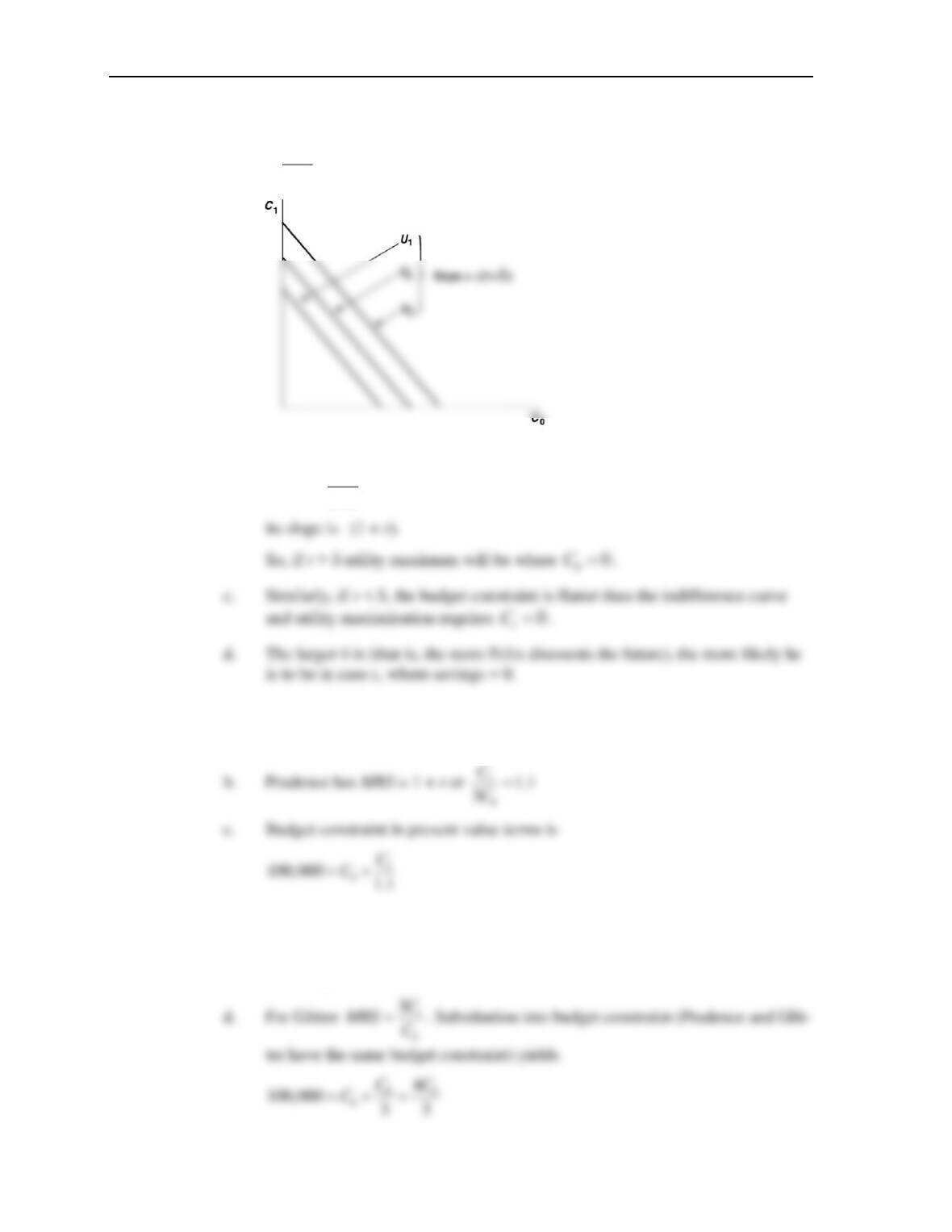
14.2 a. Felix’s indifference curves are straight lines with slope
1
0
(1 )
C
C
= − +
b. Since the budget constraint is
1
01
C
IC r
=+
+
14.3 a. Present value of income is
50,000 + 55,000/(1 + r) = 50,000 + 55,000/1.1 = 100,000.
Using the utility maximizing condition from part b gives
00
100,000 3CC=+
Hence C0 = 25,000. Savings in period 0 are 25,000.
Chapter 16: Capital and Time
219
borrows with the intention of repaying later.
14.4 a. v = P (r + d) = 2,000 (.05 + .10) = 300.
14.5 a. Assuming revenues are received at the end of each year gives a present value
14.6
2100 12
100 6 t
V t t proportional growth is V
−
=−
Value greatest at t = 8.33
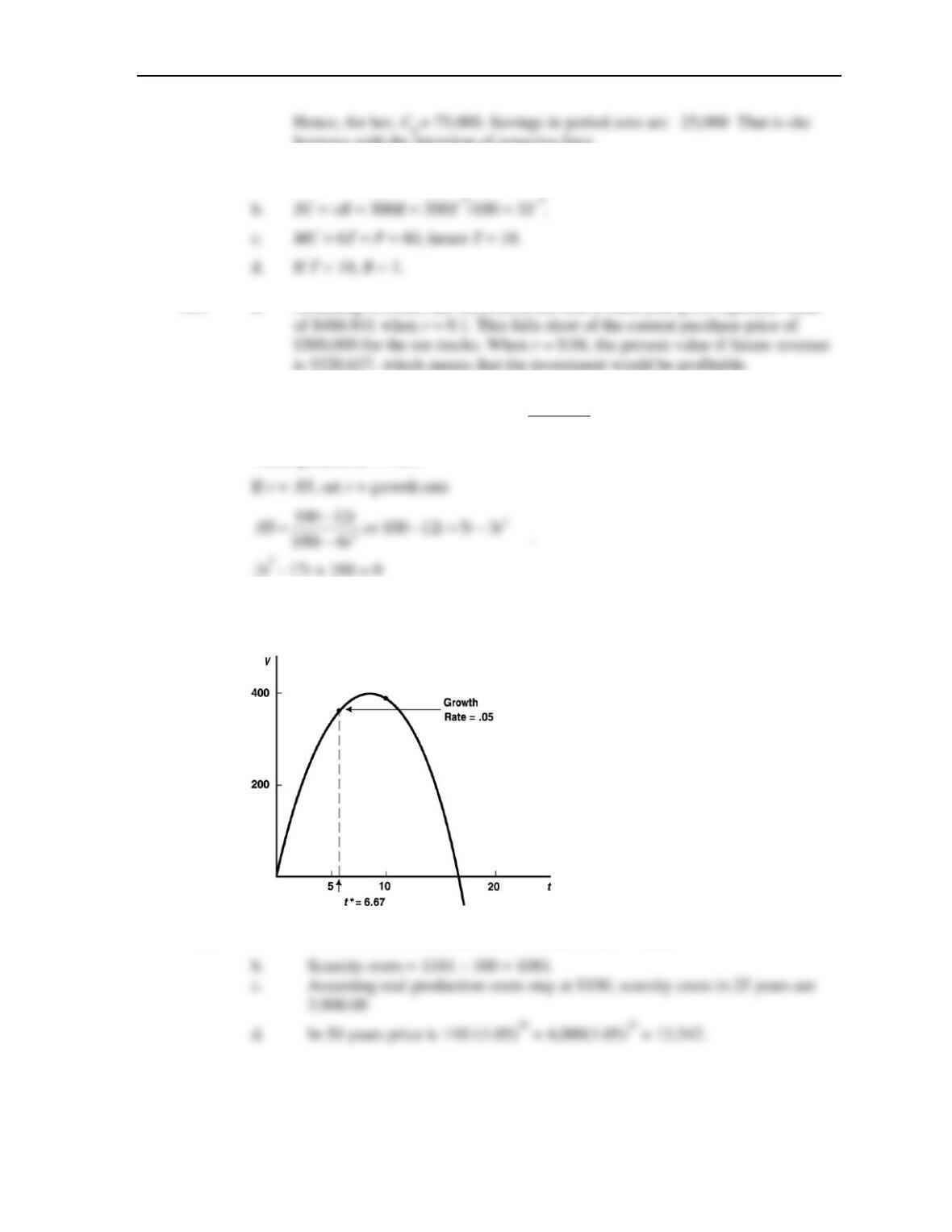
which can be factored as (.3t – 2)(t – 50) = 0. Hence, t = 6.67 or t = 50. As the graph
shows, however, only the first root provides an optimal solution since the second root is
extraneous.
14.7 a. Price should be 4,000/(1.05)25 = 4,000/3.3864 = 1181.
Chapter 16: Capital and Time
220
14.8 Salesman’s pitch ignores the opportunity cost of interest.
4
1
2000
()
(1 )
i
PDV wholelife r
=+
14.9 The fallacy here is that the calculation assumes that you have borrowed $10,000 for
all three years. Since the repayment plan includes some repayment of the $10,000
14.10 a.
10 10 200
.05
PDV i
= = =
b. Nominal payments are now
10(1.03)i
P=
but real payments are