
1. Suppose the production function for coffee (C) is C = min(B,W), where B = beans in pounds and W = water in gallons.
Suppose the price of water is $.10 per gallon and the price of beans is $10 per pound. The cost minimizing combination of
beans and water for C = 200 is
a.
B = 200, W = 2000
b.
B = 2000, W = 200
c.
B = 100, W = 100
d.
B = 200, W = 200
2. Suppose the production function for coffee (C) is C = min(B,W), where B = beans in pounds and W = water in gallons.
Suppose the price of water is $.10 per gallon and the price of beans is $10 per pound. The expansion path is
a.
B = 10W
b.
B = .1W
c.
B = W
d.
−10 = B + W
ANSWER:
POINTS:
1
3. Suppose the production function for coffee (C) is C = min(B,W), where B = beans in pounds and W = water in gallons.
Suppose the price of water is $.10 per gallon and the price of beans is $10 per pound. The expansion path
a.
depends on the price of beans only.
b.
depends on the price of water only
c.
depends on the price of neither beans nor water.
d.
depends of the costs of both beans and water.
ANSWER:
POINTS:
1
4. Suppose pigs (P) can be fed corn-based feed (C) or soybean-based feed (S) such that the production function is P = 2C
+ 5S. If the price of corn feed is $4 and the price of soybean feed is $5, what is the cost-minimizing feed combination
producing P = 200?
a.
C = 100
b.
S = 40
c.
C = 50, S = 20
d.
C = 20, S = 50
ANSWER:
b
POINTS:
1
5. Suppose pigs (P) can be fed corn-based feed (C) or soybean-based feed (S) such that the production function is P = 2C
+ 5S. If the price of corn feed is $2 and the price of soybean feed is $5, what is the cost-minimizing feed combination
producing P = 100?
a.
C = 50
b.
S = 20
c.
C = 25, S = 10
d.
All points on the P = 100 isoquant, including those listed in a-c would cost the same.
ANSWER:
d
POINTS:
1
ANSWER:
d
POINTS:
1

6. Suppose pigs (P) can be fed corn-based feed (C) or soybean-based feed (S) such that the production function is P = 2C
+ 5S. If the price of corn feed is $2 and the price of soybean feed is $6, what is the cost-minimizing fee combination
producing P = 200?
a.
C = 100
b.
S = 40
c.
C = 50, S = 20
d.
All points on the P = 200 isoquant would cost the same.
7. Suppose pigs (P) can be fed corn-based feed (C) or soybean-based feed (S) such that the production function is P = 2C
+ 5S. If the price of corn feed is $4 and corn feed is on the horizontal axis, and the price of soybean feed is $5 and soybean
feed lies on the vertical axis, what is expansion path?
a.
C =5S/2
b.
S =2C/5
c.
the horizontal axis
d.
the vertical axis
ANSWER:
d
POINTS:
1
8. Suppose pigs (P) can be fed corn-based feed (C) or soybean-based feed (S) such that the production function is P = 2C
+ 5S. The expansion path depends
a.
on the price of corn-based feed only.
b.
on the price of soybean-based feed only.
c.
on neither the price of corn-based or soybean-based feed.
d.
on whether the price of corn-based feed is greater than or less than 2/5 the price of soybean-based feed.
ANSWER:
d
POINTS:
1
9. Suppose that a lawn mowing services production function for lawns mowed in a week is M = (LK)1/2, where L is labor
hours and K is the amount of capital (mowers and trimmers). The expansion path depends on
a.
the wage rate only.
b.
the rental rate only.
c.
both the wage and rental rates.
d.
neither the wage nor rental rates.
ANSWER:
POINTS:
1
10. Suppose a cost function is TC = Aq3 + bq2 + cq + d. Then the total fixed cost is
a.
Aq2 + bq + cq +d/q
b.
Aq2 + bq + c
c.
Aq3 + bq2 + cq
d.
d
ANSWER:
d
POINTS:
1
ANSWER:
POINTS:
1
11. Suppose a cost function is TC = Aq3 + bq2 + cq + d. Then the average total cost is
a.
Aq2 + bq + cq +d/q
b.
Aq2 + bq + c
c.
Aq3 + bq2 + cq
d.
d
12. Suppose a cost function is TC = Aq3 + bq2 + cq + d. Then the average variable cost is
a.
Aq2 + bq + cq +d/q
b.
Aq2 + bq + c
c.
Aq3 + bq2 + cq
d.
d
b
1
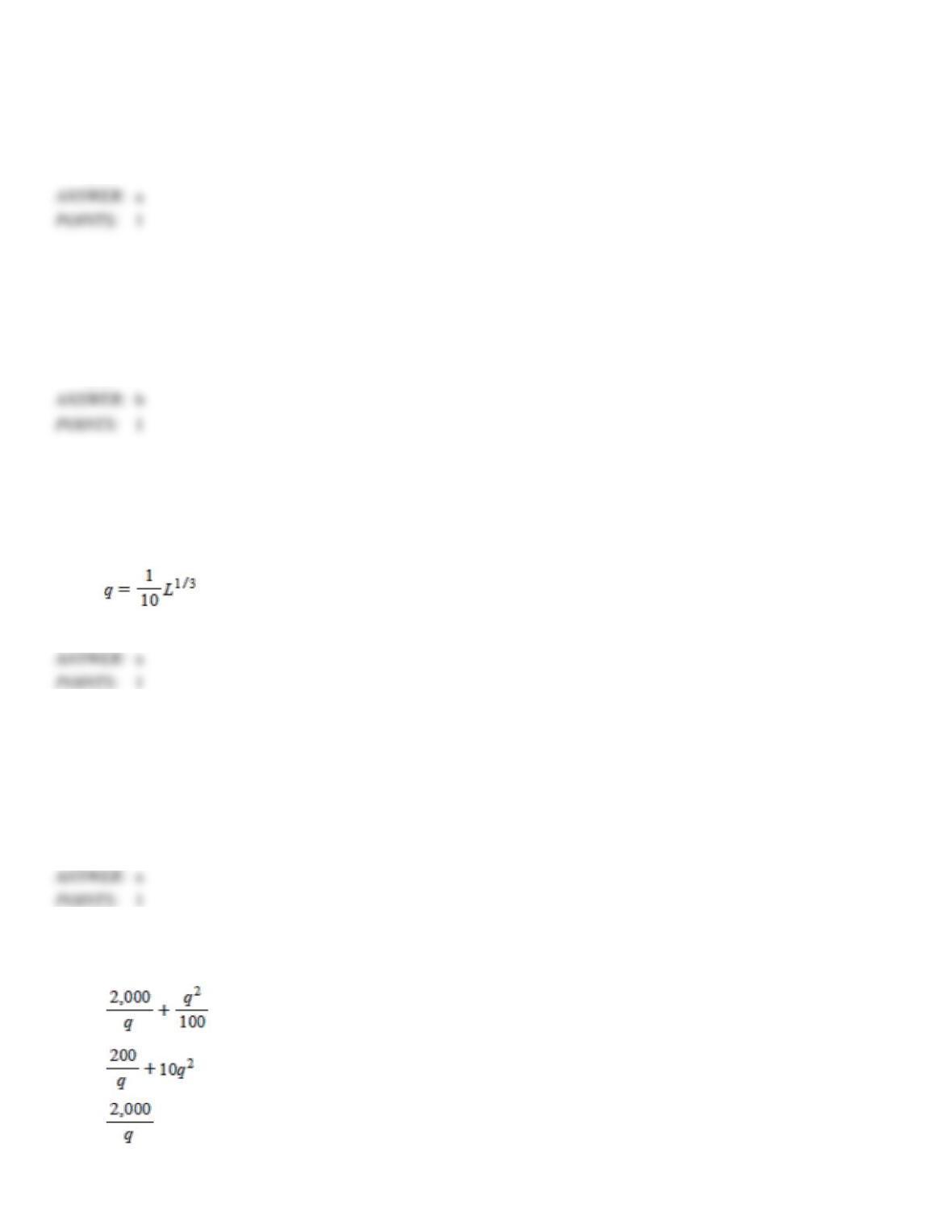
13. Suppose a production function is q = K1/2L1/3 and in the short run capital (K) is fixed at 100. If the wage is $10 and
the rental rate on capital is $20, the short run production function is
a.
q = 10L1/3
b.
q = 100L1/3
c.
d.
q = 100
a
1
14. Suppose a production function is q = K1/2L1/3 and in the short run capital (K) is fixed at 100. If the wage is $10 and
the rental rate on capital is $20, the fixed cost is
a.
$2,000
b.
$200
c.
$20,000
d.
$0
a
1
15. Suppose a production function is q = K1/2L1/3 and in the short run capital (K) is fixed at 100. If the wage is $10 and
the rental rate on capital is $20, the short run average cost is
a.
b.
c.
a
1

d.
16. Suppose a production function is q = K1/2L1/3 and in the short run capital (K) is fixed at 100. If the wage is $10 and
the rental rate on capital is $20, the short run marginal cost is
a.
1000 + q3
b.
c.
q3
d.
2q3
b
1
17. Suppose MPL = 20 and MPK = 40 and the rental rate on capital is $10. If the level of production is currently efficient,
the wage rate must be
a.
$10
b.
$5
c.
$20
d.
$40
b
1
18. Suppose MPL = 40 and MPK = 20 and the rental rate on capital is $10. If the level of production is currently efficient,
the wage rate must be
a.
$10
b.
$5
c.
$20
d.
$40
1
19. The opportunity cost of producing a bicycle refers to
a.
the out–of-pocket payments made to produce the bicycle.
b.
the value of the goods that were given up to produce the bicycle.
c.
the bicycle’s retail price.
d.
the marginal cost of the last bicycle produced.
b
1
20. The accountant’s cost of producing a bicycle refers to
a.
the out–of-pocket payments made to produce the bicycle.
b.
the value of the goods that were given up to produce the bicycle.
c.
the bicycle’s retail price.
1
d.
the marginal cost of the last bicycle produced.
21. A firm’s economic profits are given by
a.
total revenue minus total accounting cost.
b.
the owner’s opportunity cost.
c.
total revenue minus total economic cost.
d.
total revenue minus the cost of capital.
c
1
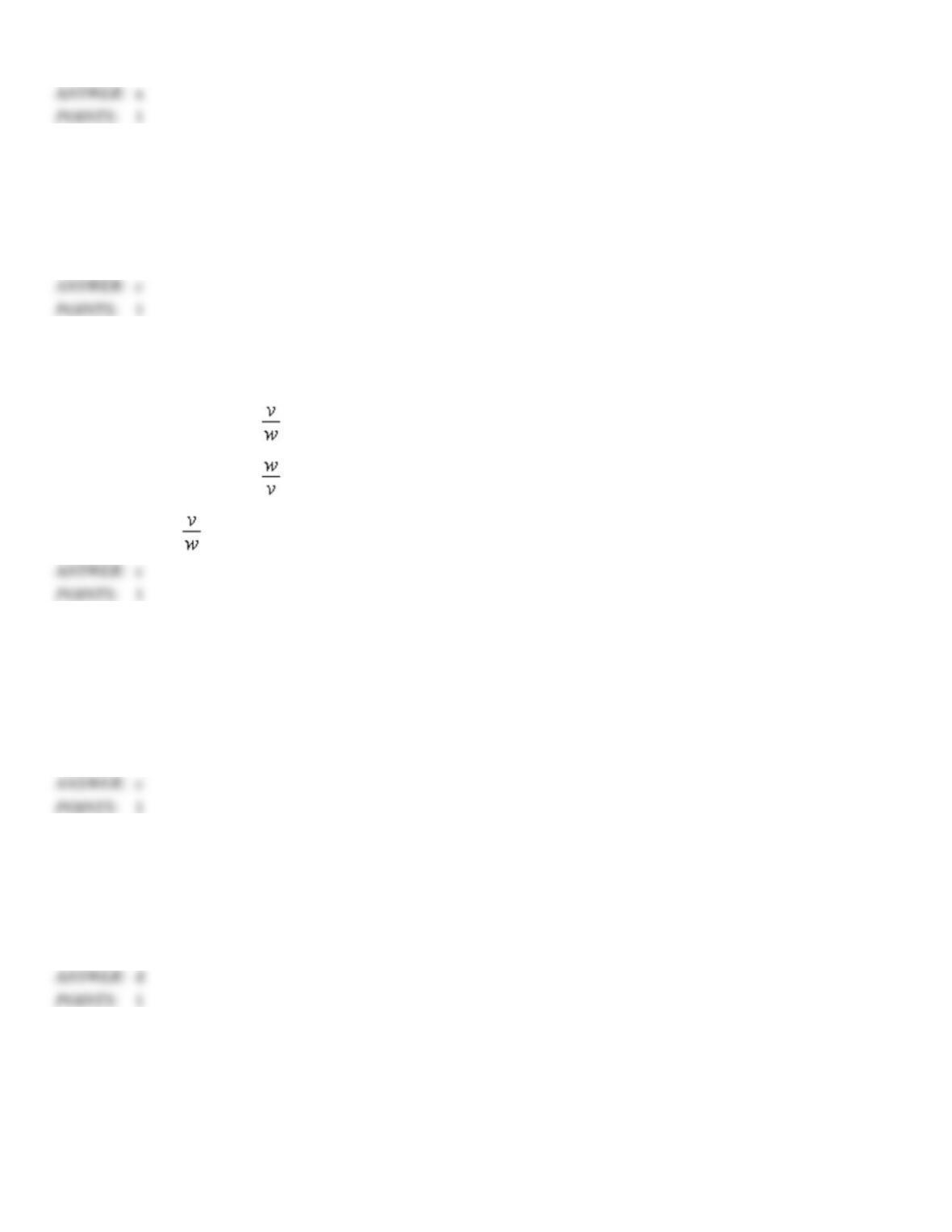
22. In order to minimize the cost of a particular level of output, a firm should produce where
a.
labor input equals capital input
b.
the RTS (of L for K) =
c.
the RTS (of L for K) =
d.
the MRS =
c
1
23. The firm’s expansion path records
a.
profit-maximizing output choices for every possible price.
b.
cost-minimizing input choices for all possible output levels for when input prices expand along with
production.
c.
cost-minimizing input choices for all possible output levels for a fixed set of input prices.
d.
cost-minimizing input choices for profit-maximizing output levels.
c
1
24. The shape of a firm’s expansion path depends upon
a.
the price of the labor input.
b.
the price of the capital input.
c.
the shape of the firm’s production function.
d.
all of these factors.
d
1
25. The expansion path for a constant-returns-to-scale production function
a.
is a straight line through the origin with a slope greater than 1 if w > v.
b.
is a straight line through the origin with a slope greater than 1 if w < v.
c.
is a straight line through the origin, though its slope cannot be determined by w and v alone.
d.
has a positive slope but is not necessarily a straight line.
a
1

26. A firm whose production function displays increasing returns to scale will have a total cost curve that is
a.
a straight line through the origin.
b.
a curve with a positive and continually decreasing slope.
c.
a curve with a positive and continually increasing slope.
d.
a curve with a negative and continually decreasing slope.
b
1
27. A firm’s marginal cost is defined as
a.
the ratio of total cost to total output.
b.
the ratio of total output to total cost.
c.
the additional cost of producing one more unit of output.
d.
the reciprocal of total average cost.
c
1
28. A linear total cost curve which passes through the origin implies that
a.
average cost is constant and marginal cost is variable.
b.
average cost is variable and marginal cost is constant.
c.
average and marginal costs are constant and equal.
d.
need more information to answer question.
c
1
29. As long as marginal cost is below average cost, average cost will be
a.
falling
b.
rising.
c.
constant.
d.
changing in a direction that cannot be determined without more information
a
1
30. In the short run,
a.
all inputs are fixed.
b.
all inputs are variable.
c.
some inputs are fixed.
d.
no production occurs.
c
1
31. In the long run
a.
all inputs are fixed.
b.
all inputs are variable.
c
1

c.
some inputs are fixed.
d.
production levels never change.
32. The shape of a firm’s long-run average cost curve is determined by
a.
the degree to which each input encounters diminishing marginal productivity.
b.
the underlying nature of the firm’s production function when all inputs are able to be varied.
c.
how much the firm decides to produce.
d.
the way in which the firm’s expansion path reacts to changes in the rental rate on capital.
b
1
33. For a constant-returns-to-scale production function,
a.
marginal costs are constant but the average cost curve has a U-shape.
b.
both average and marginal costs are constant.
c.
marginal cost has a U-shape; average costs are constant.
d.
both average and marginal cost curves are U-shaped.
b
1
34. Short-run total cost is the sum of
a.
short-run fixed cost, short-run variable cost, and short-run marginal costs.
b.
short-run fixed cost and short-run marginal costs.
c.
short-run variable cost and short-run costs.
d.
short-run fixed cost and short-run variable cost.
d
1
35. A firm’s marginal cost curve
a.
is always U-shaped.
b.
always has a positive slope.
c.
is always below its average cost curve.
d.
always intersects its average cost curve at its minimum point.
d
1
36. A firm’s short-run average cost is defined as
a.
the ratio of total output to short-run total cost.
b.
the ratio of short-run total cost to total output.
c.
the additional cost of producing one more unit of output while some input is fixed.
d.
the additional cost of producing one more unit of output while all inputs are fixed.
b
1
37. For any given output level, a firm’s long-run costs
b
1

a.
are always greater than or equal to its short-run costs.
b.
are usually greater than or equal to its short-run costs except in the case of diminishing returns to scale.
c.
are always less than or equal to its short-run costs.
d.
are usually less than or equal to its short-run costs except in the case of diminishing returns to scale.
38. An increase in the wage rate will have a greater effect on average costs
a.
the larger the proportion labor costs are of total costs and the easier it is to substitute capital for labor.
b.
the larger the proportion labor costs are of total costs and the harder it is to substitute capital for labor.
c.
the greater is the diminishing marginal product of labor.
d.
the greater are returns to scale.
b
1
39. Technical progress will
a.
shift a firm’s production function and its related cost curves.
b.
not affect the production function, but may shift cost curves.
c.
shift a firm’s production function and alter its marginal revenue curve.
d.
shift a firm’s production function and cause more capital (and less labor) to be hired.
1
1