
1. What are the main differences between neoclassical economics and behavioral economics?
a.
Neoclassical economics is mainly theoretical.
b.
Behavioral economics does not take as given that decision makers are rational.
c.
Neoclassical economics assumes that decision makers are fully informed.
d.
All of the above.
2. Limits to self-interested payoff maximization that have been studied by behavioral economists include
a.
limited cognitive ability.
b.
limited willpower.
c.
limits to self interest.
d.
all of the above.
d
1
3. An economist encounters some unexpected behavior in a market or laboratory setting. How can he or she distinguish
between behavior resulting from mistakes by decision makers as opposed to being decisions based on unusual
preferences?
a.
If the same behavior is observed repeatedly even after opportunities to learn are provided, it is probably not a
mistake.
b.
If the behavior is observed more often with inexperienced subjects, it is likely a mistake.
c.
Both a and b.
d.
It is impossible to distinguish between mistakes and unusual preferences empirically.
c
1
4. Which is not a factor that makes cognitive mistakes more likely?
a.
uncertainty.
b.
time pressure.
c.
repetition.
d.
large number of choices.
c
1
5. In what way does prospect theory differ from the standard theory of expected utility?
a.
With prospect theory, preferences depend only on final wealth levels.
b.
With prospect theory, preferences vary with initial (reference) wealth levels.
c.
With prospect theory, individuals are risk loving over small losses.
d.
With prospect theory, risk aversion does not play a role.
b
1
6. When psychologists refer to the “Paradox of Choice”, what do they mean?
a.
More choices may lead people to avoid the decision all together.
b.
More choices always make people at least as well off (related to the option value principle).
c.
Risk-averse people sometimes prefer risk because of the thrill it provides.
b

d.
If two people with free will make simultaneous decisions, these may sometimes conflict.
7. Which of the following would make a player more inclined to continue into later stages of the Centipede Game rather
than ending the game immediately? (Choose all that apply.)
a.
The subgame-perfect equilibrium is to continue as long as possible because the payoffs eventually get much
larger.
b.
An increase in the chance that your rival has difficulty performing a long chain of deductions.
c.
An increase in the chance that your rival believes you have difficulty solving a long chain of deductions.
d.
Altruism toward one’s rival.
b, c, d
1
8. Which of the following weights on utility (over four periods starting with the current one) provide an illustration of
hyperbolic discounting that could well lead to inconsistent choices over time?
a.
1, .5, .25, .125.
b.
1, .25, .0625, .015625.
c.
1, .8, .72, .648.
d.
1, 1, 1, 1.
c
1
9. The option-value principle can be roughly stated as “more choices can’t make a person worse off.” Are there any
exceptions to this rule? Choose all that apply.
a.
No.
b.
Yes, in strategic situations.
c.
Yes, in situations involving self-control.
d.
Yes, for certain complicated financial derivatives.
b, c
1
10. Consider a version of the ultimatum game in which player A makes an integer offer {1,2 …,9} to player B. If B
accepts, he or she gets that amount of money and A gets to keep the remainder of $10. If B rejects, both get nothing.
Which of the following is an offer that arises in a subgame-perfect equilibrium assuming players only care about
monetary payoffs?
a.
1.
b.
2.
c.
4.
d.
5.
a
1
11. Consider the same ultimatum game as in the previous question but consider some new preferences reflecting a desire
for fairness. In particular, now assume players get 1 util per dollar earned but lose 1/4 util for the absolute difference
between their monetary payoffs. Which of the following is an offer that arises in a subgame-perfect equilibrium with
these new preferences?
a.
1.
a
1

b.
2.
c.
4.
d.
5.
12. Consider the same ultimatum game as in the previous questions but consider yet new preferences reflecting envy. In
particular, now assume players get 1 util per dollar earned. That is all for the player who earns at least as much as the
other. The player who earns strictly less than the other loses 1 util for each dollar difference. Which of the following is
an offer that arises in a subgame-perfect equilibrium with these preferences?
a.
1.
b.
2.
c.
4.
d.
5.
1
13. People are sometimes seen to give up money to make an allocation more fair. What experiment could be used to
determine if this is because people truly care about fairness or because people want to avoid the consequences of others’
spite?
a.
The Ultimatum Game could be run to see if an even split is proposed.
b.
The Dictator Game could be run to see if an even split is proposed.
c.
The Battle of the Sexes could be run to see if players choose the rival’s preferred outcome.
d.
The repeated Prisoners Dilemma could be run to see if players can tacitly collude on Silent.
b
1
14. The government is considering a mandatory savings program that forces people to save 8% of their income each year
for retirement. What behavioral biases might be used as a justification for such a program? (Choose all that apply.)
a.
Limited cognitive ability, preventing people from being able to accurately estimate how much an investment
early in one’s career will grow.
b.
Limited willpower, preventing people from being able to give up the pleasure of current consumption for the
benefits of consumption later in retirement.
c.
Limited commitment power, leading the government to use the funds for current expenditures.
d.
Risk aversion, leading people to consume now rather than wait until the uncertain future.
a, b
1
15. An individual has preferences consistent with prospect theory. The person takes their current wealth of $10,000 (plus
any certain additions) as their reference point. Gains above this reference point are worth +1 util. Losses below this
reference point are worth –2 utils. The person is faced with two choice problems. The first involves a choice between (A)
no gamble and (B) a gamble with an equal chance of winning $1,800 and losing $1,000. The second choice problem, the
person first has $1,000 taken away (resulting in the adjustment of the reference point). The choice is then between (C)
being given back $1,000 for sure and (D) an equal chance of winning $2,800 or nothing. What choices would the person
make?
a.
A and C.
b.
A and D.
c.
B and C.
b
1

d.
B and D.
16. An individual has preferences consistent with standard expected utility theory. They have utility function U(x) over
wealth x. Starting with initial wealth of $10,000, the person is then faced with two choice problems. The first involves a
choice between (A) no gamble and (B) a gamble with an equal chance of winning $1,800 and losing $1,000. The second
choice problem, the person first has $1,000 taken away (resulting in the adjustment of the reference point). The choice is
then between (C) being given back $1,000 for sure and (D) an equal chance of winning $2,800 or nothing. What can be
said about the choices the person would make?
a.
The person would never choose both A and D.
b.
The person would never choose both A and C.
c.
The person would choose A and D.
d.
The person would choose A and C.
ANSWER:
POINTS:
1
17. Jan is a hyperbolic discounter. She puts weight 1 on utility earned in the current period but only weight .5 on utility
earned in future periods. In period 1 she comes up with a plan, which involves taking some action that leads to a loss of C
utils in period 2 but provides a benefit of B utils in period 3. What values of B and C will lead her to behave
inconsistently and not follow through on her plans?
a.
C < B < 2C.
b.
B < C.
c.
B > 2C.
d.
B < C < 2B.
ANSWER:
POINTS:
1
18. Return to the case of Jan, the hyperbolic discounter from the previous question. What values of B and C will lead her
to be consistent with a plan not to undertake the action?
a.
C < B < 2C.
b.
B < C.
c.
B > 2C.
d.
B < C < 2B.
ANSWER:
b
POINTS:
1
19. Return to the case of Jan, the hyperbolic discounter from the previous question. What values of B and C will lead her
to be consistent with a plan to undertake the action?
a.
C < B < 2C.
b.
B < C.
c.
B > 2C.
d.
B < C < 2B.
ANSWER:
POINTS:
1
20. Return to the case of Jan, the hyperbolic discounter from the previous question. Suppose she can sign a contract that
requires her to give up money equivalent to a loss of X utils if she does not undertake the action. Assume she does not
ANSWER:
b
POINTS:
1
behave consistent with her plans without this contract. How high would the contractual value of X have to be to prevent
her inconsistency?
a.
C – B/2.
b.
B.
c.
C.
d.
B + C.
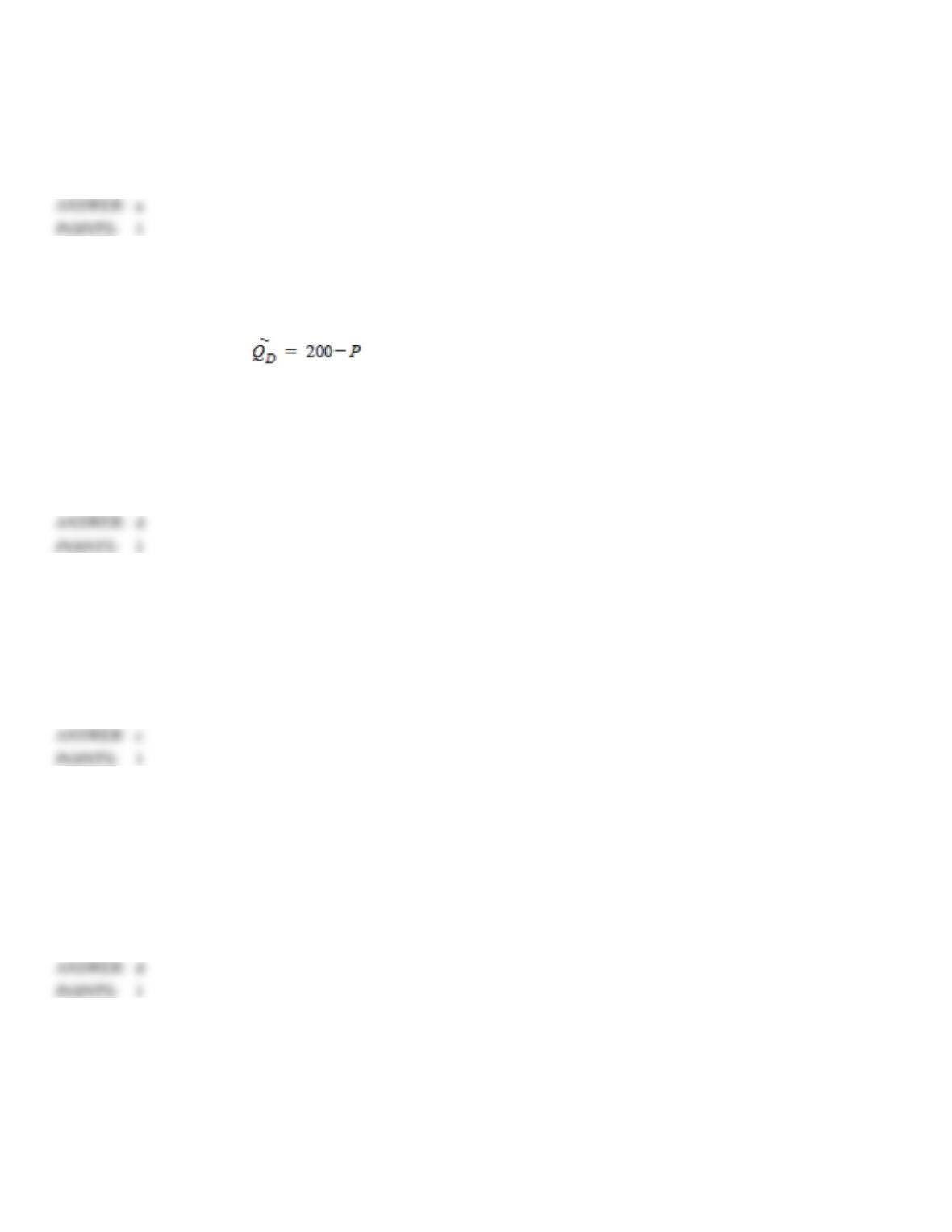
21. Supply in the market for cigarettes is perfectly competitive, given by the function QS = P. True demand in the market
is QD = 100 – P. Due to behavioral biases (of whatever form, whether people have limited willpower or have limited
cognitive abilities to process the actual health effects of smoking), people overestimate the value of cigarettes, leading to
the perceived demand curve . Compute the deadweight loss from the overconsumption generated by this
behavioral bias. (Hint: use the perceived demand curve to compute market equilibrium but make your welfare
calculations using the true demand curve.)
a.
DWL = 0.
b.
DWL = 500.
c.
DWL = 1,000
d.
DWL = 2,500.
ANSWER:
d
POINTS:
1
22. Return to the market for cigarettes from the previous question. What per-unit tax could the government levy to
eliminate the deadweight loss from the behavioral bias?
a.
0
b.
1
c.
50
d.
100
ANSWER:
POINTS:
1
23. Return to the market for cigarettes from the previous questions. Suppose the government implements the tax you
found in the previous question. But suppose the government is making a mistake. The true demand curve is in fact , and
this is not a result of any behavioral bias. Compute the deadweight loss of the government’s tax policy.
a.
DWL = 0.
b.
DWL = 500.
c.
DWL = 1,000
d.
DWL = 2,500.
ANSWER:
d
POINTS:
1
ANSWER:
POINTS:
1