
1. Which of the following functional forms for utility suggests the greatest substitution effect when starting at the point
where
a.
b.
c.
d.
2. With only two goods, if the income effect is in the same direction as the substitution effect then the good is
a.
normal
b.
inferior but not Giffen
c.
Giffen
d.
There is not enough information to answer.
a
1
3. With only two goods, if the income effect is in the opposite direction as the substitution effect but the substitution effect
dominates then the good is
a.
normal
b.
inferior but not Giffen
c.
Giffen
d.
There is not enough information to answer.
b
1
4. With only two goods, if the income effect is in the opposite direction as the substitution effect but the income effect
dominates then the good is
a.
normal
b.
inferior but not Giffen
c.
Giffen
d.
There is not enough information to answer.
c
1
5. Suppose a person’s utility is only a function of their consumption of diet soda and they do not care which brand, Diet
Coke (DC) or Diet Pepsi (DP) they consume. Suppose further that . If PDC rises but it remains less than PDP
then the consumption of DC
a.
Falls from a positive amount to zero
b.
Falls from a positive amount to another positive amount.
c.
rises.
d.
stays at zero.
b
1
b
1

6. Suppose a person’s utility is only a function of their consumption of diet soda and they do not care which brand, Diet
Coke (DC) or Diet Pepsi (DP) they consume. Suppose further that . If PDC rises to a point where then
the consumption of DC
a.
Falls from a positive amount to zero
b.
Falls from a positive amount to another positive amount.
c.
rises.
d.
stays at zero.
7. Suppose two goods coffee and creamer provide the consumer with utility but only if they are consumed in fixed
proportions. An increase in the price of coffee will yield
a.
a substitution effect and an income effect in opposite directions.
b.
a substitution effect and an income effect in the same direction.
c.
a substitution effect but no income effect.
d.
an income effect but no substitution effect.
d
1
8. Suppose you were to believe that “money illusion” exists that is as prices and incomes both rise proportionally, people
buy more. Which of the following characteristics of demand does that cause you to doubt?
a.
demand functions are downward sloping
b.
demand has a positive vertical intercept
c.
demand has a positive horizontal intercept.
d.
demand functions are homogeneous of degree zero.
d
1
9. Suppose there are two goods (X and Y). On a traditional graph of a budget line a tripling of all prices and incomes will
a.
alter the slope of the budget line only.
b.
alter the slope of the budget line as well as the Y-intercept.
c.
alter the slope of the budget line as well as the X-intercept.
d.
leave the budget line unaltered.
d
1
10. The lump sum principle suggests that the tax that reduces utility the least is
a.
a tax on income
b.
a tax on a good with many substitutes
c.
an equal tax per-unit on all goods
d.
a tax on a good with only a few substitutes
a
1
11. If a good is normal and its price increases,
a.
the income effect will be positive and the substitution effect will be positive.
b.
the income effect will be negative and the substitution effect will be negative.
a
1

c.
the income effect will be positive and the substitution effect will be negative.
d.
the income effect will be negative and the substitution effect will be positive.
12. If a good is inferior and its price increases,
a.
the income effect will be positive and the substitution effect will be positive.
b.
the income effect will be negative and the substitution effect will be negative.
c.
the income effect will be positive and the substitution effect will be negative.
d.
the income effect will be negative and the substitution effect will be positive.
c
1
13. If a good is Giffen and its price increases,
a.
the income effect will be positive and the substitution effect will be positive.
b.
the income effect will be negative and the substitution effect will be negative.
c.
the income effect will be positive and the substitution effect will be negative.
d.
the income effect will be negative and the substitution effect will be positive.
c
1
14. If a good is normal and its price decreases,
a.
the income effect will be positive and the substitution effect will be positive.
b.
the income effect will be negative and the substitution effect will be negative.
c.
the income effect will be positive and the substitution effect will be negative.
d.
the income effect will be negative and the substitution effect will be positive.
a
1
15. If a good is inferior and its price decreases,
a.
the income effect will be positive and the substitution effect will be positive.
b.
the income effect will be negative and the substitution effect will be negative.
c.
the income effect will be positive and the substitution effect will be negative.
d.
the income effect will be negative and the substitution effect will be positive.
d
1
16. Suppose and the price of X is 1, the price of Y is 1 and income is $12. If the price of X increases to 2,
the income effect (in terms of units of X bought) is
a.
2
b.
-1
c.
0
d.
-2
d
1
b
1

17. Suppose and the price of X is 1, the price of Y is 1 and income is $12. If the price of X increases to 2,
the substitution effect is
a.
2
b.
-1
c.
0
d.
-2
18. If the prices of all goods increase by the same proportion as income, the quantity demanded of good X will
a.
decrease.
b.
increase.
c.
remain unchanged.
d.
change in a way that cannot be determined from the information given.
c
1
19. Demand functions are “homogeneous of degree zero in all prices and income.” This means
a.
a proportional increase in all prices and income will leave quantities demanded unchanged.
b.
a doubling of all prices will not alter consumption decisions.
c.
prices directly enter individuals’ utility functions.
d.
an increase in income will cause all quantities demanded to increase proportionately.
a
1
20. The relationship between changes in income and purchase of a good indicates
a.
whether the good is a luxury or necessity.
b.
whether the good is normal or inferior.
c.
whether the good is a complement or substitute.
d.
Both a and b.
d
1
21. If income doubles and the quantity demanded of good X more than doubles, then good X can be described as a
a.
substitute good.
b.
complement good.
c.
necessity.
d.
luxury.
d
1
22. If an individual’s housing purchases are always a constant fraction of income, then the income elasticity of demand for
housing is
a.
greater than one.
b.
equal to one.
c.
less than one.
1

d.
Cannot be determined from the available information.
23. If an individual buys only two goods and these must be used in a fixed relationship with one another (e.g., coffee and
cream for a coffee drinker who never varies the amount of cream used in each cup), then
a.
there is no substitution effect from a change in the price of coffee.
b.
there is no income effect from a change in the price of coffee.
c.
Giffen’s Paradox must occur if both coffee and cream are inferior goods.
d.
an increase in income will not affect cream purchases.
1
24. Consider the two statements:
I.
X is an inferior good.
II.
X exhibits Giffen’s Paradox.
Which of the following is true?
a.
I implies II, but II does not necessarily imply I.
b.
II implies I, but I does not necessarily imply II.
c.
I and II are statements of the same phenomenon.
b
1
25. Two goods, X and Y, are called substitutes if
a.
an increase in PX causes more Y to be bought.
b.
an increase in PX causes less Y to be bought.
c.
an increase in PY causes less Y to be bought.
d.
an increase in income causes more of both X and Y to be bought.
1
26. Two goods, X and Y, are called complements if
a.
an increase in PX causes more Y to be bought.
b.
an increase in PX causes less Y to be bought.
c.
an increase in PY causes less Y to be bought.
d.
an increase in income causes more of both X and Y to be bought.
b
1
b
1

27. If good X is a normal good and its price rises, then quantity demanded
a.
may or may not fall.
b.
will always fall.
c.
will always rise.
d.
will remain unchanged.
28. Assume X and Y are the only two goods a person consumes. If after a rise in the quantity demanded of Y
increases, one could say
a.
the income effect dominates the substitution effect for Y.
b.
the substitution effect dominates the income effect for Y.
c.
it is impossible to determine whether the substitution or income effect dominates for Y.
d.
None of the above.
b
1
29. An individual’s demand curve
a.
represents the various quantities that a consumer is willing to purchase of a good at various prices.
b.
is derived from an individual’s indifference curve map.
c.
will shift if preferences, prices of other goods, or income change.
d.
all of the above.
d
1
30. An increase in quantity demanded is represented by
a.
a shift outward of the entire demand curve.
b.
a shift inward of the entire demand curve.
c.
a movement along the demand curve in a southeasterly direction in response to a decline in the good’s price.
d.
a movement along the demand curve in a northwesterly direction in response to a decline in the good’s price.
1
31. Which of the following will not cause a demand curve to shift position?
a.
A doubling of the good’s price.
b.
A doubling of the price of a closely substitutable good.
c.
A doubling of income.
d.
A shift in preferences.
e.
A doubling of both the price of X and the price of Y.
1
32. A decrease in demand is represented by
a.
a shift outward of the entire demand curve.
b.
a shift inward of the entire demand curve.
c.
a movement along the demand curve in a southeasterly direction.
b

d.
a movement along the demand curve in a northwesterly direction.
33. Suppose demand can be written as . The price elasticity of demand is
a.
increasing as price rises.
b.
decreasing as price rises.
c.
constant regardless of prices and perfectly elastic.
d.
constant regardless of prices and unit elastic.
d
1
34. Suppose demand can be written as . The elasticity of demand is
a.
increasing as price rises.
b.
decreasing as price rises.
c.
constant regardless of prices and perfectly elastic.
d.
constant regardless of prices and unit elastic.
1
35. Suppose demand can be written as . The elasticity of demand is)
a.
increasing as price rises.
b.
decreasing as price rises.
c.
constant regardless of prices and perfectly inelastic.
d.
constant regardless of prices and unit elastic.
1
36. The demand for gasoline is more elastic in the long run than in the short run because
a.
other prices are more likely to change in the long run.
b.
incomes tend to rise over time.
c.
people can buy new cars in the long run.
d.
cars have become more expensive over time.
1
37.
b
1
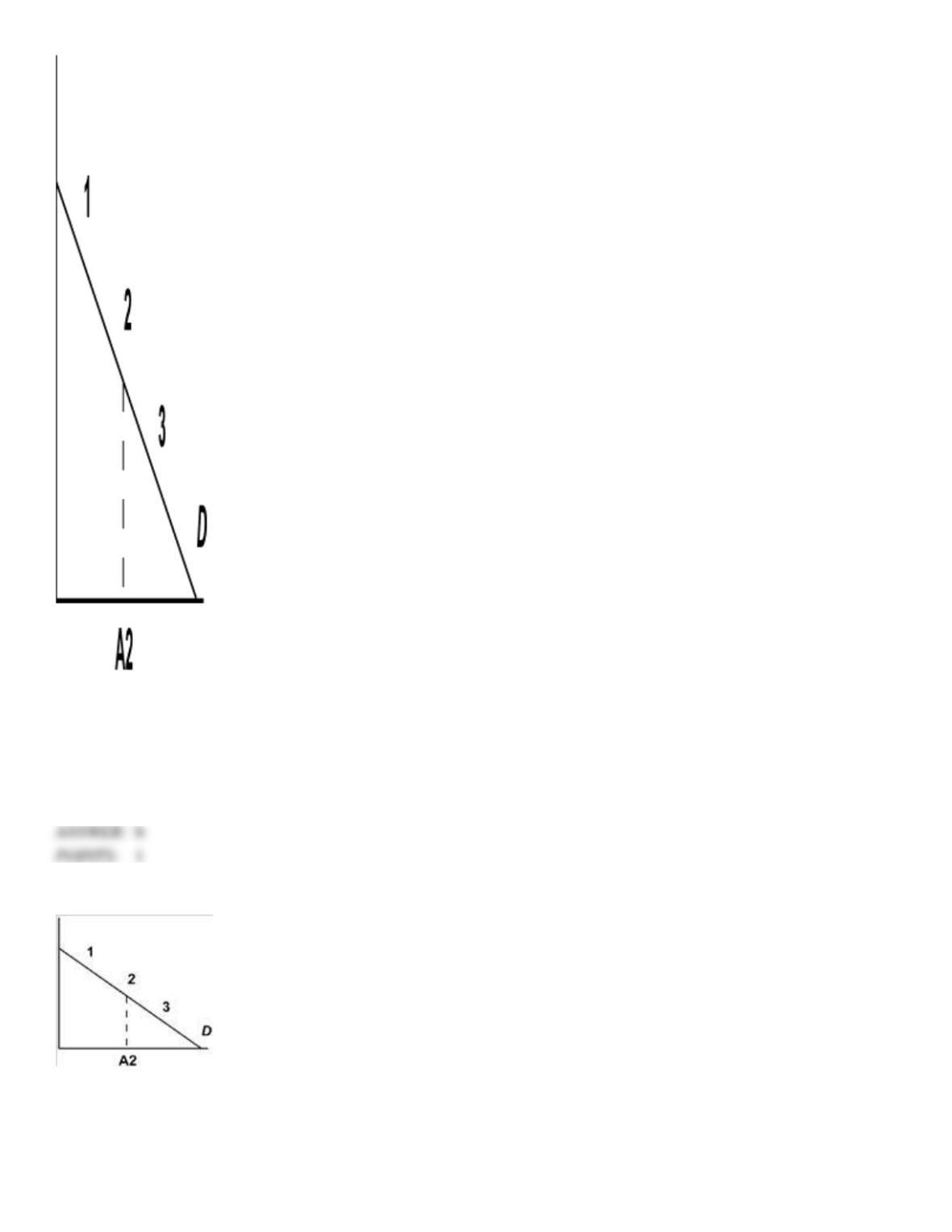
In the picture above the point A2 is half way between the origin and the quantity intercept of the demand curve. The price
elasticity at point “1” is
a.
0
b.
between –∞ and -1
c.
-1
d.
between -1 and 0
38.
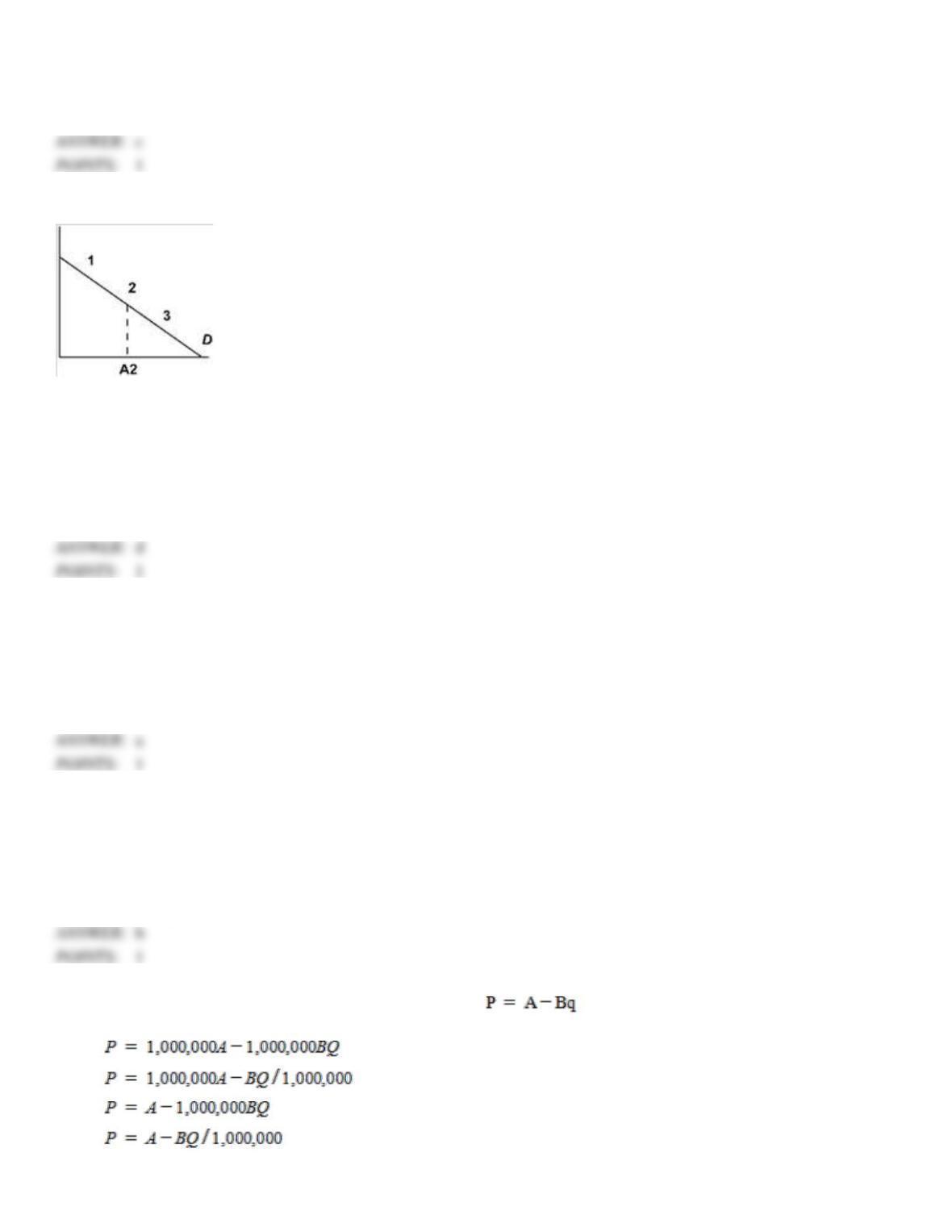
In the picture above the point A2 is half way between the origin and the quantity intercept of the demand curve. The price
elasticity at point “2” is
a.
0
b
1
b.
between –∞ and -1
c.
-1
d.
between -1 and 0
39.
In the picture above the point A2 is half way between the origin and the quantity intercept of the demand curve. The price
elasticity at point “3” is
a.
0
b.
between –∞ and -1
c.
-1
d.
between -1 and 0
d
1
40. If the income elasticity of demand is 2, the good is
a.
a luxury.
b.
a normal good (but not a luxury).
c.
an inferior good.
d.
a Giffen good.
a
1
41. If the income elasticity of demand is 0.5, the good is
a.
a luxury.
b.
a normal good (but not a luxury).
c.
an inferior good.
d.
a Giffen good.
b
1
42. In Homogenia everyone is the same. Demand for apples is for each of its 1 million citizens. Market
demand for apples in Homogenia is given by the equation
a.
.
b.
.
c.
.
d.
.
c
1

43. In Sameslopia (all N people) have a different price at which they will start buying apples, but their reaction to a price
change is the same so for each person i, individual demand is . At a price where they are all buying a
positive amount, the slope of the market demand curve (with P as a function of Q) will be
a.
-B
b.
c.
–BN
d.
-N
b
1
44. Suppose the “poor” and “rich” have identical demand functions for good X but only differ in income (I):
. At a given price of X, the price elasticity of their individual demand curves is such that
a.
the rich person’s demand is more elastic than the poor person’s.
b.
the poor person’s demand is more elastic than the rich person’s.
c.
the poor person’s demand is as elastic as the rich person’s.
b
1
45. The market demand curve for any good is
a.
independent of individuals’ demand curves for the good.
b.
the vertical summation of individuals’ demand curves.
c.
the horizontal summation of individuals’ demand curves.
d.
derived from the firm’s marginal cost of production.
c
1
46. An increase in the price of good X will be accompanied by
a.
a shift in the market demand curve for good X.
b.
a shift in the market demand curve for good Y (a substitute for good X).
c.
a movement along the market demand curve for good X.
d.
Both b and c.
d
1
47. If the demand for a product is elastic, then a rise in price will
a.
cause total spending on the good to increase.
b.
cause total spending on the good to decrease.
c.
keep total spending the same, but reduce the quantity demanded.
d.
keep total spending the same, but increase the quantity demanded.
b
1
d
1

48. The price elasticity of demand for a linear demand curve follows the pattern (moving from high prices to low prices)
a.
elastic, unit elastic, inelastic.
b.
unit elastic, inelastic, elastic.
c.
inelastic, unit elastic, elastic.
d.
elastic, inelastic, unit elastic.
49. If demand is elastic, a decrease in quantity will cause the total spending to
a.
rise.
b.
fall.
c.
remain unchanged.
d.
change in a way that cannot be determined.
b
1
50. If there are only two goods and these are consumed in fixed proportions, the price elasticities of demand for these two
goods will sum to
a.
0.0
b.
-0.5
c.
-1.0
d.
a number between 0 and –1.
c
1
51. A change in the distribution of income which leaves total income constant will not shift the market demand curve for a
product if
a.
everyone has an income elasticity of demand of zero for the product.
b.
everyone has the same income elasticity of demand for the product.
c.
individuals have differing income elasticities for the product, but the average income elasticity for income
gainers is equal to the average income elasticity for income losers.
d.
any of the above conditions occur.
d
1
52. If a consumer purchases only two goods (X and Y ) and the demand for X is elastic, then a rise in the price of X
a.
will cause total spending on good Y to rise.
b.
will cause total spending on good Y to fall.
c.
will cause total spending on good Y to remain unchanged.
d.
will have an indeterminate effect on total spending on good Y.
a
1
53. The price elasticity of demand for any good must be less than or equal to zero unless
a.
the good is a necessity.
b.
the good is a luxury.
a

c.
the good is a Giffen good.
54. If goods X and Y are complements, then the cross price elasticity of demand between them will be
a.
positive.
b.
negative.
c.
zero.
d.
infinity.
b
1
c
1