
1. In the very short run
a.
new firms may enter the industry.
b.
existing firms may change the quantity they are supplying.
c.
price and quantity supplied is absolutely fixed.
d.
quantity supplied is absolutely fixed.
2. In the short run
a.
new firms may enter an industry.
b.
existing firms may change the quantity they are supplying.
c.
price and quantity supplied are absolutely fixed.
d.
quantity supplied is absolutely fixed.
b
1
3. The short-run market supply curve is
a.
the horizontal summation of each firm’s short-run supply curve.
b.
the vertical summation of each firm’s short-run supply curve.
c.
the horizontal summation of each firm’s short-run average cost curve.
d.
the vertical summation of each firm’s short-run average cost curve.
a
1
4. In the short run, an increase in market demand will usually lead to a(n)
a.
decrease in price and an increase in quantity.
b.
decrease in price and a decrease in quantity.
c.
increase in price and an increase in quantity.
d.
increase in price and a decrease in quantity.
c
1
5. A demand curve will shift out for any of the following reasons except
a.
preference for a good increases.
b.
price of a substitute falls.
c.
income rises.
d.
price of a complement falls.
b
1
6. If a 1 percent increase in price leads to a .7 percent increase in quantity supplied in the short run, the short-run supply
curve is
a.
elastic.
b.
inelastic.
c.
unit elastic.
d.
perfectly inelastic.
d

7. If the market for hula-hoops is characterized by a very inelastic supply curve and a very elastic demand curve, an
inward shift in the supply curve would be reflected primarily in the form of
a.
higher prices.
b.
higher output.
c.
lower prices.
d.
lower output.
d
1
8. If the market for bottled spring water is characterized by a very elastic supply curve and a very inelastic demand curve,
an outward shift in the supply curve would be reflected primarily in the form of
a.
higher prices.
b.
higher output.
c.
lower prices.
d.
lower output.
c
1
9. Suppose that the price elasticity of demand for a product is −1 and that the price elasticity of supply is +1. Assume also
that the income elasticity of demand is +2. Then an increase in income of 10% will raise equilibrium price by
a.
10%.
b.
5%.
c.
20%.
d.
an annual amount that cannot be determined.
a
1
10. Under perfect competition, if an industry is characterized by positive economic profits in the short run
a.
firms will leave the market in the long run and the short-run supply curve will shift outward.
b.
firms will enter the market in the long run and the short-run supply curve will shift outward.
c.
firms will enter the market in the long run and the short-run supply curve will shift inward.
d.
firms will leave the market in the long run and the short-run supply curve will shift inward.
b
1
11. Positive economic profits exist for a firm in the long run if price is above
a.
long-run average cost.
b.
long-run marginal cost.
c.
long-run total cost.
d.
long-run variable cost.
a
1
12. Firms in long-run equilibrium in a perfectly competitive industry will produce at the low points of their average total
b
1

cost curves because
a.
free entry implies that long-run profits will be zero no matter how much each firm produces.
b.
firms seek maximum profits and to do so they must choose to produce where average costs are minimized.
c.
firms maximize profits and free entry implies that maximum profits will be zero.
d.
firms in the industry desire to operate efficiently.
13. For an increasing cost industry, the long-run supply curve has a(n) elasticity of supply
a.
infinite.
b.
negative.
c.
positive.
d.
zero.
c
1
14. Long-run elasticity of supply is defined as
a.
percentage change in quantity demanded in the long run divided by percentage change in price.
b.
percentage change in price divided by percentage change in quantity demanded in the long run.
c.
percentage change in quantity supplied in the long run divided by percentage change in price.
d.
percentage change in price divided by percentage change in quantity demanded in the long run.
c
1
15. Suppose domestic beef producers face demand of QD = 1000 – 5P. In the very short run 500 head of beef are
produced. Suppose mad cow strikes a portion of the national herd and the amount brought to market falls to 400. The
price per head will rise by
a.
10
b.
30
c.
30
d.
50
b
1
16. Suppose domestic beef producers face demand of QD = 1000 – 5P. Suppose the Chinese acquire a taste for U.S. beef
such that their demand is QD = 500 – 5P. Market demand is now
a.
1000 – 10P for all P
b.
1500 – 10P for all P
c.
1500 – 5P for all P
d.
1000 – 5P for P > 100 and 1500 – 10P for P < 100
d
1
17. Suppose a chemical company is in a perfectly competitive industry and has a short run total cost curve of
and a short run marginal cost of SMC = q2 + 10q + 10. At the price of 49, how much will
c
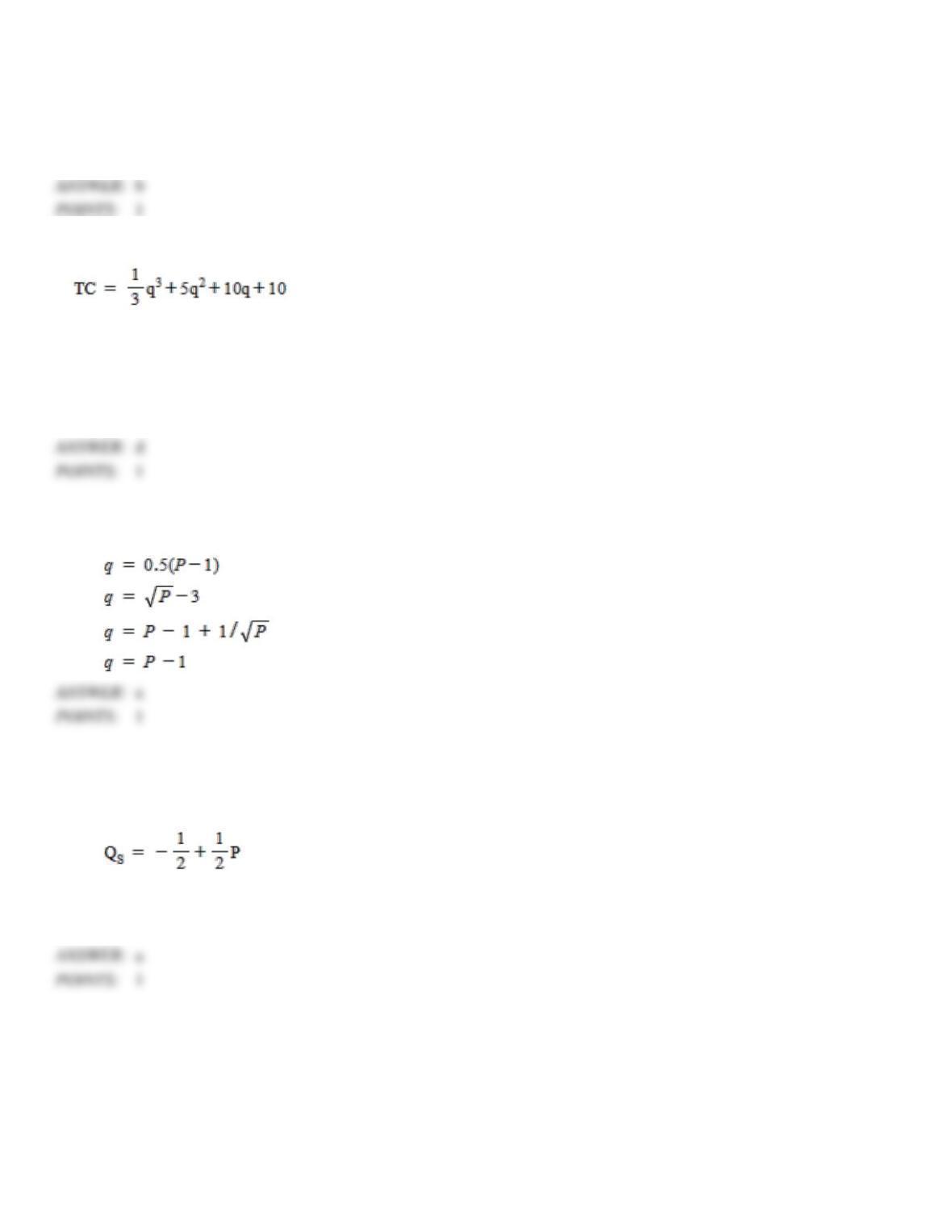
be produced?
a.
0
b.
3
c.
5
d.
15
18. Suppose a chemical company is in a perfectly competitive industry and has a short run total cost curve
of and a short run marginal cost of SMC = q2 + 10q + 10. At the price of 385, how much
will be produced?
a.
0
b.
3
c.
5
d.
15
d
1
19. Suppose there are 100 firms each with a short run total cost of STC = q2 + q + 10, so that marginal cost is MC = 2q
+1. The short-run supply curve for each firm is
a.
b.
c.
d.
1
20. Suppose there are 100 firms each with a short run total cost of STC = q2 + q + 10, so that marginal cost is MC = 2q
+1. The market supply curve is
a.
QS = −50 + 50P
b.
c.
QS = −100 + 100P
d.
QS = −50 + 50P2
1
21. Suppose there are 100 firms each with a short run total cost of STC = q2 + q + 10, so that marginal cost is MC = 2q
+1. If market demand is given by QD = 1050 − 50P, what is the equilibrium price?
a.
5
b.
10
c.
11
d.
50
b

22. Suppose there are 100 firms each with a short run total cost of STC = q2 + q + 10, so that marginal cost is MC = 2q
+1. If market demand is given by QD = 1050 − 50P, how much will the individual firm produce?
a.
3
b.
4
c.
5
d.
6
1
23. Suppose there are 100 firms each with a short run total cost of STC = q2 + q + 10, so that marginal cost is MC = 2q
+1. If market demand is given by QD = 1050 − 50P, how much will be produced in the market?
a.
300
b.
400
c.
500
d.
600
1
24. A deadweight loss of consumer and/or producer surplus occurs when
a.
producers fail to maximize profits.
b.
mutually beneficial transactions cannot be completed.
c.
consumers do not maximize their utility.
d.
the price of inputs increases.
b
1
25. In a competitive market, an efficient allocation of resources is characterized by
a.
a price greater than the marginal cost of production.
b.
the possibility of further mutually beneficial transactions.
c.
the largest possible sum of consumer and producer surplus.
d.
a value of consumer surplus equal to that of producer surplus.
1
26. “Missing markets” result from
a.
high transactions costs of such markets.
b.
strict price controls.
c.
the inability of producers to gain economies of scale.
d.
foreign countries dominating a domestic market for a product.
1
1

27. Price controls
a.
are always popular with consumers because they lower prices.
b.
create shortages.
c.
increase producer surplus because firms can now sell a greater quantity of a good at a lower price.
d.
are necessary to preserve equity.
28. One example of Ricardian rent is
a.
rent paid to landlords under price controls.
b.
the difference between the wage of a star baseball player and what he could earn outside of baseball.
c.
the amount paid to a seller above the equilibrium price of tourist class tickets in order to receive higher quality
seats in first class.
d.
the price rise of wool from a disease among sheep.
b
1
29. In the short run, the incidence of a sales tax is
a.
wholly absorbed by the producer.
b.
shared between the consumer and the producer.
c.
deferred until the market is able to re-establish an equilibrium price.
d.
wholly absorbed by the consumer.
b
1
30. In the long run, the greater burden of a specific tax will usually be absorbed by
a.
consumers.
b.
the party⎯consumers or producers⎯with the more elastic demand/supply curve.
c.
the party with the least elastic demand/supply curve.
d.
shareholders and employees of the firm in the form of reduced dividends and wages.
c
1
31. In the short run, specific taxes on a firm result in
a.
price increases that may not persist in the long run.
b.
an increase in consumer surplus because the tax permits spending in additional government services.
c.
shortages of the good being taxed.
d.
an increase in producer surplus because of the rise in price.
a
1
32. The excess burden of a tax is
a.
the amount by which the price of a good increases.
b.
the loss of consumer and producer surplus that is not transferred elsewhere.
c.
The amount by which a person’s after-tax income decreases as a result of the new tax.
d.
the welfare costs to firms forced to leave the market due to an inward shift of the demand curve.
b

33. One way to minimize the deadweight loss resulting from a specific tax is to
a.
tax only wealthy firms and individuals.
b.
spread the tax over many goods and services.
c.
tax goods for which either supply or demand is inelastic.
d.
tax luxury items such as yachts and sports cars.
c
1
34. Per-unit transaction costs
a.
may cause the demand and supply curves to shift either inward or outward depending on the value obtained
from transaction agents.
b.
refer only to the commission paid to a third party for each transaction made.
c.
are absorbed by the party seeking the transaction.
d.
have the same effect on behavior as do lump-sum transaction costs; the difference in terminology is purely
definitional.
a
1
35. When prices drop in response to a decline in demand for an increasing cost industry
a.
producer surplus will increase but rents may decrease.
b.
rent earned by elastically supplied inputs will decline by more than rent earned by inelastically supplied
inputs.
c.
rent earned by elastically supplied inputs will decline by less than rent earned by inelastically supplied inputs.
d.
both producer surplus and rents will increase.
c
1
36. If quantity supplied is either greater or less than the equilibrium quantity, then all of the following are true except:
a.
total loss of surplus will depend on the shape of the demand and supply curves.
b.
the resulting loss of consumer surplus will depend on the price of the good.
c.
total loss of surplus will depend on the price of the good.
d.
there will be an inefficient allocation of resources.
c
1
37. In the opening of free trade, if world prices of a good are less than domestic prices of that same good,
a.
domestic consumers will experience a loss of surplus.
b.
domestic prices will drop to the world price level.
c.
all domestic producers of that good will try to find another market because they can’t compete with foreign
producers.
d.
domestic producers will increase the quantity supplied in order to crowd out the foreign-produced good.
b
1
b
1

38. Who benefit(s) from protectionism?
a.
Consumers
b.
Domestic producers
c.
No one
d.
Both consumers and domestic producers.
39. Quotas that limit the quantity of imports of a foreign good provide an incentive for foreign suppliers to:
I.
Provide higher quality goods.
II.
Seek more open markets elsewhere.
III.
Lower prices to be more competitive.
IV.
Stop all trade with the country imposing the quotas.
Which of the above statements are true?
a.
I and II.
b.
I and III.
c.
II and IV.
d.
I, III, and IV.
e.
III only.
a
1
40. When a quota/trade barrier is instituted, the loss of domestic consumer surplus may be transferred to all of the
following except
a.
foreign consumers.
b.
domestic producers.
c.
foreign producers.
d.
consumers of other domestic products.
d
1
41. Suppose demand for a good is QD = 100 – P and supply is QS = –20 + P. What is the equilibrium price?
a.
20
b.
40
c.
60
d.
80
c
1
42. Suppose demand for a good is QD = 100 – P and supply is QS = –20 + P. What is the equilibrium quantity?
a.
20
b.
40
c.
60
d.
80
b
1
b

43. Suppose demand for a good is QD = 100 – P and supply is QS = –20 + P. What is the value consumers place on the
amount of the good they consume?
a.
60
b.
2400
c.
2800
d.
3200
44. Suppose demand for a good is QD = 100 – P and supply is QS = –20 + P. What is the amount consumers pay
producers?
a.
60
b.
2400
c.
3600
d.
6400
b
1
45. Suppose demand for a good is QD = 100 – P and supply is QS = –20 + P. What is the consumer surplus?
a.
200
b.
400
c.
600
d.
800
d
1
46. Suppose demand for a good is QD = 100 – P and supply is QS = –20 + P. Suppose that a nationwide quota (of 20) is
enforced so that more can be used in a war effort. What is the price?
a.
20
b.
40
c.
60
d.
80
d
1
47. Suppose demand for a good is QD = 100 – P and supply is QS = –20 + P. Suppose that a nationwide quota (of 20) is
enforced so that more can be used in a war effort. What is the consumer surplus?
a.
200
b.
400
c.
600
d.
800
1
d
1