1
CHAPTER 6
Production
A. Summary
This chapter describes production functions. Returns to scale and substitution
possibilities are stressed as descriptive and analytical concepts for studying
production in the real world. Each of these concepts offers difficulties to stu-
dents. Returns to scale is often confused with returns to a single factor. That
confusion is easily remedied by examining constant returns with fixed pro-
B. Lecture and Discussion Suggestions
Chapter 6 will generally require two lectures: one on theory, one on policy or
empirical applications. For the theory lecture, one could proceed in much the
same way that consumer theory was developed (by asking about trade-offs
for example). The important difference in production theory is that produc-
tion functions are measurable and one is therefore more interested in their
specific shapes. Both returns to scale and substitution possibilities should
probably be covered in a lecture to reinforce those concepts in students’
minds and to plant the notion that they are not simply useless baggage from
the text.
An empirical lecture might discuss both traditional production function
examples (i.e., the ever popular case of Beer —Application 6.4) and nontra-
Chapter 6: Production
2
computing, big data, smartphones) might show up in tomorrow’s productivi-
ty statistics.
C. Glossary Entries in the Chapter
• Firm
• Fixed-Proportions Production Function
SOLUTIONS TO CHAPTER 6 PROBLEMS
6.1 a. K = 6, q = 6K + 4L = 6(6) + 4L = 36 + 4L.
If q = 60, 4L = 60 – 36 = 24, L = 6.
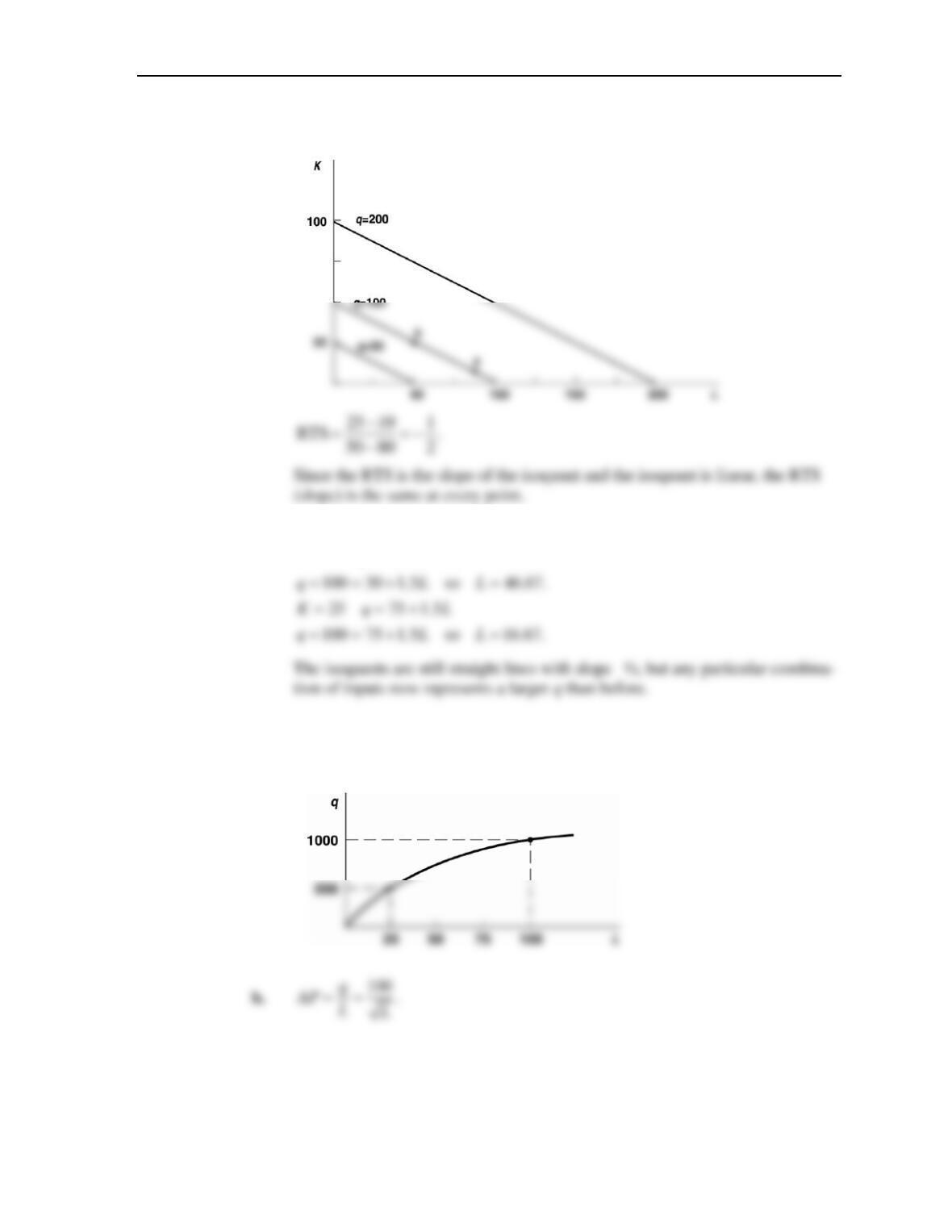
6.2 a. When K = 10, the production function is
Chapter 6: Production
3
If q = 100, L = 50.
c.
d. See graph in part c. This production function has linear isoquants.
e. K = 10 q = 3(10) + 1.5L = 30 + 1.5L.
6.3 a.
Chapter 6: Production
4
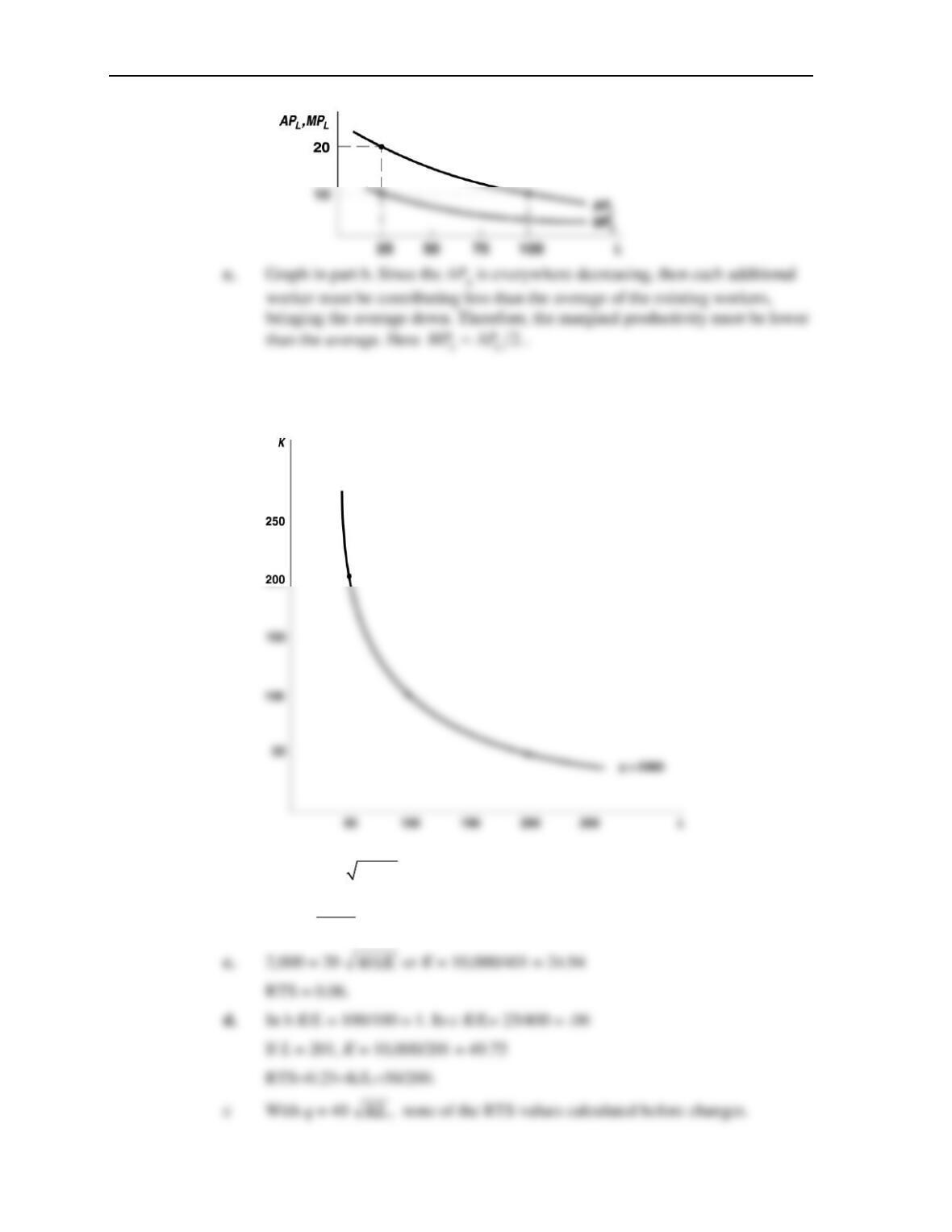
6.4 a.
b. 2,000 = 20
101K
or K = 10,000/101 – 99.01
1RTS =
−
=L
K
.
Chapter 6: Production
5
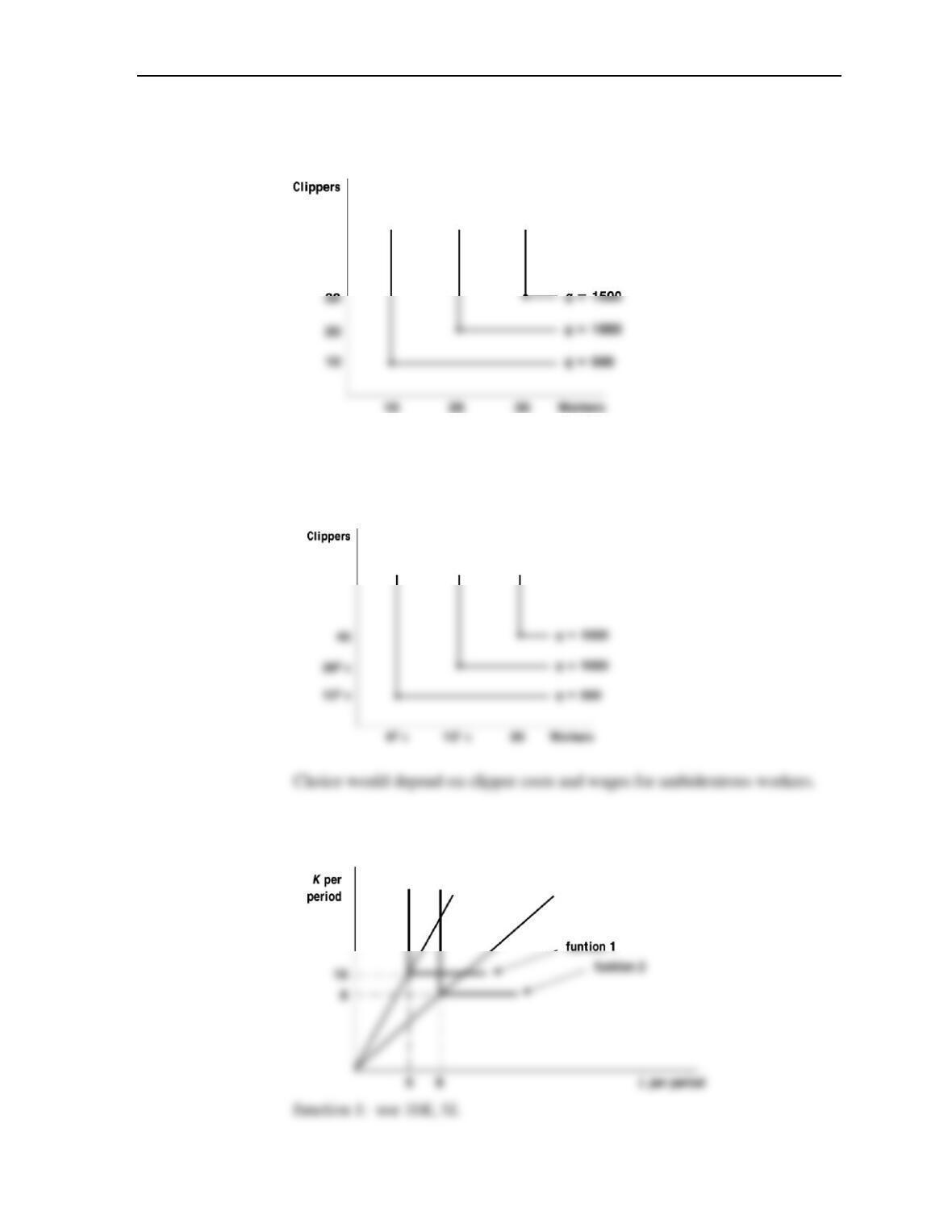
6.5 a.
Will operate at the vertex of the isoquants
b. Hire 20 workers, q = 1,000.
c. Depends on whether grapes can be sold for a price exceeding average cost.
d.
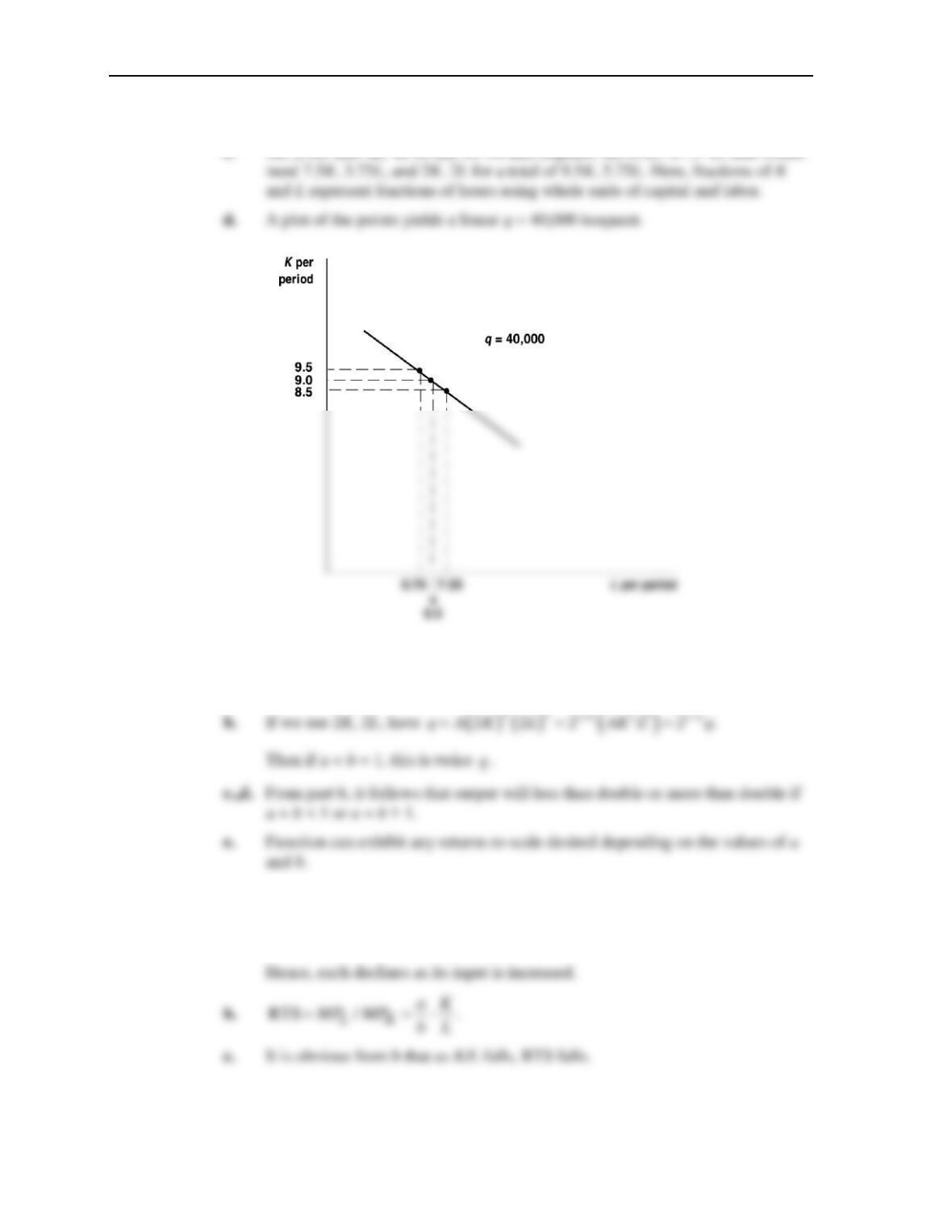
6.6 a., b.
Chapter 6: Production
6
function 2: use 8K, 8L
c. 5K, 2.5L, and 4K, 4L so this 50–50 mix requires 9K, 6.5L. A 75–25 mix would
6.7 a. In Equation 6.7,
10A=
and a = b = 1/2.
6.8 a. If a + b = 1,
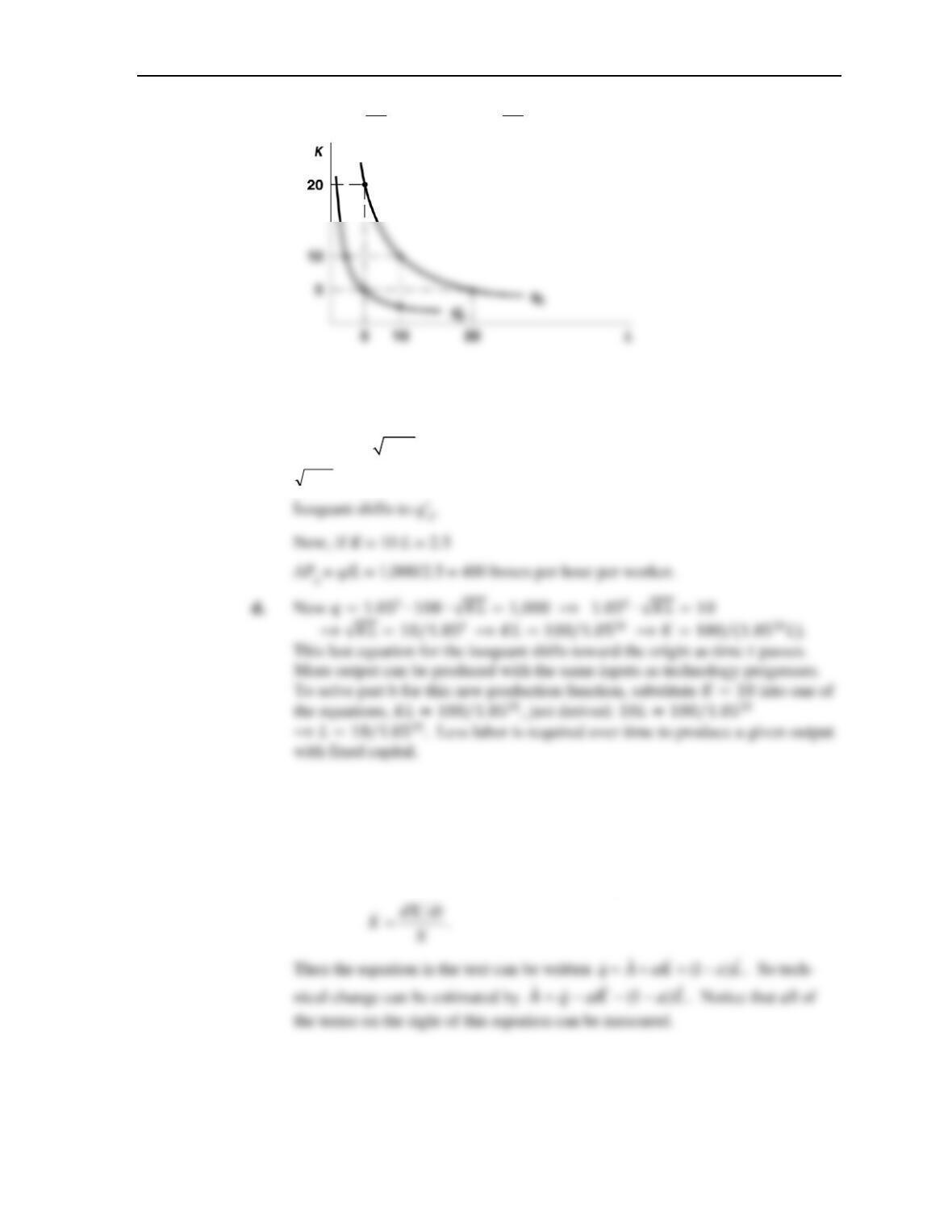
( / ) ( / )
ba
KL
MP a L K MP b K L==
Chapter 6: Production
7
6.9 a. 𝑞 = 100√𝐾𝐿 = 1,000 ⟹ √𝐾𝐿 =10 ⟹ 𝐾𝐿 =100 ⟹ 𝐾 = 100/𝐿.
b. K = 10, L = 10
APL = q/L = 1,000/10 = 100 boxes per hour per worker.
c. If q = 200
KL
= 1000
KL
= 5, or, KL = 25.
6.10 a. The function exhibits constant returns to scale because its exponents sum to
one.
b. Let
X
denote the proportional change in the “generic” variable X . That is,
Chapter 6: Production
8
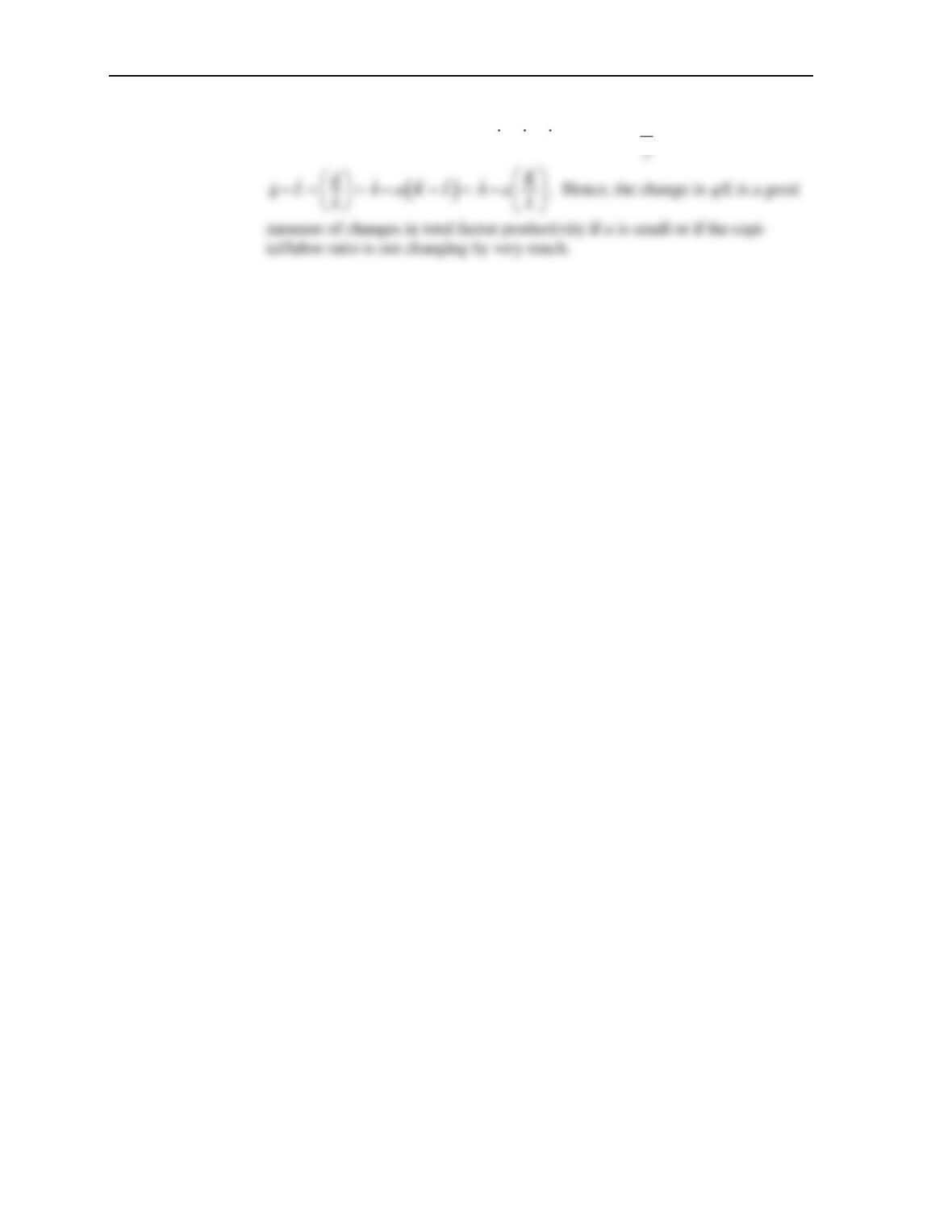
c. Use the math facts that if z = xy
z x y=+
and if
yxz
x
z
−==
. Hence