1. The problem of scarcity
a.
arises only in poor countries.
b.
exists because the price of goods is too high.
c.
exists because of limited resources.
d.
will eventually be solved by better planning.
2. If society is producing a combination of goods on its production possibilities frontier
a.
it must be employing all available resources.
b.
it must be growing.
c.
it is using all the available natural resources but may not be using all available labor resources.
d.
Both a and b.
1
3. The slope of the production possibility frontier shows
a.
how inputs must be changed to keep them fully employed.
b.
the technically efficient combinations of the two goods.
c.
how demanders are willing to trade one good for another.
d.
the opportunity cost of one good in terms of the other.
d
1
4. If the prevailing price of shirts is $10 and at this price demanders demand 100 shirts while suppliers are willing to
supply 110 shirts, there is a(n)
a.
shortage at the $10 price.
b.
surplus at the $10 price.
c.
equilibrium in this market.
d.
shortage if price were to rise above $10.
b
1
5. Positive economic analysis
a.
involves the study of firms with positive profits.
b.
involves how resources are actually used in an economy.
c.
involves judgments on how resources should be used in an economy.
d.
is usually thought to be a waste of time.
b
1
6. Normative economic analysis
a.
involves the study of what comprises a normal firm.
b.
involves how resources are actually used in an economy.
c.
involves judgments on how resources should be used in an economy.
d.
is usually thought to be a waste of time.
7. A major problem that may occur with models that predict the values of economic variables in the future is that
a.
researchers are pessimistic about the future.
b.
the model may fail to acknowledge that economic actors will change their behavior in response to changing
situations.
c.
the model may make predictions that conflict with widely held opinions.
d.
no one cares about these predictions.
b
1
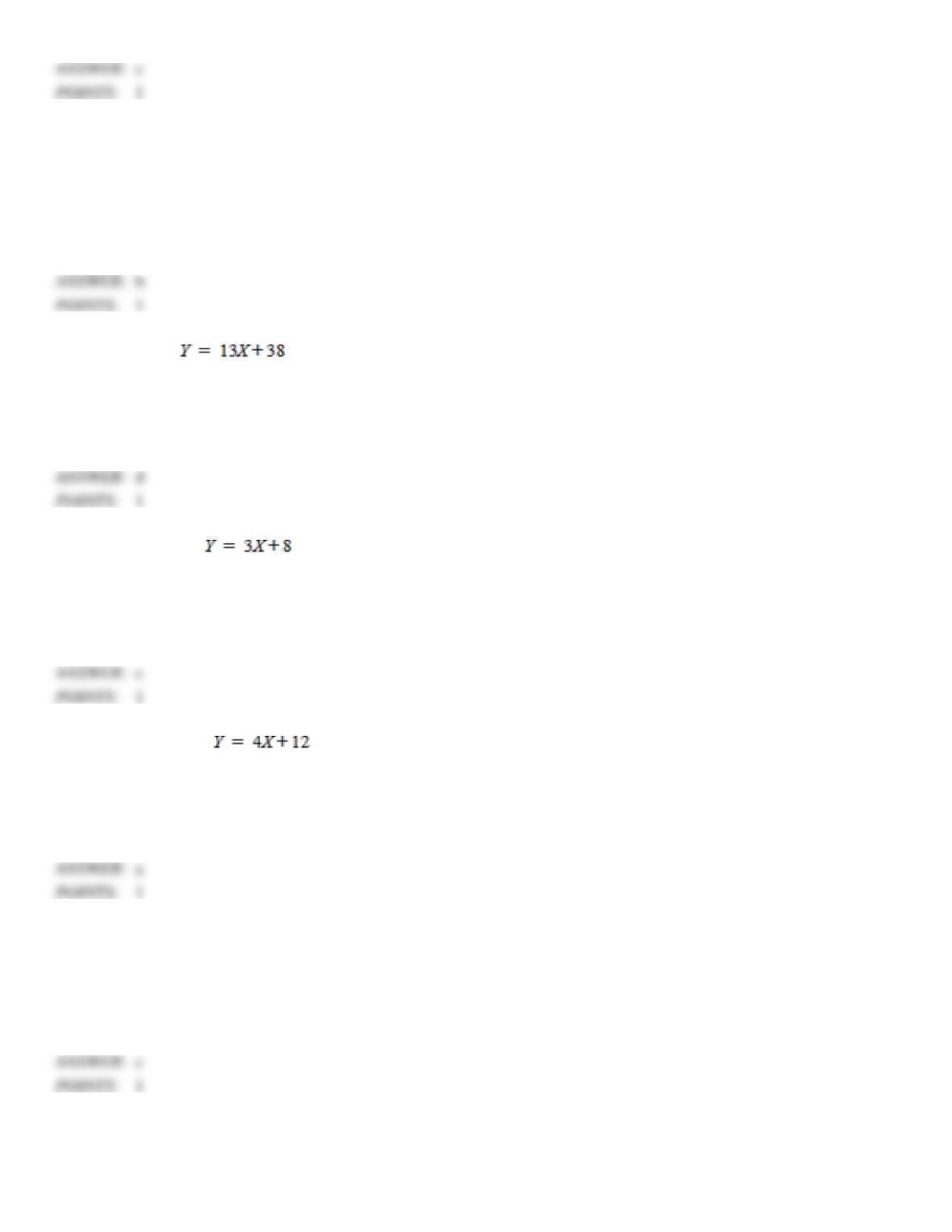
8. In the equation where Y is a function of X
a.
Y is the independent variable.
b.
38 is a variable.
c.
the slope of the line is 38.
d.
None of the above.
d
1
9. The Y-intercept of is
a.
3/8.
b.
3.
c.
8.
d.
–8/3.
c
1
10. The X-intercept of is
a.
−3.
b.
3.
c.
−1/3
d.
12.
a
1
11. If the Y-intercept of a linear function increases while the slope remains unchanged
a.
the graph must shift down in a parallel way.
b.
the graph must rotate to the left about the X intercept.
c.
the graph must shift up in a parallel.
d.
the graph remains unchanged.
c
1
12. If the slope of a linear function changes with no change in the Y-intercept
a.
the graph shifts either up or down in a parallel way.
c
1
b.
the graph remains unchanged.
c.
the graph rotates about its X-intercept.
d.
the graph rotates about its Y-intercept.
13. The slope of a nonlinear function at some particular point
a.
is the slope of the straight line that is tangent to the function at that point.
b.
is the slope of the straight line connecting the origin and the point.
c.
cannot be determined.
d.
is constant for the entire function.
1
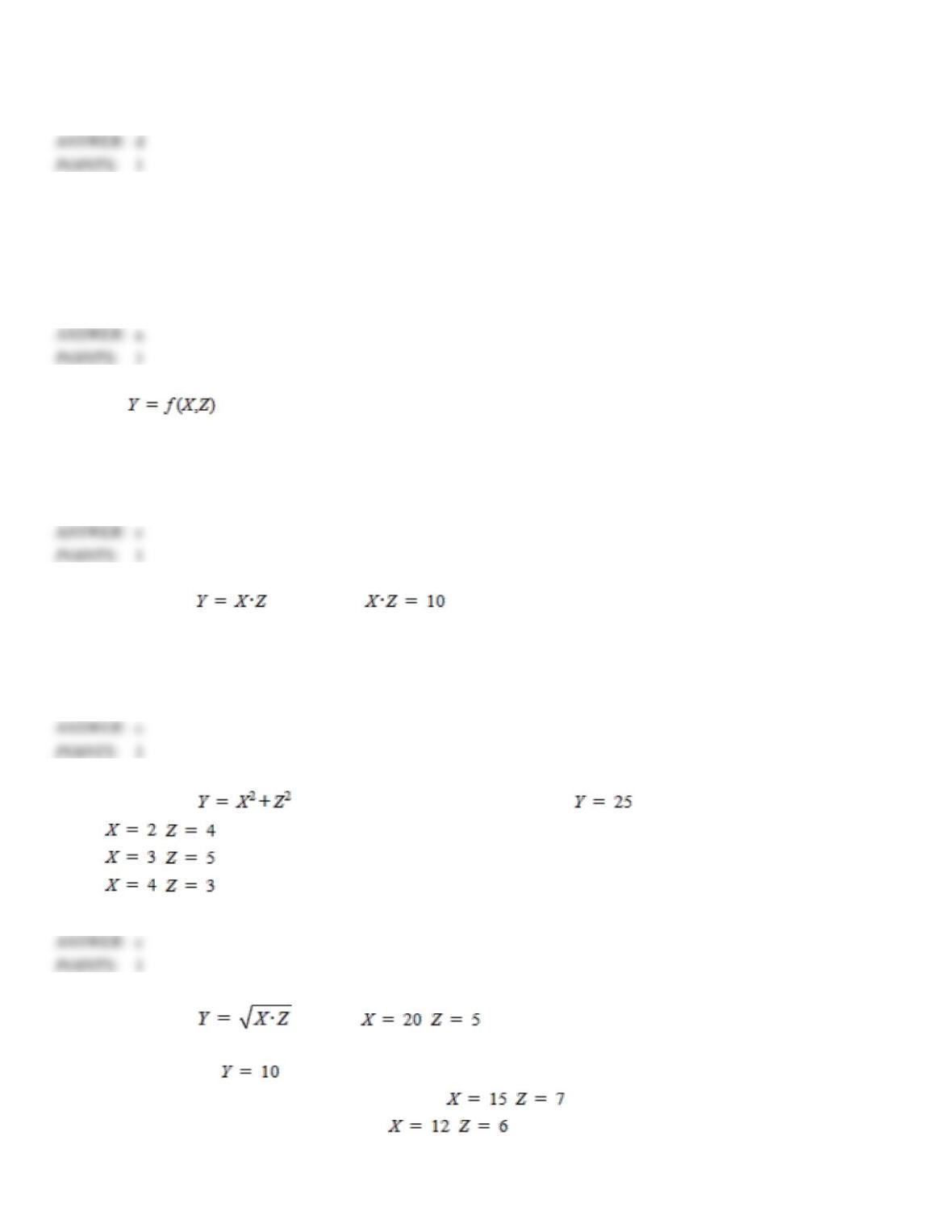
14. Given which of the following are necessarily true?
a.
Y is a linear function.
b.
X, Z are dependent variables.
c.
A contour line of this function would keep Y constant.
d.
An increase in X would increase Y.
1
15. For the function , the equation represents
a.
the X-intercept.
b.
the Y-intercept.
c.
a contour line.
d.
a tangent line.
1
16. For the equation , which of the following points lie on the contour line?
a.
, .
b.
. .
c.
, .
d.
Both a and c.
1
17. For the equation the point ,
a.
yields a value of .
b.
lies below the contour line that includes the point , .
c.
lies on the same contour line as the point , .
d.
Both a and b.
d
1
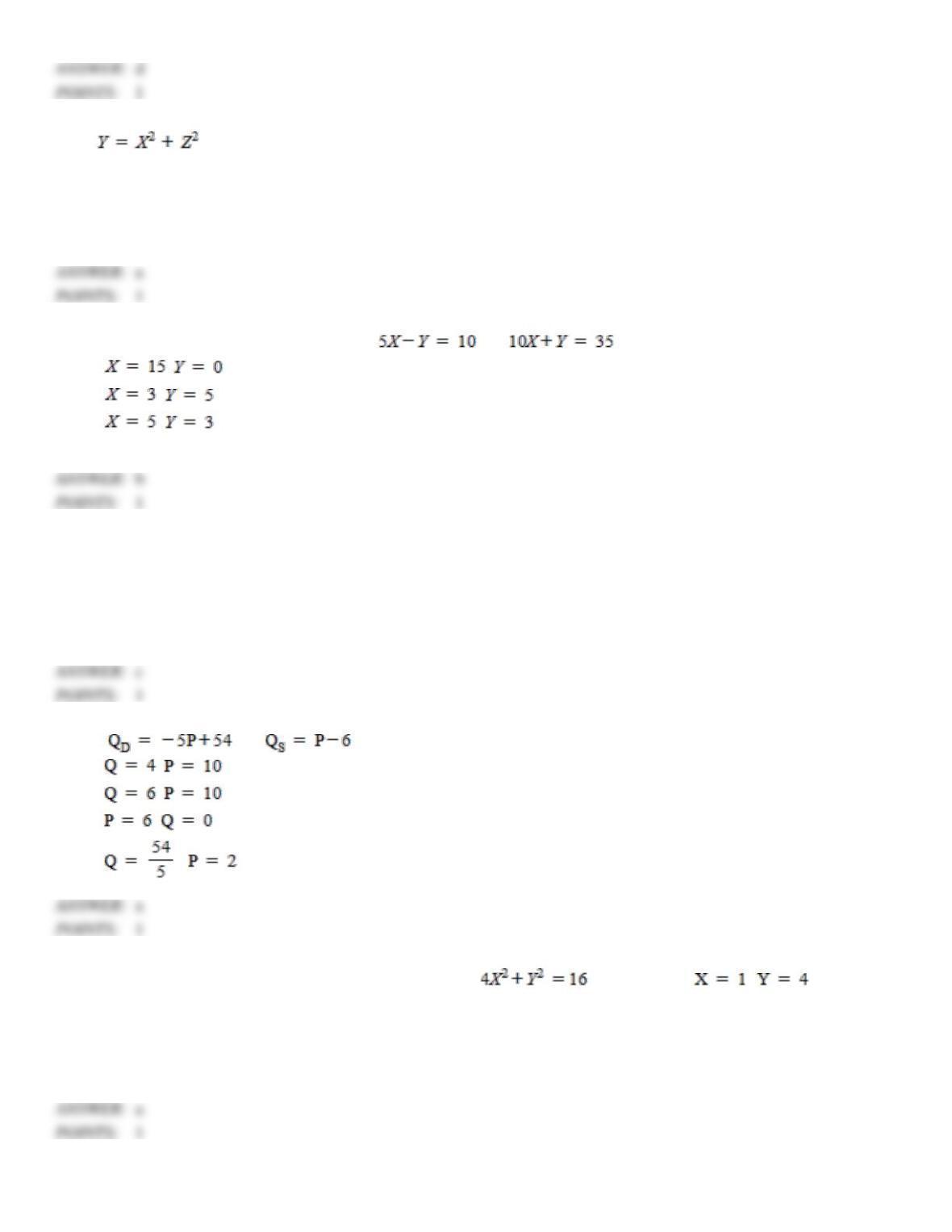
18. If , the contour lines
a.
are concentric circles.
b.
are parabolas.
c.
are hyperbolas.
d.
intersect whenever either X or Z is zero.
1
19. The solution to the simultaneous equations and is
a.
, .
b.
, .
c.
, .
d.
None of the above.
b
1
20. Graphically, the solution to a system of two independent linear equations is usually
a.
the average of the slopes.
b.
the average of the intercepts.
c.
a single point.
d.
None of the above.
1
21. Let and . Here equilibrium price and quantity are
a.
;
b.
;
c.
;
d.
;
1
22. If the production possibilities frontier can be expressed as then the point ; is
a.
outside the production possibilities frontier
b.
on the production possibilities frontier
c.
inside the production possibilities frontier
d.
in the wrong quadrant to be on the graph
1
d
1
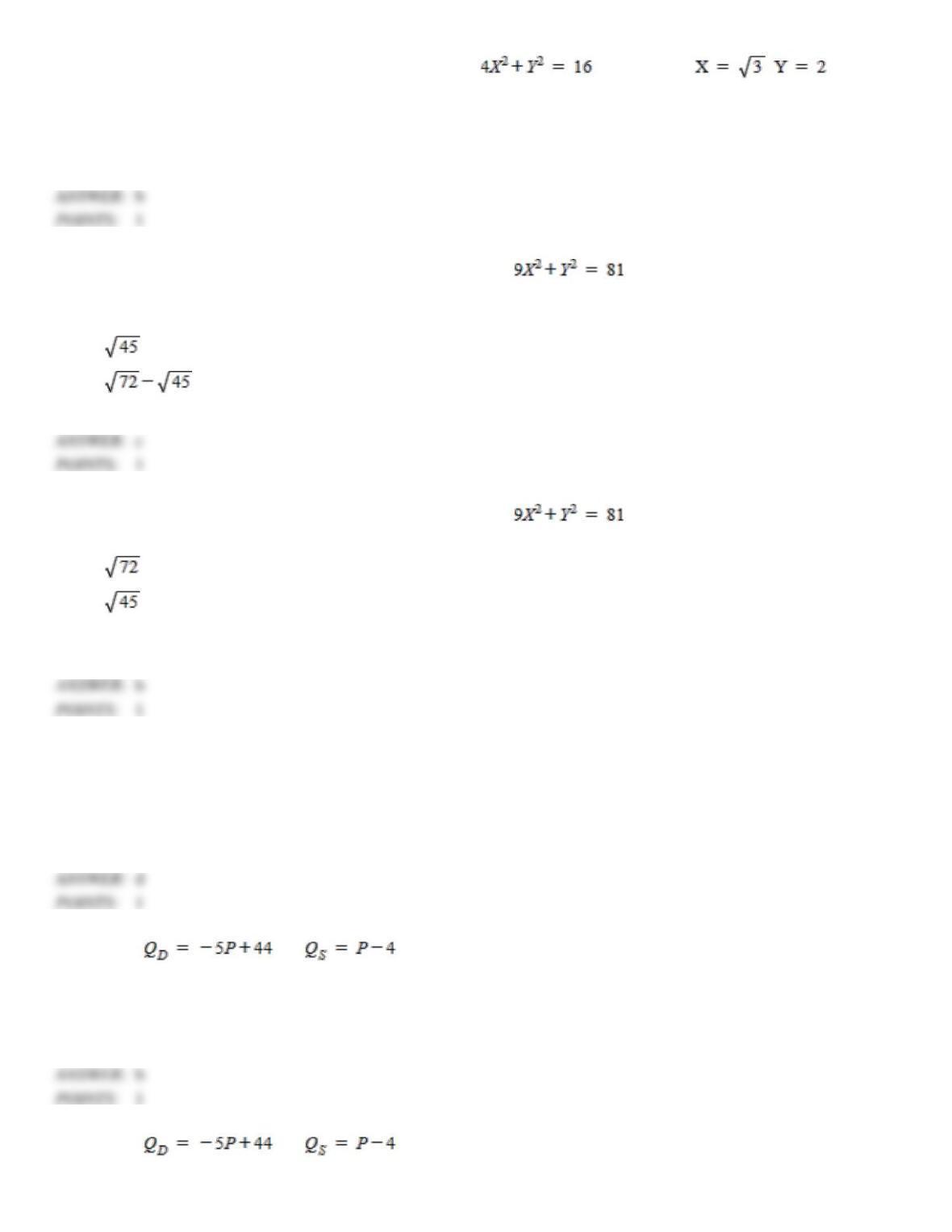
23. If the production possibilities frontier can be expressed as then the point ; is
a.
outside the production possibilities frontier
b.
on the production possibilities frontier
c.
inside the production possibilities frontier
d.
in the wrong quadrant to be on the graph
24. Suppose a production possibilities frontier can be expressed as what is the opportunity cost of going
from 1 unit of X to 2 units of X (in terms of units of Y)?
a.
45
b.
c.
d.
1
1
25. Suppose a production possibilities frontier can be expressed as what is the opportunity cost of going
from 2 units of X to 3 units of X (in terms of units of Y)?
a.
b.
c.
1
d.
0
b
1
26. An increase in the technology used in the production of only one of the two goods in a society will
a.
eliminate scarcity
b.
move the production possibilities frontier out in all directions
c.
move the production possibilities frontier in all directions
d.
leave one intercept of the production possibilities frontier fixed and swing out from the other
d
1
27. Suppose and . The equilibrium price is
a.
7
b.
8
c.
9
d.
10
b
1
28. Suppose and . The equilibrium quantity is
b
1
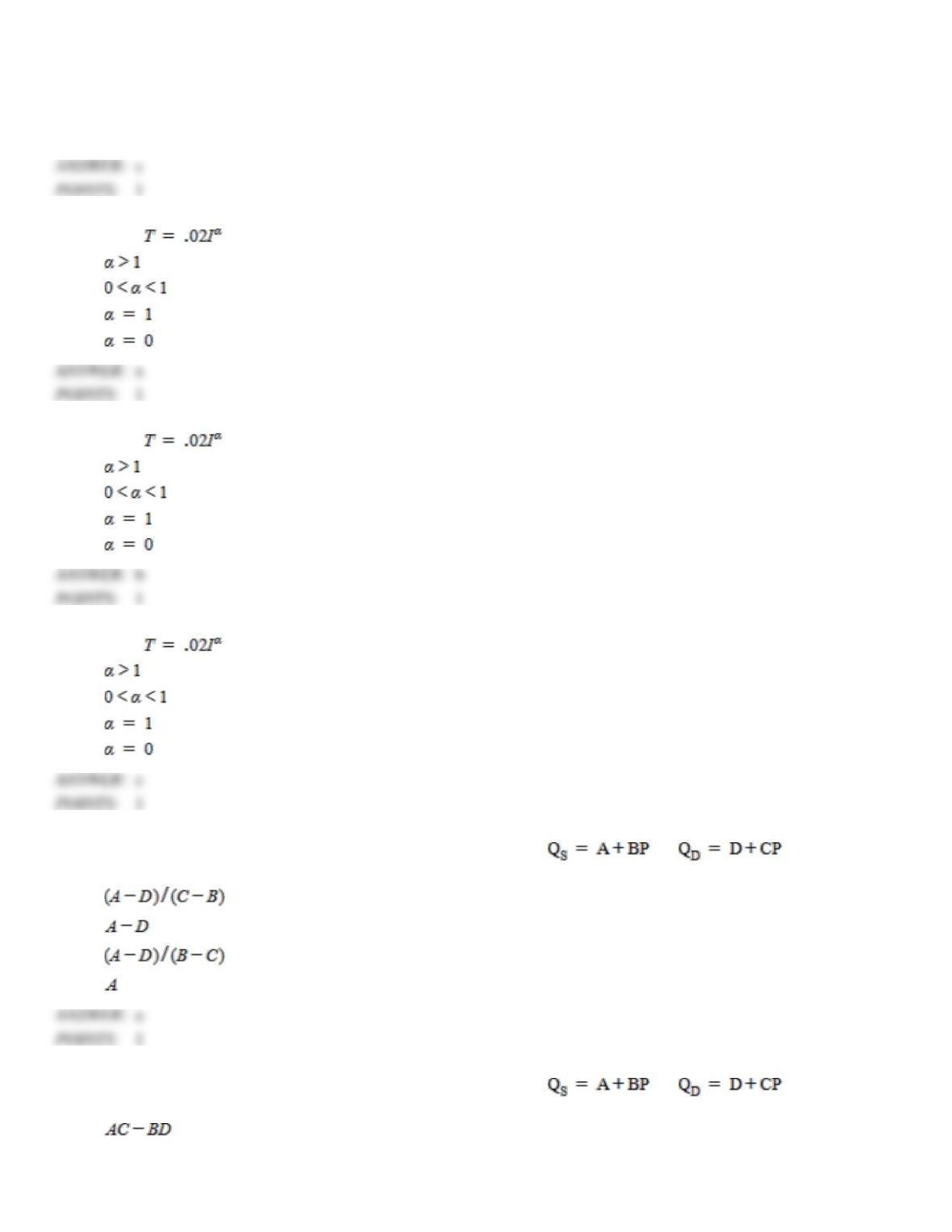
a.
2
b.
3
c.
4
d.
5
29. Suppose . If taxes are progressive which of the following is true?
a.
b.
c.
d.
1
30. Suppose . If taxes are regressive which of the following is true?
a.
b.
c.
d.
b
1
31. Suppose . If taxes are proportional which of the following is true?
a.
b.
c.
d.
1
32. Suppose you can write generic supply and demand curves such that and . Equilibrium
price is given by
a.
b.
c.
d.
1
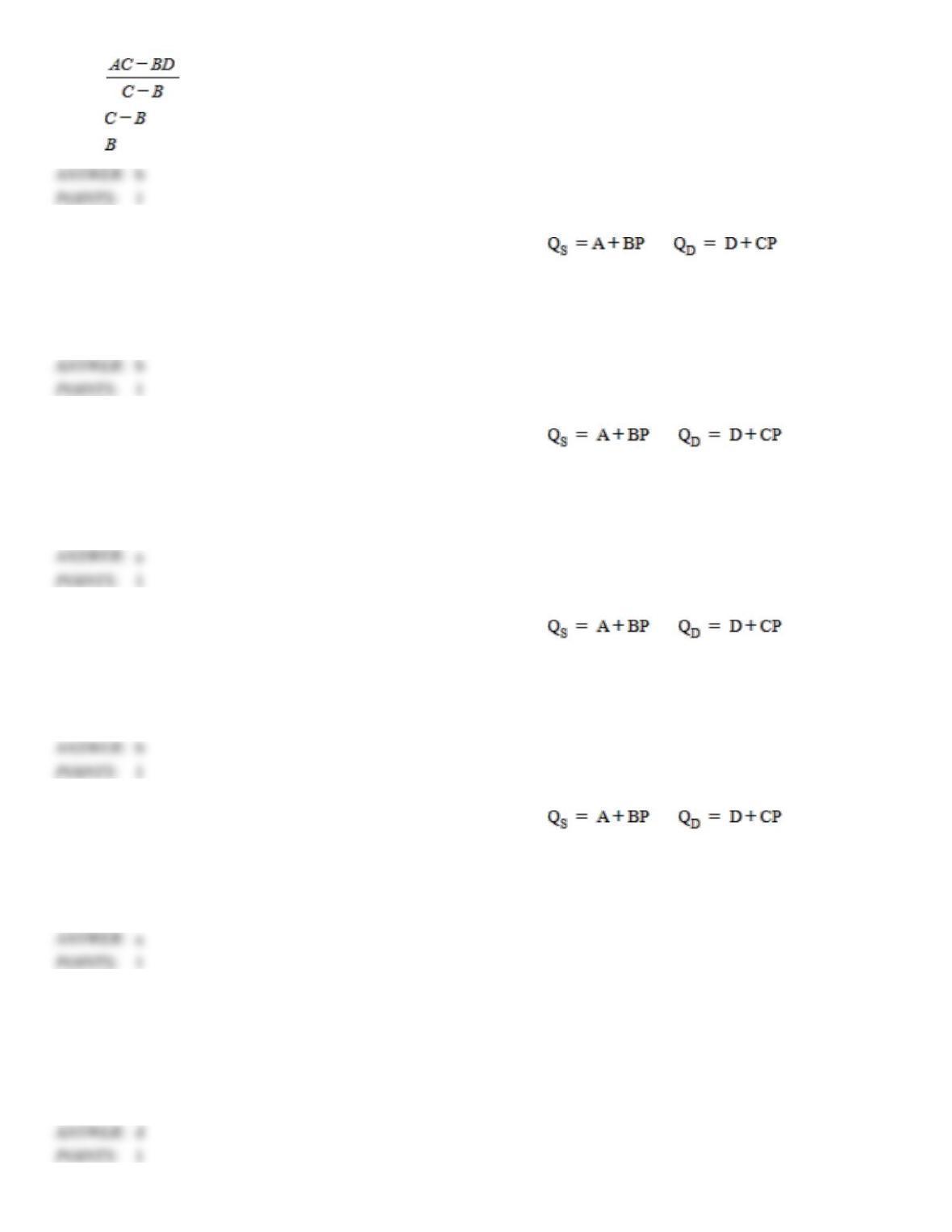
33. Suppose you can write generic supply and demand curves such that and . Equilibrium
quantity is then given by
a.
1
b.
c.
d.
34. Suppose you can write generic supply and demand curves such that and . If price must
reach a certain level before firms supply anything,, A must be
a.
positive
b.
negative
c.
0
b
1
35. Suppose you can write generic supply and demand curves such that and . If firms
produce more when price rises, B must be
a.
positive
b.
negative
c.
0
a
1
36. Suppose you can write generic supply and demand curves such that and . If consumers
demand less as price rises, C must be
a.
positive
b.
negative
c.
0
b
1
37. Suppose you can write generic supply and demand curves such that and . In the usual
supply-demand configuration, D must be
a.
positive
b.
negative
c.
0
a
1
38. The Ricardian notion that of diminishing returns implies that
a.
as more input is used more output will be made.
b.
as more input is used less output will be made.
c.
as more input is used the increase in output will increase.
d.
as more input is used the increase in output will decrease.
d
1
b
1

39. Economists typically use ____ analysis, whereas clergy members typically use ____ analysis.
a.
positive; positive
b.
normative; normative
c.
positive; normative
d.
normative; positive
1