
1. In the two-period utility maximization model the opportunity cost of one unit of C1 is
a.
one unit of C0.
b.
1 + r units of C0.
c.
1/(1 + r) units of C0.
d.
cannot be determined without more information.
2. A rise in the real interest rate r
a.
creates income and substitution effects that reduce C0.
b.
creates income effects that reduce C0, substitution effects that increase C0.
c.
creates income effects that increase C0, substitution effects that reduce C0.
d.
creates income and substitution effects that increase C0.
1
3. Suppose an individual has a fixed amount of wealth to allocate between consumption in two periods (C1 and C2). Any
funds not spent in period 1 will earn interest (at the rate r), which will increase purchasing power in period 2. Consider
four possible reactions to an increase in r:
I.
C1 increases.
II.
C1 decreases.
III.
C2 increases.
IV.
C2 decreases.
Which of these is consistent with the hypothesis that both C1 and C2 are normal goods?
a.
I, II, III, and IV.
b.
I, II, and IV, but not III.
c.
I, III, and IV, but not II.
d.
II and III, but not I and IV.
e.
I, II and III, but not IV.
1
4. The annual rental rate for a machine is
a.
the yearly depreciation and maintenance costs for the machine.
b.
the yearly interest costs associated with owning the machine.
c.
the initial purchase price of the machine divided by the number of years the machine is expected to last.
d.
the sum of the yearly depreciation, maintenance, and interest costs associated with owning the machine.
d
1
5. A fall in the real interest rate leads to
a.
an increase in the rental rate on a machine.
b.
a decrease in the rental rate on a machine.
c.
no change in the rental rate on a machine.
1

d.
a fall in the marginal productivity of capital.
6. An increase in the corporate profits tax will most likely lead to
a.
a decrease in the rental rate of capital in the corporate sector.
b.
no change in the rental rate of capital in the corporate sector.
c.
no change in the rental rate of capital in the non-corporate sector.
d.
an increase in the rental rate of capital in the corporate sector.
d
1
7. The present value of $1 payable in two years is
a.
$1.
b.
$1/(1 + 2r).
c.
$1/(1 − 2r).
d.
$1/(1 + r)2.
d
1
8. The present value of $1 payable in the future decreases
a.
the higher r is and the sooner it is to be paid.
b.
the lower r is and the sooner it is to be paid.
c.
the higher r is and the longer time until it is paid.
d.
the lower r is and the longer time until it is paid.
1
9. In a perfectly competitive market a firm’s rental rate for a machine (v) will be given by: v = P(r + d) where r is the
prevailing rate of interest and d is the depreciation rate. In this formula P represents
a.
the present market price of the machine.
b.
the initial purchase price of the machine (assuming this differs from its present market price.
c.
the price of the firm’s product.
d.
the depreciated value of the machine.
1
10. Accelerated depreciation laws may increase firms’ investment in equipment because
a.
machines will wear out more rapidly.
b.
profits will be increased.
c.
the rental rate on capital will be lowered.
d.
the price of machines will fall.
1
11. If real extraction costs do not change, the relative price of a finite resource would be expected to
b
1

a.
fall over time.
b.
remain constant over time.
c.
rise at a rate given by the nominal rate of interest.
d.
rise at a rate given by the real rate of interest.
12. A monopolist who owned the entire supply of a scarce resource would set a price
a.
at about the competitive level.
b.
lower than the competitive level.
c.
higher than the competitive level but lower than what a monopoly producer of a non-scarce good would.
d.
above that which would be chosen by a monopoly producer of a nonscarce good.
a
1
13. The difference in present value between a perpetuity that promised $1 per year starting today and one that promised $1
per year starting next year is
a.
0.
b.
$1.
c.
$1/(1 + r).
d.
$r/(1 + r).
b
1
14. A firm that wished to calculate the present value of its future nominal profits should use the ____ to do so.
a.
real interest rate
b.
nominal interest rate
c.
nominal interest rate minus the expected inflation rate
d.
real interest rate minus the expected inflation rate
b
1
15. The yield on a bond is that interest rate for which the present value of the interest and principal payments promised by
the bond are
a.
equal.
b.
as large as possible.
c.
equal to the price of the bond.
d.
equal to the face value of the bond.
c
1
16. For a given interest rate, r, which of the following expressions is smallest?
a.
1 + r.
b.
(1 + r/2)2.
c.
(1 + r/12)12
d.
(1 + r/365)365.
d
1
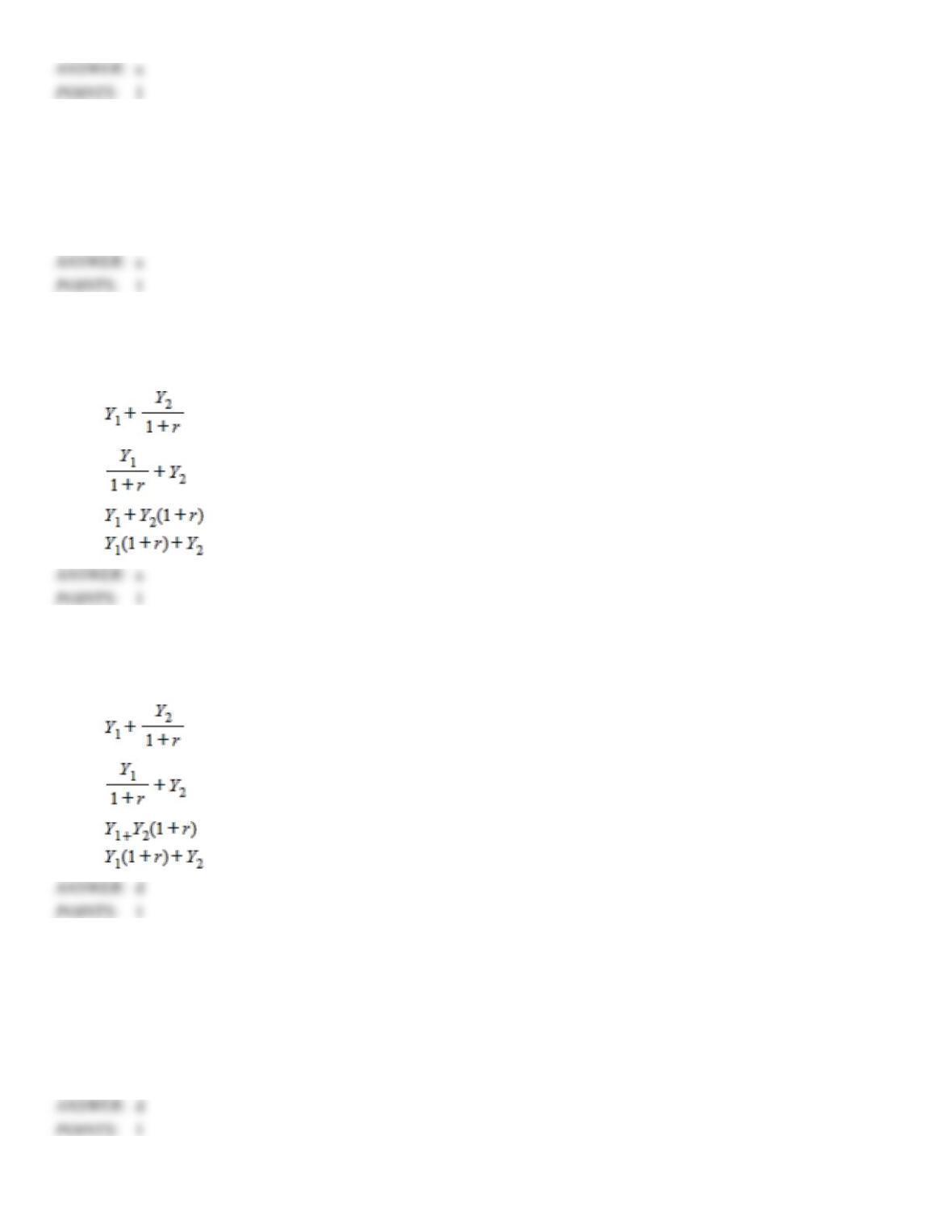
17. The rental rate approach to investment choices by firms and the present value approach
a.
always agree.
b.
agree only if depreciation is 0.
c.
agree only if the price of equipment does not change.
d.
agree only when inflation rates are zero.
1
18. Draw a two period budget line where the borrow/lending rate of interest, r, allows consumers to choose consumption
in each of the two periods. C1 and C2 given their anticipated income on two periods, Y1 and Y2. The horizontal (C1)
intercept is
a.
b.
c.
d.
1
19. Draw a two period budget line where the borrow/lending rate of interest, r, allows consumers to choose consumption
in each of the two periods. C1 and C2 given their anticipated income on two periods, Y1 and Y2. The vertical (C2)
intercept is
a.
b.
c.
d.
d
1
20. Draw a two period budget line where the borrow/lending rate of interest, r, allows consumers to choose consumption
in each of the two periods. C1 and C2 given their anticipated income on two periods, Y1 and Y2. The slope is
a.
r
b.
−r
c.
1 + r
d.
−(1 + r)
d
1
1
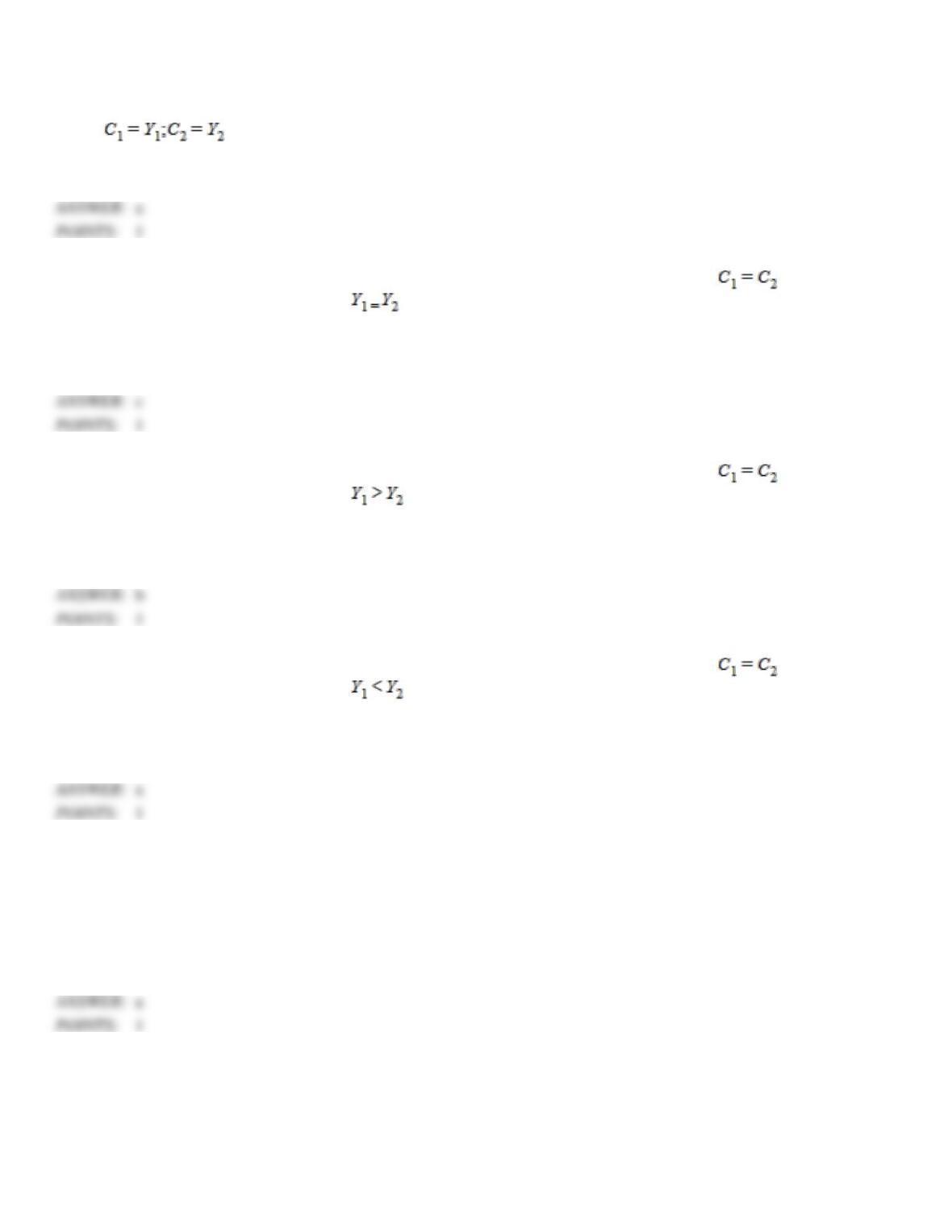
21. Draw a two period budget line where the borrow/lending rate of interest, r, allows consumers to choose consumption
in each of the two periods. C1 and C2 given their anticipated income on two periods, Y1 and Y2. The one point on the
budget line not affected by the interest rate is
a.
b.
the horizontal intercept.
c.
the vertical intercept
22. Suppose a person’s preferences are to “consumption smooth”, which means they wish to get for all incomes
and interest rates. For any interest rate and , the person will ____ in the first period.
a.
borrow
b.
save
c.
neither borrow nor save
c
1
23. Suppose a person’s preferences are to “consumption smooth”, which means they wish to get for all incomes
and interest rates. For any interest rate and , the person will ____ in the first period.
a.
borrow
b.
save
c.
neither borrow nor save
b
1
24. Suppose a person’s preferences are to “consumption smooth”, which means they wish to get for all incomes
and interest rates. For any interest rate and , the person will ____ in the first period.
a.
borrow
b.
save
c.
neither borrow nor save
a
1
25. Suppose you know a piece of land will be worth $1 million (real) in 2025, and the real interest rate is 5%. About how
much should you be willing to pay for the land today (20150)? (Assume no taxes).
a.
$610,000
b.
$1 million
c.
$1.89 million
d.
$230.000
a
1
26. Suppose you know a piece of land will be worth $1 million (real) in 2045, and the real interest rate is 5%. About how
much should you be willing to pay for the land today (2015)? (Assume no taxes).
a.
$610,000
b.
$1 million
1

c.
$1.89 million
d.
$230,000
27. Suppose Johnny Stroller sells 12, 25, and 75 year-old scotch in under black, red, and blue labels. Suppose the storage
costs are zero and the initial production costs are the same. What is the implied (approximate) interest rate if black sells
for $18, red for $34 and blue for $388.
a.
2
b.
5
c.
8
d.
10
b
1
28. Suppose Johnny Stroller sells 12, 25, and 75 year-old scotch in under black, red, and blue labels. Suppose the storage
costs are zero and the initial production costs are the same. What is the implied (approximate) interest rate if black sells
for $12, red for $16 and blue for $44.
a.
2
b.
5
c.
8
d.
10
a
1
29. The two-period budget line for incomes Y1 and Y2 and consumption C1 and C2 can be written as
, if the interest rate were to rise the budget line would
a.
shift to the left in a parallel fashion
b.
shift to the right in a parallel fashion
c.
rotate counter-clockwise pivoting on Y1, Y2
d.
rotate clockwise pivoting on Y1, Y2
d
1
30. The two-period budget line for incomes Y1 and Y2 and consumption C1 and C2 can be written as
, if the interest rate were to fall the budget line would
a.
shift to the left in a parallel fashion
b.
shift to the right in a parallel fashion
c.
rotate counter-clockwise pivoting on Y1, Y2
d.
rotate clockwise pivoting on Y1, Y2
c
1
d
1