
1. A firm’s demand for labor is known as a “derived demand” because
a.
the firm gains utility from hiring more labor.
b.
the amount of labor hired depends upon how much output the firm can sell.
c.
the wage rate paid to workers is derived from the market for labor.
d.
it is derived from the demand for capital.
2. If the price of an input falls, a firm would increase the use of that input for two reasons:
a.
The input is now more productive, and the firm can substitute this input for other relatively more expensive
inputs.
b.
The input is now more productive, and overall production costs are now lower, meaning a firm may choose to
increase production.
c.
Overall production costs are now lower and the firm can substitute this input for other relatively more
expensive inputs.
d.
Overall production costs are now lower and the firm will have more of other inputs to use with the one in
question.
c
1
3. In an input market, economic rent is defined as
a.
the total remuneration paid to a factor of production.
b.
the minimum amount required to retain a factor of production in its present use.
c.
the total cost for a firm of renting land, equipment, and buildings.
d.
the extent to which payments to a factor of production exceed the minimum amount required to retain it in its
present use.
d
1
4. If a factor of production comes to have more and more alternative uses, its supply curve to any one use
a.
remains unchanged.
b.
becomes more inelastic.
c.
becomes more elastic.
d.
may move in any direction.
c
1
5. A firm will hire additional units of any input up to the point where
a.
the marginal productivity of the input is maximized.
b.
the marginal cost of employing the input is minimized.
c.
the expense of employing the last unit is equal to the revenue brought in by the last unit.
d.
the revenue brought in by the input is maximized.
c
1
6. An input’s marginal revenue product is given by
a.
the input’s marginal expense times marginal revenue.
b

b.
the input’s marginal expense times the input’s marginal physical productivity.
c.
marginal revenue times the number of units employed.
d.
the input’s marginal physical productivity times marginal revenue of the firm’s output.
7. If a profit-maximizing firm is a price taker in the input market but not in the output market, its marginal value product
of labor
a.
exceeds the marginal revenue product of labor.
b.
equals its marginal revenue product of labor.
c.
is less than the marginal revenue product of labor.
d.
equals the marginal physical product of labor.
1
8. If a profit-maximizing firm is a price taker in both the input and output markets, its marginal revenue product of labor is
given by
a.
the price of its output times labor’s marginal physical productivity.
b.
the marginal value product of labor.
c.
the marginal revenue product of capital times the ratio of the wage rate to the rental rate on capital.
d.
all of the above.
d
1
9. A profit-maximizing firm will never hire that quantity of a factor of production for which that factor has an increasing
marginal productivity because
a.
it would not be maximizing output.
b.
it would not be maximizing the productivity of labor.
c.
it would not be minimizing costs.
d.
it would not be maximizing profits.
d
1
10. The substitution effect of a change in wage rate on a firm’s demand for labor input will be more significant
a.
the greater the change in output.
b.
the more sharply curved are the firm’s isoquants.
c.
the flatter are the firm’s isoquants.
d.
the larger the quantity of labor employed.
b
1
11. The output effect of a change in the wage rate on a firm’s demand for labor input will be greater
a.
the larger the share of labor costs in total costs and the greater the price elasticity of demand for output.
b.
the larger the share of labor costs in total costs and the smaller the price elasticity of demand for output.
c.
the larger the share of labor costs in total costs and the higher the quantity demanded.
d.
the smaller the possibilities of substituting capital for labor.
d
1

12. The notion that when the price of an input falls, a firm’s marginal cost curve shifts down and overall production
increases so that more of every input is employed is known as
a.
the output effect.
b.
the substitution effect.
c.
the input effect.
d.
the cost effect.
a
1
13. The size of the reduction in quantity of labor hired by a firm due to an increase in the wage rate depends upon all of
the following except
a.
what percentage of total costs are made up of labor costs.
b.
how much quantity demanded in the output market will be reduced by a higher price.
c.
the capital to labor ratio before the wage increase.
d.
how easily other inputs can be substituted for labor.
c
1
14. Suppose capital and labor must be used in fixed proportions to produce widgets and that the price elasticity of demand
for widgets is zero. Then the wage elasticity of demand for labor by widget makers will be
a.
+1.
b.
−1.
c.
0.
d.
infinite.
c
1
15. If the wage rate rises, labor’s share in the total costs of a production process
a.
will increase.
b.
will decrease.
c.
may increase or decrease depending on the elasticity of demand for the product.
d.
may increase or decrease depending on the ease of substitution of other inputs for labor.
d
1
16. If a firm is a monopsonistic hirer of labor,
a.
its marginal expense for labor is greater than the market wage.
b.
its marginal expense for labor is equal to the market wage.
c.
its marginal expense for labor is less than the market wage.
d.
it is a price taker in the labor market.
a
1
17. A monopsonist will hire labor up to the point where
a
1

a.
the marginal expense of labor is minimized.
b.
the marginal physical productivity of labor is maximized.
c.
the marginal expense of labor is equal to marginal revenue.
d.
the marginal expense of labor is equal to the marginal value product of labor.
18. For a monopsonistic hirer of labor the gap between labor’s marginal value product and its wage rate will be greater
a.
the more elastic the supply curve for labor.
b.
the more inelastic the supply curve for labor.
c.
the more elastic the firm’s demand for labor.
d.
the more inelastic the firm’s demand for labor.
b
1
19. A price discriminating monopsonist could increase its profits by
a.
paying the minimum wages possible.
b.
hiring as little capital as possible.
c.
paying lower wages to workers with inelastic supply of labor curves than to workers with elastic curves.
d.
paying lower wages to workers with elastic supply of labor curves than to workers with inelastic curves.
c
1
20. Consider two situations: In situation A the production of widgets is monopolized by a single firm. In situation B the
production of widgets is perfectly competitive. In both situations the supply of labor to widget makers is infinitely elastic
at a wage of w. Which of the following statements is true?
a.
The marginal value product of labor will be the same in the two cases.
b.
The marginal value product of labor is higher in case B than in case A.
c.
The marginal value product of labor is higher in case A than in case B.
d.
From the information given it is not possible to make a definite statement about the marginal value product of
labor.
c
1
21. A monopolist union that desired to maximize its total wage bill ( ) would offer that quantity of labor for which
a.
labor’s marginal productivity is zero.
b.
labor’s wage falls to zero.
c.
the quantity of labor hired is as great as possible given the firm’s demand curve.
d.
the marginal revenue from providing one more worker to the market is zero.
d
1
22. In the study of labor supply, “leisure” refers to
a.
time spent sleeping.
b.
time spent doing absolutely nothing (except breathing).
c.
time spent in one’s place of residence.
d
1

d.
time spent that is not spent in market work.
23. When an individual’s wage rises, the substitution effect tends to
a.
increase hours worked.
b.
decrease hours worked.
c.
leave hours worked unchanged.
d.
it is impossible to predict what will happen to hours worked.
a
1
24. When an individual’s wage rises, the income effect tends to
a.
increase hours worked.
b.
decrease hours worked.
c.
leave hours worked unchanged.
d.
it is impossible to predict what will happen to hours worked.
b
1
25. If an individual’s supply of labor curve is positively sloped throughout, then
a.
the substitution effect always dominates the income effect.
b.
the income effect always dominates the substitution effect.
c.
the substitution effect dominates at low real wage levels and the income effect dominates at high real wage
levels.
d.
the income effect dominates at low real wage levels and the substitution effect dominates at high real wage
levels.
a
1
26. The fact that more women have chosen to work as real wages rise is evidence that, for them
a.
leisure is an inferior good.
b.
income and substitution effects of higher real wages work in the same direction.
c.
income and substitution effects of higher real wages may work in opposite directions.
d.
income and substitution effects may work in opposite directions but that the substitution effect is stronger.
d
1
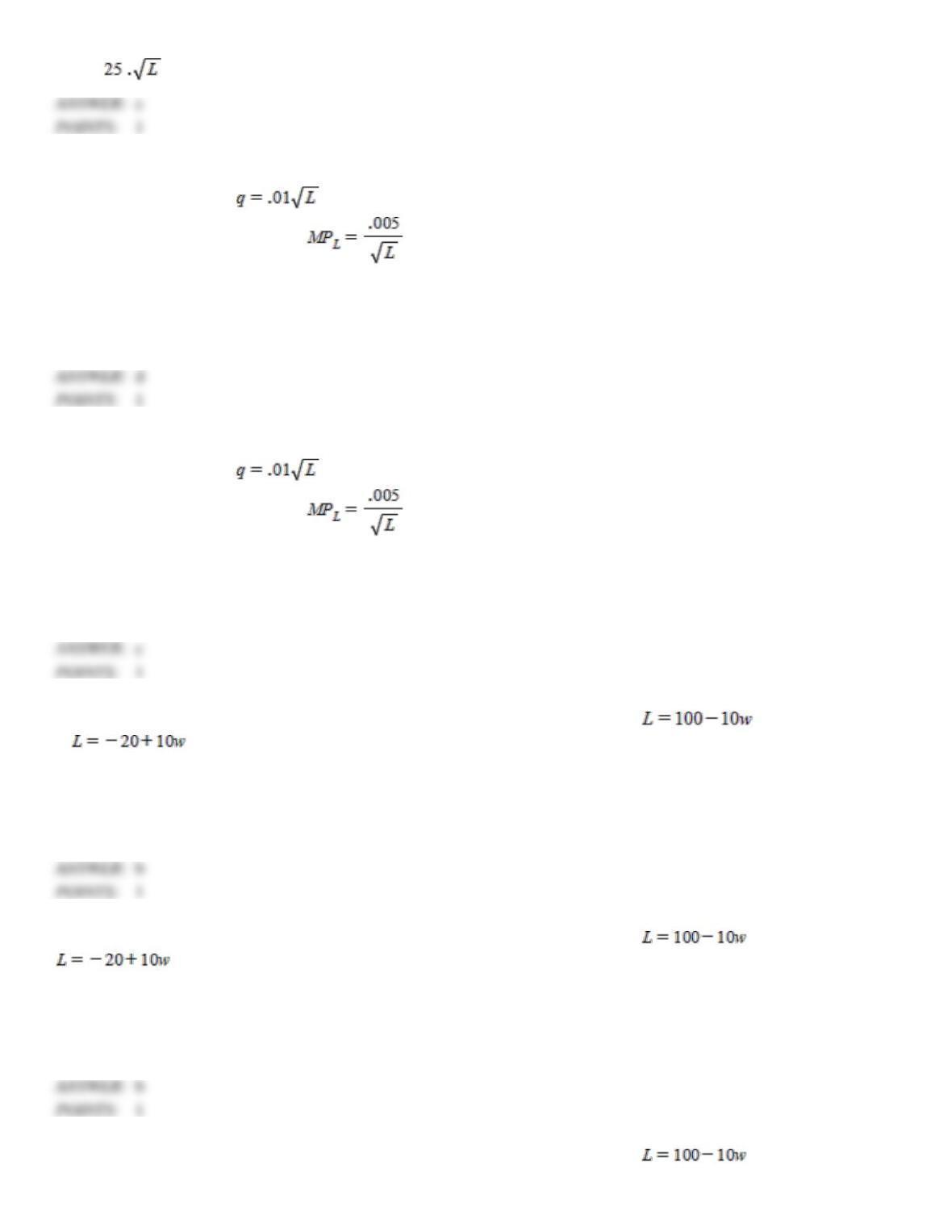
27. Suppose Woody Chuck’s business is to clear trees for housing developments. Given the constraints of fixed capital,
the production function is . Suppose Woody Chuck’s is one of many firms clearing land and that the market
price per cleared lot is $5000. (Note ) The marginal Revenue Product of labor is
a.
constant at $5000.
b.
constant at 25
c.
d
1
d.
28. Suppose Woody Chuck’s business is to clear trees for housing developments. Given the constraints of fixed capital,
the production function is . Suppose Woody Chuck’s is one of many firms clearing land and that the market
price per cleared lot is $5000. (Note ) How many workers will Woody Chuck hire at w = 5?
a.
1
b.
4
c.
16
d.
25
d
1
29. Suppose Woody Chuck’s business is to clear trees for housing developments. Given the constraints of fixed capital,
the production function is . Suppose Woody Chuck’s is one of many firms clearing land and that the market
price per cleared lot is $5000. (Note ) How many workers will Woody Chuck hire at w = 6.25?
a.
1
b.
4
c.
16
d.
25
1
30. Suppose the market for labor is perfectly competitive and the demand for labor is and market supply
is . The equilibrium wage will be
a.
5
b.
6
c.
7
d.
8
b
1
31. Suppose the market for labor is perfectly competitive and the demand for labor is and market supply is
. The equilibrium number of workers hired will be
a.
30
b.
40
c.
50
d.
60
b
1
32. Suppose the market for labor is perfectly competitive and the demand for labor is and market supply is
1

. If a minimum wage is imposed at w = 8, the number of workers hired will be
a.
20
b.
40
c.
60
d.
80
33. Suppose the market for labor is perfectly competitive and the demand for labor is and market supply
is . If a minimum wage is imposed at w = 8, the total unemployed ( ) will be
a.
20
b.
40
c.
60
d.
80
b
1
34. Suppose the market for labor is perfectly competitive and the demand for labor is and market supply
is . If a minimum wage is imposed at w = 8, the net gain to all workers, not just those who keep their jobs,
(in producer surplus terms) will be
a.
10
b.
20
c.
30
d.
40
b
1
35. Suppose the market for labor is perfectly competitive and the demand for labor is and market supply is
. If a minimum wage is imposed at w = 8, the gain to workers who keep their jobs, (in producer surplus
terms) will be
a.
10
b.
20
c.
30
d.
40
d
1
36. Suppose the market for labor is perfectly competitive and the demand for labor is and market supply
is . If a minimum wage is imposed at w = 8, the loss to firms will be
a.
20
b.
40
c.
60
d.
80
1
1
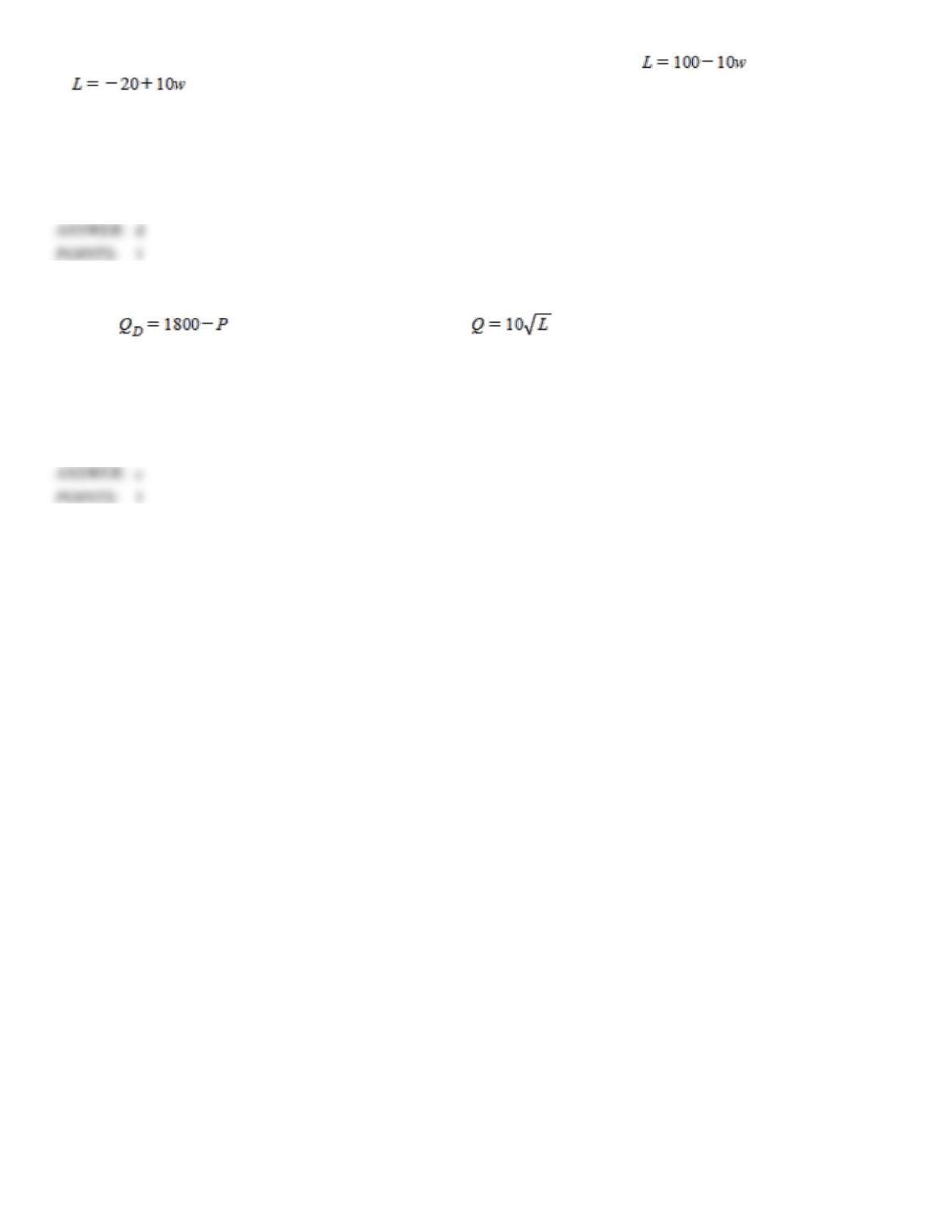
37. Suppose the market for labor is perfectly competitive and the demand for labor is and market supply
is . If a minimum wage is imposed at w = 8, the deadweight loss of the imposition of the minimum wage
is
a.
10
b.
20
c.
30
d.
40
38. Suppose a firm is a monopolist in its output market and a perfect competitor in its input market. The demand for its
output is . The firm’s production is given by and the market wage is $50. The profit-
maximizing level of labor input is
a.
100
b.
1,000
c.
3,600
d.
5,000
c
1
d
1