1.
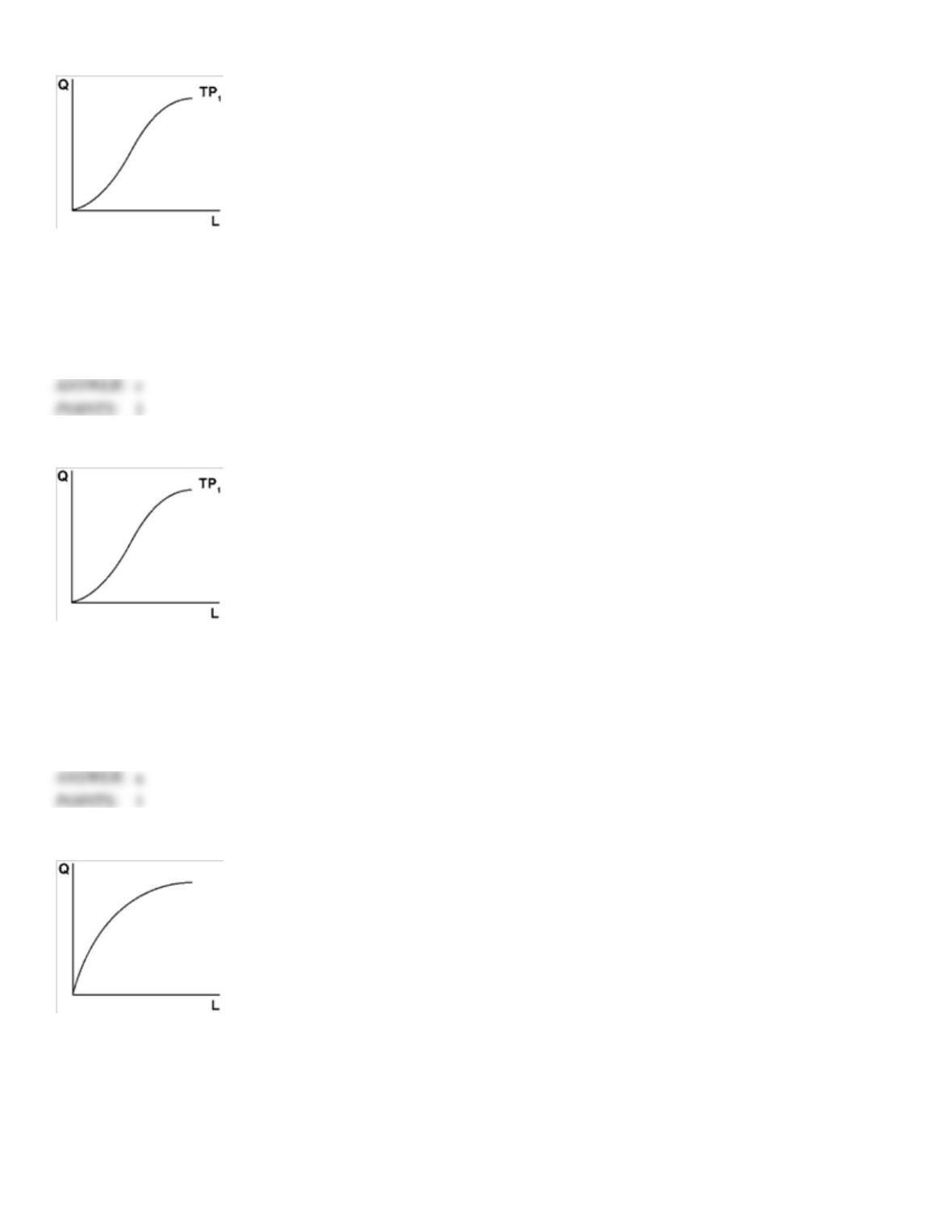
With a cubic production with fixed capital Q = A + BL + CL2 + DL3 and a shape shown above, A is
a.
positive and greater than B.
b.
positive and less than B.
c.
zero.
d.
negative.
2.
With a cubic production with fixed capital Q = A + BL + CL2 + DL3 and a shape shown above, C is
a.
positive.
b.
zero.
c.
negative and less than D.
d.
negative and greater than D.
a
1
3.
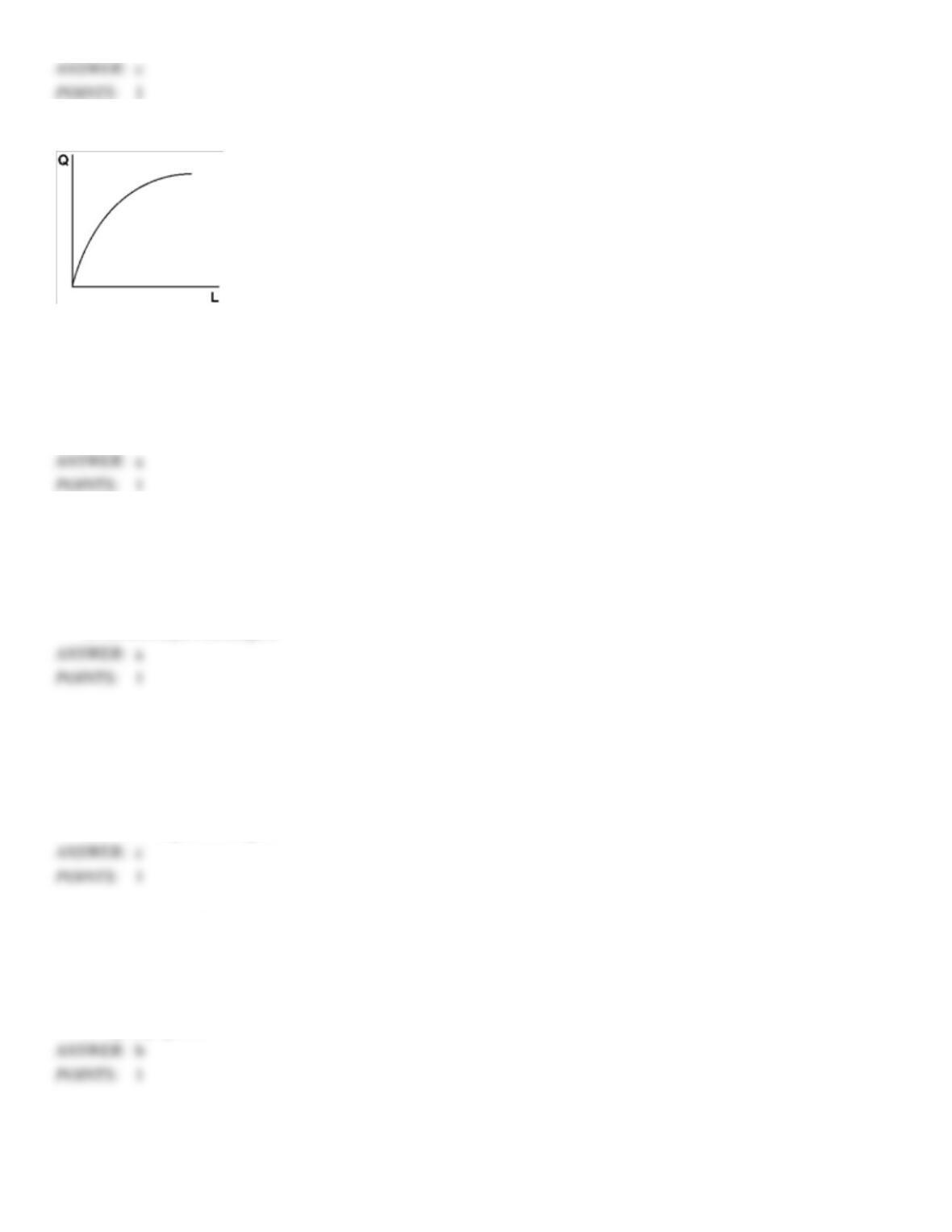
With a quadratic production with fixed capital Q = A + BL + CL2 and the shape shown above, A is
a.
positive and greater than B.
b.
positive and less than B.
c.
zero.
d.
negative.
c
1
4.
With a quadratic production with fixed capital Q = A + BL + CL2 and the shape shown above, B is
a.
positive.
b.
zero.
c.
negative and less than C.
d.
negative and greater than C.
a
1
5. If production is given by Q = KL, doubling both inputs
a.
more than doubles output.
b.
exactly doubles output.
c.
increases output but does not double it.
d.
leaves output unchanged.
a
1
6. If production is given by Q = KsLb, (a + b < 1) doubling both inputs
a.
more than doubles output.
b.
exactly doubles output.
c.
increases output but does not double it.
d.
leaves output unchanged.
c
1
7. Suppose Q = KaLb, if a + b > 1 the isoquants will be
a.
upward sloping.
b.
progressively closer together at higher quantities.
c.
progressively further apart at higher quantities.
d.
equally spaced.
b
8. Suppose Q = KaLb, if a + b < 1 the isoquants will be
a.
upward sloping.
c
1

b.
progressively closer together at higher quantities.
c.
progressively further apart at higher quantities.
d.
equally spaced.
9. If Q = K1/2L1/2 the MPL is
a.
constant
b.
increasing
c.
diminishing
c
1
10. If Q = K1/2L1/2 the MPK is
a.
constant
b.
diminishing
c.
increasing
b
1
11. If Q = K2L2 the MPL is
a.
constant
b.
diminishing
c.
increasing
c
1
12. If Q = K2L2 the MPK is
a.
constant
b.
diminishing
c.
increasing
c
1
13. If Q = K1/3L2 the MPL is
a.
constant
b.
diminishing
c.
increasing
c
1
14. If Q = K1/3L2 the MPK is
a.
constant
b.
diminishing
c.
increasing
c
1

15. Suppose electricity (E) can be produced with coal (C) or gas (G) to operate steam turbines (T). Suppose gas is more
efficiently burned than coal but that they are otherwise perfect substitutes. E = min((G + .5C), T). The isoquants between
gas and coal will be
a.
hyperbolas
b.
quarter circles
c.
straight lines
c
1
16. When isoquants get progressively further apart there is
a.
increasing returns to scale
b.
decreasing returns to scale
c.
constant returns to scale
b
1
17. When isoquants get progressively closer together there is
a.
increasing returns to scale
b.
decreasing returns to scale
c.
constant returns to scale
a
1
18. In a two-input model you can tell that a non-optimal short-run production decision is being made if
a.
all decisions in the short run are nonoptimal
b.
the rate of technical substitution is equal to the ratio of the input prices
c.
the rate of technical substitution is not equal to the ratio of the input prices
c
1
19. A firm is defined as
a.
a president, some vice presidents, and some employees.
b.
any organization that wants to make a profit.
c.
any accumulation of productive assets.
d.
any organization that turns inputs into outputs.
d
1
20. A production function measures how
an individual maximizes utility.
a.
a firm transforms output into input.
b.
a firm transforms inputs into output.
c.
b
1

d.
a firm minimizes cost.
21. The marginal physical product of labor is defined as
a.
a firm’s total output divided by total labor input.
b.
the extra output produced by employing one more unit of labor while allowing other inputs to vary.
c.
the extra output produced by employing one more unit of labor while holding other inputs constant.
d.
the extra output produced by employing one more unit of capital while holding labor input constant.
1
22. If more and more labor is employed while keeping all other inputs constant, the marginal physical productivity of
labor
a.
will eventually increase.
b.
will eventually decrease.
c.
will eventually remain constant.
d.
cannot tell from the information provided.
b
1
23. The marginal physical product of labor is
a.
the slope of the total output curve at the relevant point.
b.
the negative of the slope of the total output curve at the relevant point.
c.
the slope of the line connecting the origin with the relevant point on the total output curve.
d.
the negative of the slope of the line connecting the origin with the relevant point on the total output curve.
1
24. The average productivity of capital is defined as
the ratio of total capital employed to the total output produced.
a.
the extra output produced by employing one more unit of capital while holding other inputs constant.
b.
the extra output produced by employing one more unit of capital while allowing other inputs to vary.
c.
the ratio of total output produced to the quantity of capital employed.
d.
1
25. Graphically, the average productivity of labor would be illustrated by
the slope of the marginal productivity curve at the relevant point.
a.
the slope of the total product curve at the relevant point.
b.
c.
the negative of the slope of the marginal productivity curve at the relevant point.
d.
the slope of the chord connecting the origin with the relevant point on the total output curve.
d
1
b
1

26. A firm’s isoquant shows
a.
the amount of labor needed to produce a given level of output with capital held constant.
b.
the amount of capital needed to produce a given level of output with labor held constant.
c.
the various combinations of capital and labor that will produce a given amount of output.
d.
None of the above.
27. The marginal rate of technical substitution of labor for capital measures
a.
the amount by which capital input can be reduced while holding quantity produced constant when one more
unit of labor is used.
b.
the amount by which labor input can be reduced while holding quantity produced constant when one more unit
of capital is used.
c.
the ratio of total labor to total capital.
d.
the ratio of total capital to total labor.
1
28. A firm’s rate of technical substitution is represented graphically by
a.
the slope of the line connecting the origin with the relevant point on the isoquant.
b.
the negative of the slope of the line connecting the origin with the relevant point on the isoquant.
c.
the slope of the isoquant at the relevant point.
d.
the negative of the slope of the isoquant at the relevant point.
d
1
29. A production function may exhibit
a.
constant returns to scale and diminishing marginal productivities to all inputs.
b.
constant returns to scale and diminishing marginal productivities to all but one input, but at least one input
must have a constant marginal productivity.
c.
constant returns to scale and diminishing marginal productivity to at most one input.
d.
constant returns to scale and diminishing marginal productivities for no inputs.
1
30. Suppose the production function for good q is given by q = 3K + 2 L where K and L are capital and labor inputs.
Consider three statements about this function:
I.
The function exhibits constant returns to scale.
II.
The function exhibits diminishing marginal productivities to all inputs.
III.
The function has a constant rate of technical substitution.
Which of these statements is true?
a.
All of them.
b.
None of them.
c.
I and II but not III.
d.
I and III but not II.
e.
only I.
1

31. For a fixed proportion production function, at the vertex of any of the (L-shaped) isoquants the marginal productivity
of either input is
a.
constant
b.
zero.
c.
negative.
d.
a value that cannot be determined.
b
1
32. If, as a result of doubling all its inputs, a firm can more than double its output, the firm’s production function exhibits
a.
constant returns to scale.
b.
increasing returns to scale.
c.
decreasing returns to scale.
d.
increasing marginal productivity to at least one input.
b
1
33. The production function
a.
exhibits constant returns to scale and constant marginal productivities for K and L.
b.
exhibits diminishing returns to scale and diminishing marginal productivities for K and L.
c.
exhibits constant returns to scale and diminishing marginal productivities for K and L.
d.
exhibits diminishing returns to scale and constant marginal productivities for K and L..
c
1
34. A fixed-proportion production function has isoquants that are
a.
almost flat (i.e., the isoquants are almost straight lines).
b.
L-shaped.
c.
normally shaped (rectangular hyperbolas).
d.
None of the above.
b
1
35. A technical innovation in the production of automobiles by Ford Motor Company’s for 1 million cars per year would
necessarily
a.
shift the “1 million car” isoquant away from the origin.
b.
shift the “1 million car” isoquant toward the origin.
c.
cause 1 million cars to be produced with more capital and less labor.
d.
cause 1 million cars to be produced with more labor and less capital.
b
1
36. A rise in the average productivity of labor
d
1

a.
always reflects technical progress.
b.
reflects technical progress if other input usage hasn’t changed.
c.
reflects technical progress only if labor input hasn’t changed.
d.
reflects technical progress only if the quantity of output is increased.
b
1