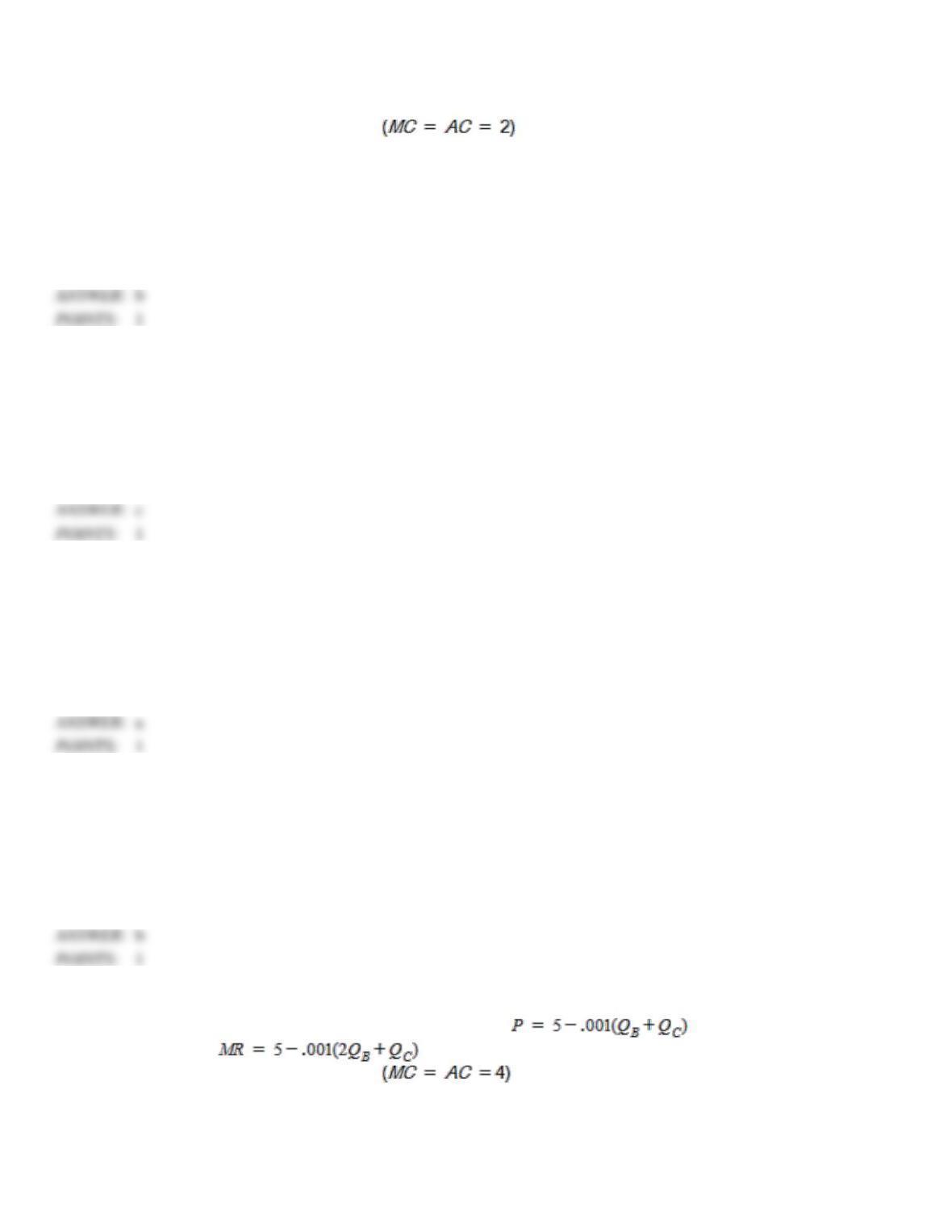
1. Suppose there are two firms, Boors and Cudweiser, each selling identical-tasting nonalcoholic beer. Consumers of this
beer have no brand loyalty so market demand can be expressed as P = 5 − .001(QB + QC). Boors’ marginal revenue
function can be written MR = 5 − .001(2QB + QC) and symmetrically for Cudweiser. Boors operates with out–of-date
technology and has constant cost of $2 per unit , whereas Cudweiser has constant cost of $1 per unit.
Assuming the firms behave as Cournot competitors, Boor’s best-response function is
a.
QB = 2,000 − .5QC
b.
QB = 1,500 − .5QC
c.
QC = 2,000 − .5QB
d.
QC = 1,500 − .5QB
2. Consider the same market for nonalcoholic beer as in the previous question. Cudweiser’s response function is
a.
QB = 2,000 − .5QC
b.
QB = 1,500 − .5QC
c.
QC = 2,000 − .5QB
d.
QC = 1,500 − .5QB
c
1
3. Consider the same market for nonalcoholic beer as in the previous question. How many “units” of beer will Boors
produce in the Nash equilibrium?
a.
667
b.
1,667
c.
2,333
d.
3,000
a
1
4. Consider the same market for nonalcoholic beer as in the previous question. How many “units” of beer will Cudweiser
produce?
a.
667
b.
1,667
c.
2,333
d.
3,000
b
1
5. Suppose there are two firms, Boors and Cudweiser, each selling identical-tasting nonalcoholic beer. Consumers of this
beer have no brand loyalty so market demand can be expressed as . Boors’ marginal revenue
function can be written and symmetrically for Cudweiser. Boors operates with out–of-date
technology and has constant cost of $4 per unit , whereas Cudweiser has constant cost of $2 per unit.
Assuming the firms behave as Cournot competitors, in the Nash equilibrium, Cudweiser will produce
a.
1,333
b.
2,333
b
1

c.
3,333
d.
4,333
6. Consider the same market for nonalcoholic beer as in the previous question. How many units will Boors produce in the
Nash equilibrium?
a.
1,333
b.
2,333
c.
3,333
d.
4,333
a
1
7. Suppose there are two firms, Boors and Cudweiser, each selling nonalcoholic beer. Suppose Boors and Cudweiser are
not viewed as perfect substitutes but rather demand for Boors is QB = 5000 − 1000PB + 100PC and demand for Cudweiser is
QC = 3000 − 1500PC + 100PB. For simplicity, assume zero marginal costs. Which is the more preferred beer?
a.
Boor’s
b.
Cudweiser
c.
they are equally preferred
d.
neither are preferred
a
1
8. Consider the market for nonalcoholic beers from the previous question. Which of the following is the best-response
function for Boors from the Bertrand game?
a.
PB = -2.5 + .05PC
b.
PB = 2.5 + .05PC
c.
PC = 2.5 – .05PB
d.
PB = 2.5 – .15PC
b
1
9. Consider the market for nonalcoholic beers from the previous question. Which of the following is the Bertrand reaction
function for Cudweiser?
a.
PC = 1 + .033PB
b.
PC = 1 – .033PB
c.
PC = 1.5 + .075PB
d.
PB = 1.5 + .075PC
a
1
10. Consider the market for nonalcoholic beers from the previous question. Boors’ price in a Nash equilibrium (assuming
Bertrand competition in these differentiated beers) is about
a.
1.71
c
1

b.
2.55
c.
3.55
d.
4.29
11. Consider the market for nonalcoholic beers from the previous question. Cudweisers’ price in a Nash equilibrium
(assuming Bertrand competition in these differentiated beers) is about
a.
0.99
b.
1.09
c.
1.71
d.
2.55
b
1
12. Two firms engage in Bertrand competition in differentiated products. After doing all the appropriate calculations, you
find the best-response functions are PB = 2.5 + .15PC and PC = 1.5 + .075PB. Without doing any further calculations, can
you determine the relationship between their Nash equilibrium prices?
a.
Yes, PB > PC
b.
Yes, PC > PB
c.
Yes, PB = PC
d.
No; it cannot be determined.
a
1
13. Which game does the Cournot model most resemble and why?
a.
the Battle of the Sexes because firms need to coordinate their outputs.
b.
the Battle of the Sexes because firms disagree on which outcome is best.
c.
the Prisoners Dilemma because firms don’t maximize joint payoffs in equilibrium.
d.
the Prisoners Dilemma because firms play dominant strategies.
c
1
14. Which alteration of the assumptions behind the Bertrand model can help avoid the Bertrand Paradox (that an outcome
resembling perfect competition may arise with even as few as two firms)?
a.
assume firms have limited capacities.
b.
assume firms produce differentiated rather than homogeneous products.
c.
assume firms play repeatedly and thus may collude.
d.
all of the above.
d
1
15. Which factor would facilitate tacit collusion among firms in a market?
a.
an increase in the number of firms.
b.
a decrease in the probability the market will continue into future periods.
c.
a decrease in the interest rate.
b
1

d.
none of these.
16. Relative to the case in which two identical firms choose quantities simultaneously in a Cournot model, if one of the
two moves first and is observed by the other, how would this affect its output?
a.
it would increase its output, more so if it could deter the other from entering the market at all.
b.
it would increase its output, but would moderate this increase if it were concerned about entry deterrence.
c.
it would decrease its output if it couldn’t deter entry and increase it otherwise.
d.
it would decrease its output whether or not it wanted to deter entry.
1
17. In the monopolistic competition model
a.
firms are price takers
b.
barriers to entry maintain some monopoly “rents” in the long run.
c.
one dominant firm acts as the monopolist that is followed by the fringe of competitors.
d.
none of these.
d
1
18. In the long run, in the model of monopolistic competition, for a typical firm, price is
a.
above average cost but equal to marginal cost.
b.
above marginal cost but equal to average cost.
c.
above marginal cost.
d.
equal to marginal cost and equal to or greater than average cost.
b
1
19. In the cartel model
a.
firms believe that price increases result in a very elastic demand, while price decreases result in an inelastic
demand for their products.
b.
each firm acts as a price taker.
c.
one dominant firm takes the reactions of all other firms into account in its output and pricing decisions.
d.
firms coordinate their decisions to act as a multiplant monopoly.
d
1
20. Under the cartel model, each firm produces where
a.
marginal cost equals marginal revenue.
b.
price equals marginal cost.
c.
the average cost curve is at a minimum.
d.
price exceeds marginal cost by the greatest amount.
1
1

21. All of the following are problems associated with maintaining a cartel except
a.
cartels are illegal.
b.
a large amount of information is needed to coordinate a cartel.
c.
profits are not maximized by a cartel so it will evolve into a monopoly.
d.
each member of the cartel has an incentive to “chisel” by expanding output.
22. Each firm in a cartel has an incentive to chisel because market price exceeds
a.
marginal cost.
b.
average cost.
c.
average variable cost.
d.
average fixed cost.
a
1
23. In the price-leadership model,
a.
firms believe that price increases result in a very elastic demand, while price decreases result in an inelastic
demand for their product.
b.
each firm acts as a price taker.
c.
one dominant firm takes the reactions of all other firms into account in its output and pricing decisions.
d.
firms coordinate their decisions to act as multiplant monopolies.
c
1
24. In the Cournot model, each firm assumes that its rival will ____ its output when the firm adjusts its own output. Which
word best completes the sentence?
a.
increase
b.
not change
c.
decrease
d.
adjust
b
1
25. In a Cournot equilibrium, each firm chooses an output level that
a.
maximizes joint profits.
b.
maximizes the price received.
c.
maximizes profits given what the other firm produces.
d.
maximizes revenue given what the other firm produces.
c
1
26. Product differentiation complicates the study of oligopolies because such markets may not
a.
be efficient.
b.
have prices equal to marginal cost.
c.
have free entry and exit.
c

d.
obey the law of one price.
27. A profit-maximizing firm should spend an additional dollar on advertising so long as this expenditure results in more
than one dollar of
a.
additional sales.
b.
reduced costs.
c.
increased profits.
d.
demand.
c
1
d
1