Archives
978-0134319056 Chapter 1 Part 1
1 Excellence in Business Communication, 12e (Thill/Bovee) Chapter 1 Professional Communication in a Digital, Social, Mobile World 1) Which of the following best describes the communication process? A) transferring information and meaning B) listening actively C) writing messages D) speaking […]
978-0134319056 Chapter 1 Part 2
11 22) An audience-centered approach to communication involves A) saying whatever it takes to win over the members of your audience. B) embedding a layer of technology between you and the members of your audience. C) respecting, understanding and meeting […]
978-0134319056 Chapter 1 Part 3
21 45) ________ is the process of transferring information and meaning between senders and receivers. A) Reflection B) Projection C) Communication D) Illumination E) Conjecture Answer: C Explanation: C) Communication is the process of transferring information and meaning between senders […]
978-0134319056 Chapter 1 Part 4
31 67) Companies are wrestling with the ________, in which employees want to use their personal tablets and smartphones to access company networks and files. A) BAPD phenomenon B) BMSP phenomenon C) BYOD phenomenon D) BCNU phenomenon E) BMPD phenomenon […]
978-0134319056 Chapter 1 Part 5
39 85) Explain the concept of gamification and how companies are using this tool to reach a larger audience. Answer: Gamification is the addition of game-playing aspects to an activity or a process with the goal of increasing user engagement, […]
978-0134319056 Chapter 10 Part 1
1 Excellence in Business Communication, 12e (Thill/Bovee) Chapter 10 Writing Persuasive Messages 1) In general, the best persuasive messages ________ the audience’s motivations. A) avoid mentioning B) downplay C) openly address D) dismiss E) eliminate Answer: C Explanation: C) The […]
978-0134319056 Chapter 10 Part 2
11 24) Most persuasive business messages involve requests for action. Answer: TRUE Explanation: The majority of your persuasive business messages will involve requests for action. LO: 10.1: Apply the three-step writing process to persuasive messages. AACSB: Written and oral communication […]
978-0134319056 Chapter 10 Part 3
21 45) One way to overcome audience resistance to your message is to A) use the hard-sell approach. B) address possible concerns that your audience has. C) emphasize the positive. D) indicate the competition is not worth addressing. E) speak […]
978-0134319056 Chapter 10 Part 4
31 68) Whereas ________ focus on what the product does, ________ focus on what the user experiences or gains. A) wants; needs B) selling points; benefits C) benefits; selling points D) actionable features; desirable benefits E) benefits; objections Answer: B […]
978-0134319056 Chapter 10 Part 5
38 82) Unlike more traditional promotional messages, those written for social media A) are less interactive. B) enable companies to engage in conversations about their products and services. C) allow for less transparency and openness with customers. D) save money […]
978-0134319056 Chapter 11 Part 1
1 Excellence in Business Communication, 12e (Thill/Bovee) Chapter 11 Planning Reports and Proposals 1) The ________ for a report describes what you plan to accomplish and outlines the boundaries of your work. A) mission brief B) statement of purpose C) […]
978-0134319056 Chapter 11 Part 2
11 26) When evaluating material you’ve gathered for a report, you should A) assume that any information taken from a webpage will be credible and reliable. B) throw out any information published by an organization that might be biased. C) […]
978-0134319056 Chapter 11 Part 3
21 47) When you’re selecting people to participate in a survey, it is critical to get a ________ of the population you want to survey. A) stratified sample B) crossover sample C) sizeable sample D) transparent sample E) representative sample […]
978-0134319056 Chapter 11 Part 4
31 69) Many businesses optimize their website to incorporate a A) single-dimensional medium. B) mobile-first strategy. C) supply and demand strategy. D) more linear medium. E) one-page website. Answer: B Explanation: B) Many businesses now optimize their websites to be […]
978-0134319056 Chapter 11 Part 5
38 85) Unlike reports focused on conclusions or recommendations, reports focusing on logical arguments A) use an indirect approach. B) are not very convincing. C) emphasize the positive. D) do not include outside evidence. E) use a direct approach. Answer: […]
978-0134319056 Chapter 12 Part 1
1 Excellence in Business Communication, 12e (Thill/Bovee) Chapter 12 Writing Reports and Proposals 1) To gain credibility with your audience in business reports, verifying facts and references will help to ensure A) completeness. B) accuracy. C) the report is well […]
978-0134319056 Chapter 12 Part 2
11 21) The closing section of a proposal should A) ask for a decision from the reader. B) review costs. C) identify when each step of the proposal will be completed. D) describe the proposed solution in detail. E) include […]
978-0134319056 Chapter 12 Part 3
21 46) When drafting content for online reports, it is helpful to use the inverted pyramid style of organization in which you A) cover the most important information first and then gradually reveal more detail. B) cover the least important […]
978-0134319056 Chapter 12 Part 4
31 67) Flowcharts are used to A) summarize large amounts of statistical data. B) show the relative sizes of the parts of a whole. C) show how something looks or operates. D) illustrate processes and procedures. E) indicate trends over […]
978-0134319056 Chapter 12 Part 5
39 84) Tables presented in printed documents must contain fewer columns and rows than tables presented online. Answer: FALSE Explanation: For printed documents, you can adjust font size and column/row spacing to fit a considerable amount of information on the […]
978-0134319056 Chapter 13 Part 1
1 Excellence in Business Communication, 12e (Thill/Bovee) Chapter 13 Completing Reports and Proposals 1) The four tasks involved in completing business reports and proposals include all of the following except A) distributing. B) revising. C) producing. D) illustrating. E) proofreading. […]
978-0134319056 Chapter 13 Part 2
11 25) An executive summary A) is shorter than a synopsis. B) gives a fully developed “mini” version of the report. C) provides additional information (not covered in the report) that executives will need. D) is a “prose table of […]
978-0134319056 Chapter 13 Part 3
21 51) Because they fall at the beginning of a report, write the prefatory parts first. Answer: FALSE Explanation: Many prefatory parts—such as the table of contents, the list of illustrations, and the executive summary—are easier to prepare after the […]
978-0134319056 Chapter 13 Part 4
30 79) A synopsis or executive summary is usually less useful in a formal proposal than in other types of formal reports. Answer: TRUE Explanation: You may include a synopsis or an executive summary for your reader’s convenience when your […]
978-0134319056 Chapter 14 Part 1
1 Excellence in Business Communication, 12e (Thill/Bovee) Chapter 14 Developing and Delivering Business Presentations 1) Speeches and oral presentations are much like any other messages in that A) they all require similar planning. B) they are delivered to groups that […]
978-0134319056 Chapter 14 Part 2
11 24) When planning a presentation, what does it mean to “analyze the situation”? Briefly explain each of the tasks involved. Answer: Analyzing the situation involves defining your purpose, developing an audience profile, and assessing the circumstances in which you […]
978-0134319056 Chapter 14 Part 3
21 49) For most business presentations, ________ are the medium of choice. A) flip charts B) whiteboards C) electronic slides D) overhead transparencies E) chalkboards Answer: C Explanation: C) Most speakers support their presentations with slides created in Microsoft PowerPoint, […]
978-0134319056 Chapter 14 Part 4
31 69) The most effective and easiest mode of delivering presentations in nearly all situations is A) memorization. B) reading from a prepared script. C) speaking from an outline or notes. D) impromptu speaking. E) from a seated position. Answer: […]
978-0134319056 Chapter 14 Part 5
38 86) Sending preview materials to the audience prior to an online presentation A) will discourage participants from attending your presentation. B) can suggest that you are not confident in your abilities as a presenter. C) can help audience members […]
978-0134319056 Chapter 15 Part 1
1 Excellence in Business Communication, 12e (Thill/Bovee) Chapter 15 Building Careers and Writing Résumés 1) The best time for college students to begin developing a job-search strategy is A) about six months prior to graduation. B) now—even if they are […]
978-0134319056 Chapter 15 Part 2
11 26) For someone who’s involved in the job search process, volunteer work A) has little to no value, since it does not involve working for pay. B) is helpful only for those seeking employment in the nonprofit sector. C) […]
978-0134319056 Chapter 15 Part 3
21 47) Using your résumé to tell employers you are detail oriented, a team player, and a hard worker A) is an effective strategy, since all employers appreciate these characteristics. B) is generally not helpful unless you also include concrete […]
978-0134319056 Chapter 15 Part 4
31 67) When preparing your list of references, A) leave enough space on the résumé to include them. B) have the data on your cell phone so you can write the information down, if asked. C) prepare a reference sheet […]
978-0134319056 Chapter 15 Part 5
39 86) An online résumé A) consists of a PDF version of a traditional chronological résumé and a cover letter. B) lets jobseekers use multimedia to expand on the information in a basic résumé. C) requires a paid subscription to […]
978-0134319056 Chapter 16 Part 1
1 Excellence in Business Communication, 12e (Thill/Bovee) Chapter 16 Applying and Interviewing for Employment 1) The best approach for an application letter depends on A) how much you need to stand out from other applicants. B) whether or not your […]
978-0134319056 Chapter 16 Part 2
11 22) Most employers interview an applicant ________ before deciding to make a job offer. A) once B) multiple times C) via email D) at job fairs E) via Skype or other online method. Answer: B Explanation: B) The interview […]
978-0134319056 Chapter 16 Part 3
21 42) An employment interview is A) an unstructured dialogue with a representative from a potential employer. B) an easy way for you to learn about the company’s operations and markets. C) a formal meeting during which you and the […]
978-0134319056 Chapter 16 Part 4
31 66) One way to increase your confidence before the start of the interview is A) to understand that everyone has some negative aspects in their background and you are no different. B) practice public speaking. C) think about irrelevant […]
978-0134319056 Chapter 16 Part 5
39 84) During the close of the interview, be sure to A) ask the interviewer if they have any other questions for you. B) try to identify why you were asked illegal questions. C) check your watch and see if […]
978-0134319056 Chapter 2 Part 1
1 Excellence in Business Communication, 12e (Thill/Bovee) Chapter 2 Collaboration, Interpersonal Communication, and Business Etiquette 1) As an approach to resolving conflict during team activities, a ________ proposes that both sides can satisfy their goals (at least to some extent) […]
978-0134319056 Chapter 2 Part 2
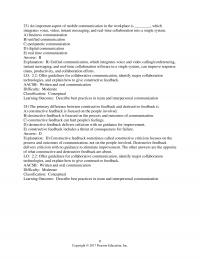
11 23) An important aspect of mobile communication in the workplace is ________, which integrates voice, video, instant messaging, and real-time collaboration into a single system. A) business communication B) unified communication C) peripatetic communication D) digital communication E) real […]
978-0134319056 Chapter 2 Part 3
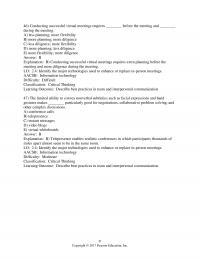
21 46) Conducting successful virtual meetings requires ________ before the meeting and ________ during the meeting. A) less planning; more flexibility B) more planning; more diligence C) less diligence; more flexibility D) more planning; less diligence E) more flexibility; more […]
978-0134319056 Chapter 2 Part 4
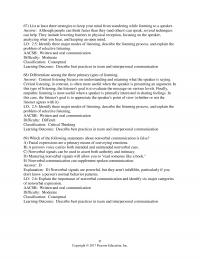
31 67) List at least three strategies to keep your mind from wandering while listening to a speaker. Answer: Although people can think faster than they (and others) can speak, several techniques can help. They include lowering barriers to physical […]
978-0134319056 Chapter 2 Part 5
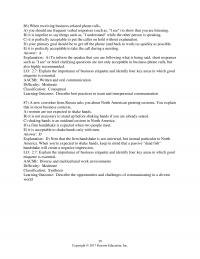
39 86) When receiving business-related phone calls, A) you should use frequent verbal responses (such as, “I see”) to show that you are listening. B) it is impolite to say things such as, “I understand” while the other person is […]
978-0134319056 Chapter 3 Part 1
1 Excellence in Business Communication, 12e (Thill/Bovee) Chapter 3 Communication Challenges in a Diverse, Global Marketplace 1) “All the characteristics and experiences that define each of us as individuals” is the definition of A) ethnicity. B) diversity. C) culture. D) […]
978-0134319056 Chapter 3 Part 2
11 22) The practice of accepting multiple cultures on their own terms is known as A) ethnocentrism. B) cultural pluralism. C) ethnography. D) stereotyping. E) cultural coherency. Answer: B Explanation: B) Cultural pluralism tries to avoid making judgments about other […]
978-0134319056 Chapter 3 Part 3
21 43) The social media and technological skills of ________ are helping to change business communication practices. A) Generation X B) Generation Q C) Generation Y D) Generation Z E) Baby Boomers Answer: C Explanation: C) Generation Y’s comfort level […]
978-0134319056 Chapter 3 Part 4
31 63) List at least three types of nonverbal differences might you encounter when working with businesspeople from other cultures. Provide at least one example of how these differences might cause misunderstandings in communication. Answer: Nonverbal differences among cultures are […]
978-0134319056 Chapter 3 Part 5
40 83) Which of the following sentences contains an idiomatic expression? A) Our monthly sales quota is unrealistic. B) We don’t expect to meet our monthly sales quota. C) Making our monthly sales quota will be a piece of cake. […]
978-0134319056 Chapter 4 Part 1
1 Excellence in Business Communication, 12e (Thill/Bovee) Chapter 4 Planning Business Messages 1) The three primary steps involved in preparing a business message are A) planning, writing, and completing. B) informing, persuading, and collaborating. C) defining the purpose, the main […]
978-0134319056 Chapter 4 Part 2
11 25) By forecasting the audience’s probably reaction, a writer can better determine A) who key decision makers are. B) when to state conclusions and recommendations. C) level of understanding. D) attitudes and experiences. E) best medium for delivery. Answer: […]
978-0134319056 Chapter 4 Part 3
21 50) Phone calls are A) incapable of conveying nonverbal signals. B) only acceptable for external communication. C) capable of offering the give-and-take of in-person conversations. D) no longer practical due to IM and texting. E) preferable to electronic media […]
978-0134319056 Chapter 4 Part 4
31 70) One of the disadvantages of using an oral medium with an in-person channel is A) limited opportunity for immediate feedback. B) reliance on nonverbal cues and voice inflections. C) the ability to express emotion in the message. D) […]
978-0134319056 Chapter 4 Part 5
38 85) Whatever the length of your message, you should limit the number of major support points to roughly A) two. B) three. C) six. D) ten. E) fifteen. Answer: C Explanation: C) Most arguments can be supported by six […]
978-0134319056 Chapter 5 Part 1
1 Excellence in Business Communication, 12e (Thill/Bovee) Chapter 5 Writing Business Messages 1) Which of the following statements that would appear in a business message best reflects the “you” attitude? A) You failed to enclose a check for $25. B) […]
978-0134319056 Chapter 5 Part 2
11 23) In business messages, using terms such as “if,” “hope,” and “trust” is A) usually a bad idea since it takes away from the writer’s credibility. B) a good way to show your modesty. C) common courtesy. D) acceptable […]
978-0134319056 Chapter 5 Part 3
21 47) When choosing words to convey a message, successful writers pay attention to A) convenience and mannerisms. B) correctness and effectiveness. C) metaphors and euphemisms. D) connotation and vocalization. E) using words that don’t convey too much power. Answer: […]
978-0134319056 Chapter 5 Part 4
31 Copyright © 2017 Pearson Education, Inc. 71) Identify and define the four basic varieties of sentences. within a message. AACSB: Written and oral communication Difficulty: Difficult Classification: Conceptual Learning Outcome: Compose and shape business messages 72) A typical paragraph […]
978-0134319056 Chapter 5 Part 5
38 88) As a rule, keep subject lines and headlines to around ________ when writing messages for smartphone users. A) 5 characters B) 10 characters C) 15 characters D) 20 characters E) 25 characters Answer: E Explanation: E) When you’re […]
978-0134319056 Chapter 6 Part 1
1 Excellence in Business Communication, 12e (Thill/Bovee) Chapter 6 Completing Business Messages 1) Regarding the three-step writing process, all of the following except ________ are important elements of the completing step. A) proofreading the message B) revising the message C) […]
978-0134319056 Chapter 6 Part 2
11 26) When incorporating lists into a document, they should all use the same grammatical pattern, referred to as A) repetitiveness. B) bulleting. C) clauses. D) mix. E) parallelism. Answer: E Explanation: E) Regardless of the format you choose, the […]
978-0134319056 Chapter 6 Part 3
21 49) Word combinations such as basic fundamentals, anonymous stranger, and future plans are examples of A) predicates. B) redundancies. C) split modifiers. D) camouflaged verbs. E) parallel terms. Answer: B Explanation: B) In some word combinations, the words say […]
978-0134319056 Chapter 6 Part 4
31 75) The term ________ refers to the physical design of letters, numbers, and other text characters. A) type style B) typography C) typeface D) serigraphy E) white space Answer: C Explanation: C) Typeface refers to the physical design of […]
978-0134319056 Chapter 6 Part 5
37 91) In order to do an effective job at proofreading a document, A) scan each page as quickly as you can. B) go through the document several times. C) avoid using a systematic approach. D) stop the process after […]
978-0134319056 Chapter 7 Part 1
1 Excellence in Business Communication, 12e (Thill/Bovee) Chapter 7 Crafting Messages for Digital Channels 1) Marketers can use ________ to link the virtual world of online social networking with the physical world of retail stores. A) near-field collaboration B) location-based […]
978-0134319056 Chapter 7 Part 2
11 24) Networks that focus on a particular function or audience are known as A) public, general-purpose networks. B) public, specialized networks. C) private networks. D) private, general-purpose networks. E) augmented networks. Answer: B Explanation: B) Whereas Facebook and Google+ […]
978-0134319056 Chapter 7 Part 3
21 45) YouTube, Wikipedia, and Twitter are popular examples of A) general-purpose social networks. B) user-generated content sites. C) community macromedia outlets. D) private-label social networks. E) personalized synchronous networks. Answer: B Explanation: B) Users rather than website owners contribute […]
978-0134319056 Chapter 7 Part 4
31 69) You can plan for important business exchanges via IM by viewing them as A) invitations to discuss personal matters. B) conversations with specific goals in mind. C) opportunities to save time by multitasking. D) routine events that don’t […]
978-0134319056 Chapter 7 Part 5
38 84) When you’re creating a blog, include one or more ________ so that your audience can receive headlines and blog-post summaries automatically. A) information portals B) newsfeed options C) data-retrieval links D) email addresses E) uniform resource locators Answer: […]
978-0134319056 Chapter 8 Part 1
1 Excellence in Business Communication, 12e (Thill/Bovee) Chapter 8 Writing Routine and Positive Messages 1) When making a routine request, you should begin with A) an indication of the importance of your request. B) a statement of who you are. […]
978-0134319056 Chapter 8 Part 2
11 28) When writing for a claim or adjustment, the opening should state the problem as well as A) who is at fault. B) competitive options. C) how the issue has affected the business relationship. D) model and serial number. […]
978-0134319056 Chapter 8 Part 3
21 52) If you have strongly negative information to deliver as part of a positive message, you should A) open with the negative information. B) use the indirect approach. C) put the negative information in a separate message. D) apologize […]
978-0134319056 Chapter 8 Part 4
31 78) If you decide to write a letter of recommendation about a job candidate, your goal should be to A) remain neutral about the candidate’s suitability for the job. B) boost the job candidate’s sense of self-worth and well-being. […]
978-0134319056 Chapter 9 Part 1
1 Excellence in Business Communication, 12e (Thill/Bovee) Chapter 9 Writing Negative Messages 1) During the process of composing a negative message, you should try to A) choose a buffer that will distract your reader. B) gain the reader’s acceptance of […]
978-0134319056 Chapter 9 Part 2
11 32) One important goal of a buffer is to A) delay stating the bad news. B) establish common ground with your reader. C) make your reader wonder what the message is about. D) divert the reader’s attention to a […]
978-0134319056 Chapter 9 Part 3
21 59) When you are refusing a routine request from someone in an established relationship, you A) should use the indirect approach. B) should invoke company policy if that is a possible out. C) don’t need to invest as much […]
978-0134319056 Chapter 9 Part 4
30 80) When preparing to respond to negative messages, it is important to consider A) how to combat the negative information. B) the source, tone and content. C) who the audience is. D) why the comment was made. E) legal […]
978-0134319056 Thill_ebc12_handbook
1 Excellence in Business Communication, 12e (Thill/Bovee) Chapter 17 Handbook of Grammar, Mechanics, and Usage 1) Which of the following is a demonstrative pronoun? A) he B) this C) who D) anyone E) either Answer: B Explanation: B) Demonstrative pronouns […]