Archives: Quiz
Economics Chapter 1 1 In the Keynesian model, if households and businesses attempt to purchase more output than the economy is capable of producing
Introduction to Economic Reasoning, 8e (Rohlf) Web Chapter: The Keynesian Total Expenditures Model 1) According to the Keynesian model, the primary determinant of the level of equilibrium output is A) the level of total income. B) the level of total […]
Chapter 9 1 Superposition can be used to determine voltages and currents in the circuit even if the frequency of the sources is different
Exam Name___________________________________ MULTIPLE CHOICE. Choose the one alternative that best completes the statement or answers the question. 1) When performing superposition to analyze acircuit, series–parallel circuit analysis 1) A) cannot be used to analyze the circuit for each source. B) […]
Economics Chapter 1 1 According to the classical economists, the amount that businesses plan to invest will always be equal to the amount that households desire to save because
Introduction to Economic Reasoning, 8e (Rohlf) Web Chapter: Keynes and the Classical Economists: The Early Debate on Policy Activism 1) The aggregate supply curve implied by the classical model of the economy is A) upward sloping. B) downward sloping. C) […]
Chapter 8 1 The conversion from the polar form of a complex number to the rectangular form, or vice-versa, is based on trigonometry
Exam Name___________________________________ MULTIPLE CHOICE. Choose the one alternative that best completes the statement or answers the question. 1) The conversion from the polar form of acomplex number to the rectangular form, or vice–versa, 1) A) requires calculus. B) is based […]
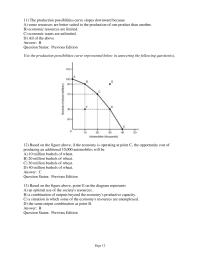
Economics Chapter 1 2 Based on the figure above, if the economy is operating at point B, the opportunity cost of producing another one million bushels of wheat is
11) The production possibilities curve slopes downward because A) some resources are better suited to the production of one product than another. B) economic resources are limited. C) economic wants are unlimited. D) All of the above Answer: B Question […]
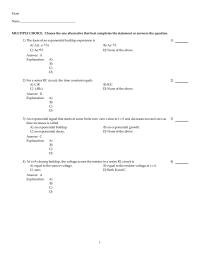
Chapter 7 1 All voltage and current values in an RL circuit at the moment when a DC source is switched on are equal to the DC steady-state values
Exam Name___________________________________ MULTIPLE CHOICE. Choose the one alternative that best completes the statement or answers the question. 1) The form of an exponential buildup expression is 1) A) A(1–e–t/) B) Ae–t/ C) Ae+t/ D) None of the above 2) For […]
Economics Chapter 1 1 Suppose an economy is operating at a point on its production possibilities curve showing clothing and food. If the economy desires to produce additional clothing
Introduction to Economic Reasoning, 8e (Rohlf) Chapter 1: The Study of Economics 1) Economics is the study of how to use A) limited resources to fully satisfy unlimited wants. B) unlimited resources to satisfy unlimited wants as fully as possible. […]
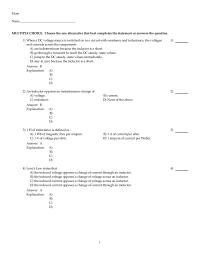
Chapter 6 1 When a DC voltage source is switched on in a circuit with resistance and inductance, the voltages and currents across the components
Exam Name___________________________________ MULTIPLE CHOICE. Choose the one alternative that best completes the statement or answers the question. 1) When aDC voltage source is switched on in acircuit with resistance and inductance, the voltages and currents across the components 1) A) […]
Chapter 5 1 For two capacitors in series, if one capacitance is much larger than the other, the total capacitance is. A capacitor opposes an instantaneous change of
Exam Name___________________________________ MULTIPLE CHOICE. Choose the one alternative that best completes the statement or answers the question. 1) For two capacitors in series, if one capacitance is much larger than the other, the total capacitance is 1) A) approximately equal […]
Chapter 4 1 A negative phase shift advances the signal in time. The waveform is shifted to the left. The average power is the RMS voltage times the RMS current
Exam Name___________________________________ MULTIPLE CHOICE. Choose the one alternative that best completes the statement or answers the question. 1) Asinusoidal wave form hasthe expression v(t) = 20sin(1000t). The cyclic frequency is 1) A) 500Hz B) 20 Hz C) 159Hz D) 1000 […]
Chapter 3 1 The sum of the currents entering anode must equal the sum of the currents leaving anode. Energy can be created or destroyed under ideal conditions
Exam Name___________________________________ MULTIPLE CHOICE. Choose the one alternative that best completes the statement or answers the question. 1) Aload resistor has 12 Vacross it and 20 mA through it. Aresistor is added in series and the current drops to 10 […]
Chapter 2 1 Power is directly proportional to voltage and indirectly proportional to current. Energy is defined as the ability to do work
Exam Name___________________________________ MULTIPLE CHOICE. Choose the one alternative that best completes the statement or answers the question. 1) Aresistor load dissipates 200mW when 9 V is applied. The color code is 1) A) Yellow–Green–Brown–Gold. B) Yellow–Yellow–Brown–Gold. C) Orange–White–Brown–Gold. D) Orange–Violet–Brown–Gold. […]
Chapter 1 1 The electrical conductors guide the electrical energy from the source to the load The force between electric charges can be used to perform work
Exam Name___________________________________ MULTIPLE CHOICE. Choose the one alternative that best completes the statement or answers the question. 1) What does the unit prefix Tequal? 1) A) 109 B) 1015 C) 10–9 D) 1012 2) Documentation is critical in electronics 2) […]
Economics Chapter 22d 3 87 The average fiscal burden on state and local government for each low-skilled immigrant household may be as high as
Chapter 22 – Immigration 87. Economists point out that the strong inflow of undocumented workers to some extent reflects the: A. Increasing return to capital in the United States B. Increasing scarcity of unskilled labor in other countries C. More […]
Economics Chapter 22d 2 Studies indicate that a lack of skill transferability in the U.S. has a particularly large effect on the earnings of
Chapter 22 – Immigration 55. Refer to the above graphs. (Assume that the pre-migration labor force in Country A is 100 and that it is 150 in country B.) In country A, total business income after immigration occurs is: A. […]
Economics Chapter 22d 1 Of all of the people who became permanent legal residents of the U.S. in 2009, about how many were sponsored by employers
Chapter 22 – Immigration 1. Between 2000 and 2009, legal immigration averaged about: A. 500,000 per year B. 1 million per year C. 1.5 million per year D. 2.5 million per year AACSB: Analytic Bloom’s: Level 1 Remember Difficulty: 1 […]
Economics Chapter 22d 3 Other things equal, the greater the degree of complementarity between potential immigrants and native-born workers
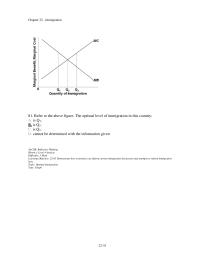
Chapter 22 – Immigration 81. Refer to the above figure. The optimal level of immigration in this country: A. is Q1. B. is Q2. C. is Q3. D. cannot be determined with the information given 22–33 AACSB: Reflective Thinking Bloom’s: […]
Economics Chapter 22d 2 If the government effectively prevents illegal immigrants from working in this labor market, the equilibrium wage and level of employment are, respectively
Chapter 22 – Immigration 57. According to estimates, what percentage of agricultural workers in the United States are illegal immigrants? A. 12 B. 17 C. 24 D. 43 AACSB: Analytic Bloom’s: Level 1 Remember Difficulty: 1 Easy Learning Objective: 22-04 […]
Economics Chapter 22d 1 Kara is considering migrating to another country. Which of the following represents a cost she will face if she decides to move
Chapter 22 – Immigration 1. Economic immigrants: A. are defined as any international migrants that have an impact on the economy. B. are defined as international migrants motivated by economic gain. C. only impact the economy if they enter the […]
Economics Chapter 21d 3 In order to help pay for the costs of extending health insurance to previously uninsured people, the PPACA imposes new taxes including the following
Chapter 21 – Health Care 90. The Patient Protection and Affordable Care Act (PPACA) includes the following elements, except: A. Insurance companies cannot anymore deny coverage to anyone on the basis of a preexisting condition B. To contain costs, insurance […]
Economics Chapter 21d 2 Assume that health insurance pays four-fifths the cost of health care. For the consumer, the price and the quantity of health care consumed would be
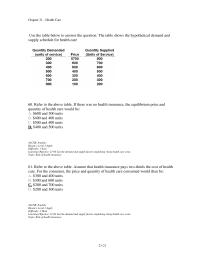
Chapter 21 – Health Care Use the table below to answer the question. The table shows the hypothetical demand and supply schedule for health care 60. Refer to the above table. If there was no health insurance, the equilibrium price […]
Economics Chapter 21d 1 Approximately what portion of health care spending in the U.S. is paid by the consumer and not by private or public insurance
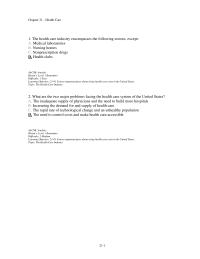
Chapter 21 – Health Care 1. The health care industry encompasses the following sectors, except: A. Medical laboratories B. Nursing homes C. Nonprescription drugs D. Health clubs AACSB: Analytic Bloom’s: Level 1 Remember Difficulty: 1 Easy Learning Objective: 21-01 Convey […]
Economics Chapter 21d 3 Which of the following provisions of the PPACA do proponents expect to reduce the growth of health care spending
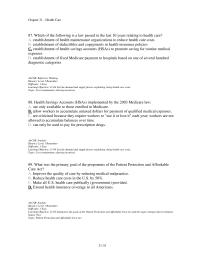
Chapter 21 – Health Care 87. Which of the following is a law passed in the last 10 years relating to health care? A. establishment of health maintenance organizations to reduce health care costs B. establishment of deductibles and copayments […]
Economics Chapter 21d 2 If an individual is less careful about avoiding accidents or illness because she has health insurance, this is an example of
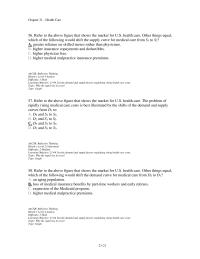
Chapter 21 – Health Care 56. Refer to the above figure that shows the market for U.S. health care. Other things equal, which of the following would shift the supply curve for medical care from S1 to S2? A. greater […]
Economics Chapter 21d 1 approximately what percentage of people in the U.S. with private health insurance received it as an employer-provided benefit
Chapter 21 – Health Care 1. Approximately how many workers are employed in the U.S. health care industry? A. 820,000 B. 1 million C. 5.8 million D. 16 million AACSB: Analytic Bloom’s: Level 1 Remember Difficulty: 1 Easy Learning Objective: […]
Economics Chapter 20d 3 Assume that there is a supply and demand market for non-preferred workers. If prejudice against these workers among employers increases
Chapter 20 – Income Inequality and Poverty 102. Assume that there is a supply and demand market for non-preferred workers. If prejudice against these workers among employers increases, then there will be a(n): A. Increased supply of these workers, a […]
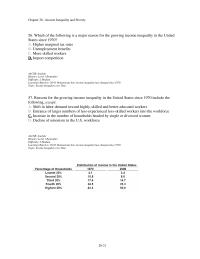
Economics Chapter 20d 2 Which of the following would be evidence of an increase in income inequality over time in the United States
Chapter 20 – Income Inequality and Poverty 20–21 56. Which of the following is a major reason for the growing income inequality in the United States since 1970? AACSB: Analytic Bloom’s: Level 1 Remember Difficulty: 2 Medium Learning Objective: 20-03 […]
Economics Chapter 20d 1 The greater the degree of inequality in the distribution of income, the more bowed will be the Lorenz curve toward the
Chapter 20 – Income Inequality and Poverty 1. The average household income in the United States in 2008 was: A. $34,231 B. $51,999 C. $68,424 D. $80,250 AACSB: Analytic Bloom’s: Level 1 Remember Difficulty: 1 Easy Learning Objective: 20-01 Explain […]
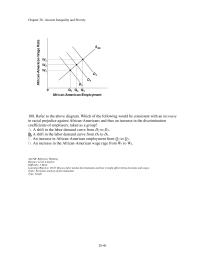
Economics Chapter 20d 3 Which of the following would be consistent with an increase in racial prejudice against African-Americans and thus an increase
Chapter 20 – Income Inequality and Poverty 108. Refer to the above diagram. Which of the following would be consistent with an increase in racial prejudice against African-Americans and thus an increase in the discrimination coefficients of employers, taken as […]
Economics Chapter 20d 2 Refer to the above diagrams that show identical marginal utility from income curves for Singer and Catalano
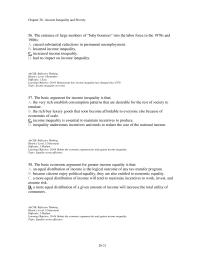
Chapter 20 – Income Inequality and Poverty 56. The entrance of large numbers of “baby boomers” into the labor force in the 1970s and 1980s: A. caused substantial reductions in permanent unemployment. B. lessened income inequality. C. increased income inequality. […]
Economics Chapter 20d 1 People’s incomes are relatively low when they are young, reach a peak in middle age, and then decline. This fact helps explain
Chapter 20 – Income Inequality and Poverty 1. In 2008, the average income for households in the United States was about: A. $68,424. B. $42,820. C. $19,610. D. $62,725. AACSB: Reflective Thinking Bloom’s: Level 1 Remember Difficulty: 1 Easy Learning […]
Economics Chapter 19d 3 Public choice theory would suggest that the lobbying of Congress by farm organizations for legislation that would increase the appropriations
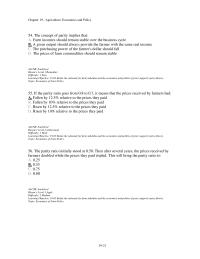
Chapter 19 – Agriculture: Economics and Policy 87. A major criticism of the parity concept is that: A. It is based on relative prices from a long time ago B. It is not easily and objectively measured C. The index […]
Economics Chapter 19d 2 If price supports are established, and producers are producing more than consumers want to buy at that price, to maintain producers’ income the government will have to
Chapter 19 – Agriculture: Economics and Policy 54. The concept of parity implies that: A. Farm incomes should remain stable over the business cycle B. A given output should always provide the farmer with the same real income C. The […]
Economics Chapter 19d 1 The inelastic demand for agricultural products means that relatively small increases in supply will result in a relatively
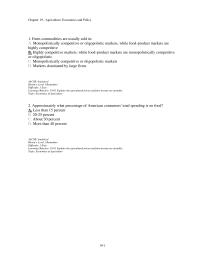
Chapter 19 – Agriculture: Economics and Policy 1. Farm commodities are usually sold in: A. Monopolistically competitive or oligopolistic markets, while food-product markets are highly competitive B. Highly competitive markets, while food-product markets are monopolistically competitive or oligopolistic C. Monopolistically […]
Economics Chapter 19d 2 Farm groups spend considerable amounts of money to maintain and enlarge political support for farm subsidies. This illustrates
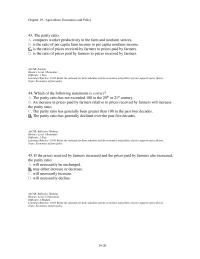
Chapter 19 – Agriculture: Economics and Policy 43. The parity ratio: A. compares worker productivity in the farm and nonfarm sectors. B. is the ratio of per capita farm income to per capita nonfarm income. C. is the ratio of […]
Economics Chapter 19d 1 Which of the following statements about U.S. agriculture is true as it relates to the past several decades
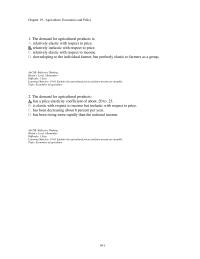
Chapter 19 – Agriculture: Economics and Policy 1. The demand for agricultural products is: A. relatively elastic with respect to price. B. relatively inelastic with respect to price. C. relatively elastic with respect to income. D. downsloping to the individual […]
Economics Chapter 18d 2 If there was a conspiracy to fix prices, but the conspiracy did not succeed, the government can still take the conspiring firm to court for improper conduct
Chapter 18 – Antitrust Policy and Regulation 60. Which of the following is a per se violation? A. Price discrimination B. Price-fixing C. Extremely high Herfindahl index D. Horizontal merger AACSB: Analytical Bloom’s: Level 1 Remember Difficulty: 1 Easy Learning […]
Economics Chapter 18d 1 Which antitrust act provided that injured parties could file suit and, if successful, collect triple damages from monopolistic violators
Chapter 18 – Antitrust Policy and Regulation 1. Laws and government actions designed to prevent monopoly and to promote competition are the focus of: A. Social regulation B. Industrial regulation C. Antitrust policy D. Incomes policy AACSB: Analytical Bloom’s: Level […]
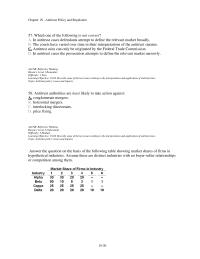
Economics Chapter 18d 2 The view that the antitrust laws should be enforced relatively leniently because of the tendency for monopoly power to erode over time is known as the
Chapter 18 – Antitrust Policy and Regulation 18–20 57. Which one of the following is not correct? AACSB: Reflective Thinking Bloom’s: Level 1 Remember Difficulty: 1 Easy Learning Objective: 18-02 Describe some of the key issues relating to the interpretation […]
Economics Chapter 18d 1 Suppose Slow Ketchup requires that, as a condition of purchase, all restaurants using its product must buy and make available its new sales product
Chapter 18 – Antitrust Policy and Regulation 1. All of the following can file antitrust charges under the Sherman Act except: A. the U.S. Justice Department. B. state attorney generals. C. injured private parties. D. the Federal Energy Regulatory Commission. […]
Economics Chapter 17d 1 Suppose a firm offers its workers a cafeteria plan in which it allows workers to allocate a set amount of fringe benefit money toward specific insurance
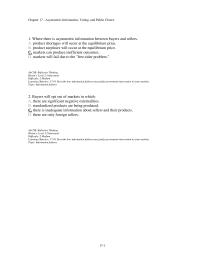
Chapter 17 – Asymmetric Information, Voting, and Public Choice 1. Where there is asymmetric information between buyers and sellers. A. product shortages will occur at the equilibrium price. B. product surpluses will occur at the equilibrium price. C. markets can […]
Economics Chapter 17d 2 Voters are making a choice to spend money on three projects: a dam, a school, or a road. In the choice between the dam and the school
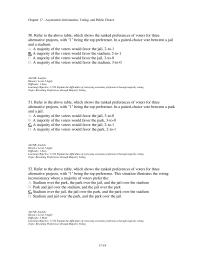
Chapter 17 – Asymmetric Information, Voting, and Public Choice 50. Refer to the above table, which shows the ranked preferences of voters for three alternative projects, with “1” being the top preference. In a paired-choice vote between a jail and […]
Economics Chapter 17d 1 Which would be an example of where the government has intervened to correct a market failure caused by inadequate information about sellers
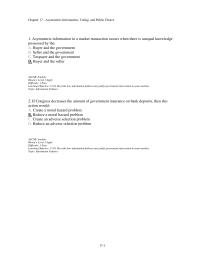
Chapter 17 – Asymmetric Information, Voting, and Public Choice 1. Asymmetric information in a market transaction occurs when there is unequal knowledge possessed by the: A. Buyer and the government B. Seller and the government C. Taxpayer and the government […]
Economics Chapter 17d 2 Domino argues for a medium pizza, Godfather contends a large pizza will be needed, and Little Caesar wants a super-large pizza
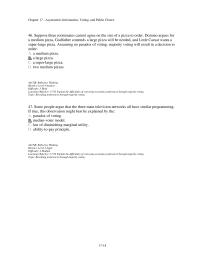
Chapter 17 – Asymmetric Information, Voting, and Public Choice 46. Suppose three roommates cannot agree on the size of a pizza to order. Domino argues for a medium pizza, Godfather contends a large pizza will be needed, and Little Caesar […]
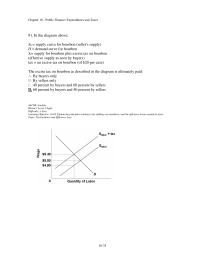
Economics Chapter 16d 3 Refer to the above graph for the labor market. The government decides to impose a wage tax as shown on the graph
Chapter 16 – Public Finance: Expenditures and Taxes 91. In the diagram above: S0 = supply curve for bourbon (seller’s supply) D = demand curve for bourbon St= supply for bourbon plus excise tax on bourbon (effective supply as seen […]
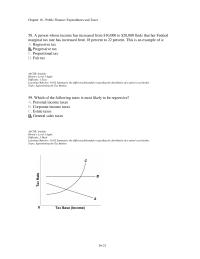
Economics Chapter 16d 2 The relationship between the average tax rate and the tax base in a proportional tax would be represented by
Chapter 16 – Public Finance: Expenditures and Taxes 58. A person whose income has increased from $10,000 to $20,000 finds that her Federal marginal tax rate has increased from 18 percent to 22 percent. This is an example of a: […]
Economics Chapter 16d 1 If government levies a tax or fee on hunting licenses and uses the resulting revenue for wildlife stocking programs
Chapter 16 – Public Finance: Expenditures and Taxes 1. Public finance is the sub-discipline of economics that studies the various ways in which: A. The general public acquire financing for their purchases B. Governments raise and expend money C. Firms […]
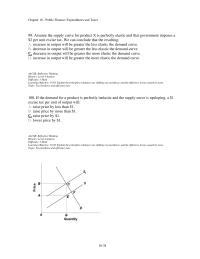
Economics Chapter 16d 3 If the demand for a product is perfectly inelastic and the supply curve is upsloping, a $1 excise tax per unit of output will
Chapter 16 – Public Finance: Expenditures and Taxes 99. Assume the supply curve for product X is perfectly elastic and that government imposes a $2 per unit excise tax. We can conclude that the resulting: A. increase in output will […]
Economics Chapter 16d 2 The rationale for ability-to-pay taxation and the contention that those with large incomes should pay more taxes both absolutely and relatively is that
Chapter 16 – Public Finance: Expenditures and Taxes 55. In 2008, U.S. governments (local, state, and Federal) employed approximately how many million workers? A. 9.2 B. 13.0 C. 19.4 D. 22.5 AACSB: Analytic Bloom’s: Level 1 Remember Difficulty: 1 Easy […]
Economics Chapter 16d 1 Revenues flowing to the government from government-run or government-sponsored businesses, such as public utilities and state lotteries, are known as
Chapter 16 – Public Finance: Expenditures and Taxes 1. Proprietary income refers to: A. revenue flowing to the government from taxes. B. money borrowed by the government to finance its operations. C. revenue generated by government-run businesses. D. transfer payments […]