Chapter 18 – Antitrust Policy and Regulation
18–20
57. Which one of the following is not correct?
58. Antitrust authorities are least likely to take action against:
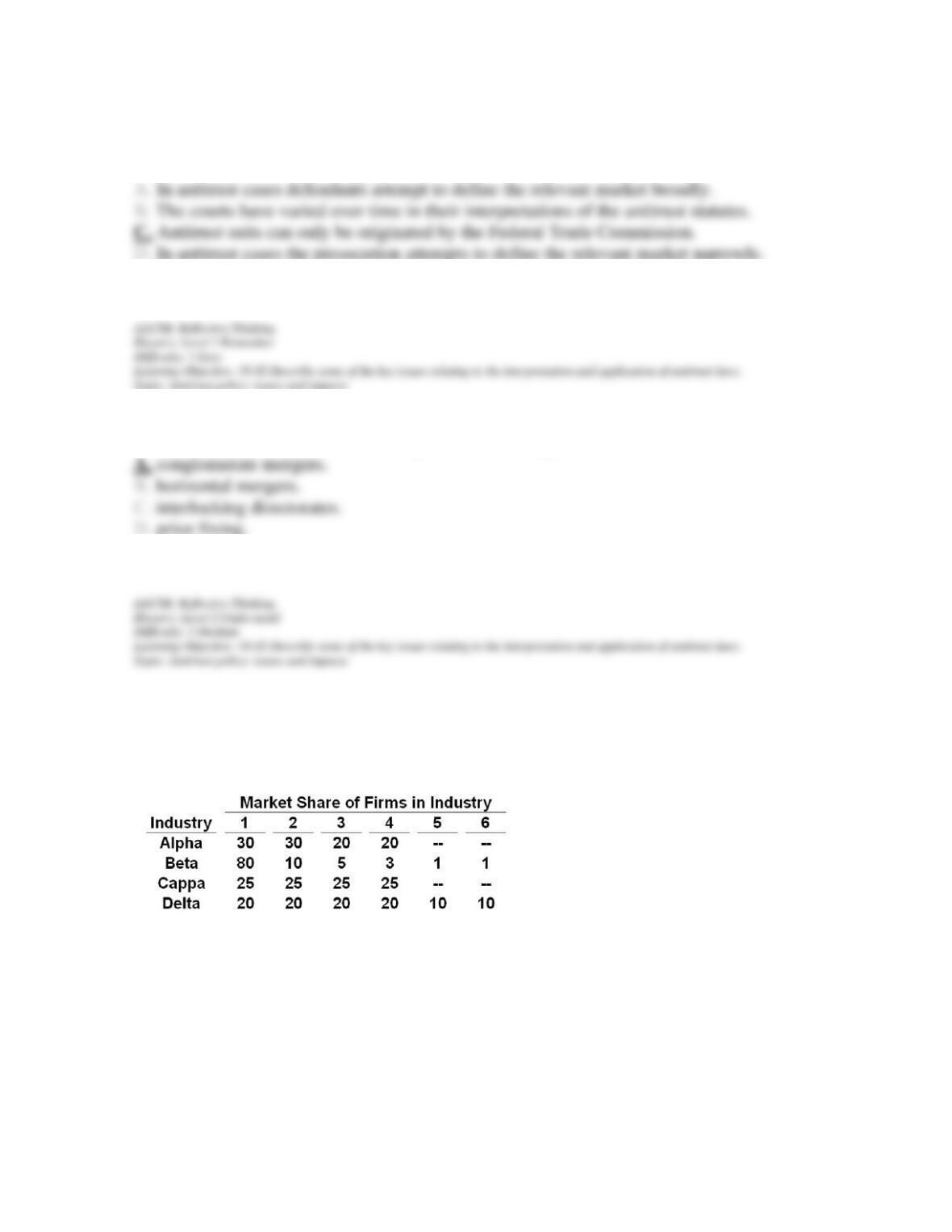
Answer the question on the basis of the following table showing market shares of firms in
hypothetical industries. Assume these are distinct industries with no buyer-seller relationships
or competition among them.
Chapter 18 – Antitrust Policy and Regulation
59. Refer to the above table. The Herfindahl index for Cappa is:
60. Refer to the above table. The industry with the greatest market power as measured by the
Herfindahl index is:
61. Refer to the above table. A merger between Firm 2 and Firm 3 in Alpha would be a:
Chapter 18 – Antitrust Policy and Regulation
62. Refer to the above table. A merger between Firm 1 in Alpha and Firm 2 in Delta would be
a:
63. Refer to the above table. The government would likely challenge a merger between:
64. Refer to the above table. A structuralist would most likely assert that there is a violation of
antitrust law in which industry?
Chapter 18 – Antitrust Policy and Regulation
65. Suppose the firms in a five-firm industry have market shares of 30, 30, 20, 10, and 10
percent, respectively. The Herfindahl index for the industry is:
66. Suppose that two firms in an industry with a Herfindahl index of 5,000 announce a
merger. The U.S. Justice Department concludes the merger will boost the index to 5,500. The
antitrust authorities will most likely:
Chapter 18 – Antitrust Policy and Regulation
67. Suppose that two firms in an industry that has a Herfindahl index of 1,000 announce a
merger. The U.S. Justice Department concludes the merger will boost the index to 1,050. The
antitrust authorities will most likely:
68. The view that the antitrust laws should be enforced relatively leniently because of the
tendency for monopoly power to erode over time is known as the:
69. The view that the antitrust laws need to be strongly enforced to prevent illegal business
behaviors, monopolization of markets, and allocative inefficiency is known as the:
Chapter 18 – Antitrust Policy and Regulation
70. Economists who adhere to the laissez-faire antitrust perspective:
71. A firm is likely to be a natural monopoly:
72. Which of the following is characteristic of a regulated natural monopoly?
Chapter 18 – Antitrust Policy and Regulation
73. Suppose the transportation industry has been regulated for many years. Government now
proposes to deregulate the industry, only to find that firms in the industry oppose this action.
This is consistent with the:
74. Using antitrust law to split up an unregulated natural monopoly into several competing
firms:
75. A major criticism of industrial regulation is that:
Chapter 18 – Antitrust Policy and Regulation
76. Critics of the regulation of natural monopolies contend that:
77. A market in which the entire demand for a good or service can be satisfied at the least cost
by a single firm is a:
78. The legal cartel theory of regulation argues that:
Chapter 18 – Antitrust Policy and Regulation
79. The public interest theory of industrial regulation contends that:
80. Which one of the following is concerned with industrial regulation, as distinct from social
regulation?
81. All of the following are regulatory commissions dealing with industrial regulation (as
distinct from social regulation) except the:
Chapter 18 – Antitrust Policy and Regulation
82. Where there is natural monopoly, government is most likely to implement:
83. The main purpose of industrial regulation is to:
84. Critics of industrial regulation say that such regulation:
Chapter 18 – Antitrust Policy and Regulation
85. Critics of industrial regulation say that such regulation:
86. Overall, economists believe that deregulation of industries formerly subjected to industrial
regulation:
Chapter 18 – Antitrust Policy and Regulation
88. Social, as distinct from industrial, regulation is the major focus of the:
89. Defenders of social regulation point out that:
90. Social regulation differs from industrial regulation in that:
Chapter 18 – Antitrust Policy and Regulation
91. Critics of social regulation argue that it:
92. Which one of the following is concerned with social regulation?
93. The optimal amount of social regulation occurs where the marginal benefit of such
regulation:
Chapter 18 – Antitrust Policy and Regulation
94. Congressional representatives have called for extensive ergonomics regulations to reduce
strains and injuries from repetitive activities by workers. Such regulation, if passed, would be
a good example of:
95. (Consider This) The Consider This box “Of Catfish and Art (and Other Things in
Common)” lists examples of recent antitrust cases involving:
96. (Consider This) According to the Consider This box on catfish and art, which of the
following firms were recently convicted of price fixing?
Chapter 18 – Antitrust Policy and Regulation
97. (Consider This) According to the Consider This box on catfish and art, which of the
following airlines in 2007 agreed to pay $300 million fines for fixing fuel surcharges on
passenger tickets and cargo?
98. (Last Word) In 2001, Microsoft was found guilty of violating:
99. (Last Word) In 2001, Microsoft was found guilty of:
Chapter 18 – Antitrust Policy and Regulation
100. (Last Word) In 2001, a U.S. court of appeals tossed out an earlier U.S. district court
order that Microsoft:
101. (Last Word) The final settlement of the United States v. Microsoft case:
102. Price fixing is illegal under Section 1 of the Sherman Act.
Chapter 18 – Antitrust Policy and Regulation
103. Monopolization is illegal under Section 1 of the Sherman Act.
104. The U.S. Justice Department, the Federal Trade Commission, state attorneys general, and
injured private parties can independently file charges against firms under the Sherman Act.
105. Anticompetitive mergers are illegal under provisions of the Clayton Act (as amended).
106. Proposed ergonomics regulations are an example of industrial regulation (rather than
social regulation).
Chapter 18 – Antitrust Policy and Regulation
107. Tying agreements are contracts by which retailers agree to charge the prices that
manufacturers set on branded goods.
108. The Celler-Kefauver Act outlawed interlocking directorates.
109. The regulation of natural monopolies has been criticized because it creates a tendency for
regulated firms to use too much labor and too little capital in the production process.
110. The Celler-Kefauver Act made vertical mergers legal, provided each firm does not have
more than 30 percent of its relevant market.
Chapter 18 – Antitrust Policy and Regulation
111. The legal cartel theory indicates that, in any industry where market demand and the long-
run average total cost curve intersect close to the latter’s minimum, government regulation is
mandatory and desirable.
112. The Consumer Product Safety Commission engages in social regulation, rather than
industrial regulation.
113. The Americans with Disabilities Act of 1990 is an example of industrial regulation.