Chapter 17 – Asymmetric Information, Voting, and Public Choice
1. Where there is asymmetric information between buyers and sellers.
2. Buyers will opt out of markets in which:
Chapter 17 – Asymmetric Information, Voting, and Public Choice
3. Sellers will opt out of markets in which:
4. As it applies to insurance, the moral hazard problem is the tendency for:
5. As it applies to insurance, the adverse selection problem is the tendency for:
Chapter 17 – Asymmetric Information, Voting, and Public Choice
6. Suppose a firm offers its workers a cafeteria plan in which it allows workers to allocate a
set amount of fringe benefit money toward specific insurance. Mary, who has five kids
needing braces, selects the family dental coverage. This is an example of the:
7. Because the Federal government typically provides disaster relief to farmers, many farmers
do not buy crop insurance even through it is federally subsidized. This illustrates:
8. In response to the financial crisis that began in 2007, the government began to bail out
banks deemed “too big to fail.” Critics of this action argued that this would create the prospect
of future bailouts and encourage banks to be fiscally irresponsible in the future. This
illustrates:
Chapter 17 – Asymmetric Information, Voting, and Public Choice
9. Upon buying a car with airbags, Indy begins to drive recklessly. This is an example of the:
10. Firms are not likely to provide sufficient workplace safety if:
11. Government can promote workplace safety by:
Chapter 17 – Asymmetric Information, Voting, and Public Choice
12. Professional buyers of antiques often have more information about the value of antique
objects than do the sellers. This illustrates:
13. Upon learning that his auto transmission is about to fail, Ray Roma sells his car to an
unsuspecting buyer. This circumstance illustrates:
14. In a television advertisement for AFLAC supplemental health insurance, an ice skater says
to his skating partner, “Do you want to try a triple jump?” She responds, “Why not, I have
AFLAC.” This response illustrates the:
Chapter 17 – Asymmetric Information, Voting, and Public Choice
15. The field of economics that analyzes government decision making, politics, and elections
is called:
16. Public choice economists:
17. Which one of the following topics would be of most interest to a public choice
economist?
Chapter 17 – Asymmetric Information, Voting, and Public Choice
18. An economic analysis of the relationship between proposed legislation affecting major
employers in each state and the voting patterns of Senators and representatives in Congress on
that legislation would fit within the subcategory of economics called:
19. “Government failure” is a prominent topic in:
20. Public choice theory focuses on the economics of:
Chapter 17 – Asymmetric Information, Voting, and Public Choice
21. Because majority voting fails to incorporate the strength of the preferences of individual
voters, it:
22. Suppose that Katie and Kelly each expect to receive $500 worth of marginal benefits from
a proposed new recreation center, whereas Kerry expects to receive only $100 worth. If the
proposed tax levied on each for the center would be $400, a majority vote will:
23. Suppose that Steve and Susie each perceive $200 of marginal benefit from a proposed
new park, whereas Elizabeth perceives $800. If the proposed tax levied on each for the park
would be $300, a majority vote will:
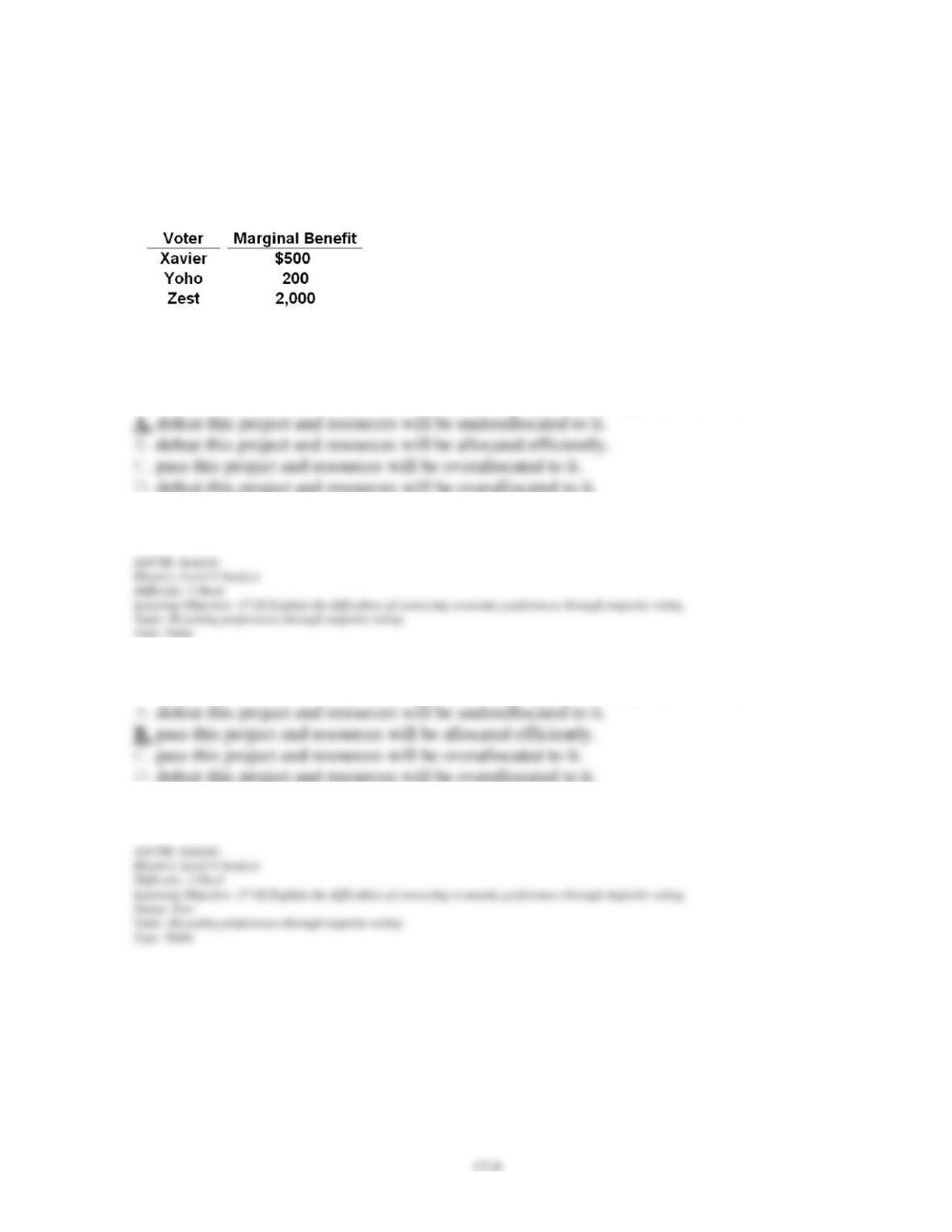
Chapter 17 – Asymmetric Information, Voting, and Public Choice
Answer the next question on the basis of this table showing the marginal benefit that a
particular public project will provide to each of the three members of a community. No vote
trading is allowed.
24. If the tax cost of this proposed project is $600 per person, a majority vote will:
25. If the tax cost of this proposed project is $300 per person, a majority vote will:
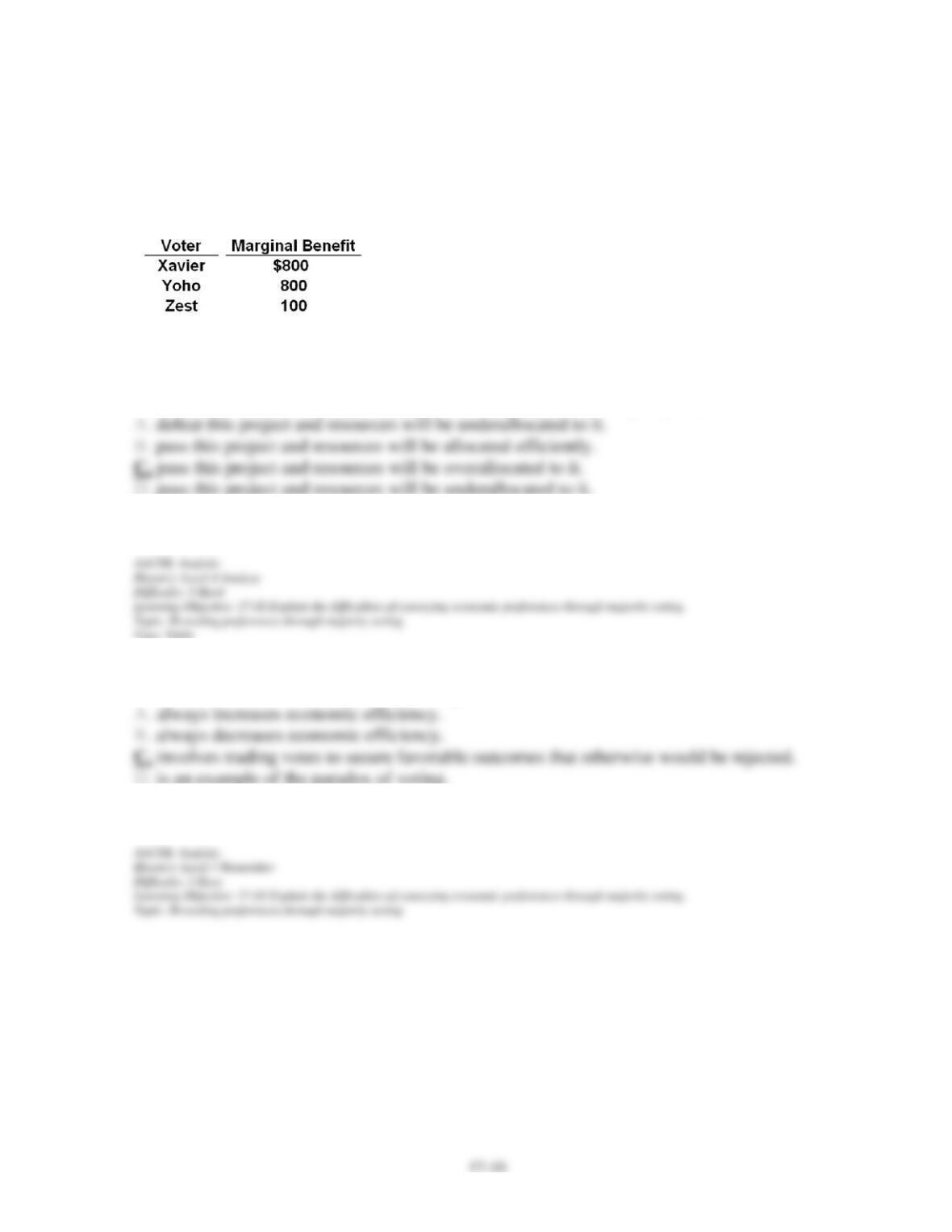
Chapter 17 – Asymmetric Information, Voting, and Public Choice
Answer the next question on the basis of this table showing the marginal benefit a particular
public project will provide to each of the three members of a community. No vote trading is
allowed.
26. If the tax cost of this proposed project is $600 per person, a majority vote will:
27. The political technique called logrolling:
Chapter 17 – Asymmetric Information, Voting, and Public Choice
28. The trading of votes by elected officials to secure favorable outcomes is called:
29. Senator A agrees to vote for Senator K’s state project in exchange for Senator K voting for
Senator A’s state project. This is an example of:
30. A situation in which society may not be able to rank its preferences consistently through
paired-choice majority voting refers to:
Chapter 17 – Asymmetric Information, Voting, and Public Choice
31. The principle that under some circumstances majority voting fails to make consistent
choices reflecting the community’s underlying preference is best demonstrated by the:
32. According to the paradox of voting:
33. Suppose that in a series of paired-choice votes a new park is preferred to new recreation
center and a new recreation center is preferred to street widening. Also suppose that street
widening is preferred to a new park. This set of votes is an example of the:
Chapter 17 – Asymmetric Information, Voting, and Public Choice
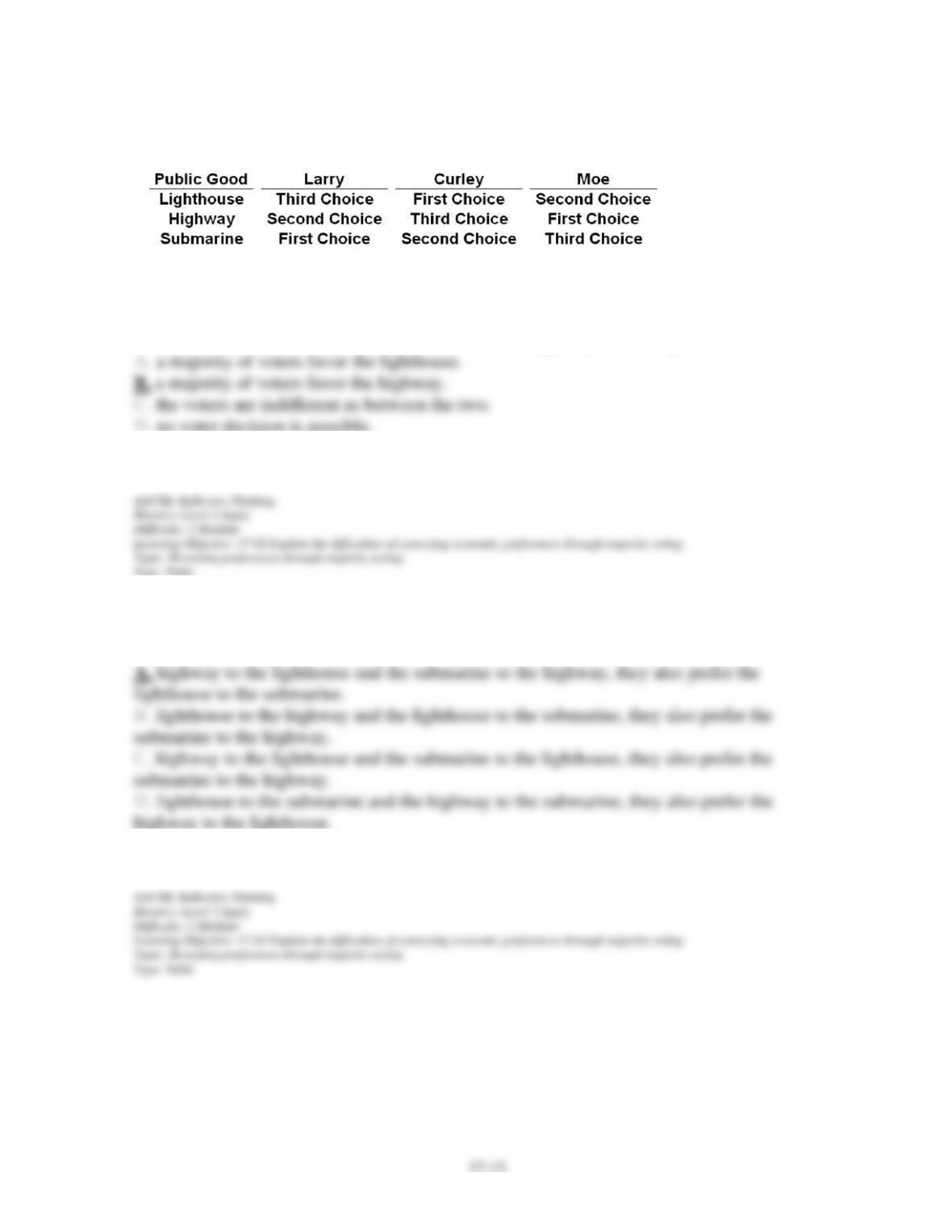
34. Refer to the above table. In a choice between the highway and the lighthouse:
35. Refer to the above table. The inconsistency illustrated by the table is that, while a majority
of voters prefer the:
Chapter 17 – Asymmetric Information, Voting, and Public Choice
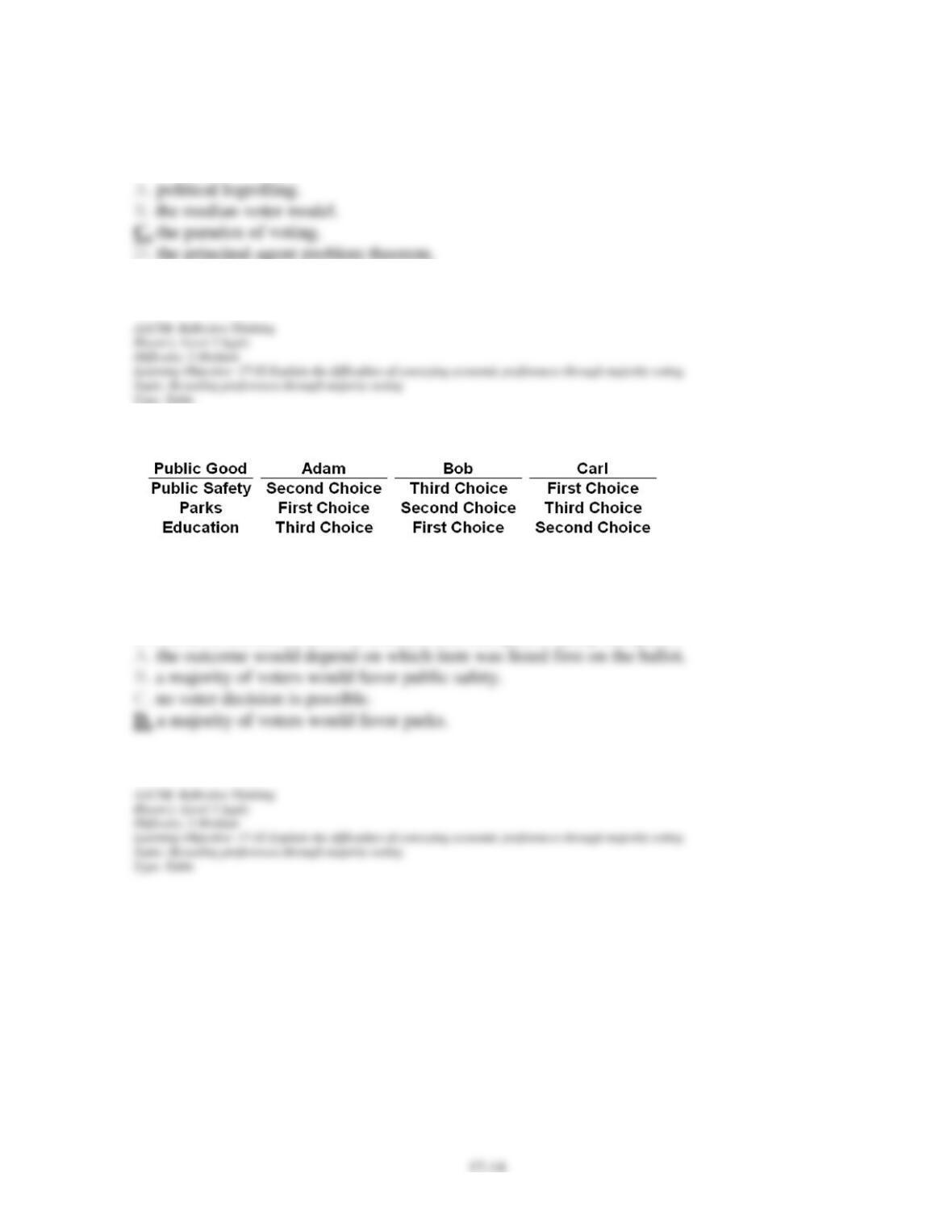
36. The information contained in the above table illustrates:
37. Refer to the above table. In a choice between public safety and parks:
Chapter 17 – Asymmetric Information, Voting, and Public Choice
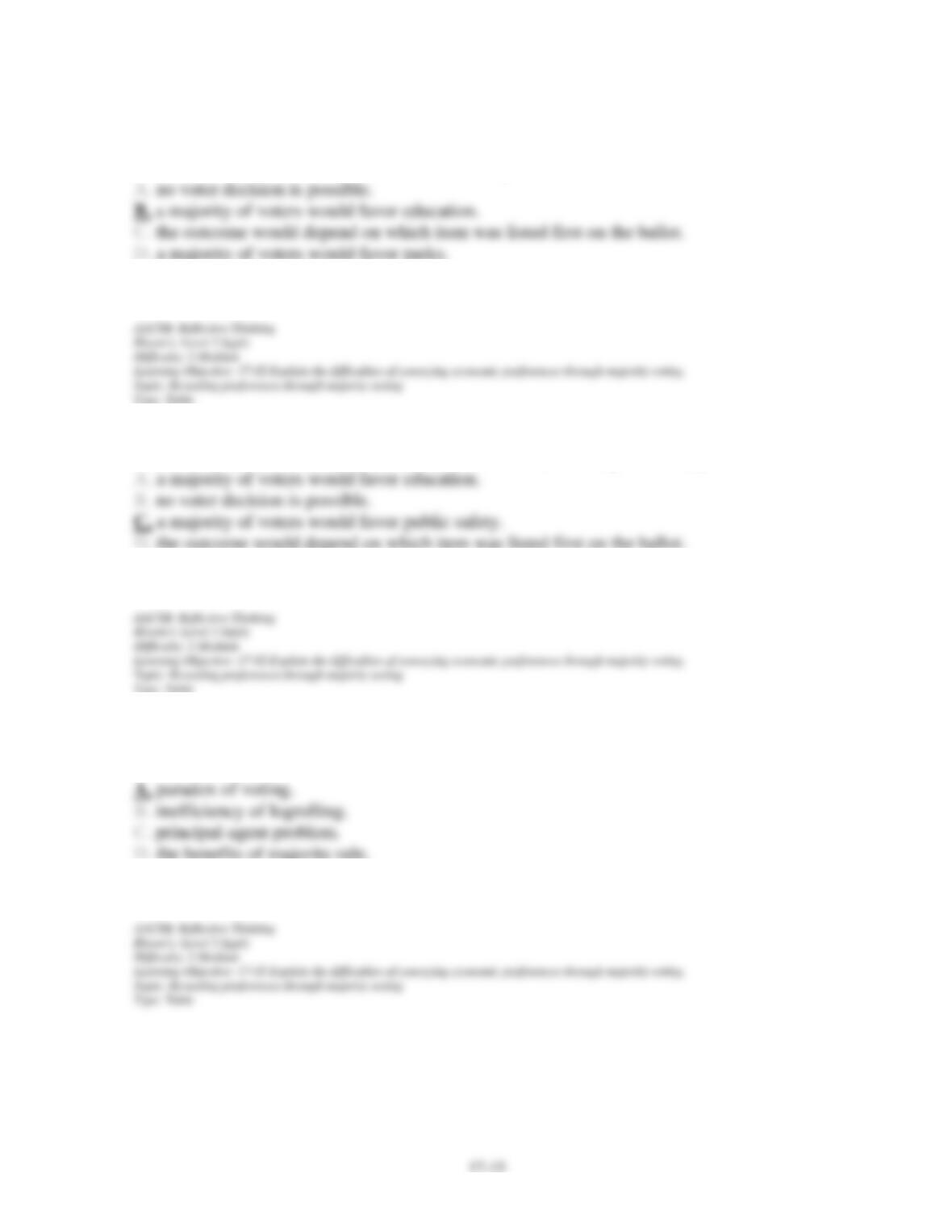
38. Refer to the above table. In a choice between parks and education:
39. Refer to the above table. In a choice between education and public safety:
40. Refer to the above table. The outcomes of the three possible sets of paired-choice majority
votes illustrate the:
Chapter 17 – Asymmetric Information, Voting, and Public Choice
17–16
41. The median-voter model implies that:
42. The median-voter model implies that a political office seeker will:
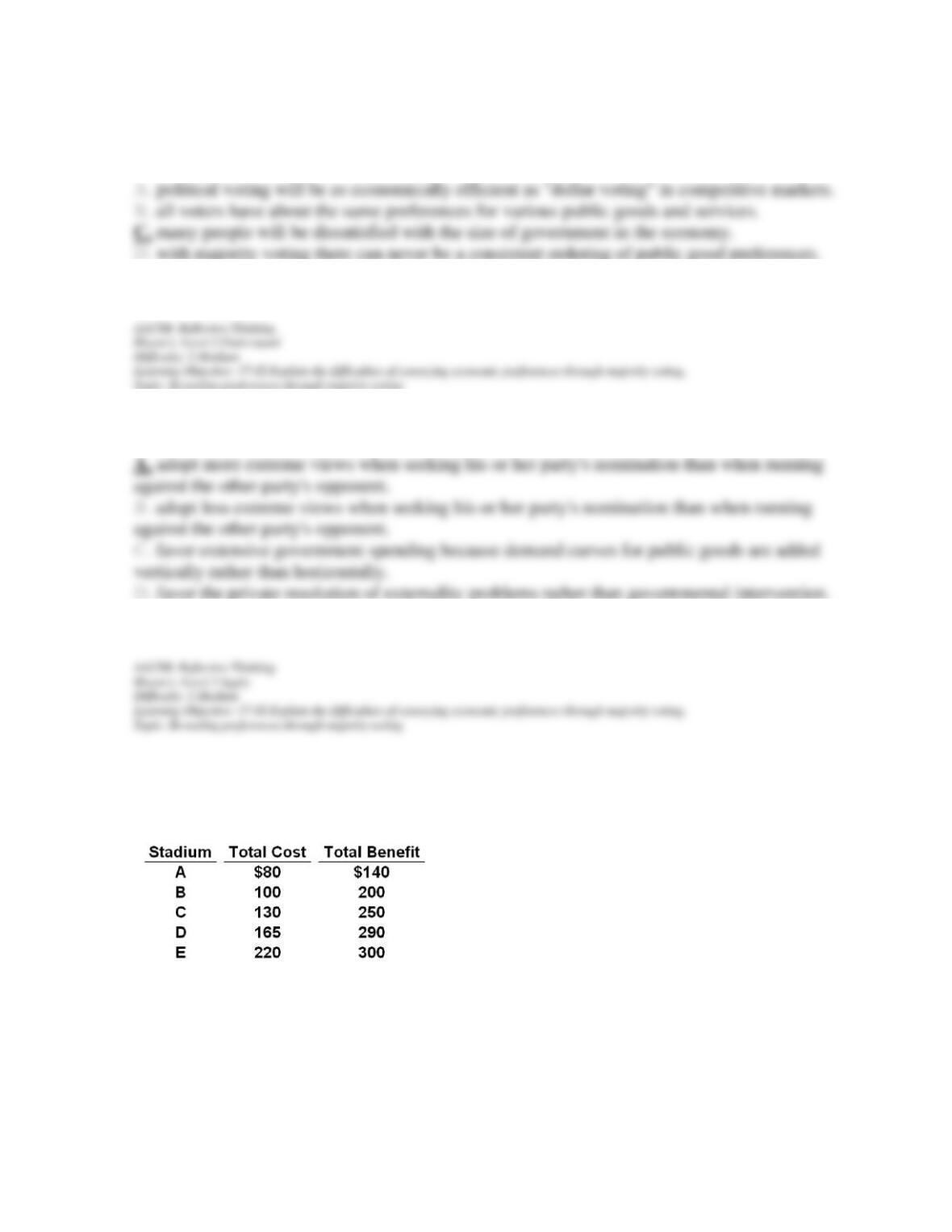
Answer the question on the basis of the following table that shows the total costs and total
benefits facing a city of five different potential baseball stadiums of increasing size. All
figures are in millions of dollars.
Chapter 17 – Asymmetric Information, Voting, and Public Choice
43. Refer to the above table. Suppose a five-person city council must decide via majority
voting which of these stadiums to build. Also suppose that each of the stadium sizes has the
support of one council member. According to the median voter model, the council will
ultimately vote in favor of stadium:
44. Refer to the above table. The marginal cost and marginal benefit of stadium B (relative to
A) are:
45. Refer to the above table. Based on cost-benefit analysis, the city should: