Chapter 17 – Asymmetric Information, Voting, and Public Choice
46. Suppose three roommates cannot agree on the size of a pizza to order. Domino argues for
a medium pizza, Godfather contends a large pizza will be needed, and Little Caesar wants a
super-large pizza. Assuming no paradox of voting, majority voting will result in a decision to
order:
47. Some people argue that the three main television networks all have similar programming.
If true, this observation might best be explained by the:
Chapter 17 – Asymmetric Information, Voting, and Public Choice
48. Suppose that friends Jennifer, Stephanie, and Megan cannot agree on how much to spend
for a bouquet of flowers to send to a person that allowed them to use their beach house for the
weekend. Jennifer want to buy a moderately priced bouquet, Stephanie wants to buy an
expensive bouquet, and Megan wants to buy a very expensive bouquet. Assuming no paradox
of voting, majority voting will result in decision to buy:
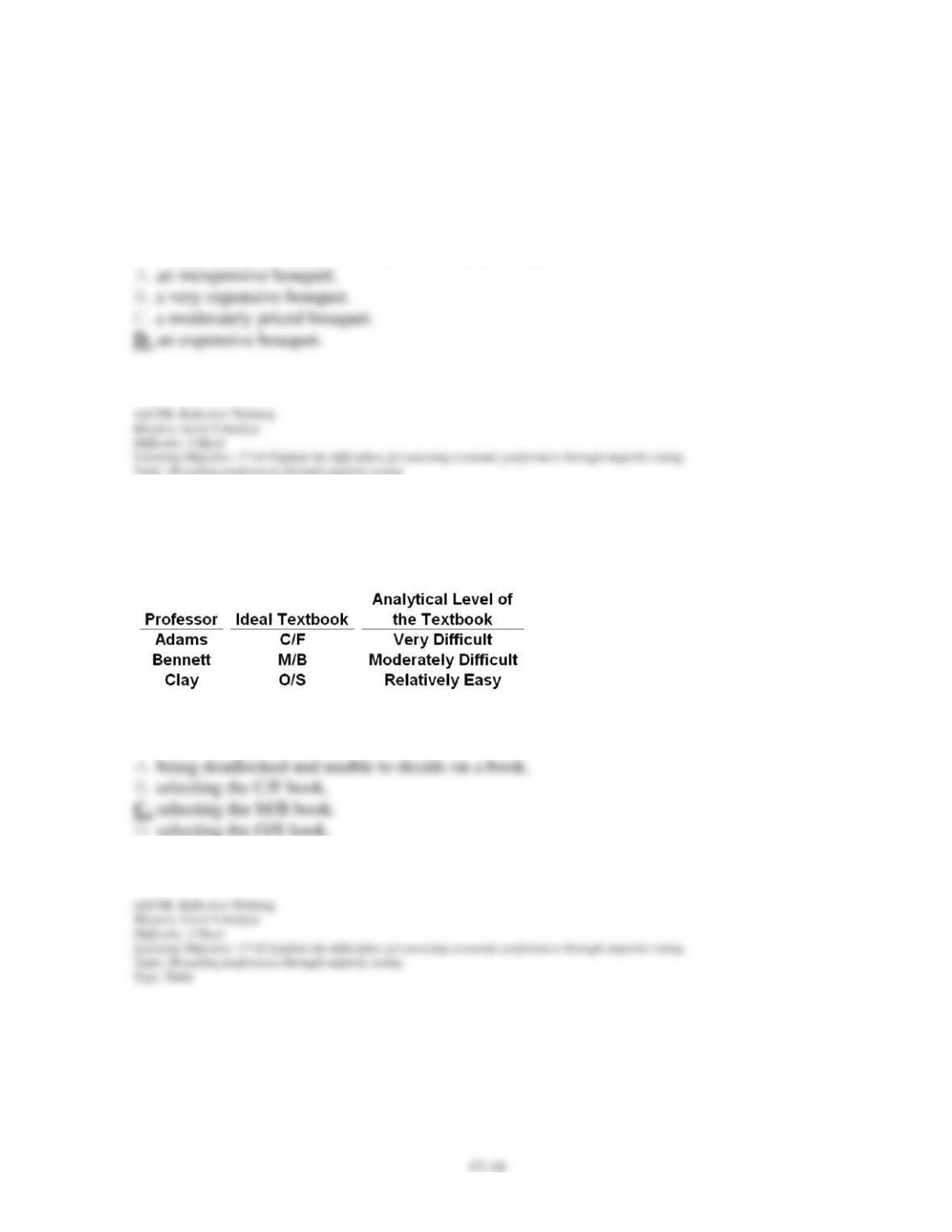
49. Suppose a college economics department decides to use a single economics text for all
sections of principles of economics. Also assume that the three individual members of the
textbook selection committee have the following preferences.
Assuming all other textbook qualities except analytical level are the same, paired-choice
majority voting will result in the committee:
Chapter 17 – Asymmetric Information, Voting, and Public Choice
50. As it relates to corporations, the principal-agent problem is that:
51. In corporations, owners are __________________ and managers are ______________.
52. In representative democracy, voters are ____________ and politicians are
Chapter 17 – Asymmetric Information, Voting, and Public Choice
53. As it relates to owners and managers, the principal-agent problem results from the:
54. As it relates to the political process, the principal-agent problem results from the:
55. “Vote for my special local project and I will vote for yours.” This political technique:
Chapter 17 – Asymmetric Information, Voting, and Public Choice
56. Factors that impede the attainment of economic efficiency in the public sector are called:
57. According to public choice theorists, the private sector is more efficient than the public
sector mainly because:
58. The idea of government failure includes all of the following except:
Chapter 17 – Asymmetric Information, Voting, and Public Choice
59. Suppose American winemakers convince the Federal government to issue a directive to
serve only domestically produced wine at government functions. This would be an example
60. Public choice theorists contend that:
61. The pursuit through government of a “transfer of wealth” at someone else’s expense refers
to:
Chapter 17 – Asymmetric Information, Voting, and Public Choice
62. Economists call the pursuit of a transfer of wealth through government at someone else’s
expense:
63. Public choice theorists hold that politicians will:
64. Public choice theorists contend public bureaucracies are inefficient primarily because:
Chapter 17 – Asymmetric Information, Voting, and Public Choice
65. A special-interest issue is one whose passage yields:
66. Public choice theorists point out that the political process:
67. When congressional representatives vote on an appropriations bill, they must vote yea or
nay, taking the bad with the good. This statement best reflects the:
Chapter 17 – Asymmetric Information, Voting, and Public Choice
68. “Pork-barrel” legislation that contains funding for hundreds of earmarks throughout
numerous states often reflects:
69. Suppose lawyers seek legislation to limit the use of computer software that enables people
to use their personal computers to self-prepare their own wills, trusts, and other legal
documents. This is an example of:
70. In a sporting goods store, you can buy the equipment you want and forgo the rest. But in
an election you “buy” the entire range of the candidate’s positions, including some you may
not agree with. This difference:
Chapter 17 – Asymmetric Information, Voting, and Public Choice
71. In 2008, the U.S. Federal government legislation authorized:
72. Narrow, specifically designated expenditures that are included in more comprehensive
legislation are known as:
73. “Earmarks” refer to:
Chapter 17 – Asymmetric Information, Voting, and Public Choice
74. The unlawful misdirection of governmental resources for personal gain is known as:
75. The Road Runner Club contributes money to Senator Sly’s reelection campaign fund, and
Senator Sly helps pass legislation to add more jogging paths across the state. From this we can
definitively conclude:
76. Political corruption occurs whenever:
Chapter 17 – Asymmetric Information, Voting, and Public Choice
77. (Consider This) In the market for used cars:
78. (Consider This) The “lemon” problem associated with the market for used cars:
79. (Consider This) Owners of defective used cars have more information about the condition
of their vehicles than potential buyers of those used cars. This is an example of:
Chapter 17 – Asymmetric Information, Voting, and Public Choice
80. (Consider This) Subsidies for mohair production illustrate:
81. (Consider This) Smaller groups are sometimes able to achieve political victories against
larger groups. This is referred to as the:
82. (Consider This) The collective action problem refers to:
Chapter 17 – Asymmetric Information, Voting, and Public Choice
83. (Last Word) In 2001, the Senate’s economic stimulus bill included $220 million in
subsidies for producers of bison meat, and eggplant, cauliflower, and pumpkin growers. This
is an example of:
84. (Last Word) In their effort to provide disaster relief after Hurricane Katrina, the Federal
Emergency Management Agency (FEMA) made payouts on as many as 900,000 claims with
85. (Last Word) A section of the 2003 Appropriations bill contained a provision to qualify
catfish farmers for livestock compensation payments for disaster relief. This is an example of
the:
Chapter 17 – Asymmetric Information, Voting, and Public Choice
86. The adverse selection problem is the tendency for workers to shirk when they are not
being monitored.
87. The moral hazard problem is the tendency of some parties to a contract to alter their
behavior as a result of the contract in ways which are costly to the other party.
88. Professor Gullible agreed to cancel the final examination if students promised to study for
it anyway. The concept of moral hazard would predict that it is unlikely that students will
study for the exam.
89. Asymmetric information always results in adverse selection.
Chapter 17 – Asymmetric Information, Voting, and Public Choice
90. Insurance co-pays and deductibles are methods used by insurance companies to reduce
moral hazard.
91. Logrolling can either increase or diminish economic efficiency.
92. Even if a majority of the population wants a law and the law is passed, the outcome may
still be economically inefficient.
93. The paradox of voting is that under majority voting rules the median-voter decides the
election outcome.
Chapter 17 – Asymmetric Information, Voting, and Public Choice
94. Majority voting assures that government will provide a public good if it yields total
benefits in excess of total costs.
95. The pursuit through government of a transfer of wealth at society’s expense is called “rent
seeking.”
96. The principal-agent problem is a problem for the private sector, but does not apply to
political decision-making.
97. The problem of limited and bundled choices explains why many voters cannot fully
express their political preferences.