Chapter 19 – Agriculture: Economics and Policy
54. The concept of parity implies that:
55. If the parity ratio goes from 0.8 to 0.7, it means that the prices received by farmers had:
56. The parity ratio initially stood at 0.50. Then after several years, the prices received by
farmers doubled while the prices they paid tripled. This will bring the parity ratio to:
Chapter 19 – Agriculture: Economics and Policy
57. The price of a certain farm product was $1.25 in the base period when the parity ratio was
100. If the index of prices paid by farmers is now at 140, then the parity price of this farm
today should be:
Chapter 19 – Agriculture: Economics and Policy
58. Refer to the above graph of the market for wheat. The government adopts a price support
program for wheat, and supports the wheat price at P2. The area of Q1ABQ2 would measure
the:
59. Refer to the above graph of the market for wheat. The government adopts a price support
program for wheat, and supports the wheat price at P2. The area of 0P2AQ1 would measure
the:
60. Refer to the above graph of the market for wheat. The government adopts a price support
program for wheat, and supports the wheat price at P2. The area Q1ABQ2 represents the:
Chapter 19 – Agriculture: Economics and Policy
61. Refer to the above graph of the market for wheat. The government adopts a price support
program for wheat, and supports the wheat price at P2. The triangular area defined by points B
and C and the intersection of the supply and demand curve represents the:
62. Refer to the above graph of the market for wheat. The government adopts a price support
program for wheat, and supports the wheat price at P2. As a result of this price support
program:
63. Farm price support programs tend to:
Chapter 19 – Agriculture: Economics and Policy
64. Farm price support programs have other costs besides the amount paid to farmers, and
these costs include the following, except:
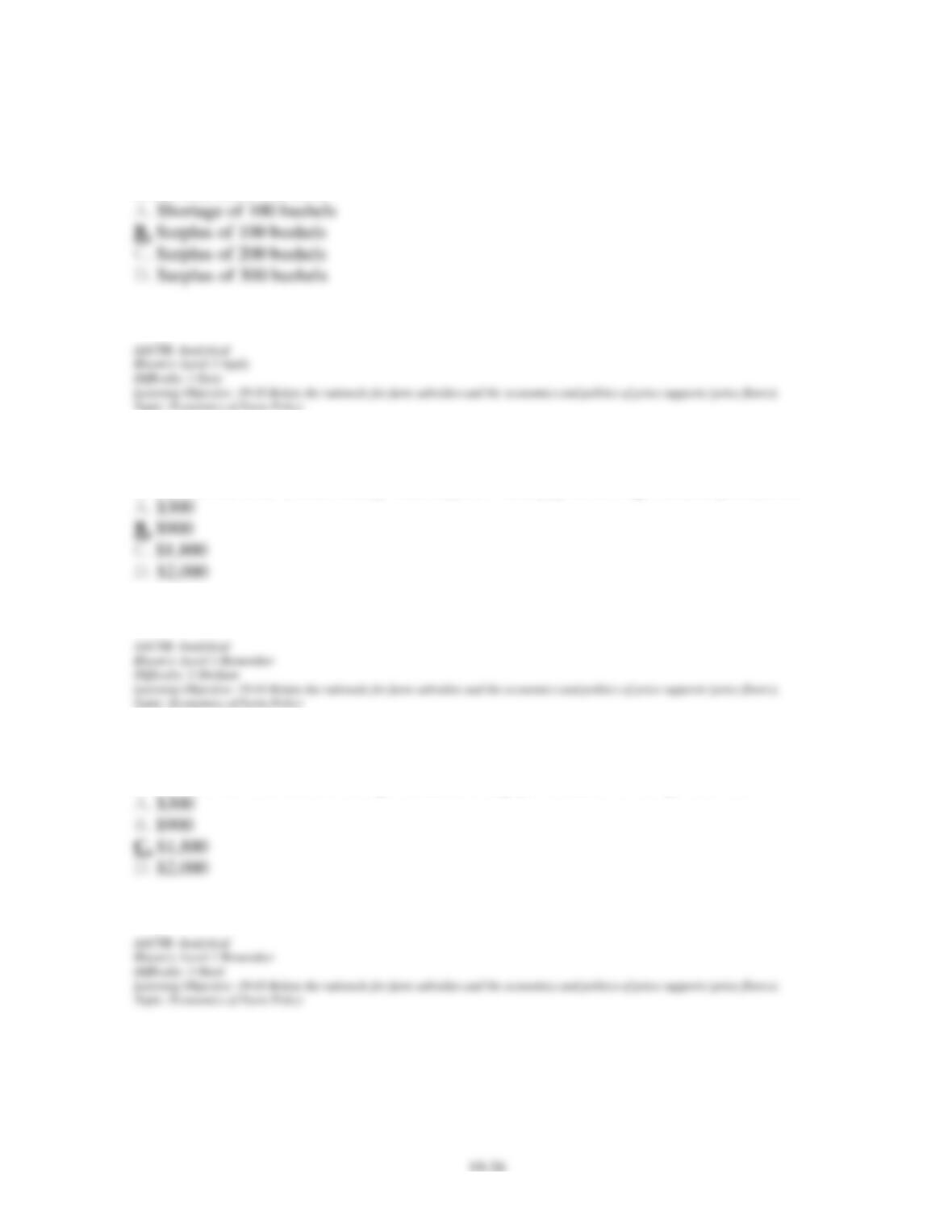
65. Refer to the above data. In a competitive market for this agricultural product, the
equilibrium price and output level will be:
Chapter 19 – Agriculture: Economics and Policy
66. Refer to the above data. If government adopts a price support program that sets the price
at $8, then there will be a:
67. Refer to the above data. If government adopts a price support program that sets the price
at $9, then the total amount that private buyers would pay for this agricultural product is:
68. Refer to the above data. If government adopts a price support program that sets the price
at $9, then the total amount that government will pay to farmers of this product is:
Chapter 19 – Agriculture: Economics and Policy
69. The agricultural price support program in the United States has resulted in:
70. Because the demand for agricultural products is price-inelastic, price support programs
tend to:
71. If government establishes a system of price supports, it is in effect setting a:
Chapter 19 – Agriculture: Economics and Policy
72. A decrease in the quantity of soybeans produced could result from:
73. If price supports are established, and producers are producing more than consumers want
to buy at that price, to maintain producers’ income the government will have to:
74. In a purely competitive market, how would a surplus of a product be eliminated?
Chapter 19 – Agriculture: Economics and Policy
75. Which of the following statements describes how a price-change in a purely competitive
market would eliminate the surplus of an agricultural commodity?
76. The Federal government has tried to eliminate agricultural surpluses by:
77. Government and private efforts to promote the production of “gasohol” using corn-based
ethanol is an attempt to:
Chapter 19 – Agriculture: Economics and Policy
78. Facets of the U.S. government’s ethanol program include the following, except:
79. Acreage allotments, which limit the number of acres planted with a particular crop, has an
effect on the crop’s price which is:
80. Comparing an acreage allotment program versus a taxpayer-subsidized price-support
program, the acreage allotment program:
Chapter 19 – Agriculture: Economics and Policy
81. Federal food distribution programs such as the food stamp program represent efforts to:
82. As a result of the acreage allotment programs, we would expect:
83. The Food for Peace program:
Chapter 19 – Agriculture: Economics and Policy
84. Agricultural price supports have been criticized because they:
85. A major criticism of agricultural subsidies is that:
86. Which group of farmers benefits the least from price supports in agriculture?