Chapter 17 – Asymmetric Information, Voting, and Public Choice
1. Asymmetric information in a market transaction occurs when there is unequal knowledge
possessed by the:
2. If Congress decreases the amount of government insurance on bank deposits, then this
action would:
Chapter 17 – Asymmetric Information, Voting, and Public Choice
3. Which would be an example of where the government has intervened to correct a market
failure caused by inadequate information about sellers?
4. A good example of a government action that creates a moral hazard problem would be the:
Chapter 17 – Asymmetric Information, Voting, and Public Choice
5. Refer to the graph above. Suppose consumers do not know the safety risks associated with
a particular good, and that the free-market equilibrium is at E as shown in the diagram above.
If an agency now provides information about the harmful characteristics of the product, then:
6. Refer to the graph above. Suppose consumers do not fully appreciate the benefits of the
product whose market is shown in the graph. If an external agency is able to provide fuller
information about the benefits of the product, then:
7. Refer to the graph above. Suppose that it is shows the market for an insurance product. If
something happens to heighten the adverse selection problem in this market, then:
Chapter 17 – Asymmetric Information, Voting, and Public Choice
8. The classic example of information failure that occurs in the market for used cars is the so-
called “lemons” problem, which illustrates:
9. The Temporary Assistance for Needy Families (TANF) program provides a sort of “divorce
insurance” and could lead to a problem of:
10. The “too big to fail” policy of the Fed, whereby some banks are bailed out if they are in
danger of failing because they are too big and could bring the system down, leads to which of
the following problems?
Chapter 17 – Asymmetric Information, Voting, and Public Choice
11. If a person drives with less care after purchasing auto insurance, this situation would be an
example of a(n):
12. Which would be an example of an adverse selection problem?
13. Which would be an example of a moral hazard problem?
Chapter 17 – Asymmetric Information, Voting, and Public Choice
14. Which would be considered an example of adverse selection?
15. The franchising of fast-food restaurants would be an example of how business:
16. Insurance policies typically stipulate a deductible amount which the insured must carry;
this is to help deal with the problem of:
Chapter 17 – Asymmetric Information, Voting, and Public Choice
17. Insurance companies typically charge higher premiums for higher-risk clients; this is to
help deal with the problem of:
18. Depositors do not check their banks carefully for stability anymore, because of the Federal
deposit insurance program. This illustrates the problem of:
19. E-bay and Amazon and other Internet shopping sites provide “seller ratings” done by
previous buyers, in order to help deal with the problem of:
Chapter 17 – Asymmetric Information, Voting, and Public Choice
20. Credit bureaus provide credit histories to banks and insurance companies, in order to help
deal with the problem of:
21. The moral hazard problem arises primarily because of:
22. Inadequate information about buyers can cause market failure in the form of:
Chapter 17 – Asymmetric Information, Voting, and Public Choice
23. Moral hazard and adverse selection are problems that result from inadequate information
about:
24. There is an adverse selection problem in the market for used cars because:
25. Which action would counteract the tendency for poor-quality products to drive out high-
quality products in a market?
Chapter 17 – Asymmetric Information, Voting, and Public Choice
26. Because of the problem of adverse selection, the average quality of a used car is:
27. There is asymmetric information for private purchases in the used car market because:
28. What economic concepts can be used to explain the reason that a new car purchased by a
consumer and driven off a new car lot decrease in value almost immediately compared with
the value of the same make and model of a car still on the new car lot?
Chapter 17 – Asymmetric Information, Voting, and Public Choice
29. Private car alarm systems with red blinking lights would tend to:
30. The study of public choice theory involves the economic analysis of the following,
except:
31. Problems with collective decision-making and economic inefficiency in government are
subjects that are studied in an area of economics called public:
Chapter 17 – Asymmetric Information, Voting, and Public Choice
32. In the U.S., society makes decisions on the direction of government policies and the
provision and financing of public goods through a process that relies heavily on:
33. Majority voting fails to incorporate the strength of the preferences of individual voters,
and therefore:
34. Assume that Matt, Joe, and Teresa are the only citizens in a community. A proposed
public good has a total cost of $1000. All three citizens will share an equal portion of this cost
in taxes. The benefit of the public good is $500 for Matt, $280 for Joe, and $260 for Teresa. In
a majority vote, this proposal will most likely be:
Chapter 17 – Asymmetric Information, Voting, and Public Choice
35. Assume that Matt, Joe, and Teresa are the only citizens in a community. A proposed
public good has a total cost of $1000. All three citizens will share an equal portion of this cost
in taxes. The benefit of the public good is $500 for Matt, $280 for Joe, and $260 for Teresa. In
a majority vote, this proposal will most likely be:
36. Assume that Abby, Ben, and Clara are the only citizens in a community. A proposed
public good has a total cost of $1000. All three citizens will share an equal portion of this cost
in taxes. The benefit of the public good is $400 each to Abby, Ben, and Clara. In a majority
vote, this proposal will most likely be:
Chapter 17 – Asymmetric Information, Voting, and Public Choice
37. Assume that Abby, Ben, and Clara are the only citizens in a community. A proposed
public good has a total cost of $1000. All three citizens will share an equal portion of this cost
in taxes. The benefit of the public good is $400 each to Abby, Ben, and Clara. Based on
economic analysis, the public good should:
38. Assume that Abby, Ben, Clara, Joe, and Matt are the only citizens in a community. A
proposed public good has a total cost of $1000. All five citizens will share an equal portion of
this cost in taxes. The benefit of the public good is $220 to Abby, $210 to Ben, $210 to Clara,
$180 to Joe, and $120 to Matt. In a majority vote, this proposal will most likely be:
Chapter 17 – Asymmetric Information, Voting, and Public Choice
39. Assume that Abby, Ben, Clara, Joe, and Matt are the only citizens in a community. A
proposed public good has a total cost of $1000. All five citizens will share an equal portion of
this cost in taxes. The benefit of the public good is $220 to Abby, $210 to Ben, $210 to Clara,
$180 to Joe, and $120 to Matt. Who are likely to vote in favor of this proposal?
40. Assume that Abby, Ben, Clara, Joe, and Matt are the only citizens in a community. A
proposed public good has a total cost of $1000. All five citizens will share an equal portion of
this cost in taxes. The benefit of the public good is $220 to Abby, $210 to Ben, $210 to Clara,
$180 to Joe, and $120 to Matt. In a majority vote, this proposal will most likely be:
41. Majority voting may produce economically inefficient outcomes because it:
Chapter 17 – Asymmetric Information, Voting, and Public Choice
42. Interest groups result when people:
43. The trading of votes to secure favorable outcomes on decisions which would otherwise be
defeated is called:
44. Inefficiencies associated with majority voting may get resolved through:
Chapter 17 – Asymmetric Information, Voting, and Public Choice
45. Which of the following would be an avenue for resolving the inefficiencies associated
with majority voting?
46. Which would be an avenue for resolving the inefficiencies associated with majority
voting?
47. A situation in which society may not be able to rank its preferences consistently through
paired-choice majority voting is:
Chapter 17 – Asymmetric Information, Voting, and Public Choice
48. The major problem with paired-choice majority voting is that the outcome:
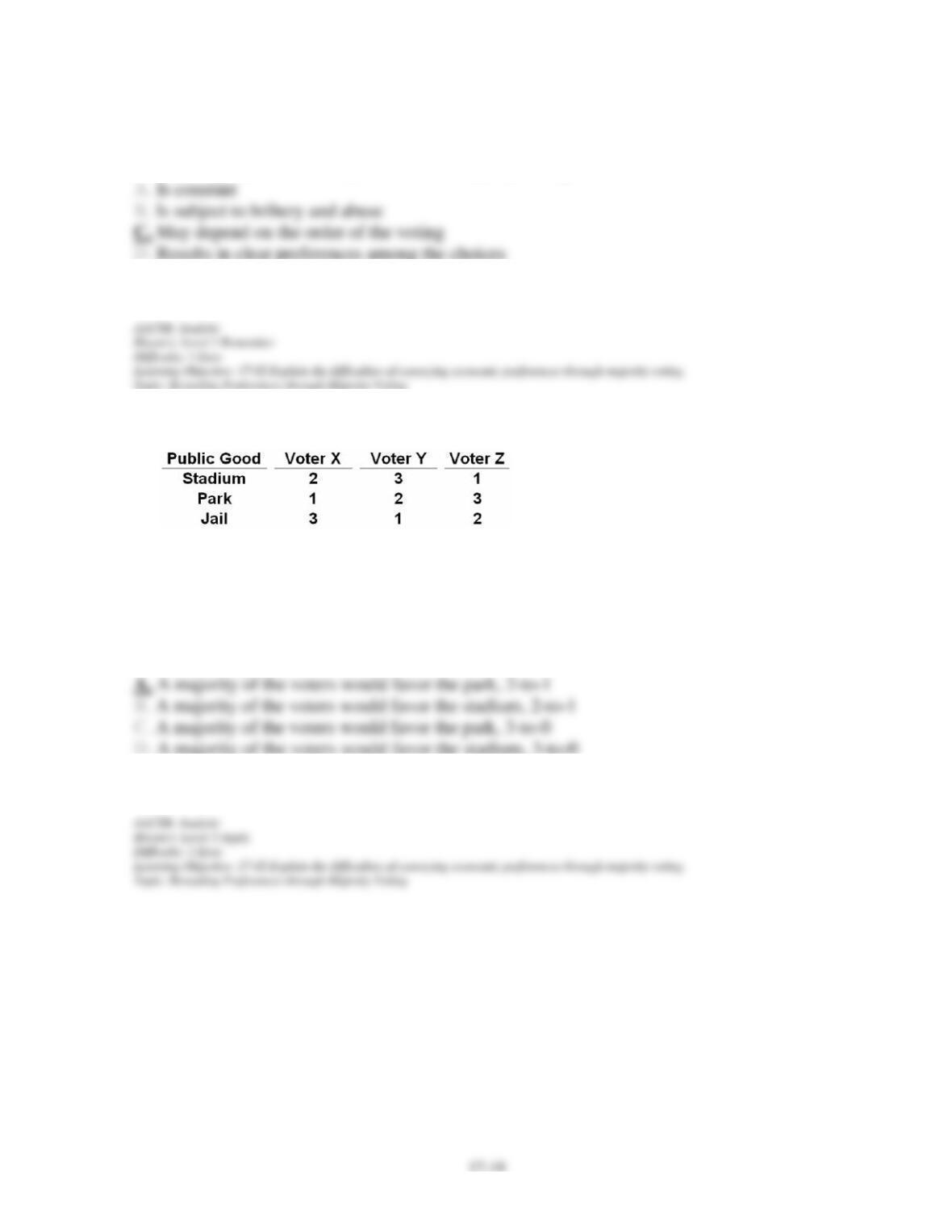
49. Refer to the above table, which shows the ranked preferences of voters for three
alternative projects, with “1” being the top preference. In a paired-choice vote between a
stadium and a park: