Chapter 16 – Public Finance: Expenditures and Taxes
1. Proprietary income refers to:
2. Revenues flowing to the government from government-run or government-sponsored
businesses, such as public utilities and state lotteries, are known as:
Chapter 16 – Public Finance: Expenditures and Taxes
3. The addition of government to the circular-flow model illustrates that government:
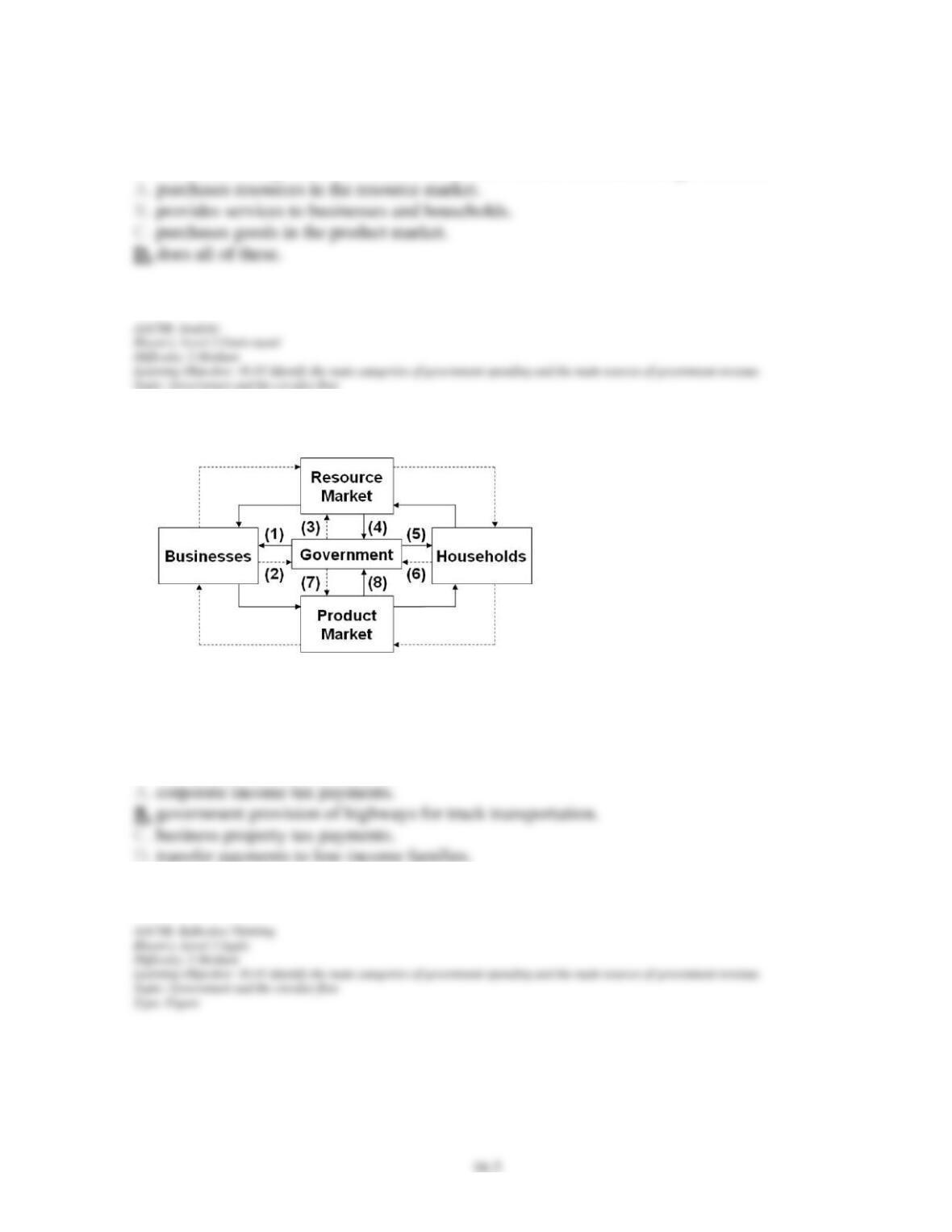
4. Refer to the above diagram, in which solid arrows reflect real flows; broken arrows are
monetary flows. Flow (1) might represent:
Chapter 16 – Public Finance: Expenditures and Taxes
5. Refer to the above diagram, in which solid arrows reflect real flows; broken arrows are
monetary flows. Flow (2) might represent:
6. Refer to the above diagram, in which solid arrows reflect real flows; broken arrows are
monetary flows. Flow (3) might represent:
7. Refer to the above diagram, in which solid arrows reflect real flows; broken arrows are
monetary flows. Flow (4) might represent:
Chapter 16 – Public Finance: Expenditures and Taxes
8. Refer to the above diagram, in which solid arrows reflect real flows; broken arrows are
monetary flows. Flow (5) might represent:
9. Refer to the above diagram, in which solid arrows reflect real flows; broken arrows are
monetary flows. Flow (6) might represent:
10. Refer to the above diagram, in which solid arrows reflect real flows; broken arrows are
monetary flows. Flow (7) might represent:
Chapter 16 – Public Finance: Expenditures and Taxes
11. Refer to the above diagram, in which solid arrows reflect real flows; broken arrows are
monetary flows. Flow (8) might represent:
12. In 2010, “Tax-Freedom Day” (the day average workers have earned enough to pay their
tax bills) was:
13. Transfer payments are about ____ of U.S. domestic output (as of 2009).
Chapter 16 – Public Finance: Expenditures and Taxes
14. Total governmental purchases—Federal, state, and local combined—account for about
what percentage of domestic output?
15. The total amount of U.S. tax revenue needed to finance the public sector:
16. As a proportion of domestic output, taxes in the United States:
Chapter 16 – Public Finance: Expenditures and Taxes
17. Which of the following is an exhaustive governmental outlay?
18. Government purchases and transfer payments:
19. Government borrowing:
Chapter 16 – Public Finance: Expenditures and Taxes
20. The opportunity cost of borrowing funds to finance government deficits is:
21. The largest source of tax revenue for the U.S. Federal government is:
22. Approximately what percentage of the Federal government’s tax revenues are generated
from personal income taxes (in 2009)?
Chapter 16 – Public Finance: Expenditures and Taxes
23. The three most important sources of Federal tax revenue in order of descending
importance are:
24. In determining one’s personal income tax, taxable income is:
25. The largest category of Federal spending is for:
Chapter 16 – Public Finance: Expenditures and Taxes
26. The tax rates embodied in the Federal personal income tax are such that:
27. The maximum Federal marginal tax rate on taxable personal income is currently (2010):
28. Which of the following is not an important source of revenue for the Federal
government?
Chapter 16 – Public Finance: Expenditures and Taxes
29. A progressive tax is such that:
30. An income tax is progressive if the:
31. The average tax rate is:
Chapter 16 – Public Finance: Expenditures and Taxes
32. If you would have to pay $5000 in taxes on a $25,000 taxable income and $7000 on a
$30,000 taxable income, then the marginal tax rate on the additional $5000 of income is:
33. The marginal tax rate is:
34. The average tax rate is:
Chapter 16 – Public Finance: Expenditures and Taxes
35. Assume that in year 1 you pay an average tax rate of 20 percent on a taxable income of
$20,000. In year 2, you pay an average tax rate of 25 percent on a taxable income of $30,000.
Assuming no change in tax rates, the marginal tax rate on your additional $10,000 of income
is:
36. The marginal tax rate is:
37. Currently (2010) the marginal tax rates of the Federal personal income tax:
Chapter 16 – Public Finance: Expenditures and Taxes
38. Assume that in year 1 your average tax rate is 20 percent on a taxable income of $20,000.
If the marginal tax rate on the next $10,000 of taxable income is 30 percent, what will be the
average tax rate if your taxable income rises to $30,000?
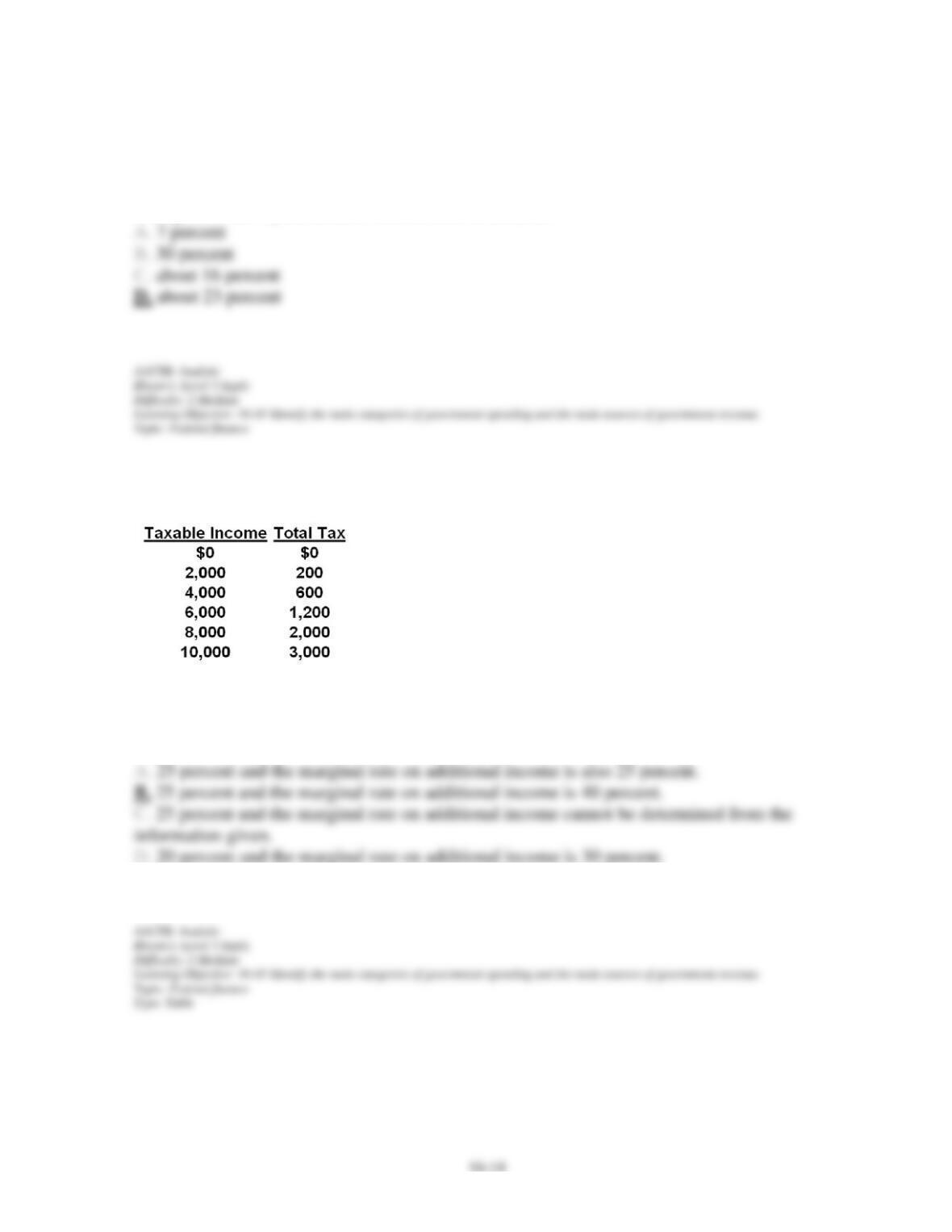
The following data represent a personal income tax schedule. Answer the question on the
basis of this information.
39. Refer to the above table. If your taxable income is $8,000, your average tax rate is:
Chapter 16 – Public Finance: Expenditures and Taxes
40. Refer to the above table. This tax is such that the after-tax distribution of income will be:
41. The tax represented above is:
Chapter 16 – Public Finance: Expenditures and Taxes
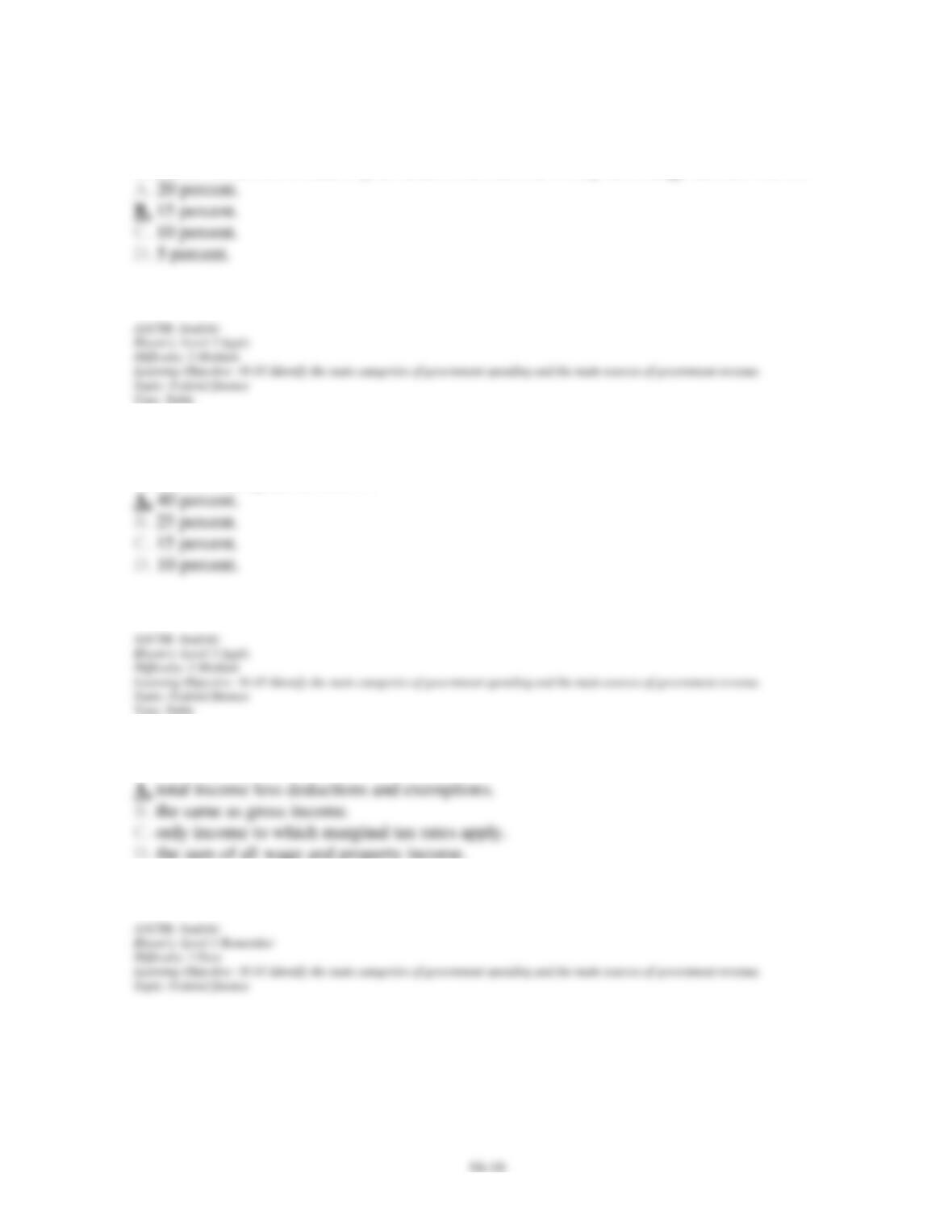
42. Refer to the above data. If your taxable income is $4000, your average tax rate will be:
43. Refer to the above data. If your taxable income increases from $4000 to $5000, you will
encounter a marginal tax rate of:
44. Taxable income is:
Chapter 16 – Public Finance: Expenditures and Taxes
45. The basic tax rate on taxable corporate income is:
46. Taxes on commodities or on purchases are known as:
47. Indy currently earns $50,000 in taxable income and pays $8000 in taxes. Suppose that
Indy faces a marginal tax rate of 25 percent and his boss offers him a raise of $2000 per year.
Indy should:
Chapter 16 – Public Finance: Expenditures and Taxes
48. With respect to state finance, for most states:
49. The main difference between sales and excise taxes is that:
Chapter 16 – Public Finance: Expenditures and Taxes
50. One difference between sales and excise taxes is that:
51. With respect to local finance:
Chapter 16 – Public Finance: Expenditures and Taxes
52. Government lotteries are:
53. Approximately what percentage of local government expenditures goes to finance
education?
54. Approximately what percentage of state spending goes to finance education?