Chapter 16 – Public Finance: Expenditures and Taxes
1. Public finance is the sub-discipline of economics that studies the various ways in which:
2. The following are government activities that are involved in public finance, except:
Chapter 16 – Public Finance: Expenditures and Taxes
3. The circular flow model with government would show that government:
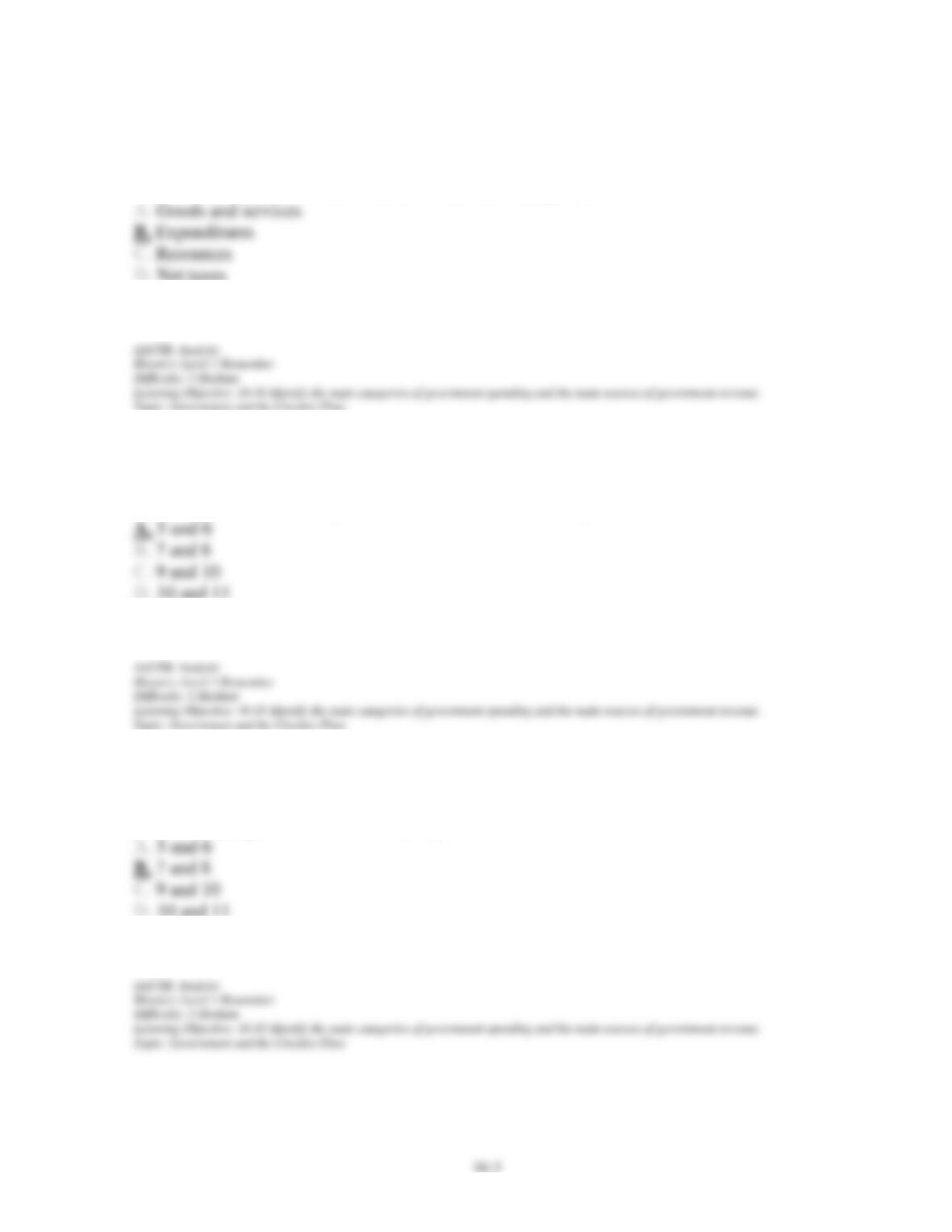
4. Refer to the diagram above. If box E represents government, box A businesses, and box C
households, then flows (11) and (12) would represent:
Chapter 16 – Public Finance: Expenditures and Taxes
5. Refer to the diagram above. If box E represents government, box B the resource market,
and box D the product market, then flows (5) and (7) represent:
6. Refer to the diagram above. If box E represents government, box A businesses, box B the
resource market, and box D the product market, then government purchases of computers,
office supplies, and military hardware would be illustrated by arrows:
7. Refer to the diagram above. If box E represents government, box A businesses, box B the
resource market, and box D the product market, then government hiring of teachers, soldiers,
police, and judges would be illustrated by arrows:
Chapter 16 – Public Finance: Expenditures and Taxes
8. The flow of “net taxes” in the circular flow model with a government sector includes the
following items, except:
9. A major distinction between government purchases and government transfer payments is
that:
10. In 2009, total government spending (comprising purchases and transfers) in the U.S. is
about:
Chapter 16 – Public Finance: Expenditures and Taxes
11. From 1960 to 2009, government purchases as a percentage of U.S. output have:
12. From 1960 to 2009, government transfer payments as a percentage of U.S. output have:
13. Government purchases of goods and services are:
Chapter 16 – Public Finance: Expenditures and Taxes
14. The so-called Tax Freedom Day of each year recognizes the day that:
15. In 2009, the so-called Tax Freedom Day in the U.S. occurred in:
16. The largest expenditure of the Federal government is for:
Chapter 16 – Public Finance: Expenditures and Taxes
17. The Federal expenditures for “pensions and income security” is dominated by:
18. The major sources of funds for the Federal government include the following, except:
19. Which of the following statements about government borrowing is true?
Chapter 16 – Public Finance: Expenditures and Taxes
20. Which is not a significant source of revenue for the Federal government?
21. In 2009, corporate income taxes contributed about what percentage of Federal tax
revenues?
22. The two largest sources of tax revenue for the Federal government are:
Chapter 16 – Public Finance: Expenditures and Taxes
23. The marginal tax rate is the:
24. If your income increases from $10,000 per year to $14,000 per year and your tax payment
increases from $2,000 to $2,840, the marginal tax rate:
25. If the marginal tax rate is 20 percent, by how much must income have increased if your
tax bill increases by $300?
Chapter 16 – Public Finance: Expenditures and Taxes
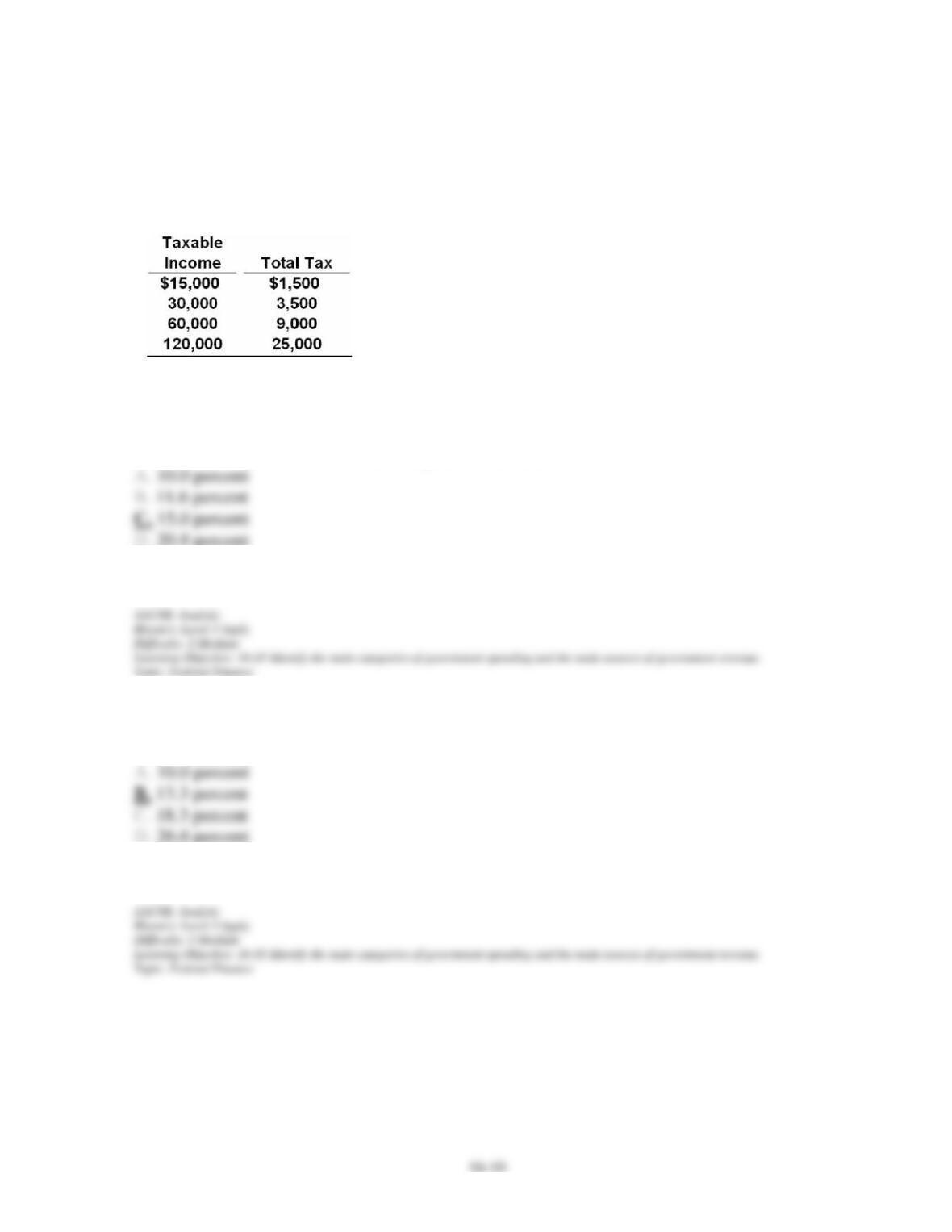
The following data represent a personal income tax schedule. Answer the question on the
basis of this information.
26. Refer to the table above. The average tax rate at the $60,000 level of income is:
27. Refer to the above table. If income increases from $15,000 to $30,000, the marginal tax
rate is:
Chapter 16 – Public Finance: Expenditures and Taxes
28. Refer to the above table. As income increases, the average tax rate:
29. Refer to the above table. As income increases, the marginal tax rate:
30. If taxes are $2,000 when income is $15,000 and they are $3,000 when income is $19,000,
then the marginal tax rate is:
Chapter 16 – Public Finance: Expenditures and Taxes
31. With a tax of $4,000 on $24,000 taxable income, the average tax rate is:
32. With a tax of $4,000 on $20,000 of income and $6,000 on $30,000 of income, the average
tax rate is:
33. Joe complains that 32% of his income last year went to taxes. He is referring to his:
Chapter 16 – Public Finance: Expenditures and Taxes
34. Social security contributions are part of:
35. Excise taxes of the Federal government include the following items, except:
36. Which of the following is the most important source of tax revenue for state
governments?
Chapter 16 – Public Finance: Expenditures and Taxes
37. Which of the following is the largest expenditure item of state governments?
38. Many states in the U.S. acquire significant amounts of funds from the following, except:
39. Which of the following statements about state lotteries is false?
Chapter 16 – Public Finance: Expenditures and Taxes
40. Which is the most important source of tax revenue for local governments?
41. Which of the following is the largest expenditure item of local governments?
42. Property taxes are:
Chapter 16 – Public Finance: Expenditures and Taxes
43. The tax revenues of local governments are typically:
44. In 2008, U.S. governments (local, state, and Federal) employed roughly how many
percent of the U.S. labor force?
45. Most of the state and local government employees are in what area?
Chapter 16 – Public Finance: Expenditures and Taxes
46. In 2008, the largest portion of Federal employees were in which of the following sectors?
47. The benefits-received principle of taxation is:
48. The progressive structure of the income-tax system is based on the:
Chapter 16 – Public Finance: Expenditures and Taxes
49. A tax structure is called progressive when:
50. If a tax is progressive, then:
51. If government levies a tax or fee on hunting licenses and uses the resulting revenue for
wildlife stocking programs, this would be an example of:
Chapter 16 – Public Finance: Expenditures and Taxes
52. A Federal excise tax on each tire purchased would be an example of the:
53. With a tax of $2,000 on $30,000 of income, and $2,000 on $70,000 of income, we can
describe the structure of this tax as:
54. If everyone pays a fixed dollar amount of tax, then the tax is a:
Chapter 16 – Public Finance: Expenditures and Taxes
55. With a proportional tax, higher-income persons will pay:
56. A tax is regressive if it:
57. A regressive tax means that if someone earning $25,000 pays $5,000, someone earning
$50,000 must pay: