Chapter 21 – Health Care
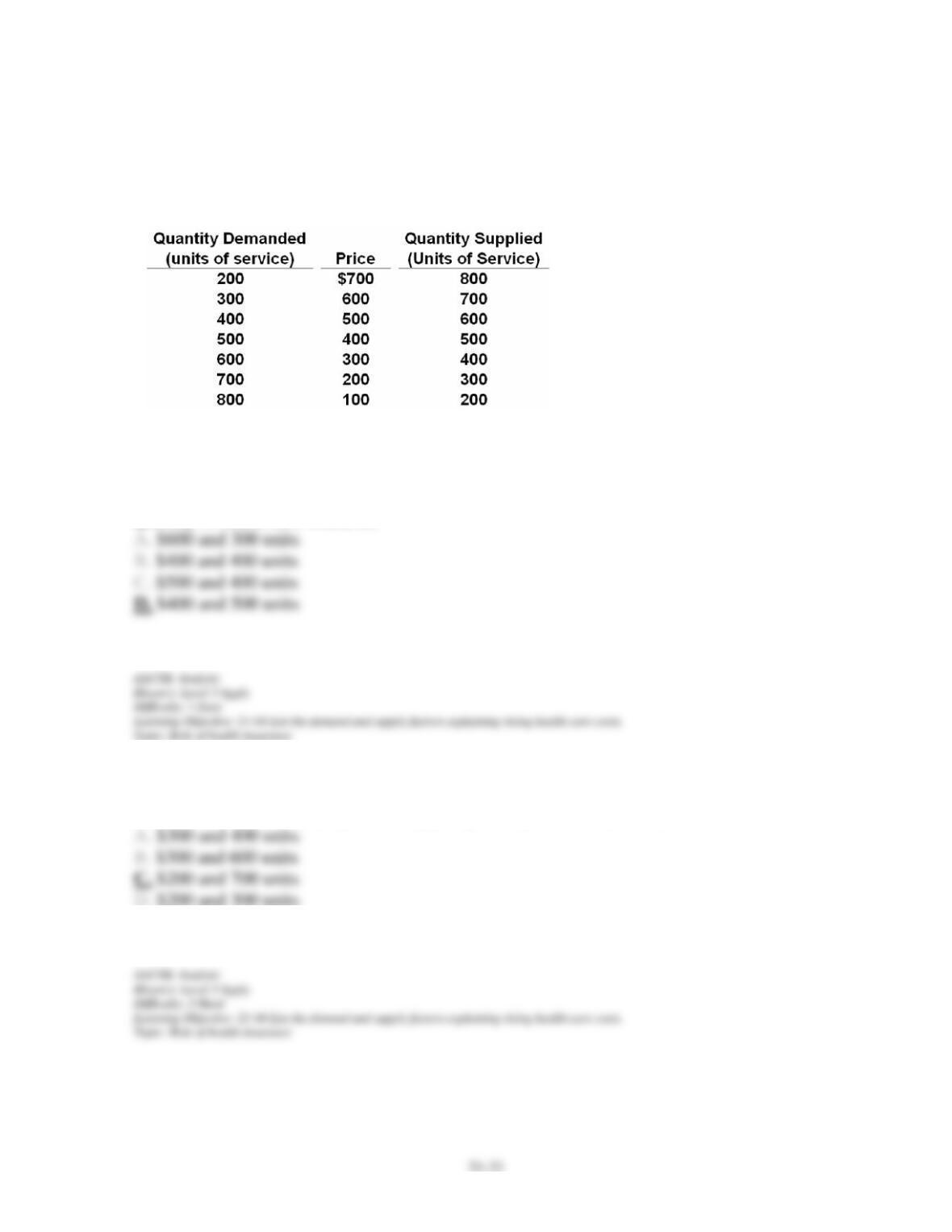
Use the table below to answer the question. The table shows the hypothetical demand and
supply schedule for health care
60. Refer to the above table. If there was no health insurance, the equilibrium price and
quantity of health care would be:
61. Refer to the above table. Assume that health insurance pays two-thirds the cost of health
care. For the consumer, the price and quantity of health care consumed would then be:
Chapter 21 – Health Care
62. Refer to the above table. With insurance paying two-thirds the cost of health care, there
would be a resulting allocative:
63. Refer to the above table. The efficiency loss caused by the availability of health insurance
paying two-thirds of the cost is:
Chapter 21 – Health Care
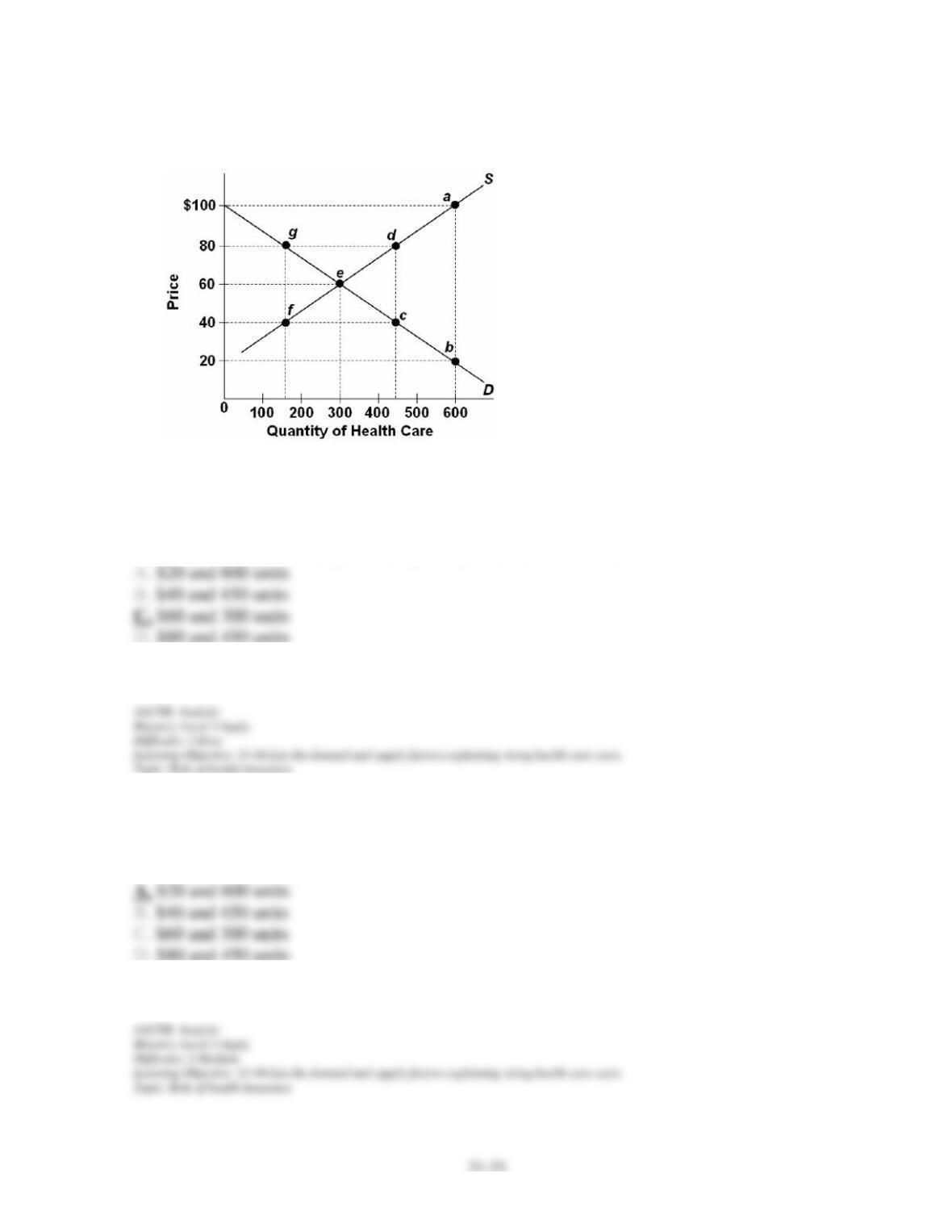
64. Refer to the above graph of a hypothetical market for health care. If there was not health
insurance, the equilibrium price and quantity of health care would be:
65. Refer to the above graph of a hypothetical market for health care. Assume that health
insurance pays four-fifths the cost of health care. For the consumer, the price and the quantity
of health care consumed would be:
Chapter 21 – Health Care
66. Refer to the graph above for the health care market. The marginal cost of health care
would be greater than the marginal benefit if the quantity consumed is:
67. Refer to the graph above for the health care market. A health insurance plan that pays
four-fifths of the cost of a consumer’s health care leads to:
68. Refer to the above graph of a hypothetical market for health care. What would be the
difference between the marginal cost and the marginal benefit of health care when the 450th
unit is consumed?
Chapter 21 – Health Care
69. Refer to the above graph of a hypothetical market for health care. The efficiency loss
caused by the provision of health insurance covering four-fifths of the cost is given by the
area:
70. Refer to the above graph of a hypothetical market for health care. The efficiency loss
caused by the provision of health insurance covering four-fifths of the cost is:
71. The following are supply factors in the health care market, except:
Chapter 21 – Health Care
72. Which would increase the supply of health care services?
73. Factors that have hampered the increase in the supply of physicians in the U.S. include the
following, except:
74. Competitive pricing has not developed in the health care industry due to the following
factors, except:
Chapter 21 – Health Care
75. Theoretically, the effect of private health insurance on the price and quantity of health
care consumed:
76. The reasons why health care costs in countries with public health insurance, like the
United Kingdom and Canada, have not risen as much as the costs in the U.S. include the
following, except:
77. Attempts to alter incentives and contain health care costs include the following, except:
Chapter 21 – Health Care
78. The percentage of cost that an insured individual pays while the insurer pays the
remainder would be considered:
79. The dollar sum of costs that an insured individual must pay before the insurer begins to
pay would be considered:
80. Raising the deductibles and copayments are a way of dealing with the:
Chapter 21 – Health Care
81. Health savings accounts (HSAs) have the following characteristics, except:
82. Some insurance companies have teamed with hospitals and doctors to provide discounts
for their services. The lists of cooperating doctors and hospitals are known as:
83. A unit set up by insurance companies that requires hospitals and physicians to provide
discounted prices for their services as a condition for being included in the insurance plan is
a:
Chapter 21 – Health Care
84. A health care organization that contracts with employers to provide health insurance to
their workers, and hires doctors and other groups to provide health care for the workers who
are insured is a:
85. One major difference between PPOs and HMOs is that:
86. The diagnosis-related-group (DRG) system adopted by Medicare since 1983 has had the
following effects, except:
Chapter 21 – Health Care
87. Supporters of setting a cap on medical malpractice (or “pain and suffering”) awards argue
the following, except:
89. Proponents of the Patient Protection and Affordable Care Act (PPACA) had one major
goal, which is: