Chapter 20 – Income Inequality and Poverty
20–21
56. Which of the following is a major reason for the growing income inequality in the United
States since 1970?
57. Reasons for the growing income inequality in the United States since 1970 include the
following, except:
Chapter 20 – Income Inequality and Poverty
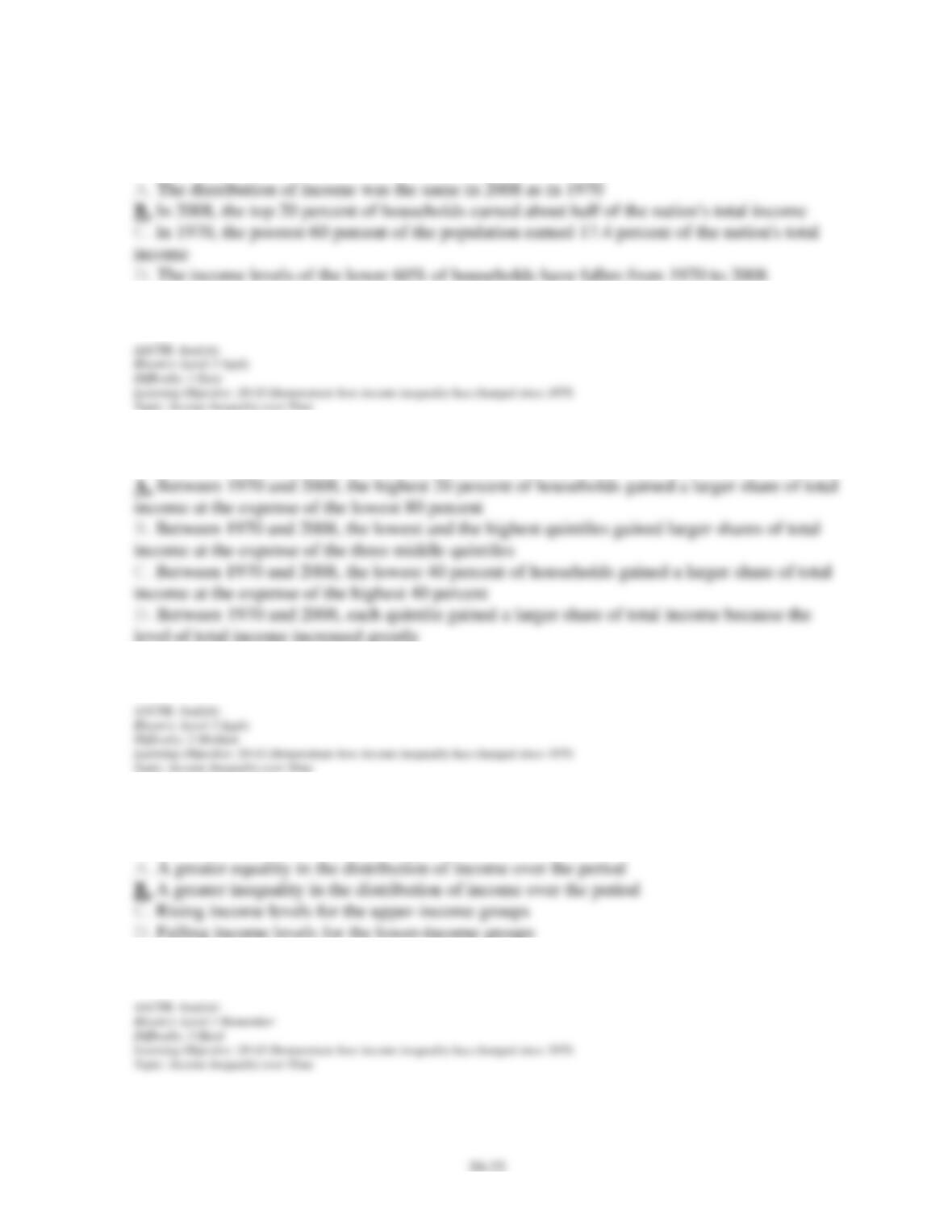
58. Refer to the data in the table above. Which of the following statements is correct?
59. Which statement best describes the data in the above table?
60. An examination of the quintile distribution of before-tax household income data for 1970
and 2008 given in the table above suggests a trend of:
Chapter 20 – Income Inequality and Poverty
61. Which of the following would be evidence of an increase in income inequality over time
in the United States?
62. “A more equal distribution of income in the United States would result in greater total
consumer satisfaction.” This statement is based on the concept that:
63. Suppose Rita obtains 10 units of utility from the last dollar of income received by her, and
Joseph obtains 6 units of utility from the last dollar of his income. Assume both Joseph and
Rita have the same capacity to derive utility from income. Those who favor an equal
distribution of income would:
Chapter 20 – Income Inequality and Poverty
64. The necessity to maintain incentives to work and incentives to produce output would be a
point made by an individual making the case for:
65. The equality-efficiency tradeoff would be most closely associated with which one of the
following statements?
66. The debate over income distribution focuses on the tradeoff between:
Chapter 20 – Income Inequality and Poverty
67. Greater income equality that is achieved through the redistribution of income is thought
to:
68. A reduction in the redistribution of income:
69. Poverty is a condition where a person or family does not have the means to:
Chapter 20 – Income Inequality and Poverty
70. In 2008, an unattached individual would be defined as living in poverty if his or her
income was less than:
71. In 2008, the poverty line for a family of four was about:
72. The following groups in the U.S. have high (above 20% in 2008) poverty rates, except:
Chapter 20 – Income Inequality and Poverty
73. In 2008, the percentage of the total U.S. population that lived in poverty was
approximately:
74. Of the following groups, which had the highest incidence of poverty in 2008?
75. The percentage of the U.S. population living in poverty during the 1959 to 1969 period:
Chapter 20 – Income Inequality and Poverty
76. From 1993 to 2000, the poverty rate:
77. The poverty rate in the U.S. from 2000 to 2008:
78. One main complaint about the official income thresholds used in defining poverty is that
Chapter 20 – Income Inequality and Poverty
79. Major complaints about the official income data used in measuring poverty include the
following, except:
80. Entitlement programs include:
81. Social insurance programs partially replace income that has been lost due to the following,
Chapter 20 – Income Inequality and Poverty
82. Which of the following statements applies to the Social Security program?
83. Government programs that pay benefits to those who are unable to earn income because
of permanent disabilities or to those who have very low incomes and dependent children are
called:
84. Government programs, such as Social Security, food stamps, AFDC, SSI, Medicare, and
Medicaid, that guarantee particular levels of transfer payments to all who fit the programs’
criteria are called:
Chapter 20 – Income Inequality and Poverty
85. Social Security payments are primarily made to assist:
86. The eligibility basis for the Supplemental Nutrition Assistance Program (or SNAP,
formerly called the food-stamp program) is:
87. The former food-stamp program is now the Supplemental Nutrition Assistance Program
(SNAP) and eligible households now receive:
Chapter 20 – Income Inequality and Poverty
88. The unemployment compensation social insurance program is a:
89. Basic differences between Medicare and Medicaid include the following, except:
90. Social insurance is distinguished from public assistance, or welfare, by the fact that:
Chapter 20 – Income Inequality and Poverty
91. Which of the following statements is correct?
92. The earned income tax credit (EITC) is, in essence:
93. Which is a payment or wage subsidy made by the Federal government to offset Social
Security taxes for low-income workers?
Chapter 20 – Income Inequality and Poverty
94. A major criticism of the welfare system that led to reforms in the mid-1990s is that
welfare payments:
95. The Temporary Assistance for Needy Families (TANF) is all of the following, except:
96. The Temporary Assistance for Needy Families (TANF) program:
Chapter 20 – Income Inequality and Poverty
97. One of the provisions of the Temporary Assistance for Needy Families (TANF) program
was to:
98. The taste-for-discrimination model examines an employer’s prejudice and discrimination
in hiring by using tools of:
99. Suppose that a prejudiced white employer is willing to hire white workers at a rate of
$16/hour, and this employer has a discrimination coefficient of $4. This implies that the
employer would:
Chapter 20 – Income Inequality and Poverty
100. Suppose that a prejudiced African-American employer has a discrimination coefficient
of $5/hour. Suppose also that the market wage rate is $20/hour for African-American workers,
and $18/hour for Hispanic workers. In this case, the employer will:
101. Suppose that white workers are getting paid $21/hour, while similarly-productive
African-American workers are getting paid $18/hour. A prejudiced white employer with a
discrimination coefficient of $24/hour will: