Chapter 19 – Agriculture: Economics and Policy
43. The parity ratio:
44. Which of the following statements is correct?
45. If the prices received by farmers increased and the prices paid by farmers also increased,
the parity ratio:
Chapter 19 – Agriculture: Economics and Policy
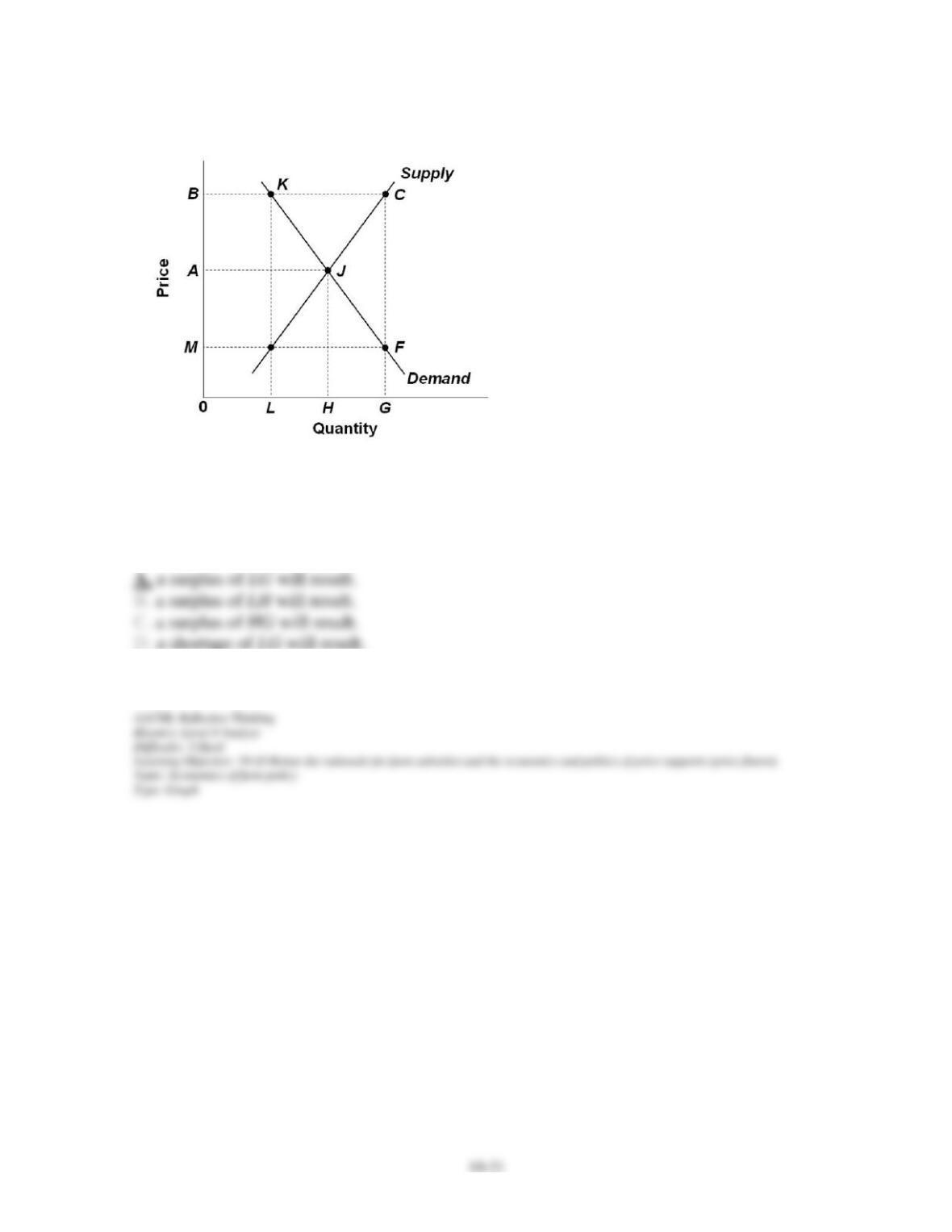
46. Refer to the above diagram for the corn market. As the result of a supported corn price of
B:
Chapter 19 – Agriculture: Economics and Policy
47. Refer to the above diagram for the corn market. As a consequence of a price support of B,
consumers will:
48. Refer to the above diagram for the corn market. A price support of B will cause a transfer
from taxpayers to farmers of:
49. Refer to the above diagram for the corn market. What effect will a price support of B have
on the gross income of farmers?
Chapter 19 – Agriculture: Economics and Policy
50. Refer to the above diagram for the corn market. Assuming no externalities, a price support
of B causes:
51. Which of the following statements is correct?
52. The misallocation of resources associated with price supports:
Chapter 19 – Agriculture: Economics and Policy
53. Acreage allotment programs were designed to:
54. Domestic price supports on, say, sugar:
55. Price supports:
Chapter 19 – Agriculture: Economics and Policy
56. Because government price supports cause surplus production, government policies have
been designed to:
57. The food-stamp program is designed to:
58. The Food for Peace program is designed to:
Chapter 19 – Agriculture: Economics and Policy
59. Price supports in agriculture have been criticized because they:
60. When critics of U.S. farm policy say that it treats symptoms rather than causes, they mean
that the:
61. Import quotas on sugar may cost consumers $2 billion per year. But this quota goes
unchallenged because the $10 average annual cost per person is so small that probably not one
voter in 200 knows the quota exists. This statement describes:
Chapter 19 – Agriculture: Economics and Policy
62. Farm groups spend considerable amounts of money to maintain and enlarge political
support for farm subsidies. This illustrates:
63. As applied to agriculture, the special-interest effect suggests that:
64. If farm state legislators support the food-stamp program to aid the urban poor and urban
state legislators in turn support farm subsidies, this is an example of:
Chapter 19 – Agriculture: Economics and Policy
65. Farm programs such as those of the United States and the European Union:
66. Farm programs such as those of the United States and the European Union:
67. Farm programs such as those of the United States and the European Union cause a
misallocation of international agricultural resources primarily because:
Chapter 19 – Agriculture: Economics and Policy
68. An international agreement reached in 1994 by the world’s trading nations provides for:
69. In 1994, the world’s trading nations agreed to:
70. The purpose of the Freedom to Farm Act of 1996 was to:
Chapter 19 – Agriculture: Economics and Policy
71. The U.S. price support program, which guaranteed prices for currently grown crops:
72. The Food, Conservation, and Energy Act of 2008:
Chapter 19 – Agriculture: Economics and Policy
73. Irving Tiller exclusively grew wheat in each of the past three years. Under the Food,
Conservation, and Energy Act of 2008, Tiller:
74. Which of the following is a feature of farm policy present in the Food, Conservation, and
Energy Act of 2008, that was not part of the Freedom to Farm Act of 1996?
75. Under the Food, Conservation, and Energy Act of 2008, subsidies to farmers based on
gaps between actual prices of crops and targeted prices are called:
Chapter 19 – Agriculture: Economics and Policy
76. Johnny Deer exclusively grew corn in each of the past three years. Under the Food,
Conservation, and Energy Act of 2008, Deer:
77. Ward Planter exclusively grew soybeans in each of the past three years and currently
participates in the marketing loan program of the Food, Conservation, and Energy Act of
2008. If the “crop price” of soybeans at harvest is less than the pre-harvest “loan price,”
Planter can:
Chapter 19 – Agriculture: Economics and Policy
78. The Food, Conservation, and Energy Act of 2008 does not address the fundamental
problem of agricultural subsidies, which is that those subsidies:
79. (Consider This) Which of the following methods is used by farmers to “hedge” against
short-run price and output fluctuations?
80. (Consider This) Which of the following methods is commonly used by farmers to
“smooth” income over time?
Chapter 19 – Agriculture: Economics and Policy
81. (Consider This) In part as a result of the U.S. government’s ethanol program, between
2005 and 2007 the inflation-adjusted price of a bushel of corn:
82. (Consider This) Which of the following has been an effect of the U.S. government’s
ethanol program?
83. (Last Word) The U.S. sugar program:
Chapter 19 – Agriculture: Economics and Policy
84. (Last Word) The U.S. sugar program has:
85. (Last Word) The U.S. sugar price support program has:
86. U.S. exports of farm products have generally declined as a percentage of U.S. farm output
over the past half-century.
Chapter 19 – Agriculture: Economics and Policy
87. Increases in incomes usually result in more than proportionate increases in the demand for
agricultural products in a growing economy.
88. Agriculture is overcrowded because of absolute and relative increases in the size of farm
employment.
89. About 10 percent of the U.S. labor force is in agriculture.
90. Farmers typically sell their products in highly competitive markets and buy in imperfectly
competitive markets.
Chapter 19 – Agriculture: Economics and Policy
91. If the demand for agricultural products is inelastic, a relatively small increase in supply
will cause farm prices and incomes to decline.
92. The use of price support programs in agriculture has hastened the exodus of resources
from agriculture.
93. The concept of parity has provided a rationale for government price supports for farm
products.
94. If prices received by farmers decline and prices paid by farmers increase, the parity ratio
will decline.
Chapter 19 – Agriculture: Economics and Policy
95. The Food, Conservation, and Energy Act of 2008 provides three types of agricultural
subsidies: direct payments, countercyclical payments, and marketing loans.
96. The Federal government has not paid subsidies to farmers since passage of the Freedom to
Farm Act in 1996.
97. Environmentalists generally support price supports because these subsidies motivate
additional farm production.
98. The principal beneficiaries of government agricultural aid have been the very low-income
farmers.