Chapter 16 – Public Finance: Expenditures and Taxes
55. In 2008, U.S. governments (local, state, and Federal) employed approximately how many
million workers?
56. Approximately what percentage of the U.S. labor force works for U.S. governments at the
Federal, state, and local levels?
57. At the state and local levels of the U.S. government, a majority of government employees
work in which of the following areas?
Chapter 16 – Public Finance: Expenditures and Taxes
58. Federal employment in the United States is dominated by what two functions?
59. The ability-to-pay principle of taxation:
60. The benefits-received principle of taxation is most evident in:
Chapter 16 – Public Finance: Expenditures and Taxes
61. Which of the following best reflects the ability-to-pay philosophy of taxation?
62. Entry fees at national parks and monuments are an example of:
63. The rationale for ability-to-pay taxation and the contention that those with large incomes
should pay more taxes both absolutely and relatively is that:
Chapter 16 – Public Finance: Expenditures and Taxes
64. Which of the following statements is most consistent with the benefits-received principle
of taxation?
65. The Federal gasoline tax is assessed on a per-gallon basis and the proceeds are used for
highway maintenance and improvements. This tax is consistent with the:
66. The Federal income tax is consistent with the __________ principle of taxation, whereas
an excise tax on sporting event tickets is consistent with the ___________ principle of
taxation.
Chapter 16 – Public Finance: Expenditures and Taxes
67. Using income as the tax base, which of the following best illustrates a regressive tax?
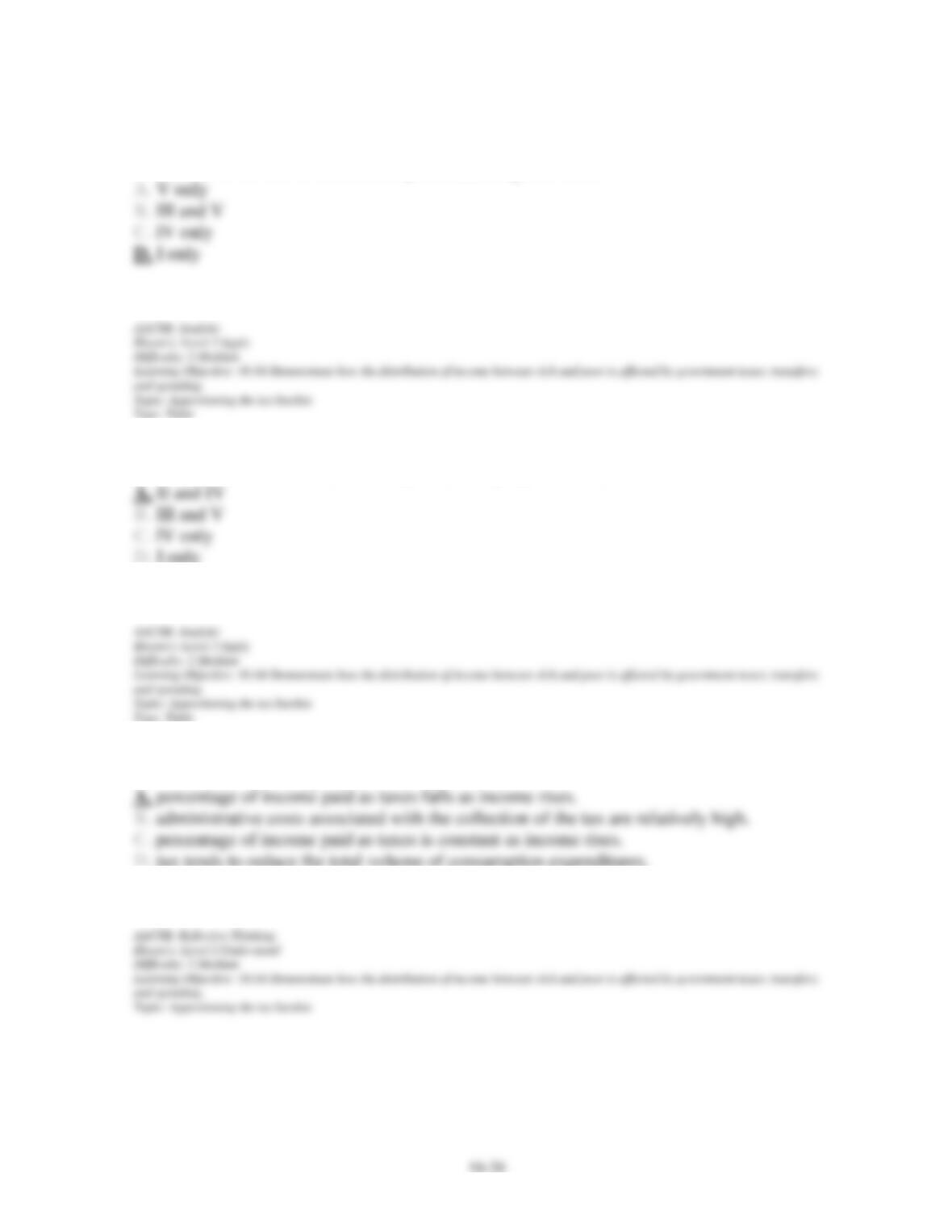
Answer the question on the basis of the following five schedules, all of which represent
income tax schedules for an economy. All figures are in billions of dollars.
68. Which of the above schedules represent(s) a progressive tax?
Chapter 16 – Public Finance: Expenditures and Taxes
69. Which of the above schedules represent(s) a regressive tax?
70. Which of the above schedules represent(s) a proportional tax?
71. The sales tax is a regressive tax because the:
Chapter 16 – Public Finance: Expenditures and Taxes
72. A tax that takes a larger proportion of income from low-income groups than from high-
income groups is a:
73. If each taxpayer paid the same lump-sum amount regardless of income level, the tax
system would be:
Chapter 16 – Public Finance: Expenditures and Taxes
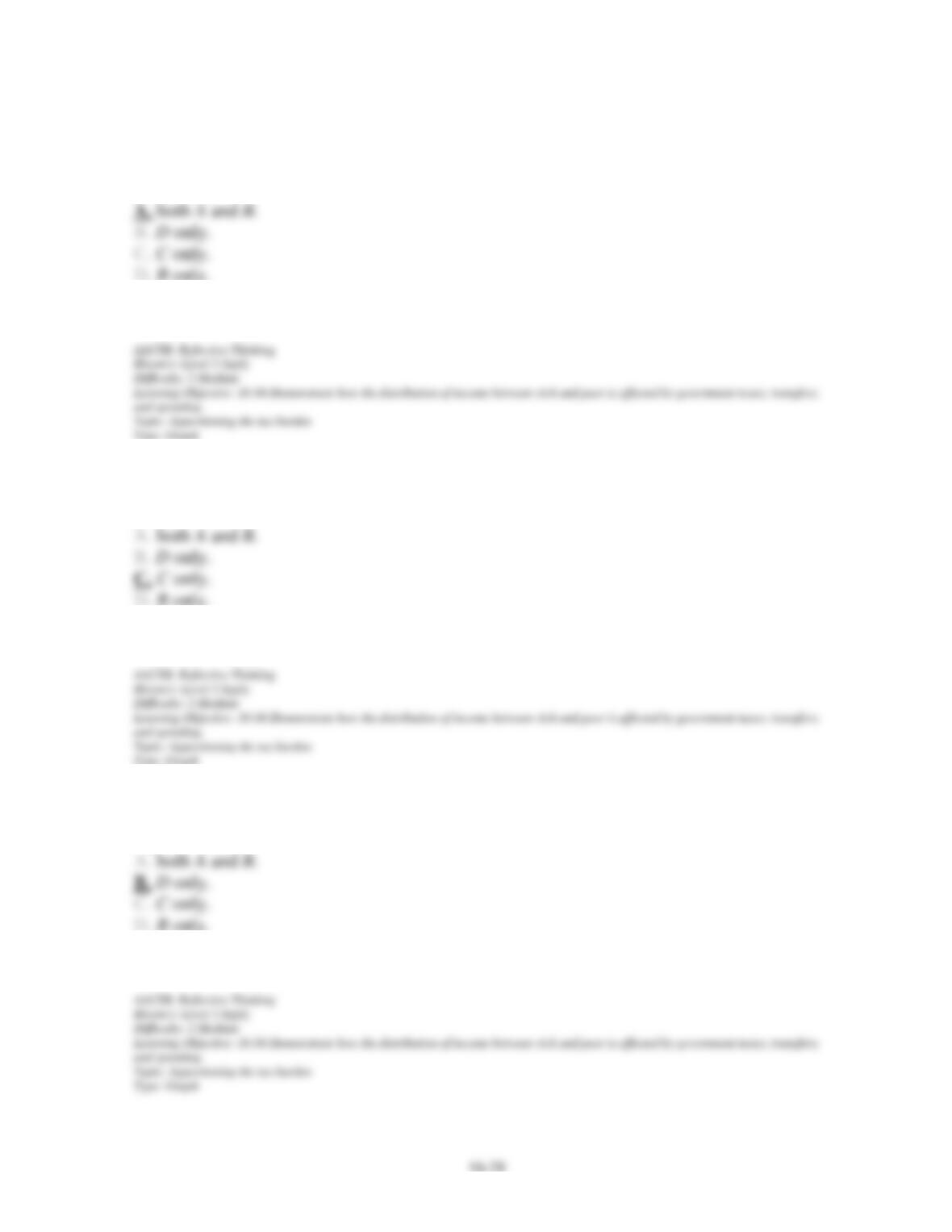
74. Refer to the above graph. Which of the lines in the above diagram represent(s) a
progressive tax?
75. Refer to the above graph. Which of the lines in the above diagram represent(s) a
proportional tax?
76. Refer to the above graph. Which of the lines in the above diagram represent(s) a
regressive tax?
Chapter 16 – Public Finance: Expenditures and Taxes
77. Assume you pay a tax of $4,000 on a taxable income of $24,000. If your taxable income
were $30,000, your tax payment would be $5,000. This suggests that the tax is:
78. Assume that you pay $10,000 of tax on a taxable income of $50,000. If your taxable
income were $150,000, your tax payment would be $25,000. This suggests the tax is:
79. Which of the following is correct?
Chapter 16 – Public Finance: Expenditures and Taxes
80. Overall, the U.S. tax system (combined Federal, state, and local) is:
81. In 2007, the top 1 percent of all taxpayers in the United States paid what percent of the
Federal income tax?
82. The U.S. tax-transfer system (as distinct from the tax system alone) is:
Chapter 16 – Public Finance: Expenditures and Taxes
83. In 2006, the 20 percent of families with the lowest incomes paid an average Federal tax
rate (on all Federal taxes) of about __, whereas the 20 percent of families with the highest
incomes paid an average tax rate of about __.
84. In 2006, the top 1 percent of all taxpayers in the United States faced an overall Federal tax
rate of:
85. The incidence of a tax pertains to:
Chapter 16 – Public Finance: Expenditures and Taxes
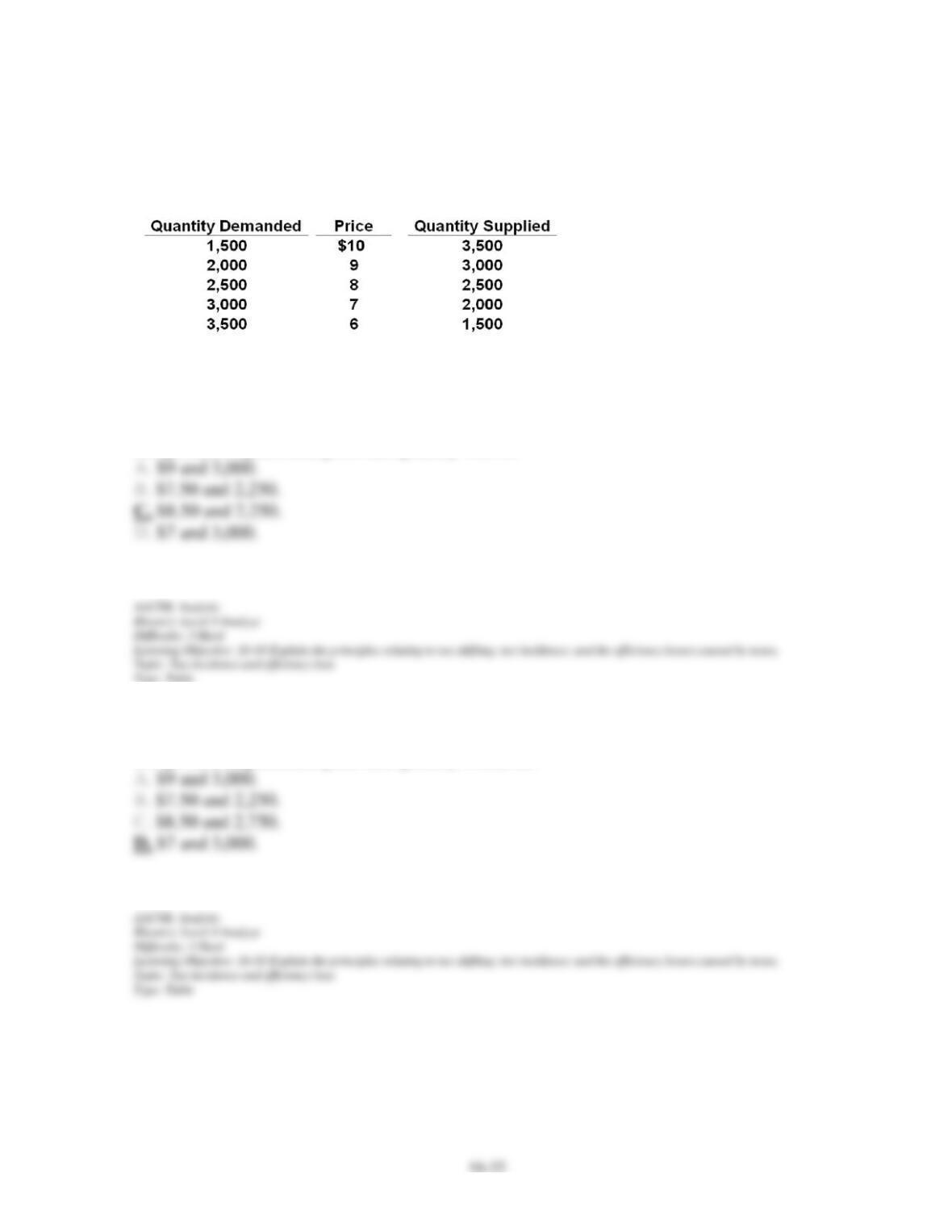
Answer the question on the basis of the following demand and supply data for a competitive
market:
86. Refer to the above data. If government levies a per unit excise tax of $1 on suppliers of
this product, equilibrium price and quantity will be:
87. Refer to the above data. If government provides a per unit subsidy of $2 to suppliers of
this product, equilibrium price and quantity would be:
Chapter 16 – Public Finance: Expenditures and Taxes
88. Assume the Environmental Protection Agency imposes an excise tax on polluting firms.
In which of the following situations would we expect the additional costs to be borne most
heavily by consumers?
89. If the demand for a product is perfectly elastic and supply is upsloping, a $1 excise tax per
unit on suppliers will:
90. If the supply of a product is perfectly elastic and demand is downsloping, an excise tax of
$2 per unit will increase price by:
Chapter 16 – Public Finance: Expenditures and Taxes
91. Suppose that government imposes a specific excise tax on product X of $2 per unit and
that the price elasticity of demand for X is unitary (coefficient = 1). If the incidence of the tax
is such that the producers of X pay $1.75 of the tax and the consumers pay $.25, we can
conclude that the:
92. Suppose that government imposes a specific excise tax on product X of $2 per unit and
that the price elasticity of demand for X is unitary (coefficient = 1). If the incidence of the tax
is such that consumers pay $1.80 of the tax and the producers pay $.20, we can conclude that
the:
Chapter 16 – Public Finance: Expenditures and Taxes
93. Suppose that government imposes a specific excise tax on product X of $2 per unit and
that the price elasticity of supply of X is unitary (coefficient = 1). If the incidence of the tax is
such that the producers of X pay $1.90 of the tax and the consumers pay $.10, we can
conclude that the:
94. Suppose that government imposes a specific excise tax on product X of $2 per unit and
that the price elasticity of supply of X is unitary (coefficient = 1). If the incidence of the tax is
such that the consumers of X pay $1.85 of the tax and the producers pay $0.15, we can
conclude that the:
Chapter 16 – Public Finance: Expenditures and Taxes
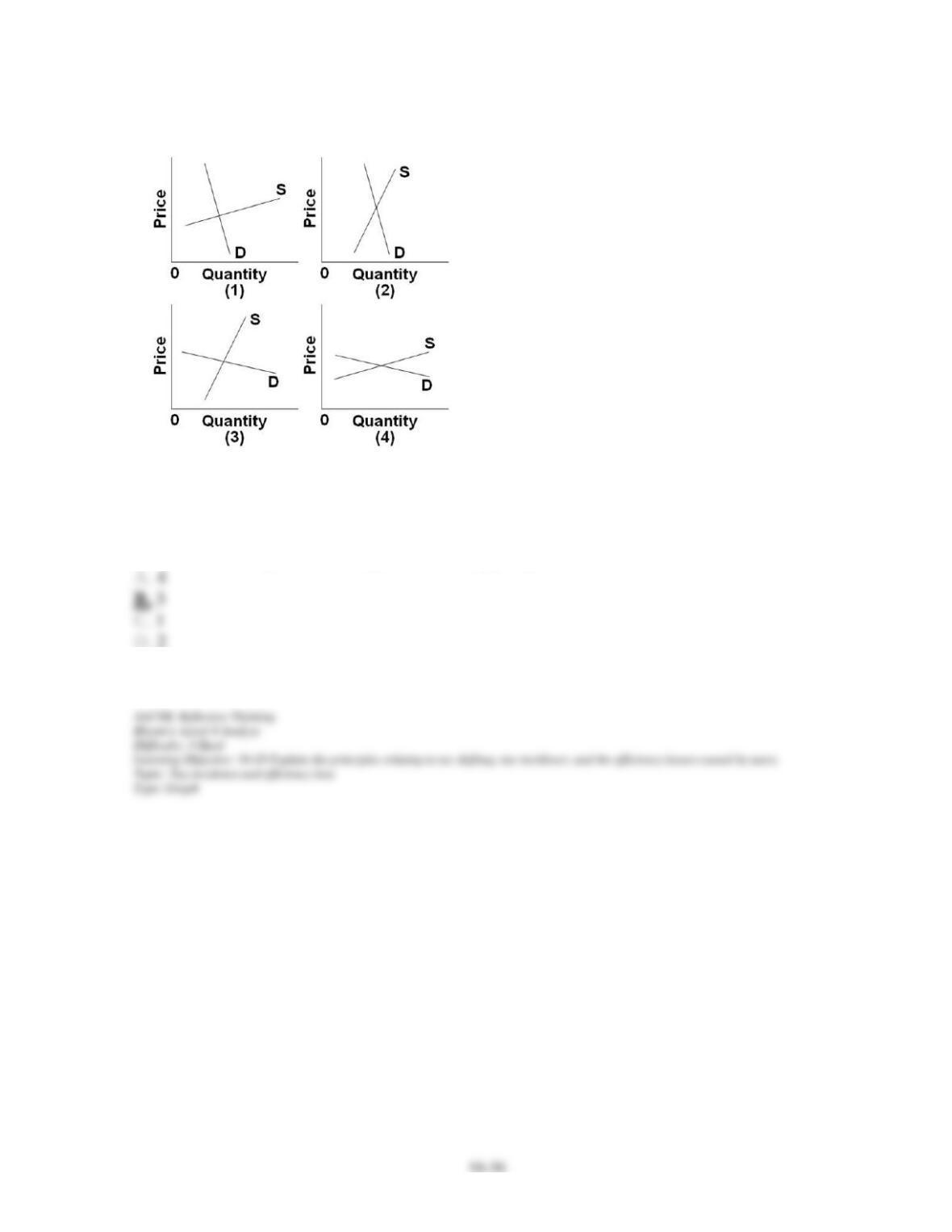
95. In which of the above market situations will the largest portion of an excise tax of a
specified amount per unit of output be borne by producers?
Chapter 16 – Public Finance: Expenditures and Taxes
96. In which of the above market situations will the largest portion of an excise tax of a
specified amount per unit of output be borne by buyers?
97. In which of the above market situations will the efficiency loss of an excise tax be the
greatest?
98. Assume the demand for automobile tires is highly inelastic and that the supply is highly
elastic. The burden of a $2 excise tax on each tire will be: