Chapter 21 – Health Care
1. Approximately how many workers are employed in the U.S. health care industry?
2. In the U.S., approximately how many doctors are there per 100,000 of population?
Chapter 21 – Health Care
3. Employer-provided private health insurance:
4. In 2007, approximately what percentage of people in the U.S. with private health insurance
received it as an employer-provided benefit?
Chapter 21 – Health Care
5. Employer-provided private health insurance began in the United States because:
6. Employer-provided private health insurance in the U.S. has resulted in:
7. The twin problems of the U.S. health care industry are:
Chapter 21 – Health Care
8. The price of medical care in the United States has:
9. Which of the following statements is true about health care costs in the United States?
10. Approximately how many millions of Americans do not have health insurance (prior to
gaining coverage through the Patient Protection and Affordable Care Act)?
Chapter 21 – Health Care
11. When the U.S. is described as having a dual system of health care, this means that:
12. The major purpose of Medicare is to:
13. The major objective of Medicaid is to:
Chapter 21 – Health Care
14. As a percentage of GDP, health care spending in the United States has:
15. Aggregate U.S. health care spending in 2009 was just over:
16. The United States devotes about ______ percent of its domestic output to health care.
Chapter 21 – Health Care
17. Between 1960 and 2009, U.S. health care spending as percentage of domestic output:
18. As a percentage of GDP, U.S. health care spending is:
19. Total U.S. health care spending in 2008 was approximately:
Chapter 21 – Health Care
20. In the past several decades U.S. health care expenditures have:
21. Roughly what portion of U.S. total health spending is paid for by private and public
insurance?
22. Rapidly rising U.S. health care costs have:
Chapter 21 – Health Care
23. Which of the following statements is correct?
24. The perceived central economic problem associated with the U.S. health care system is:
25. The fundamental problem associated with the U.S. health care system is that:
Chapter 21 – Health Care
26. When economists say that health care services are overconsumed, they mean that:
27. Approximately what percentage of U.S. health care spending is financed by public
insurance?
28. Health care expenditures coming directly out of consumers’ pockets, primarily in the form
of deductibles and copayments, account for what percent of U.S. health care spending?
Chapter 21 – Health Care
29. For many years the price of medical care in the United States has:
30. The number of Americans without health insurance (as of 2008) is approximately:
31. Given the availability of the Medicaid program, why are so many poor people uninsured?
Chapter 21 – Health Care
32. Which of the following persons is most likely to be insured for health care?
33. The unemployed are disproportionately represented among the uninsured because:
34. The health care market is characterized by:
Chapter 21 – Health Care
35. In the health care market:
36. The price elasticity of demand for health care is such that an increase in the price of health
care will:
37. The price elasticity of demand for health care is:
Chapter 21 – Health Care
38. The demand for health care in industrially advanced economies is:
39. In industrially advanced countries estimates suggest the income elasticity of demand for
health care is about:
40. Health care:
Chapter 21 – Health Care
41. In industrially advanced countries the price elasticity of demand for health care is about:
42. Other things equal, and given that the elasticity of demand for health care is 0.2, a 10
percent increase in the price of health care in the United States will reduce the quantity of
health care demanded by about:
43. Which of the following is a demand-increasing factor in the health care market?
Chapter 21 – Health Care
44. Defensive medicine refers to the idea that:
45. Defensive medicine:
46. The problem of asymmetric information is that:
Chapter 21 – Health Care
47. A major implication of asymmetric information is that:
48. If labor productivity in the health care industry rises very slowly relative to wages and
49. According to most experts, which of the following factors is most important in causing
health care costs to rise?
Chapter 21 – Health Care
50. Economists argue that in treating patients:
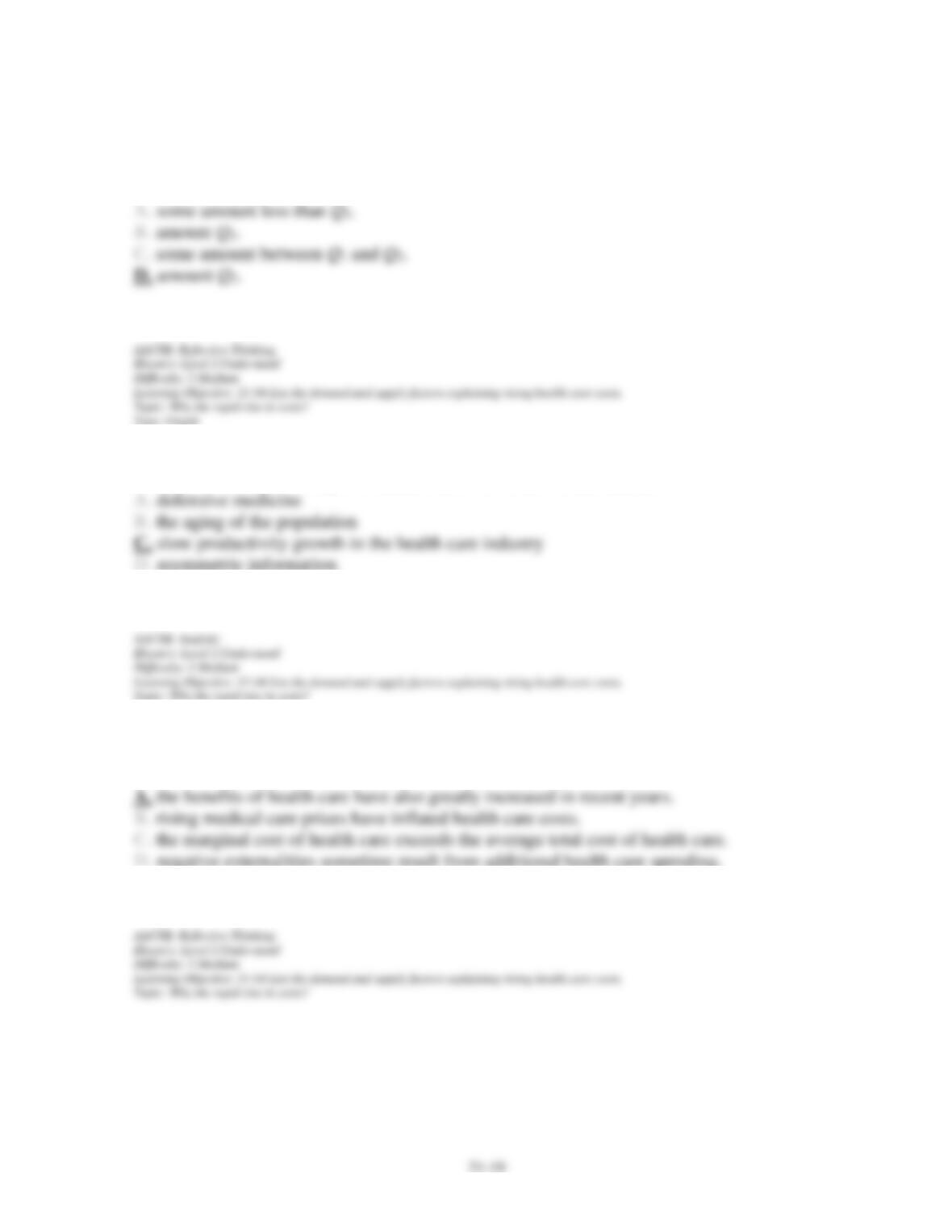
51. Refer to the above diagram. Economists would argue that health care should be provided
to patients in:
Chapter 21 – Health Care
52. Refer to the above diagram. Physicians likely would argue that health care should be
provided to patients in:
53. Which of the following is a supply factor in the health care market?
54. Health care costs have greatly increased in recent years in the United States. This fact
alone does not establish an overallocation of resources to health care because:
Chapter 21 – Health Care
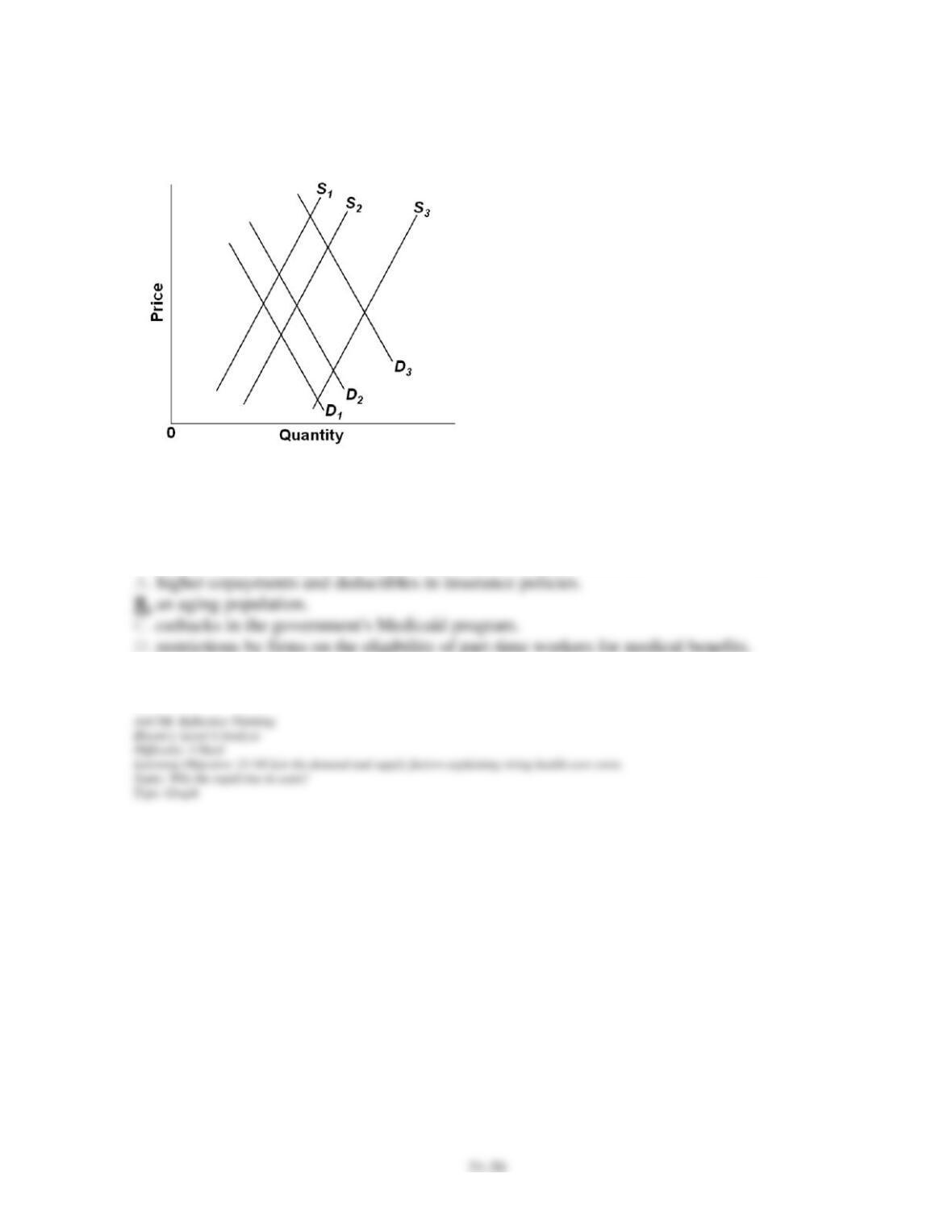
55. Refer to the above diagram that shows the market for U.S. health care. Other things equal,
which of the following would shift the demand curve for medical care from D1 to D2?