Chapter 20 – Income Inequality and Poverty
56. The entrance of large numbers of “baby boomers” into the labor force in the 1970s and
1980s:
57. The basic argument for income inequality is that:
58. The basic economic argument for greater income equality is that:
Chapter 20 – Income Inequality and Poverty
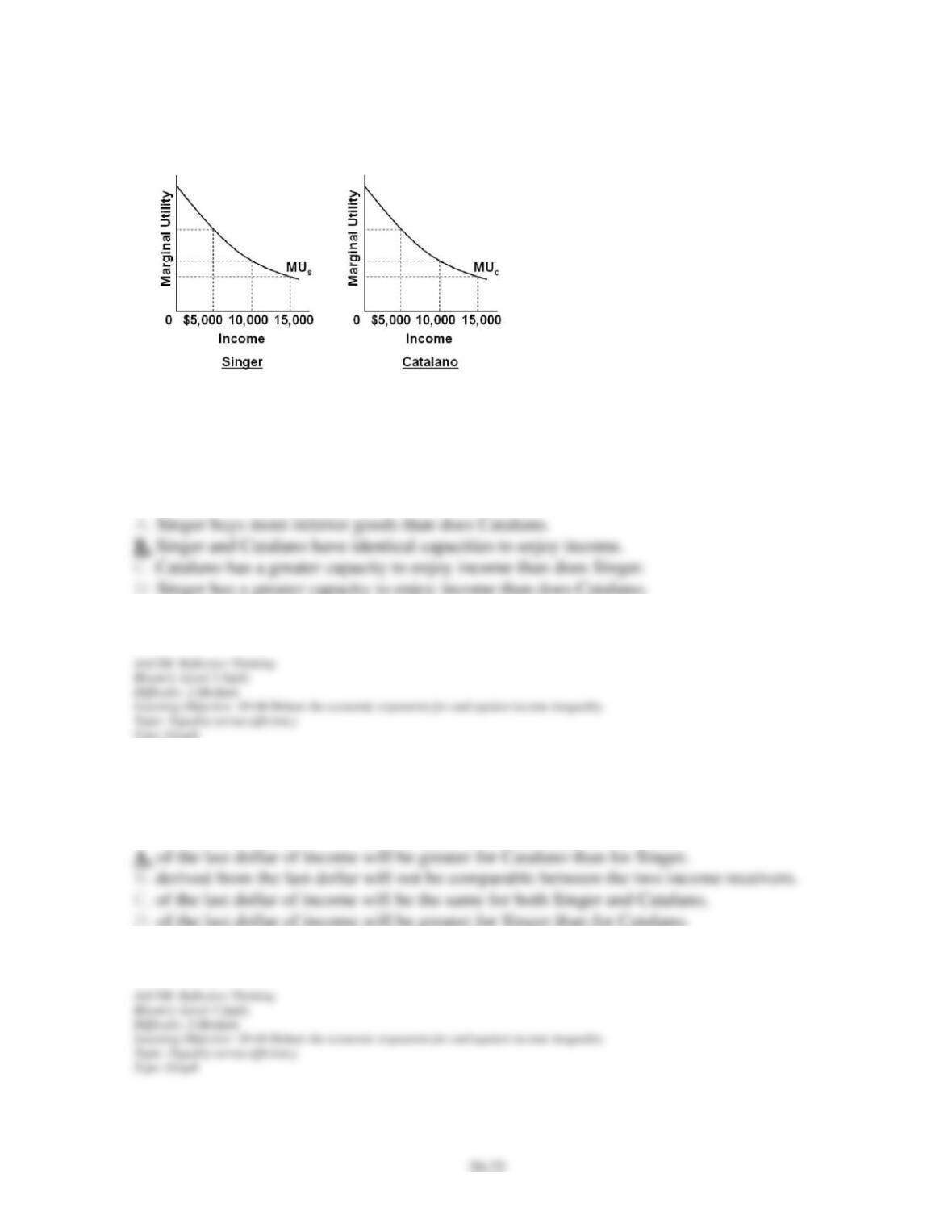
59. Refer to the above diagrams that show identical marginal utility from income curves for
Singer and Catalano. The marginal utility from income curves are drawn on the assumption
that:
60. Refer to the above diagrams that show identical marginal utility from income curves for
Singer and Catalano. If a given income of $20,000 is initially distributed so that Singer
receives $15,000 and Catalano $5,000, the marginal utility:
Chapter 20 – Income Inequality and Poverty
61. Refer to the above diagrams that show identical marginal utility from income curves for
Singer and Catalano. If a given income of $20,000 is initially distributed so that Singer
receives $15,000 and Catalano $5,000:
62. Refer to the above diagrams that show identical marginal utility from income curves for
Singer and Catalano. If this initial distribution of $15,000 to Singer and $5,000 to Catalano is
altered in favor of greater equality, it may be argued that:
Chapter 20 – Income Inequality and Poverty
63. The equality-efficiency tradeoff refers to:
64. The equality-efficiency tradeoff suggests that:
65. Gomez argues that we need to increase the nation’s output. Chang contends that our top
priority should be a more equal distribution of income and output. It can be correctly stated
that these two goals are:
Chapter 20 – Income Inequality and Poverty
66. According to the standard government definitions, the percentage of the U.S. population
now (2008) considered to be living in poverty is about:
67. In 2008, the official poverty line for a household of four in the United States was:
68. Which of the following demographic groups does not bear a disproportionate burden of
poverty?
Chapter 20 – Income Inequality and Poverty
69. The poverty rate in the United States was:
70. Which of the following groups has the highest poverty rate?
71. Which of the following groups has the lowest poverty rate?
Chapter 20 – Income Inequality and Poverty
72. The poverty rate for African-Americans is:
74. The U.S. poverty rate for:
Chapter 20 – Income Inequality and Poverty
75. Which of the following measurement issues make interpretation of U.S. poverty rates
difficult?
76. Which of the following measurement issues make interpretation of U.S. poverty rates
difficult?
Chapter 20 – Income Inequality and Poverty
77. A major difference between social insurance and welfare is that social insurance:
78. The U.S. income maintenance program consists of two kinds of programs. They are:
79. An example of a social insurance program is __________, whereas an example of public
assistance program is _____.
Chapter 20 – Income Inequality and Poverty
80. Which of the following is not a social insurance program?
81. Which of the following is a public assistance or welfare program as opposed to a social
insurance program?
82. A major difference between social insurance and public assistance is that the:
Chapter 20 – Income Inequality and Poverty
83. Social Security is financed:
84. The primary purpose of Social Security is to:
85. For which of the following income-maintenance programs is aggregate spending the
greatest?
Chapter 20 – Income Inequality and Poverty
86. Medicaid:
87. Which of the following terms describes a system of subsidized health insurance available
to the aged?
88. Which of the following provides public assistance to those who are blind and otherwise
disabled?
Chapter 20 – Income Inequality and Poverty
89. Which of the following helps finance the medical expenses of individuals receiving TANF
or SSI?
90. The Earned Income Tax Credit:
91. All but which one of the following are cash transfer programs?
Chapter 20 – Income Inequality and Poverty
92. Which one of the following would increase income inequality as measured by official
Census data and the quintile distribution?
93. Which of the following would move the Lorenz curve closer to the diagonal?
94. The TANF program:
Chapter 20 – Income Inequality and Poverty
95. The TANF program is designed to:
96. Since its inception in 1996, the Temporary Assistance for Needy Families (TANF)
program has:
97. By December 2009, the recession that began in December 2007:
Chapter 20 – Income Inequality and Poverty
98. The Supplemental Nutrition Assistance Program (SNAP):
99. African-American worker Jackson earns $30,000 per year; white worker Johnson earns
$40,000 per year. On the basis of this information we can conclude that:
100. For an employer biased against African-Americans, the discrimination coefficient d:
Chapter 20 – Income Inequality and Poverty
101. Which of the following employers is the most prejudiced? Employer:
102. In the taste-for-discrimination model:
103. Assume that all workers are equally productive but the wage rate for men is $12
compared to $9 for women. An employer who employs only male workers must have a
discrimination coefficient of:
Chapter 20 – Income Inequality and Poverty
104. An employer whose discrimination coefficient is $4 will:
105. Suppose an employer is biased against African-Americans. If his discrimination
coefficient is $2, the employer will:
Chapter 20 – Income Inequality and Poverty
106. If there is a widespread bias against African-American workers, an increase in the
collective discrimination coefficients of employers will:
107. In a labor market generally biased against Hispanics, a reduction in the collective
discrimination coefficients of employers will: