Chapter 21 – Health Care
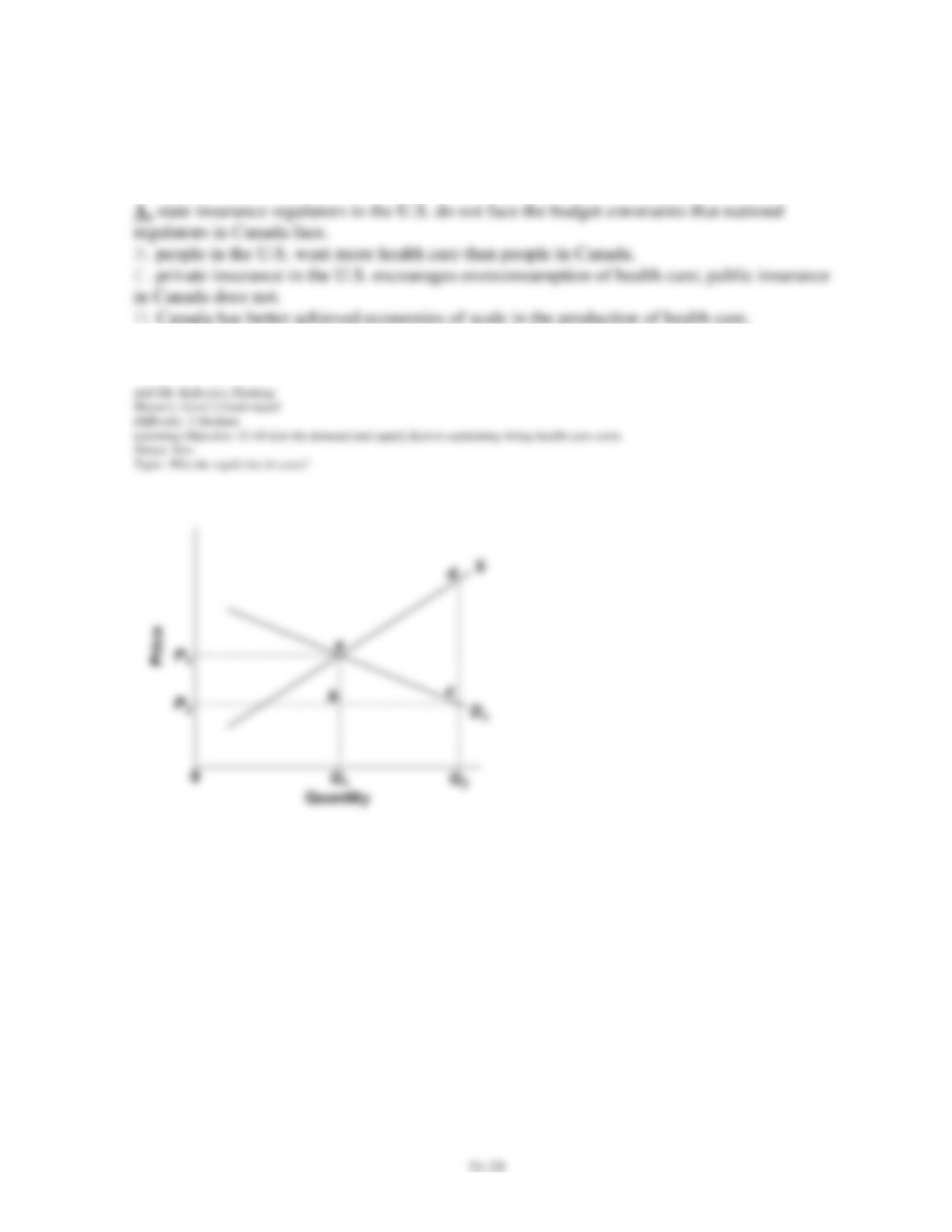
56. Refer to the above figure that shows the market for U.S. health care. Other things equal,
which of the following would shift the supply curve for medical care from S1 to S2?
57. Refer to the above figure that shows the market for U.S. health care. The problem of
rapidly rising medical care costs is best illustrated by the shifts of the demand and supply
curves from D1 to:
58. Refer to the above figure that shows the market for U.S. health care. Other things equal,
which of the following would shift the demand curve for medical care from D2 to D1?
Chapter 21 – Health Care
59. Refer to the above figure that shows the market for U.S. health care. Other things equal,
which of the following would shift the supply curve for medical care from S2 to S1?
60. If an individual is less careful about avoiding accidents or illness because she has health
insurance, this is an example of:
61. If the existence of health insurance increases one’s incentive to use the health care system
more intensively, this is an illustration of:
Chapter 21 – Health Care
62. Sam decides to join the Gigantic State University’s rugby team when he learns that his
health insurance will pay for any subsequent injury. This illustrates:
63. The availability of health insurance tends to:
64. It is generally agreed that in the long run the cost of private health insurance provided by
employers is:
Chapter 21 – Health Care
65. Other things equal, increased emphasis on providing the best possible medical care for all,
regardless of income, will:
66. Insurance tends to drive up health care costs by encouraging greater use of health care
resources. Why has this occurred in the United States, but not in Canada or the United
Kingdom?
Chapter 21 – Health Care
67. Health care costs have tended to rise more rapidly in the United States than in Canada
because:
Chapter 21 – Health Care
68. Refer to the above demand and supply diagram that relates to the health care market.
Without health insurance the equilibrium price and quantity of health care would be:
69. Refer to the above demand and supply diagram that relates to the health care market. If
suppliers provide the quantity of health care demanded and insurance pays one-half of the
equilibrium price of the health care good or service depicted above, the immediate price to the
consumer and the quantity of health care consumed would be:
70. Refer to the above demand and supply diagram that relates to the health care market. If
suppliers provide whatever quantity of health care is demanded, health care insurance causes:
Chapter 21 – Health Care
71. Refer to the above demand and supply diagram that relates to the health care market. The
efficiency loss caused by the availability of health insurance is shown by area:
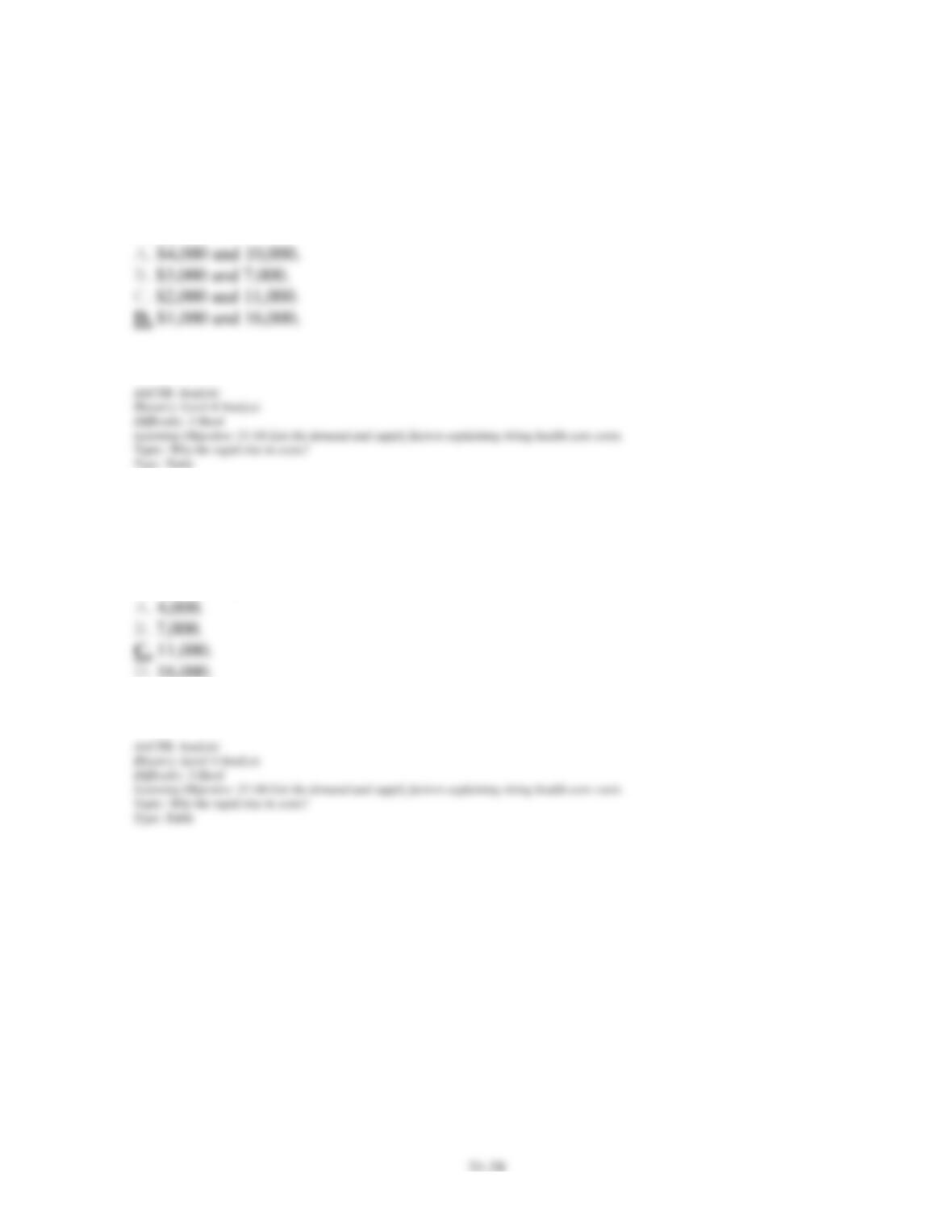
72. Refer to the above supply and demand data for a certain elective surgical procedure.
Without health insurance, the equilibrium price and quantity would be:
Chapter 21 – Health Care
73. Refer to the above supply and demand data for a certain elective surgical procedure. If
suppliers provide the quantity of health care demanded and insurance pays two-thirds of the
equilibrium price, the immediate price to the consumer and quantity of health care demanded
would be:
74. Refer to the above supply and demand data for a certain elective surgical procedure. If
suppliers provide the quantity of health care demanded and insurance pays 50 percent of the
remaining equilibrium price after a $1000 deductible is satisfied, the quantity of health care
demanded will be:
Chapter 21 – Health Care
75. Federal tax policy:
76. A tax subsidy is involved in employer-financed health insurance because:
77. Which of the following factors has contributed to rising health care prices in the United
States?
Chapter 21 – Health Care
78. Insurance companies use deductibles and copayments to:
79. Suppose you go to a doctor but your health insurance plan does not reimburse you because
you have not yet paid enough out-of-pocket for the year to qualify for insurance benefits. This
is an example of:
80. Suppose you go to a doctor but your health insurance plan reimburses you for only 80
percent of the bill. This is an example of:
Chapter 21 – Health Care
81. The two main types of managed care organizations are:
82. Health maintenance organizations (HMOs):
83. Preferred provider organizations (PPOs):
Chapter 21 – Health Care
84. The main purpose of HMOs and PPOs is to:
85. One of the main differences between PPOs and HMOs is that:
86. All of the following are designed to reduce health care expenses for consumers except: