Chapter 20 – Income Inequality and Poverty
102. Assume that there is a supply and demand market for non-preferred workers. If prejudice
against these workers among employers increases, then there will be a(n):
103. Assume that there is a supply and demand market for non-preferred workers. If prejudice
against these workers among employers decreases, then there will be a(n):
Chapter 20 – Income Inequality and Poverty
104. In the taste for discrimination model, the perceived cost for a prejudiced white employer
for hiring an African-American worker is:
105. If a prejudiced white employer behaves as if there is a disutility from hiring an African-
American worker, then this disutility is measured by the:
106. In a supply and demand model of the labor market for non-preferred workers, a reduction
in employer prejudice against non-preferred workers will:
Chapter 20 – Income Inequality and Poverty
107. Suppose the market wage rate for whites is $18 an hour and the monetary value a
prejudiced employer attaches to the disutility of hiring African-Americans is $3. This
employer will be indifferent between hiring African-Americans and whites only when the
African-American wage rate is:
108. When the occupational choices of women or minorities are restricted, this results in:
109. Ending discrimination against minority groups in educational processes and in
employment situations would cause total domestic output to:
Chapter 20 – Income Inequality and Poverty
110. From the economic point of view, discrimination:
111. The judging of an individual on the basis of the average characteristics of the group to
which the individual belongs rather than the individual’s characteristics is:
112. In statistical discrimination:
Chapter 20 – Income Inequality and Poverty
113. If a law firm prefers to hire men over women because the firm has found men to be more
productive, on average, then the firm is practicing:
114. The crowding model of occupational discrimination suggests that occupational
segregation results in:
115. The crowding of women, African-Americans, and certain ethnic groups into less
desirable, lower-paying occupations is:
Chapter 20 – Income Inequality and Poverty
20–42
116. The crowding of certain ethnic or racial groups into specific occupations results in:
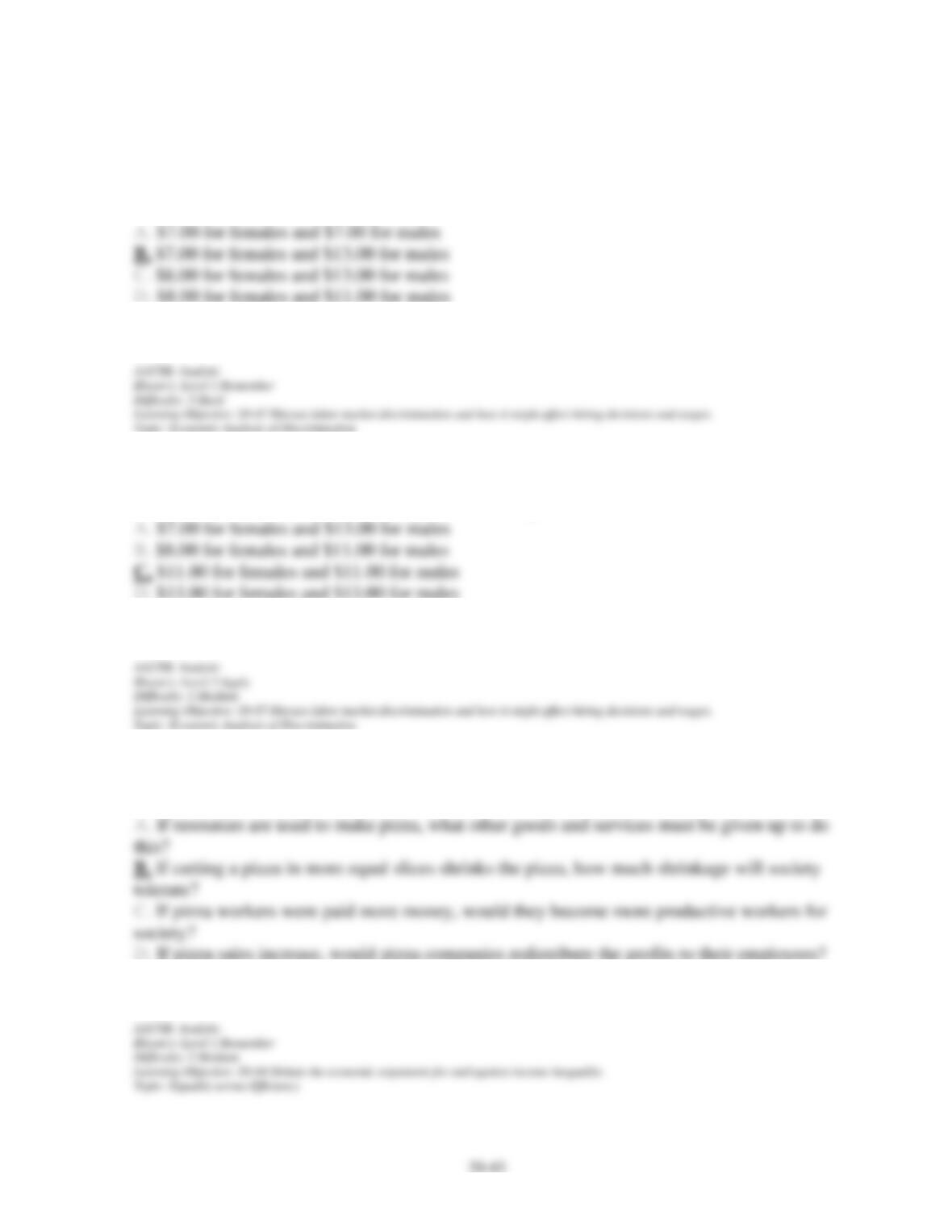
Suppose there are only three labor markets (A, B, and C) in the economy and each of these
markets is purely competitive. The table below contains the demand (or marginal-revenue-
product) schedule for labor in each of these three markets. Assume there are 24 million
homogeneous workers in the economy and that one-half of these workers are male and one-
half are female.
Chapter 20 – Income Inequality and Poverty
117. Refer to the above table. What would the wage rates be if the 12 million female workers
could work in labor market C only because of labor market discrimination, while half the 12
million male workers are employed in labor market A and the other half in labor market B?
118. Refer to the above table. What would the wage rate be if all the workers could work in
all three labor markets, and they get spread out evenly?
119. The pizza analogy of income distribution would be most closely associated with which
one of the following questions?
Chapter 20 – Income Inequality and Poverty
120. In the pizza analogy for income distribution, the pizza would shrink because:
121. The difference between household assets and liabilities is referred to as:
122. Between 1995 and 2007 family wealth increased:
Chapter 20 – Income Inequality and Poverty
123. About one-fifth of all U.S. households had incomes of $100,000 or more in 2008.
124. In the U.S., the top 20% of households received 50% of total income in 2008.
125. The Lorenz curve is a graph that relates income to household spending.
126. The distribution of personal income in the United States is significantly more unequal
after taxes and transfer payments are taken into account.
Chapter 20 – Income Inequality and Poverty
127. Differences in ability are one major reason for income differences in the United States.
128. The unequal distribution of wealth among households in the United States is one of the
causes of income inequality.
129. During the past thirty-five years or so, the degree of income inequality in the United
States has decreased considerably.
130. If income inequality is increasing, it means that the income levels of the poor are falling
while the income levels of the rich are rising.
Chapter 20 – Income Inequality and Poverty
131. One basic argument for redistributing income to achieve more equality rests on the idea
of maximizing the society’s total utility when there is diminishing marginal utility from
income.
132. The basic reason why the debate between income equality versus inequality is on-going
is because there is a tradeoff between income equality and economic efficiency.
133. U.S. income statistics indicate that more than one-eighth of the nation lived in poverty in
2008.
134. The poverty rate increased dramatically during the 1960s but has been reduced
significantly since then.
Chapter 20 – Income Inequality and Poverty
135. The incidence of poverty is very high among the elderly (65 years or older).
136. All social insurance programs are welfare or public charity programs.
137. The Social Security program is financed with funds from general tax revenues of the
Federal government.
138. Eligibility for social insurance programs is largely on the basis of need and “means
tests”.
Chapter 20 – Income Inequality and Poverty
139. The Supplemental Nutrition Assistance Program (formerly the food-stamp program)
mostly pays out cash-vouchers to eligible households.
140. The Temporary Assistance for Needy Families (TANF) that replaced the old Aid for
Families with Dependent Children welfare program succeeded in reducing the number of
welfare recipients and increasing the employment rate among single mothers.
141. The Temporary Assistance for Needy Families (TANF) expanded the welfare benefits
and has no limit on the number of years for receiving welfare benefits.
142. Labor market discrimination occurs when equivalent labor resources are paid or treated
differently even though their productive contributions are equal.

Chapter 20 – Income Inequality and Poverty
143. In the taste-for-discrimination model, a prejudiced employer who prefers white workers
and who has a discrimination coefficient of $3/hour would still hire African-Americans if the
market wage rate is $22/hour for white workers and $20/hour for African-Americans.
144. In the taste-for-discrimination model, an increase in the prejudice of employers will
decrease the demand for African-American workers, lower the African-American wage rate
and the ratio of African-American to white wages.
145. Statistical discrimination occurs when employers base hiring decisions on individual
workers’ previous employment records and statistics.

Chapter 20 – Income Inequality and Poverty
146. The crowding model of occupational segregation shows how white males earn higher
incomes at the expense of women and minorities who are restricted to a limited number of
occupations.