Chapter 22 – Immigration
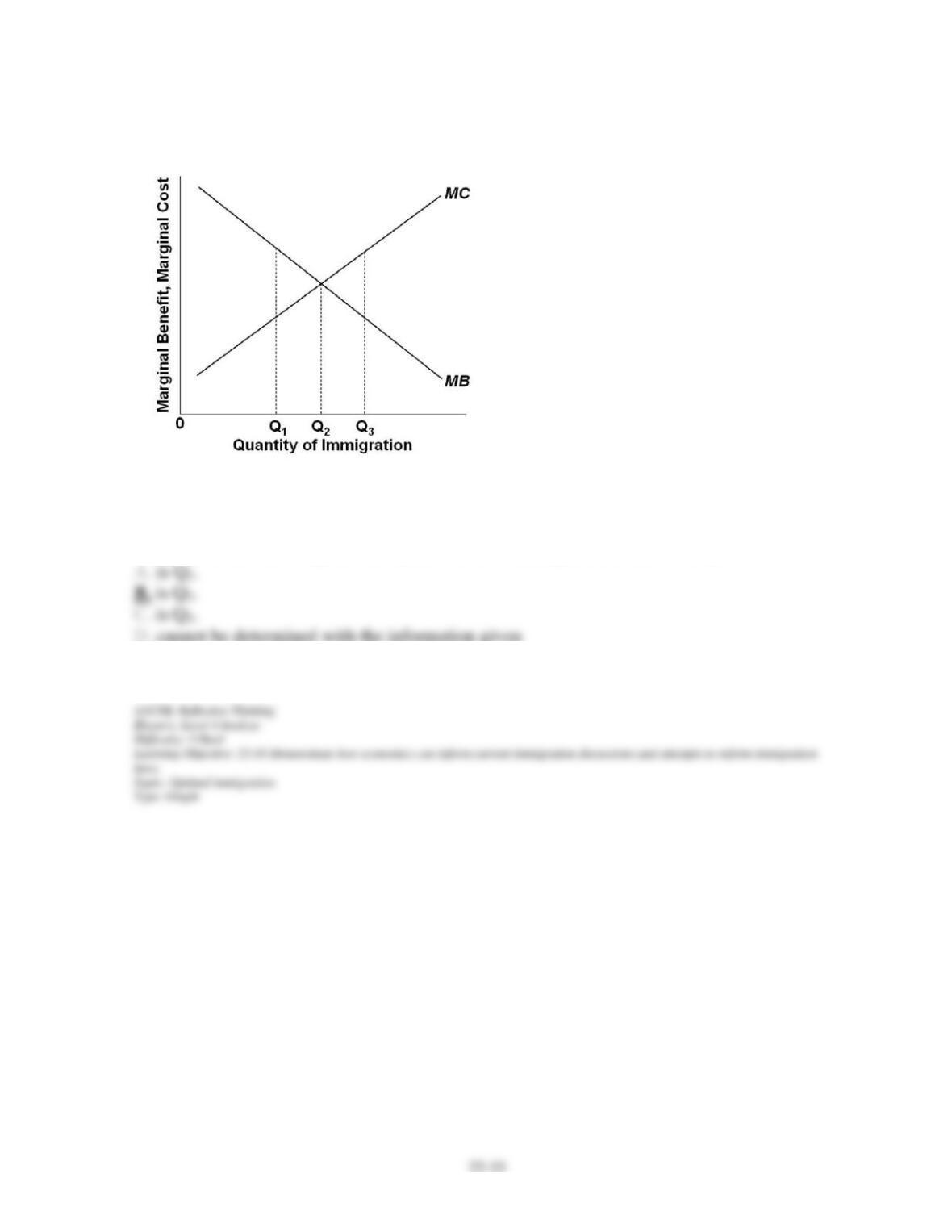
81. Refer to the above figure. The optimal level of immigration in this country:
Chapter 22 – Immigration
82. Refer to the above figure. An increase in the number of highly skilled and educated
potential immigrants would:
83. Refer to the above figure. If more criminals are in the mix of potential immigrants, how
will this affect the optimal quantity of immigrants?
84. Refer to the above figure. An increase in the number of highly motivated and skilled
potential immigrants will:
Chapter 22 – Immigration
85. Refer to the above figure. A weaker economy, characterized by higher unemployment
rates, will:
86. Other things equal, the greater the degree of complementarity between potential
immigrants and native-born workers, the:
87. Other things equal, the optimal quantity of immigrants will be greater, the:
Chapter 22 – Immigration
88. (Consider This) Since 1990, U.S. immigrants have founded ____ of every _____ public
companies financed by venture capital.
89. (Consider This) According to the Council of Economic Advisers:
90. (Last Word) The Immigration Acts of 1921 and 1924:
Chapter 22 – Immigration
91. (Last Word) Legislation proposed in 2007, if passed, would have:
92. (Last Word) “Z visas” in the proposed immigration reform of 2007:
93. Any migration that affects the economies of the countries involved is referred to as
“economic immigration.”

Chapter 22 – Immigration
94. There were over 1 million legal immigrants into the United States in 2009.
95. The U.S. Census Bureau estimates that more than one million illegal immigrants enter the
United States each year.
96. Economists treat economic immigration as a human capital investment decision.
97. The existence of “beaten paths” tends to discourage immigration because of the perception
that job prospects have been exhausted.

Chapter 22 – Immigration
98. Other things equal, younger workers are more likely to migrate than older workers.
99. Welfare payments to immigrants have steadily increased since 1996.
100. Welfare reform in 1996 reversed the trend of growing welfare payments to immigrants.
101. Economic research consistently finds that immigration negatively impacts the average
American wage.

Chapter 22 – Immigration
102. If all nations prohibited the international migration of labor, we would expect world
output to decline.
103. If the demand for labor in a country receiving immigrants is inelastic, the immigration
will increase the total wages paid in that country.
104. Business income will decrease in the nation from which workers emigrate.

Chapter 22 – Immigration
106. “Backflows” are payments made by immigrants back to their home countries.
107. Illegal immigrants displace domestic-born workers on a one-for-one basis.
108. Illegal immigration can result in higher wages for domestic-born workers who are
complementary inputs.
109. Economic models of illegal immigration suggest that domestic-born workers avoid
certain types of work more because the inflow of immigrants has reduced wages, rather than
because the work is unpleasant.

Chapter 22 – Immigration
110. Removing all illegal immigrants would expand domestic-born employment by an
amount equal to the number of illegal immigrants removed.
111. Illegal immigration helps improve the standard of living for U.S. citizens by keeping
prices lower.
112. Illegal immigrants overall contribute more in taxes than they receive in services from
state and local governments.
113. U.S. immigrants (legal and illegal combined) have lower prison rates than the native-
born population.

Chapter 22 – Immigration
114. Illegal immigration has little effect on the average level of wages in the United States.
115. Economic theory suggests that immigration should be allowed into a country until the
marginal benefit of the last immigrant is zero.
116. The optimal level of immigration occurs where marginal benefit is at its greatest.