Chapter 22 – Immigration
1. Between 2000 and 2009, legal immigration averaged about:
2. Which of the following groups does not fit in with the others?
Chapter 22 – Immigration
3. Beginning in 1990, the Federal government:
4. The current H1-B provision of the immigration law allows:
5. There was a spike in U.S. legal immigration from 1989 to 1991 due to:

Chapter 22 – Immigration
6. Among those who became permanent legal residents of the U.S. in 2009, about how many
were family sponsored?
7. Of all of the people who became permanent legal residents of the U.S. in 2009, about how
many were sponsored by employers?
8. What is the quota for “diversity immigrants” into the U.S.?
Chapter 22 – Immigration
9. The U.S. Census Bureau estimates the number of illegal immigrants by subtracting the:
10. The two leading countries of origin of U.S. legal immigrants in 2009 were Mexico and:
11. Immigration accounts for what percentage of annual population growth in the United
States in recent years?
Chapter 22 – Immigration
12. Immigration accounts for what percentage of the annual growth in the U.S. labor force in
recent years?
13. From 2000 to 2009, the net annual inflow of illegal immigrants has averaged about:
14. Some illegal immigrants move back and forth across the U.S.-Mexican border. But in
2009, as many as _____ million immigrants were residing continuously in the U.S.
Chapter 22 – Immigration
15. Illegal immigrants from Mexico who work continuously in the U.S. have the following
characteristics, except:
16. The major reasons why people immigrate into the U.S. include the following, except:
17. Human capital refers to the:
Chapter 22 – Immigration
18. Other things equal:
19. Immigrants made up approximately what percent of the labor force in the U.S. in 2006?
20. Which of the following countries has the largest share of immigrants as a percent of its
labor force?
Chapter 22 – Immigration
21. Which of the following is an implicit cost of migration?
22. Which of the following is an explicit cost of migration?
23. Which of the following statements is false?

Chapter 22 – Immigration
24. Suppose that Rosa is considering migration to another country. To move, she will have to
spend $5000 on transportation and $4000 in application and other processing fees. Rosa’s
stream of future earnings in her home country is $500,000. She expects to earn a stream of
future earnings of $800,000 in another country. Based on this information, Rosa’s implicit
cost of migrating is:
25. Suppose that Rosa is considering migration to another country. To move, she will have to
spend $5000 on transportation and $4000 in application and other processing fees. Rosa’s
stream of future earnings in her home country is $500,000. She expects to earn a stream of
future earnings of $800,000 in another country. Based on this information, Rosa’s explicit cost
of migrating is:
Chapter 22 – Immigration
26. Suppose that Rosa is considering migration to another country. To move, she will have to
spend $5000 on transportation and $4000 in application and other processing fees. Rosa’s
stream of future earnings in her home country is $500,000. She expects to earn a stream of
future earnings of $800,000 in another country. Based on this information, Rosa will decide to
migrate as long as the implicit costs of leaving her friends and family and adjusting to a new
culture are:
27. “Beaten paths” in the context of labor migration are:
Chapter 22 – Immigration
28. Younger workers are:
29. Older workers are:
Chapter 22 – Immigration
30. The Council of Economic Advisers have found that skilled immigrants in the U.S. do all
of the following, except:
31. What portion of the engineering and computer-science doctorate degree-holders in the
U.S. are foreign-born?
32. Immigrant entrepreneurs have founded what portion of semiconductor,
computer/communication, and software companies in the U.S.?
Chapter 22 – Immigration
33. Which of the following companies was not founded by immigrants?
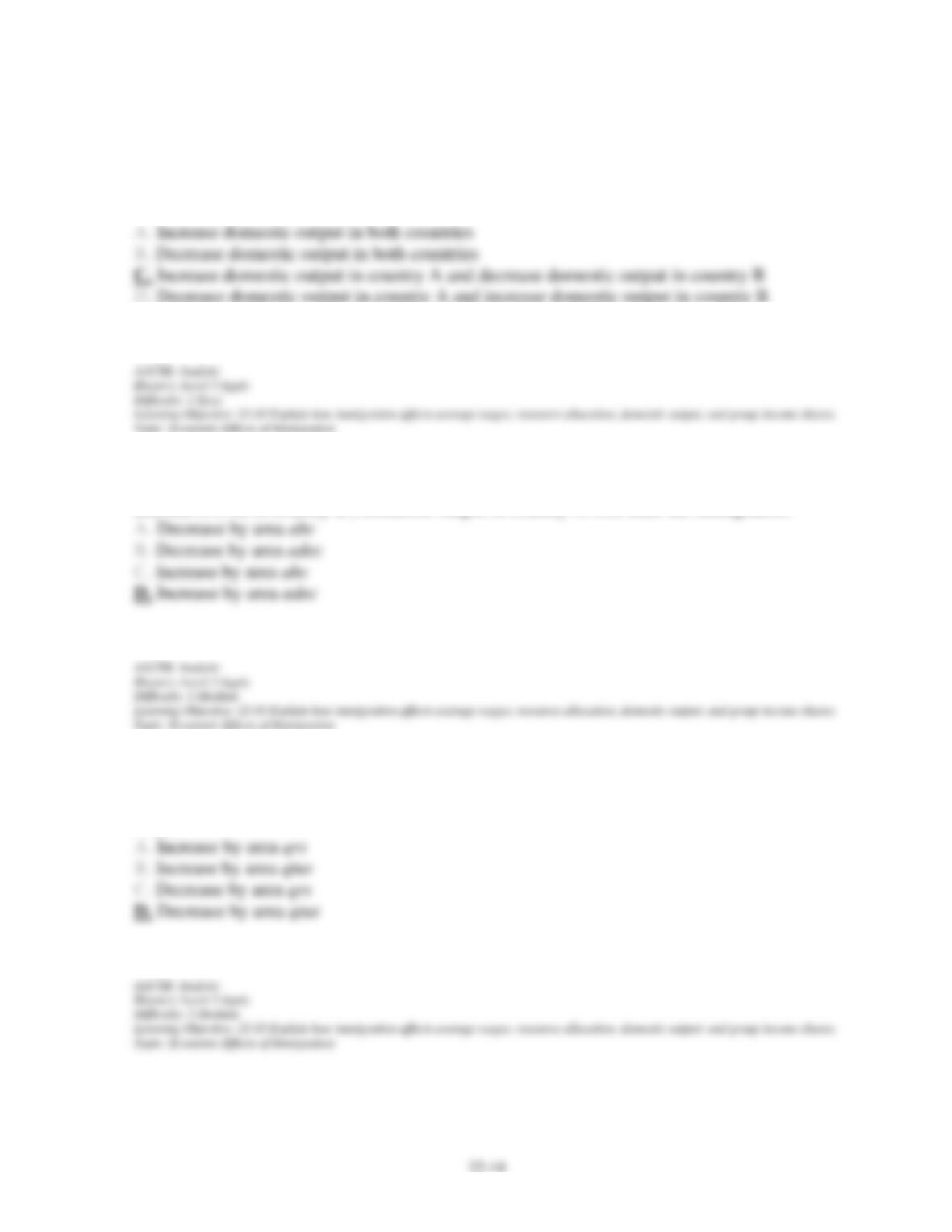
34. Refer to the above graphs. (Assume that the pre-migration labor force in Country A is 0d
and that it is 0u in country B.) The migration of labor from low-income country B to high-
income country A will:
Chapter 22 – Immigration
35. Refer to the above graphs. (Assume that the pre-migration labor force in Country A is 0d
and that it is 0u in country B.) The migration of labor from low-income country B to high-
income country A will:
36. Refer to the above graphs. (Assume that the pre-migration labor force in Country A is 0d
37. Refer to the above graphs. (Assume that the pre-migration labor force in Country A is 0d
and that it is 0u in country B.) Domestic output in country B will, after the emigration of
labor:
Chapter 22 – Immigration
38. Refer to the above graphs. (Assume that the pre-migration labor force in Country A is 0d
and that it is 0u in country B.) What part of domestic output in country A is the total wage bill
or total wage income before and after the immigration?
39. Refer to the above graphs. (Assume that the pre-migration labor force in Country A is 0d
and that it is 0u in country B.) What part of domestic output in country B is the total wage bill
or total wage income before and after the emigration?
40. Refer to the above graphs. (Assume that the pre-migration labor force in Country A is 0d
and that it is 0u in country B.) What result would indicate that worldwide output is increased
as a result of migration?
Chapter 22 – Immigration
41. Refer to the above graphs. (Assume that the pre-migration labor force in Country A is 0d
and that it is 0u in country B.) If business income is total output minus total labor cost, then
business income in country A after the immigration occurs is equal to area:
42. Refer to the above graphs. (Assume that the pre-migration labor force in Country A is 0d
and that it is 0u in country B.) If business income is total output minus total labor cost, then
business income in country B after emigration occurs:
43. With labor migration, the country of origin experiences:
Chapter 22 – Immigration
44. With labor migration, the destination country experiences:
45. With labor migration, the amount of change in the destination country’s wage rates
depends on the:
46. Who tends to be generally very much against labor migration?
Chapter 22 – Immigration
22–18
47. Who tends to lose from labor migration?
48. In the destination country, who tends to lose from labor immigration?
Chapter 22 – Immigration
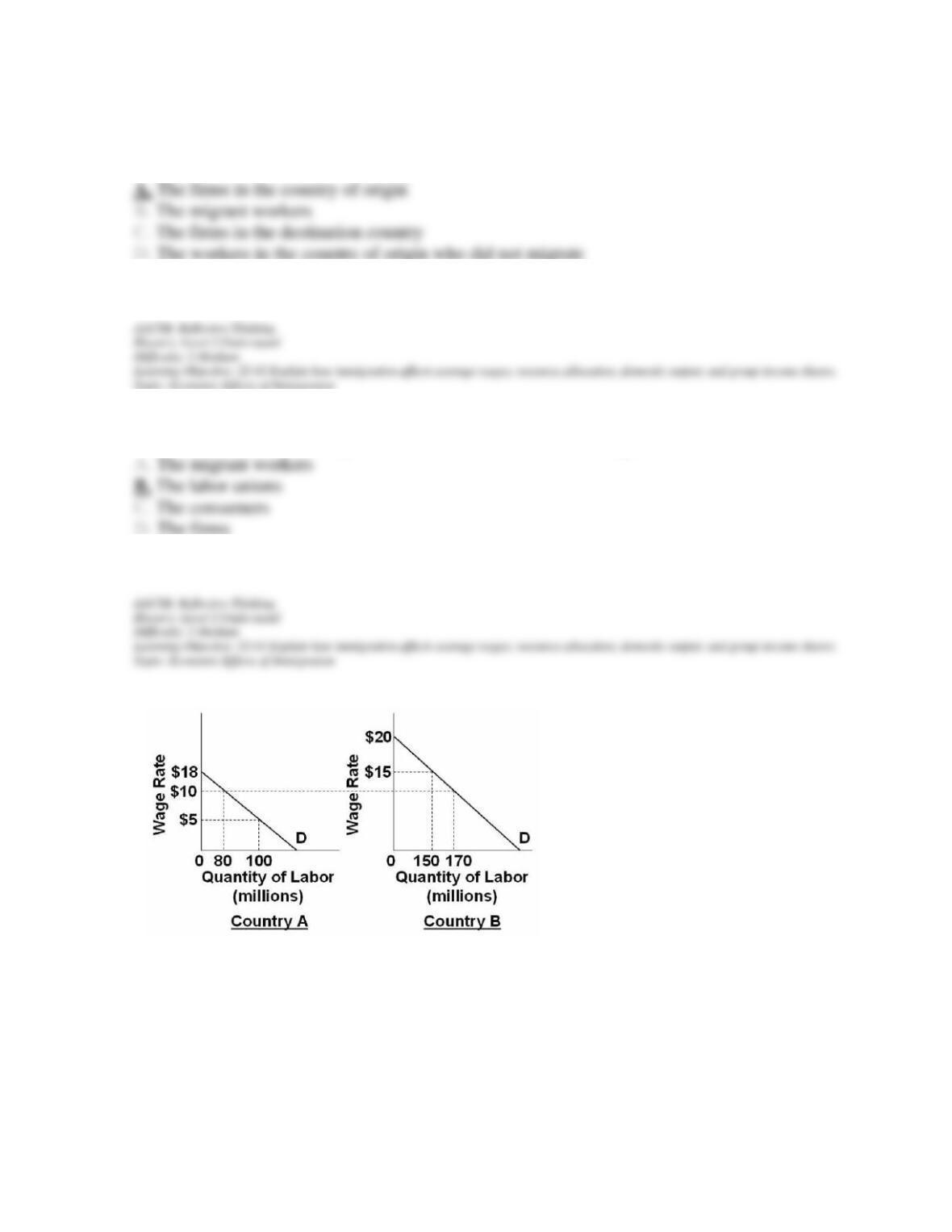
49. Refer to the above graphs. (Assume that the pre-migration labor force in Country A is 100
and that it is 150 in country B.) The migration of labor will:
50. Refer to the above graphs. (Assume that the pre-migration labor force in Country A is 100
and that it is 150 in country B.) The migration of labor will:
51. Refer to the above graphs. (Assume that the pre-migration labor force in Country A is 100
and that it is 150 in country B.) Domestic output in country A will, after immigration:
Chapter 22 – Immigration
52. Refer to the above graphs. (Assume that the pre-migration labor force in Country A is 100
and that it is 150 in country B.) Domestic output in country B will, after immigration:
53. Refer to the above graphs. (Assume that the pre-migration labor force in Country A is 100
and that it is 150 in country B.) What part of domestic output in country A is the total wage
bill before and after the immigration?
54. Refer to the above graphs. (Assume that the pre-migration labor force in Country A is 100
and that it is 150 in country B.) What part of domestic output in country B is the total wage
bill before and after the immigration?