Archives
CAS 14057
Karl Weick’s ________________ model proposes that we make decisions, then render them sensible by explaining the meaning of our decisions. Answer: Reward power is limited to organizationally specified rewards such as salary and promotion. Answer: F Integrated perspectives theories reject […]
CAS 17012
Communication networks represent the formal communication system. Answer: External communications specialists may be required to have a broad range of journalism and media production skills. Answer: T An effect must be immediate to be a true effect. Answer: F F […]
CAS 21488
Conflict episodes are comprised of the following stages: ________________, ________________, ________________, _____________, and ________________. Answer: Social media are important but not the responsibility of public relations and advertising professionals. Answer: F Fayol’s ______________ or “gang plank” has become known in […]
CAS 22304
Maslow described ____________________ needs as the desire for self-respect and the respect of others. Answer: Maslow’s theory implies it is motivational to communicate about needs that are reasonably well met. Answer: F Channels are the means of transmission of messages. […]
CAS 28068
Social support groups are a vital part of an organization. Answer: According to Alvesson and Deetz, the goal of critical theory is to create societies and workplaces free of domination, with all members having equal opportunity to contribute. Answer: T […]
CAS 33159
Change communication is the processing of new ideas and information as well as the altering of existing procedures and processes. Answer: __________________ communication tactics for leadership include seeking ideas from all involved, facilitating group processes, encouraging disagreement, and seeking idea […]
CAS 41721
Practical theory works only with theory. Answer: Fayol proposed fourteen general principles of administration or management. He described the __________________ as the chain of superiors ranging from the ultimate authority to the lowest ranks. Answer: scalar chain Communication apprehension is […]
CAS 43381
In systems theory, the concept of _________________ rejects the concept of a single course of action to reach a single goal. Answer: Structuration refers to the production of social systems but not to any future reproduction. Answer: F Educational preparation […]
CAS 46452
Emotional labor jobs require regulated emotions because they entail voice or face contact with the public, require workers to produce certain reactions to customers, and are regulated by employers who control the emotional activities of their workers. Answer: _______________ messages […]
CAS 52466
Information in the external environment which is processed by the organization is commonly known as output communication. Answer: Oral messages accompanied by supporting written messages have been described as the least effective method for transmitting information from management throughout the […]
CAS 64235
Bureaucratic authority, according to Weber, represented the ideal for organizations. Answer: Network isolates often are high communication apprehensives and deliberately avoid interactions with others. Answer: T Directional groups are usually less dependent on the communication competencies of individuals than they […]
CAS 92977
Our government is not an example of a long-standing team because, as the members change, so do the responsibilities of the positions they hold. Answer: Organizational values influence the behaviors of current members of the organization and contribute to the […]
COM CM 35149
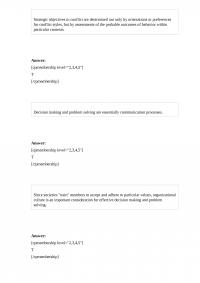
Strategic objectives in conflict are determined not only by orientations or preferences for conflict styles, but by assessments of the probable outcomes of behavior within particular contexts. Answer: Decision making and problem solving are essentially communication processes. Answer: T Since […]
COM CM 53164
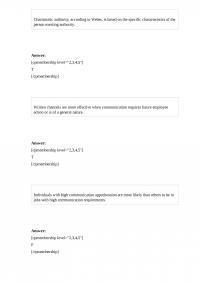
Charismatic authority, according to Weber, is based on the specific characteristics of the person exerting authority. Answer: Written channels are more effective when communication requires future employee action or is of a general nature. Answer: T Individuals with high communication […]
COM CM 59812
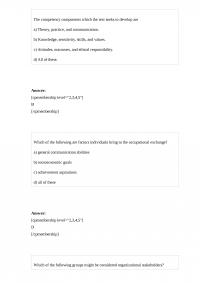
The competency components which the text seeks to develop are a) Theory, practice, and communication. b) Knowledge, sensitivity, skills, and values. c) Attitudes, outcomes, and ethical responsibility. d) All of these. Answer: Which of the following are factors individuals bring […]
COM CM 61381
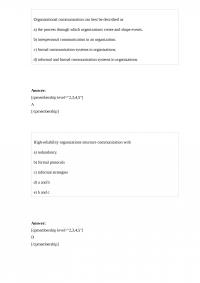
Organizational communication can best be described as a) the process through which organizations create and shape events. b) interpersonal communication in an organization. c) formal communication systems in organizations. d) informal and formal communication systems in organizations. Answer: High-reliability organizations […]
COM CM 72558
Which one is NOT a factor in changing the role of managers in current and future organizations? a) lower global productivity b) increasing competition among firms c) emphasis on speed, service, and information d) need to develop previously un(der) employed […]
COM CM 86041
Maslow described esteem and prestige needs as the belief that one has satisfied his or her full potential. Answer: ____________________is concerned with the development of messages, the identification of target audiences, the selection of media, and the budgeting for organizational […]
COM CM 88347
LMX theory, also known as _________ __________ __________, describes the relationships leaders develop and maintain with their subordinates. Answer: The factors Herzberg found to be motivational were status, interpersonal relations, supervision, policies, working conditions, and salary. Answer: F The grapevine […]
COMM 11591
The “Wallenda factor” a) is an example of focusing on failure. b) demonstrates problematical organizational goals. c) is an ability to concentrate on success. d) none of these Answer: A network member who is a member of one group and […]
COMM 20899
Organizational change is both planned and unplanned. Answer: An interpersonal barrier to problem solving would be self-centered or ego-centered behavior. Answer: T ______________ focuses our attention on studying power and abuses of power through communication and organization. Answer: critical theory […]
COMM 35365
Global influences change responsibilities for public relations and marketing professionals. Answer: Regardless of context, communication involves choice, reflects values, and may or may not have consequences. Answer: F Match the communication tactic for conflict in Column A with its example […]
COMM 38001
Sources send messages consisting of auditory, visual, olfactory, gustatory, or tactile stimuli in any combination of these five senses. Answer: Organizational influences on individuals include organizational goals, culture, task requirements, policies and procedures, and reward systems. Answer: T _________________participation behaviors […]
COMM 44702
The sociotechnical approach to organizational theory attempted to balance human social-psychological needs with organizational goals. Answer: __________________ power is the influence leaders have as a result of whom they know and the support they have from others in the organization. […]
COMM 47189
Quintilian’s ideal of the “good man speaking well” is not related to contemporary notions of communication competency. Answer: The Triple-Bottom Line of sustainability includes addressing: ____________, ______________, and _____________. Answer: people, planet, and profit Bennis and Nanus suggested that a […]
COMM 77752
Evaluative language users talk about facts, events, and behavior not attitudes, blame, or other subjective and vague concepts. Answer: A procedural barrier to problem solving would be role ambiguity. Answer: T Managers fulfill specifically defined roles designed to facilitate work […]
COMM 99632
______________________ are general prescriptions about appropriate communication behaviors. Answer: __________________ power comes from the positions, titles, or roles people occupy. Answer: legitimate Norms are rules that dictate expected behavior in a group. Answer: T communication rules ____________________ is often referred […]
COMU 20600
Change messages are not essential to an open system. Answer: Systems theorists advance a principle of optimization or looking for minimum output in return for minimum input. Answer: F List the six characteristics of effective communication strategy in organizations. Answer: […]
COMU 25852
Often referred to as autocratic leadership, the ____________________ as described by Blake and Mouton is concerned with goals or task achievement while exhibiting little concern for personal relationship. Answer: Groups are formed to fulfill organizational needs, but the underlying assumption […]
COMU 45894
The factors Herzberg found to be motivational were work itself, achievement, growth and responsibility, recognition, and advancement. Answer: Human communication is an attempt to share realities with others. Answer: T The Scientific Management theorists believed communication was management’s responsibility and […]
COMU 53459
_______________ styles of conflict are characterized by collaboration and cooperation. Answer: According to Allport, Vernon, and Lindzey, theoretical values are expressed in our concerns for artistic experiences and in our desire for form and harmony. Answer: F Rensis Likert is […]
COMU 54814
Most people engaged in interpersonal communication in organizations share common experiences. Answer: _______________ is the systems theory principle of looking for maximum output in return for minimum input. Answer: optimization Bennis and Nanus contend that the ________ leaders provide is […]
COMU 62869
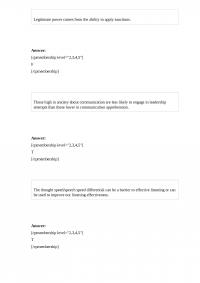
Legitimate power comes from the ability to apply sanctions. Answer: Those high in anxiety about communication are less likely to engage in leadership attempts than those lower in communication apprehension. Answer: T The thought speed/speech speed differential can be a […]
COMU 83153
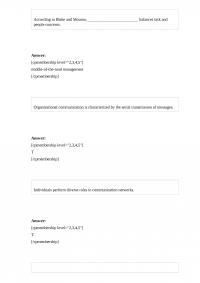
According to Blake and Mouton, _________________________ balances task and people concerns. Answer: Organizational communication is characterized by the serial transmission of messages. Answer: T Individuals perform diverse roles in communication networks. Answer: T middle-of-the-road management _______________ has been defined as […]
COMU 83242
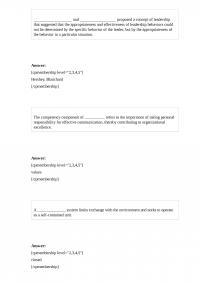
___________________ and __________________ proposed a concept of leadership that suggested that the appropriateness and effectiveness of leadership behaviors could not be determined by the specific behavior of the leader, but by the appropriateness of the behavior in a particular situation. […]
COMU 85512
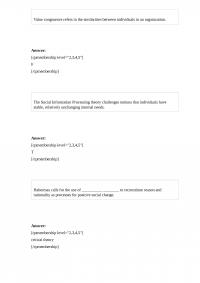
Value congruence refers to the similarities between individuals in an organization. Answer: The Social Information Processing theory challenges notions that individuals have stable, relatively unchanging internal needs. Answer: T Habermas calls for the use of __________ ________ to reconstitute reason […]
STM 17299
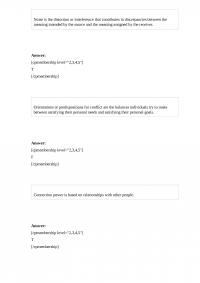
Noise is the distortion or interference that contributes to discrepancies between the meaning intended by the source and the meaning assigned by the receiver. Answer: Orientations or predispositions for conflict are the balances individuals try to make between satisfying their […]
STM 17509
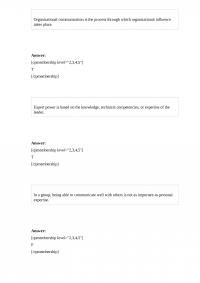
Organizational communication is the process through which organizational influence takes place. Answer: Expert power is based on the knowledge, technical competencies, or expertise of the leader. Answer: T In a group, being able to communicate well with others is not […]
STM 20506
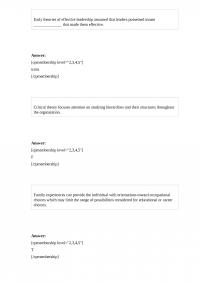
Early theories of effective leadership assumed that leaders possessed innate ______________ that made them effective. Answer: Critical theory focuses attention on studying hierarchies and their structures throughout the organization. Answer: F Family experiences can provide the individual with orientations toward […]
STM 44281
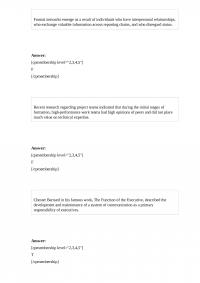
Formal networks emerge as a result of individuals who have interpersonal relationships, who exchange valuable information across reporting chains, and who disregard status. Answer: Recent research regarding project teams indicated that during the initial stages of formation, high-performance work teams […]
STM 47695
Liaisons link or connect groups with common information without being a member of either group. Answer: Upward communication distortion is less likely to occur if the employee has advancement aspirations. Answer: F Systematic environmental scanning is related to higher organizational […]
STM 52723
Gatekeepers rarely receive information which requires them to determine whether or not to transmit that information to the next link or links in the chain. Answer: Irrespective of the approach to leadership, communication competencies are necessary for excellence in leadership […]
STM 57773
Conflict is inevitable, unfortunately, and is very seldom desirable except for manipulative reasons. Answer: Relationship messages establish how the organization operates. Answer: F According to Rokeach, ______________ values can be described as desirable behaviors or modes of conduct that are […]
STM 63152
Quintilian’s ideal of the “good man speaking well” is an outdated concept of organizational communication competency. Answer: Career planning should begin as we complete our formal education. Answer: F ______________work across time, space, and cultures. Answer: Virtual teams F Contingency […]
STM 66033
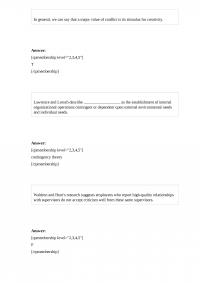
In general, we can say that a major value of conflict is its stimulus for creativity. Answer: Lawrence and Lorsch describe __________________ as the establishment of internal organizational operations contingent or dependent upon external environmental needs and individual needs. Answer: […]
STM 70664
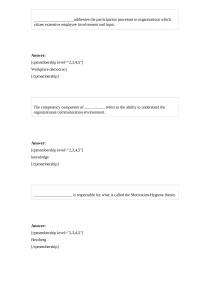
____________________addresses the participation processes in organizations which values extensive employee involvement and input. Answer: The competency component of __________ refers to the ability to understand the organizational communication environment. Answer: knowledge ___________________ is responsible for what is called the Motivation-Hygiene […]
STM 78054
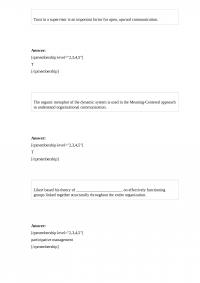
Trust in a supervisor is an important factor for open, upward communication. Answer: The organic metaphor of the dynamic system is used in the Meaning-Centered approach to understand organizational communication. Answer: T Likert based his theory of _______________________ on effectively […]
STM 82930
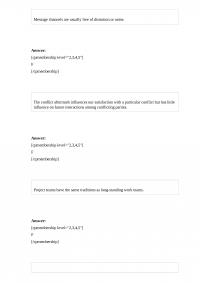
Message channels are usually free of distortion or noise. Answer: The conflict aftermath influences our satisfaction with a particular conflict but has little influence on future interactions among conflicting parties. Answer: F Project teams have the same traditions as long-standing […]
STM 95083
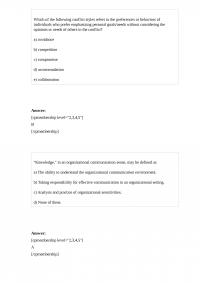
Which of the following conflict styles refers to the preferences or behaviors of individuals who prefer emphasizing personal goals/needs without considering the opinions or needs of others in the conflict? a) avoidance b) competition c) compromise d) accommodation e) collaboration […]