Archives: Quiz
BUS 723 Final
Which of the following statements is true of courage? a. It helps one to initiate change. b. It prevents people from doing what they want. c. It allows greed and self-interest to overcome concern for the common good. d. It […]
BUS 142 Final
__________is the process by which a person learns the values, norms, perspectives, and expected behaviors to participate in an organization. a. Negotiation b. Adaptation c. Selection d. Socialization Theory Y reflects the assumption that people are basically lazy and not […]
MHR 157
Companies with heroism as the basis of noble purpose often: a. reflect almost an obsession with winning. b. emphasize serving others. c. experience the joy of an entrepreneurial spirit. d. inspire others to find or create something new. Authoritarian management […]
BUA 607
A leader who is visionary, empowering, and committed to serving others is operating at the post conventional or principled level of personal moral development. a. True b. False Forces driving the need for organizational change leadership include: a. nationalization. b. […]
BUA 435 Quiz 3
Moral leadership is about: a. distinguishing right from wrong. b. taking away from others to enhance oneself. c. rewarding unethical conduct. d. nonconformity. Which of the following statements is true of the art and science of leadership? a. Leadership is […]
MGMT 155 Quiz 3
In interactive leadership, the leader favors a consensual and collaborative process. a. True b. False Strategic leaders react to environmental changes rather than studying the events that have already taken place and acting based on their anticipation of what the […]
BUA 347 Quiz 1
According to the eight-stage model of planned organizational change, a change process includes: a. creating a stable envirornnent. b. focusing on long-term goals rather than short-term accomplishments. c. communicating financial statements to an organization’s stakeholders. d. building a strong coalition […]
OBHR 788
According to Herzberg’s two-factor theory, hygiene factors include: a. recognition. b. interpersonal relationships. c. the work itself. d. personal growth Which of the following characteristics was explored by the studies evaluating the characteristics of the leader member exchange relationship? a. […]
PRST 301
As part of the brainstorming process, freewheeling involves: a. evaluating ideas of group members freely during spontaneous idea generation. b. expressing any idea that comes to mind, no matter how weird or fanciful. c. providing freedom to generate as many […]
EMBA 602
In the leader-member exchange research study on individualized leadership, leaders were trained to offer the opportunity for a high-quality relationship to all group members. Accorrding to this concept which of the following is1rne of followers? a. The followers were treated […]
BUA 483 Test
Managing up involves: a. giving advice on handling specific organizational situations and dealing with organizational politics. b. directing and controlling behavior and judging individual performance. c. telling a person exactly what needs to be done. d. consciously developing a mutually-respectful […]
Management 622 Homework
A key component ofleadership is: a. accepting the standard way of doing things. b. employing fear-based motivation. c. regarding assumptions as fixed truths. d. being emotionally connected to others. In the context of the principles for leader influence, means using […]
BUA 687 Test
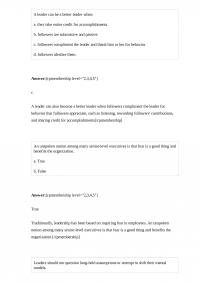
A leader can be a better leader when: a. they take entire credit for accomplishments. b. followers are submissive and passive. c. followers compliment the leader and thank him or her for behavior. d. followers idealize them. An unspoken notion […]
BUS 270 Final
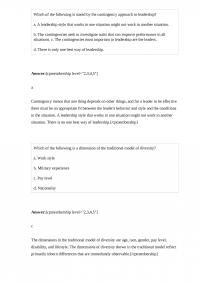
Which of the following is stated by the contingency approach to leadership? a. A leadership style that works in one situation might not work in another situation. b. The contingencies seek to investigate traits that can improve performance in all […]
MGT 886 Midterm
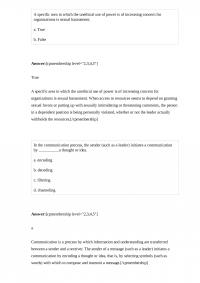
A specific area in which the unethical use of power is of increasing concern for organizations is sexual harassment. a. True b. False In the communication process, the sender (such as a leader) initiates a communication by __________a thought or […]
PRST 703 Final
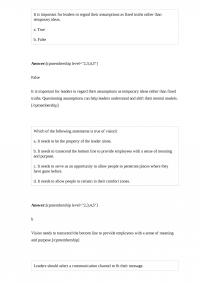
It is important for leaders to regard their assumptions as fixed truths rather than temporary ideas. a. True b. False Which of the following statements is true of vision? a. It needs to be the property of the leader alone. […]
BUS 314 Homework
Many minority leaders struggle daily with the problem of delegating authority and responsibility to employees who show them little respect. a. True b. False Who among the following use rewards and punishments to shape behavior and do not mind exploiting […]
Management 253
The__________-of handling conflict in a team reflects both a high degree of assertiveness and cooperativeness. a. collaborating style b. avoiding style c. accommodating style d. competing style A person’s values cannot change throughout life as they are fairly well established […]
EMBA 704 Quiz
Clarity of mind, clarity of objectives, and organizing to achieve objectives are the components of . a. personal mastery b. stereotyping c. emotional intelligence d. systems thinking Which of the following is an example of people-oriented leader behavior? a. Planning […]
MGT 627 Midterm
Mission statements tend to grow and change in the face of changing technologies, economic conditions, or other environmental shifts. a. True b. False Which of the following is an example of stereotyping? a. Fiona assumes that a subordinate is a […]
BUA 517 Homework
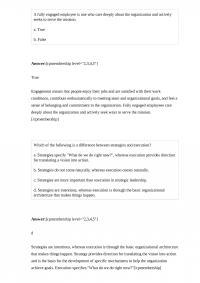
A fully engaged employee is one who care deeply about the organization and actively seeks to serve the mission. a. True b. False Which of the following is a difference between strategies and execution? a. Strategies specify “What do we […]
EMBA 562 Quiz 3
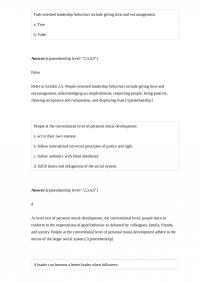
Task-oriented leadership behaviors include giving time and encouragement. a. True b. False People at the conventional level of personal moral development: a. act in their own interest. b. follow internalized universal principles of justice and right. c. follow authority with […]
BUA 793 Quiz 2
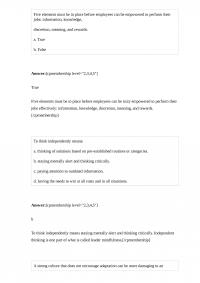
Five elements must be in place before employees can be empowered to perform their jobs: information, knowledge, discretion, meaning, and rewards. a. True b. False To think independently means: a. thinking of solutions based on pre-established routines or categories. b. […]
BUA 147
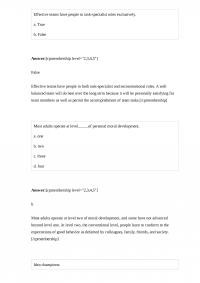
Effective teams have people in task-specialist roles exclusively. a. True b. False Most adults operate at level_____of personal moral development. a. one b. two c. three d. four Answer: b Most adults operate at level two of moral development, and […]
OBHR 393 Quiz
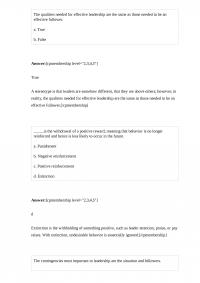
The qualities needed for effective leadership are the same as those needed to be an effective follower. a. True b. False _____is the withdrawal of a positive reward, meaning that behavior is no longer reinforced and hence is less likely […]
PRST 480
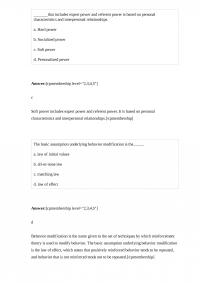
_______that includes expert power and referent power is based on personal characteristics and interpersonal relationships. a. Hard power b. Socialized power c. Soft power d. Personalized power The basic assumption underlying behavior modification is the_____. a. law of initial values […]
MGT 391 Midterm
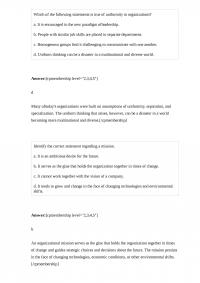
Which of the following statements is true of uniformity in organizations? a. It is encouraged in the new paradigm ofleadership. b. People with similar job skills are placed in separate departments. c. Homogenous groups fmd it challenging to communicate with […]
Management 704 Homework
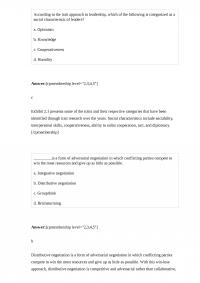
According to the trait approach to leadership, which of the following is categorized as a social characteristic of leaders? a. Optimism b. Knowledge c. Cooperativeness d. Humility _________is a form of adversarial negotiation in which conflicting parties compete to win […]
BUA 871 Test 1
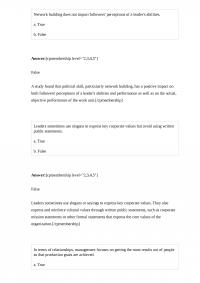
Network building does not impact followers’ perceptions of a leader’s abilities. a. True b. False Leaders sometimes use slogans to express key corporate values but avoid using written public statements. a. True b. False Answer: False Leaders sometimes use slogans […]
MGMT 622
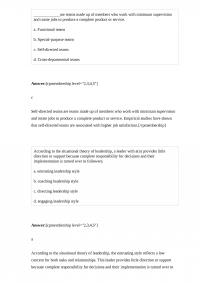
_____________are teams made up of members who work with minimum supervision and rotate jobs to produce a complete product or service. a. Functional teams b. Special-purpose teams c. Self-directed teams d. Cross-departmental teams According to the situational theory of leadership, […]
MHR 249
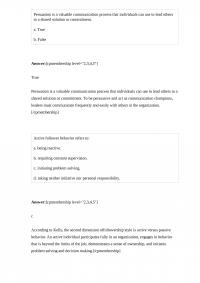
Persuasion is a valuable communication process that individuals can use to lead others to a shared solution or commitment. a. True b. False Active follower behavior refers to: a. being reactive. b. requiring constant supervision. c. initiating problem solving. d. […]
BUA 814
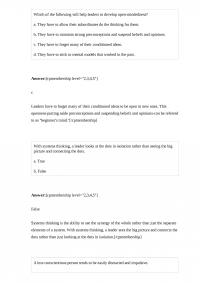
Which of the following will help leaders to develop open-mindedness? a. They have to allow their subordinates do the thinking for them. b. They have to maintain strong preconceptions and suspend beliefs and opinions. c. They have to forget many […]
BUS 557 Quiz 1
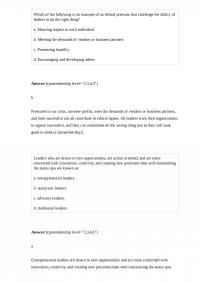
Which of the following is an example of an ethical pressure that challenge the ability of leaders to do the right thing? a. Showing respect to each individual b. Meeting the demands of vendors or business partners c. Possessing humility […]
MGT 865 Test 2
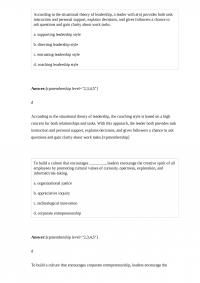
According to the situational theory of leadership, a leader with a(n) provides both task instruction and personal support, explains decisions, and gives followers a chance to ask questions and gain clarity about work tasks. a. supporting leadership style b. directing […]
Management 880 Quiz 1
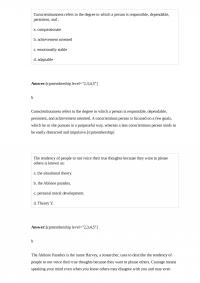
Conscientiousness refers to the degree to which a person is responsible, dependable, persistent, and . a. compassionate b. achievement oriented c. emotionally stable d. adaptable The tendency of people to not voice their true thoughts because they want to please […]
MHR 859 Stewardship leaders guide
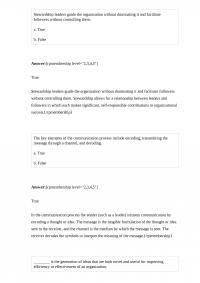
Stewardship leaders guide the organization without dominating it and facilitate followers without controlling them. a. True b. False The key elements of the communication process include encoding, transmitting the message through a channel, and decoding. a. True b. False Answer: […]
Management 543 Test 2
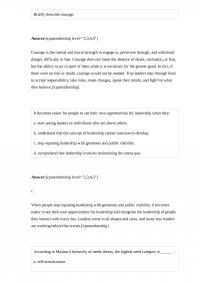
Briefly describe courage. It becomes easier for people to see their own opportunities for leadership when they: a. start seeing leaders as individuals who are above others. b. understand that the concept of leadership cannot continue to develop. c. stop […]
MicroEconomic 103 Midterm 2
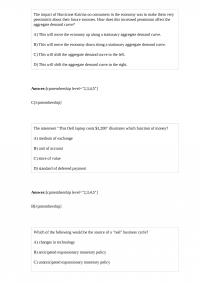
The impact of Hurricane Katrina on consumers in the economy was to make them very pessimistic about their future incomes. How does this increased pessimism affect the aggregate demand curve? A) This will move the economy up along a stationary […]
ECON A 753 Quiz
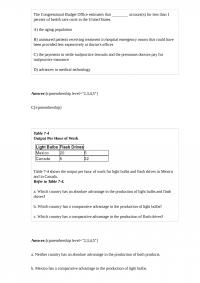
The Congressional Budget Office estimates that ________ account(s) for less than 1 percent of health care costs in the United States. A) the aging population B) uninsured patients receiving treatment in hospital emergency rooms that could have been provided less […]
Economics 242
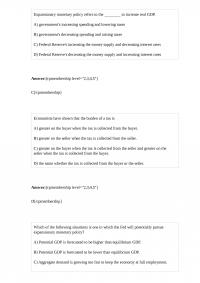
Expansionary monetary policy refers to the ________ to increase real GDP. A) government’s increasing spending and lowering taxes B) government’s decreasing spending and raising taxes C) Federal Reserve’s increasing the money supply and decreasing interest rates D) Federal Reserve’s decreasing […]
BUS 414
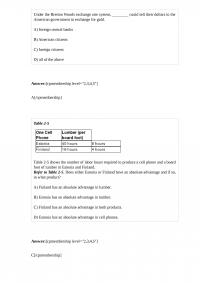
Under the Bretton Woods exchange rate system, ________ could sell their dollars to the American government in exchange for gold. A) foreign central banks B) American citizens C) foreign citizens D) all of the above Table 2-5 Table 2-5 shows […]

BUS 354 Test 2
A voluntary export restraint is an agreement negotiated by two countries that places ________ that can be imported by one country from another country. A) a tax on goods B) a minimum quantity of a good C) quality standards on […]
ECON A 580 Test 2
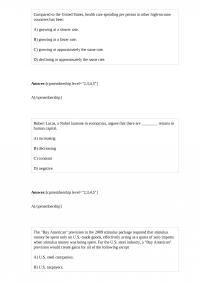
Compared to the United States, health care spending per person in other high-income countries has been A) growing at a slower rate. B) growing at a faster rate. C) growing at approximately the same rate. D) declining at approximately the […]
ECON 504
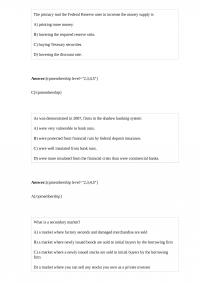
The primary tool the Federal Reserve uses to increase the money supply is A) printing more money. B) lowering the required reserve ratio. C) buying Treasury securities. D) lowering the discount rate. As was demonstrated in 2007, firms in the […]
ECB 825 Quiz 2
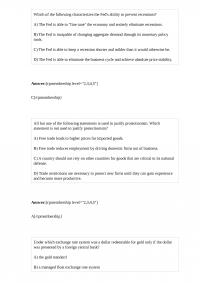
Which of the following characterizes the Fed’s ability to prevent recessions? A) The Fed is able to “fine tune” the economy and entirely eliminate recessions. B) The Fed is incapable of changing aggregate demand through its monetary policy tools. C) […]
MicroEconomic 729
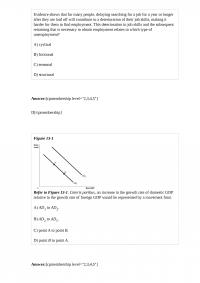
Evidence shows that for many people, delaying searching for a job for a year or longer after they are laid off will contribute to a deterioration of their job skills, making it harder for them to find employment. This deterioration […]
MicroEconomic 712 Midterm
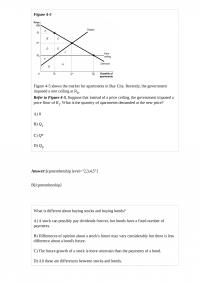
Figure 4-5 Figure 4-5 shows the market for apartments in Bay City. Recently, the government imposed a rent ceiling at R0. Refer to Figure 4-5. Suppose that instead of a price ceiling, the government imposed a price floor of R1. […]
ECON 310 Test 1
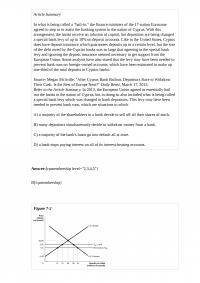
Article Summary In what is being called a “bail-in,” the finance ministers of the 17-nation Eurozone agreed to step in to assist the banking system in the nation of Cyprus. With this arrangement, the banks receive an infusion of capital, […]
BUS 587 Midterm 2
The period between a business cycle peak and a business cycle trough is called A) expansion. B) recession. C) diffusion. D) recalculation. The interest payment on a bond is called A) the coupon payment. B) principal. C) the interest rate. […]
ECON E 557 Quiz 2
If the amount you owe on your house is less than the price of the house, you have A) positive equity in your house. B) an adjustable-rate mortgage on your house. C) negative equity in your house. D) a reverse […]