Article Summary
In what is being called a “bail-in,” the finance ministers of the 17-nation Eurozone
agreed to step in to assist the banking system in the nation of Cyprus. With this
arrangement, the banks receive an infusion of capital, but depositors are being changed
a special bank levy of up to 10% on deposit accounts. Like in the United States, Cyprus
does have deposit insurance which guarantees deposits up to a certain level, but the size
of the debt owed by the Cypriot banks was so large that agreeing to the special bank
levy and ignoring the deposit insurance seemed necessary to get support from the
European Union. Some analysts have also stated that the levy may have been needed to
prevent bank runs on foreign-owned accounts, which have been estimated to make up
one-third of the total deposits in Cypriot banks.
Source: Megan McArdle, “After Cyprus Bank Bailout, Depositors Race to Withdraw
Their Cash. Is the Rest of Europe Next?” Daily Beast, March 17, 2013.
Refer to the Article Summary. In 2013, the European Union agreed to essentially bail
out the banks in the nation of Cyprus, but in doing so also included what is being called
a special bank levy which was changed to bank depositors. This levy may have been
needed to prevent bank runs, which are situations in which
A) a majority of the shareholders in a bank decide to sell off all their shares of stock.
B) many depositors simultaneously decide to withdraw money from a bank.
C) a majority of the bank’s loans go into default all at once.
D) a bank stops paying interest on all of its interest-bearing accounts.
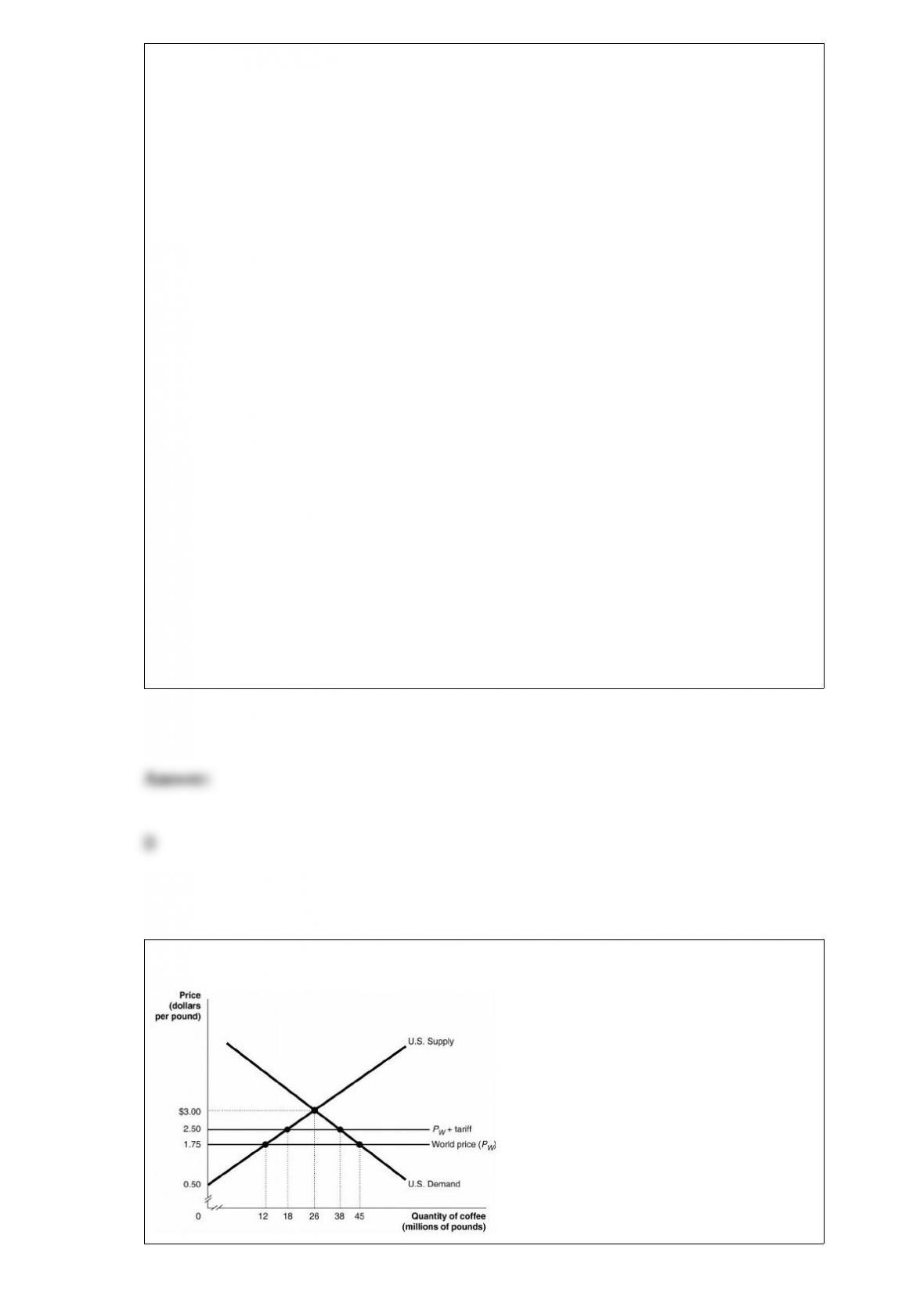
Figure 7-2

Suppose the U.S. government imposes a $0.75 per pound tariff on coffee imports.
Figure 7-2 shows the impact of this tariff.
Refer to Figure 7-2. The tariff causes domestic consumption of coffee
A) to fall by 27 million pounds.
B) to fall by 7 million pounds.
C) to rise by 6 million pounds.
D) to rise by 20 million pounds.
There has been catch-up among ________, but there has not been catch-up among
________.
A) developing countries such as Niger; industrialized countries such as Japan
B) industrialized countries such as Japan; all countries of the world
C) developing countries such as Niger; all countries of the world
D) all countries of the world together; industrialized countries such as Japan
A decrease in input costs in the production of LCD televisions caused the price of LCD
televisions to decrease. Holding everything else constant, how would this affect the
market for video game consoles (a complement to LCD televisions)?
A) The supply of video game consoles would increase and the equilibrium price of
video game consoles would decrease.

B) The demand for video game consoles would decrease and the equilibrium price of
video game consoles would decrease.
C) The demand for video game consoles would decrease because consumers could
afford to buy fewer LCD televisions and video game consoles.
D) The demand for video game consoles would increase and the equilibrium price of
video game consoles would increase.
Which of the following will cause a direct increase in consumption spending?
A) an increase in planned investment
B) an increase in government spending
C) an increase in disposable income
D) a decrease in net export spending
Figure 17-3
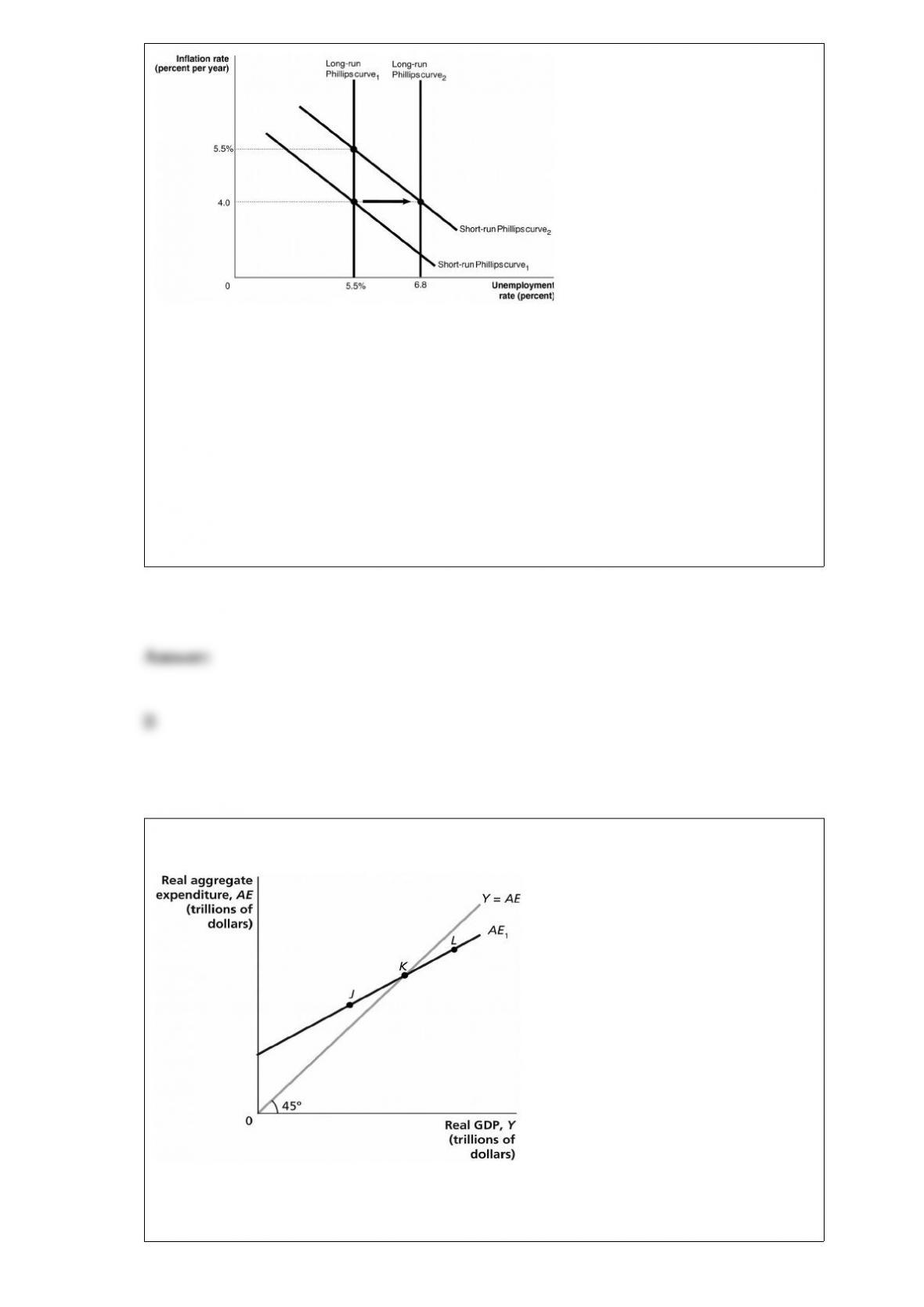
Refer to Figure 17-3. The shifts shown in the short-run and long-run Phillips curves
between period 1 and period 2 could be explained by
A) an increase in the expected inflation rate from 4.0 to 5.5 percent.
B) an increase in the natural rate of unemployment from 5.5 to 6.8 percent.
C) either an increase in expected inflation from 4.0 to 5.5 percent or an increase in the
natural rate of unemployment from 5.5 to 6.8 percent.
D) None of the above is correct.
Figure 12-1
Refer to Figure 12-1. If the economy is at point J, what will happen?
A) Inventories have fallen below their desired level, and firms decrease production.

B) Inventories have fallen below their desired level, and firms increase production.
C) Inventories have risen above their desired level, and firms decrease production.
D) Inventories have risen above their desired level, and firms increase production.
Suppliers will be willing to supply a product in all of the following situations except
A) the price received is greater than the additional cost of producing the product.
B) the price received is at least equal to the additional cost of producing the product.
C) the price received is equal to the additional cost of producing the product.
D) the price received is less than the additional cost of producing the product.
The M1 measure of the money supply equals
A) paper money plus coins in circulation.
B) currency plus checking account balances.
C) currency plus checking account balances plus traveler’s checks.
D) currency plus checking account balances plus traveler’s checks plus savings account
balances.
In the modern U.S. economy, the typical unemployed person stays unemployed for
A) a relatively long time, over a year.
B) a relatively short time, less than six months.
C) a long time during expansions and a short time during recessions.
D) an amount of time that is hard to quantify.
The circular flow model demonstrates
A) the role of the government in overseeing the market system.
B) the roles played by households and firms in the market system.
C) how shortages and surpluses are eliminated in a market.
D) how demand and supply for goods and services are brought into equilibrium.
All of the following would be considered a positive addition to household wealth
except
A) the equity in one’s home.
B) 500 shares of Google stock.
C) the balance in your savings account.
D) a credit card balance.
If the Federal Reserve chooses to fight high inflation with contractionary monetary
policy and firms and consumers expect this policy to reduce inflation, which of the
following would you expect to see?
A) a downward shift of the short-run Phillips curve
B) a reduction in the unemployment rate
C) a decrease in the long-run aggregate supply curve
D) an increase in inflationary expectations