
The period between a business cycle peak and a business cycle trough is called
A) expansion.
B) recession.
C) diffusion.
D) recalculation.
The interest payment on a bond is called
A) the coupon payment.
B) principal.
C) the interest rate.
D) the face value.
If the CPI rises from 206.7 to 212.7 between two consecutive years, by how much has
the cost of living changed between these two years?
A) The cost of living has increased by 6%.
B) The cost of living has increased by 2.9%.
C) The cost of living has increased by 12.7%.
D) The cost of living has decreased by 6%.

Since 1950,
A) economic expansions in the United States have been so short that expansions barely
exist.
B) the average length of expansions in the United States have become shorter as
compared to before 1950.
C) the average length of expansions in the United States have become longer as
compared to before 1950.
D) the average length of expansions in the United States are about the same length as
compared to before 1950.
Trade-offs force society to make choices when answering what three fundamental
questions?
A) What will be the prices of goods and services; how will these goods and services be
produced; and who will receive them?
B) What goods and services to produce; how will these goods and services be produced;
and who receives them?
C) Who gets jobs; what wages do workers earn; and who owns what property?
D) How much will be saved; what will be produced; and how can these goods and
services be fairly distributed?

Because of the slope(s) of the ________, we can say that a decrease in the price level
leads to a higher level of real GDP demanded.
A) aggregate demand curve
B) short-run aggregate supply curve
C) long-run aggregate supply curve
D) short-run and long-run aggregate supply curves
If the Federal Reserve decided to include virtual money like Bitcoins in its measure of
the money supply, what would be the effect on M1 or M2?
A) M1 would rise.
B) M1 would fall.
C) M1 would rise and M2 would remain constant.
D) M2 would rise but M1 would remain constant.

What actions could the Federal Reserve take to achieve consistent growth in real GDP
at 4 percent per year?
A) The Fed could increase in the growth rate of the money supply by 1% each year
until the inflation rate was exactly equal to 4 percent.
B) The Fed could maintain a growth rate of the money supply of 4 percent, regardless
of whether inflation was rising or falling in the economy.
C) The Fed could follow contractionary monetary policy that would reduce the federal
funds rate to zero so investment will rise consistently.
D) The Fed has no direct control over real GDP in the long run, so there are no actions
it could take to achieve that goal.
Which of the following would be most likely to induce Congress and the president to
conduct expansionary fiscal policy? A significant
A) decrease in investment spending.
B) decrease in oil prices.
C) increase in consumption spending.
D) increase in net exports.
What is the present value of $575 in a one year if the current rate of interest is 4
percent?
A) $410.71

B) $552.88
C) $598
D) $805
Which of the following statements is false?
A) Japan is less dependent on foreign trade than is the United States.
B) Imports and exports account for over one-half of the GDP of the Netherlands.
C) The United States is the leading exporting country, accounting for almost 10 percent
of total world exports.
D) Because the cost of labor used on farms is so high, the United States exports very
little of its wheat, rice and corn crops.
Table 7-3
Mateo and Celeste produce custom saddles and spurs. Table 7-3 lists the number of
saddles and pairs of spurs Mateo and Celeste can each produce in one month.
Refer to Table 7-3. Select the statement that accurately interprets the data in the table.

A) Celeste has a comparative advantage in making spurs.
B) Mateo has a comparative advantage in making spurs.
C) Celeste has a comparative advantage in making saddles and making spurs.
D) Neither Mateo nor Celeste has a comparative advantage in making spurs.
Models that focus on factors other than changes in the money supply to explain
fluctuations in real GDP are called
A) nonmonetary business cycle models.
B) real business cycle models.
C) rational expectations models.
D) short-run macroeconomic models.
Figure 16-1
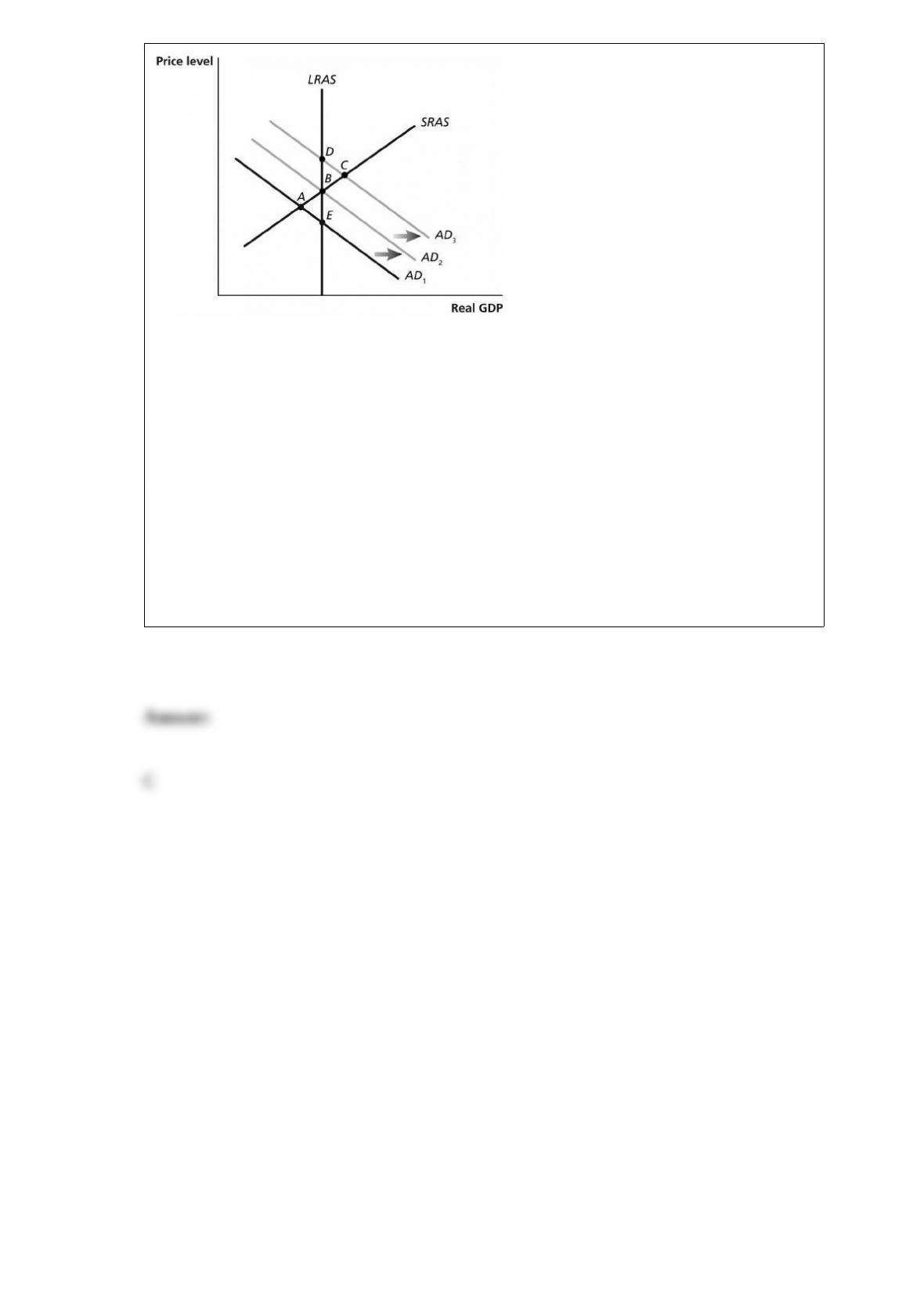
Refer to Figure 16-1. Suppose the economy is in short-run equilibrium above potential
GDP and automatic stabilizers move the economy back to long-run equilibrium. Using
the static AD–AS model in the figure above, this would be depicted as a movement from
A) D to C.
B) A to E.
C) C to B.
D) B to A.
E) E to A.