
Expansionary monetary policy refers to the ________ to increase real GDP.
A) government’s increasing spending and lowering taxes
B) government’s decreasing spending and raising taxes
C) Federal Reserve’s increasing the money supply and decreasing interest rates
D) Federal Reserve’s decreasing the money supply and increasing interest rates
Economists have shown that the burden of a tax is
A) greater on the buyer when the tax is collected from the buyer.
B) greater on the seller when the tax is collected from the seller.
C) greater on the buyer when the tax is collected from the seller and greater on the
seller when the tax is collected from the buyer.
D) the same whether the tax is collected from the buyer or the seller.
Which of the following situations is one in which the Fed will potentially pursue
expansionary monetary policy?
A) Potential GDP is forecasted to be higher than equilibrium GDP.
B) Potential GDP is forecasted to be lower than equilibrium GDP.
C) Aggregate demand is growing too fast to keep the economy at full employment.
D) Aggregate demand is growing too slowly and the economy is in danger of producing
GDP above full employment.
Hurricane Katrina destroyed oil and natural gas refining capacity in the Gulf of Mexico
which subsequently drove up natural gas, gasoline, and heating oil prices. Three years
later, once the refining capacity was restored, these prices came back down. The
restoration of refining capacity should
A) shift the short-run aggregate supply curve to the left.
B) shift the short-run aggregate supply curve to the right.
C) move the economy up along a stationary short-run aggregate supply curve.
D) move the economy down along a stationary short-run aggregate supply curve.
All of the following are true statements about the multiplier except
A) the multiplier rises as the MPC rises.
B) the smaller the MPS, the larger the multiplier.
C) the multiplier is a value between zero and one.
D) the multiplier effect occurs when autonomous expenditure changes.
If net exports are equal to net foreign investment, which of the following is not true?
A) The balance of payments is zero.
B) The current account balance is equal to the negative of the financial account balance.
C) Net capital inflows are equal to imports minus exports.
D) The balance on the financial account is zero.
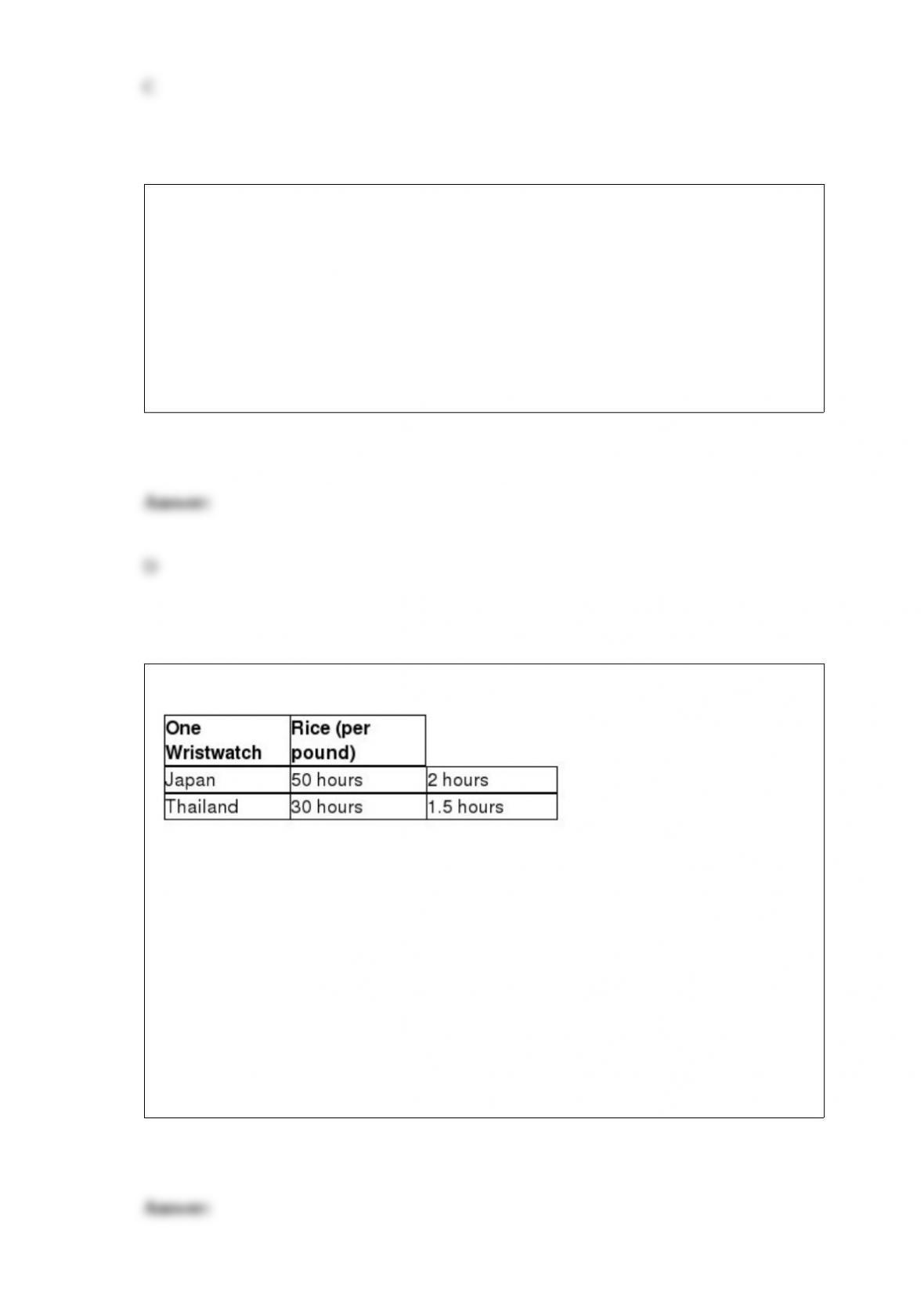
Table 2-9
Table 2-9 shows the number of labor hours required to produce a wristwatch and a
pound of rice in Japan and Thailand.
Refer to Table 2-9. What is Thailand’s opportunity cost of producing one pound of rice?
A) 60 wristwatches
B) 20 wristwatches
C) 5 wristwatches
D) 0.05 units of a wristwatch

If the economy is slipping into a recession, which of the following would be an
appropriate fiscal policy?
A) an increase in the money supply and a decrease in interest rates
B) a decrease in government purchases
C) a decrease in taxes
D) a decrease in oil prices
Suppose in 2014, you purchase a house built in 2003. Which of the following would be
included in the gross domestic product for 2014?
A) the value of the house in 2014
B) the value of the house in 2003
C) the value of the house in 2014 minus depreciation
D) the value of the services of the real estate agent
A corporation’s management
A) owns the corporation.

B) hires the board of directors.
C) are liable for the corporation’s debts.
D) operates and controls a corporation in its day-to-day activities.
Generally with bond ratings, the lower the rating, the ________ the interest rate an
investor will receive and the ________ the risk that the issuer of the bond will default.
A) higher; higher
B) higher; lower
C) lower; higher
D) lower; lower
According to the ________ Phillips curve, the unemployment rate and the inflation rate
are negatively related.
A) long-run
B) short-run
C) long-run and short-run
D) rational expectations

Since 1950, expansions in the United States have become ________, while recessions
have become ________.
A) longer; longer
B) shorter; shorter
C) shorter; longer
D) longer; shorter
Suppose there is a bank panic. Which of the following would not be a consequence of
this bank panic?
A) Bank total reserves would decrease.
B) Required reserves would increase.
C) Bank checking account balances would decrease.
D) Individual banks would have to shrink the value of loans they made.
E) The economy would likely enter into a recession.
A study conducted by Alberto Alesina and Lawrence Summers concluded that countries
with highly independent central banks had ________ than countries whose central
banks had little independence.
A) higher unemployment rates
B) lower unemployment rates
C) higher inflation rates
D) lower inflation rates