
Which of the following characterizes the Fed’s ability to prevent recessions?
A) The Fed is able to “fine tune” the economy and entirely eliminate recessions.
B) The Fed is incapable of changing aggregate demand through its monetary policy
tools.
C) The Fed is able to keep a recession shorter and milder than it would otherwise be.
D) The Fed is able to eliminate the business cycle and achieve absolute price stability.
All but one of the following statements is used to justify protectionism. Which
statement is not used to justify protectionism?
A) Free trade leads to higher prices for imported goods.
B) Free trade reduces employment by driving domestic firms out of business.
C) A country should not rely on other countries for goods that are critical to its national
defense.
D) Trade restrictions are necessary to protect new firms until they can gain experience
and become more productive.
Under which exchange rate system was a dollar redeemable for gold only if the dollar
was presented by a foreign central bank?
A) the gold standard
B) a managed float exchange rate system

C) the Bretton Woods System
D) a fiat system
Which of the following would increase net exports in the United States?
A) The United States purchases 500 silver necklaces from Mexico.
B) The government of Mexico purchases 500 Ford F-150 pickup trucks from the United
States.
C) A Mexican citizen purchases 25 shares of stock in Ford Motor Company.
D) The U.S. government donates $5 million to Mexico to help victims of drought in
Mexico.
If the short-run aggregate supply increases by less than the long-run aggregate supply,
then, at the short-run equilibrium,
A) GDP will be below potential GDP.
B) aggregate demand will increase.
C) GDP will be above potential GDP.
D) GDP will be equal to potential GDP.

The level of saving in the United States has historically been low relative to the level of
domestic investment. Based on this information, we would expect that
A) U.S. net foreign investment has been relatively high.
B) U.S. net exports have been relatively low.
C) U.S. capital inflows are negative.
D) U.S. private saving is less than its public saving.
You’re traveling in Japan and are thinking about buying a new kimono. You’ve decided
you’d be willing to pay $175 for a new kimono, but kimonos in Japan are all priced in
yen. If the kimono you’re looking at costs 14,000 yen, under which of the following
exchange rates would you be willing to purchase the kimono? (Assume no taxes or
duties are associated with the purchase.)
A) 24.5 yen per dollar
B) 65 yen per dollar
C) 80 yen per dollar
D) You would purchase the new kimono at any of the above exchange rates.
Which term refers to a legally established maximum price that firms may charge?
A) a price ceiling
B) a subsidy
C) a price floor
D) a tariff
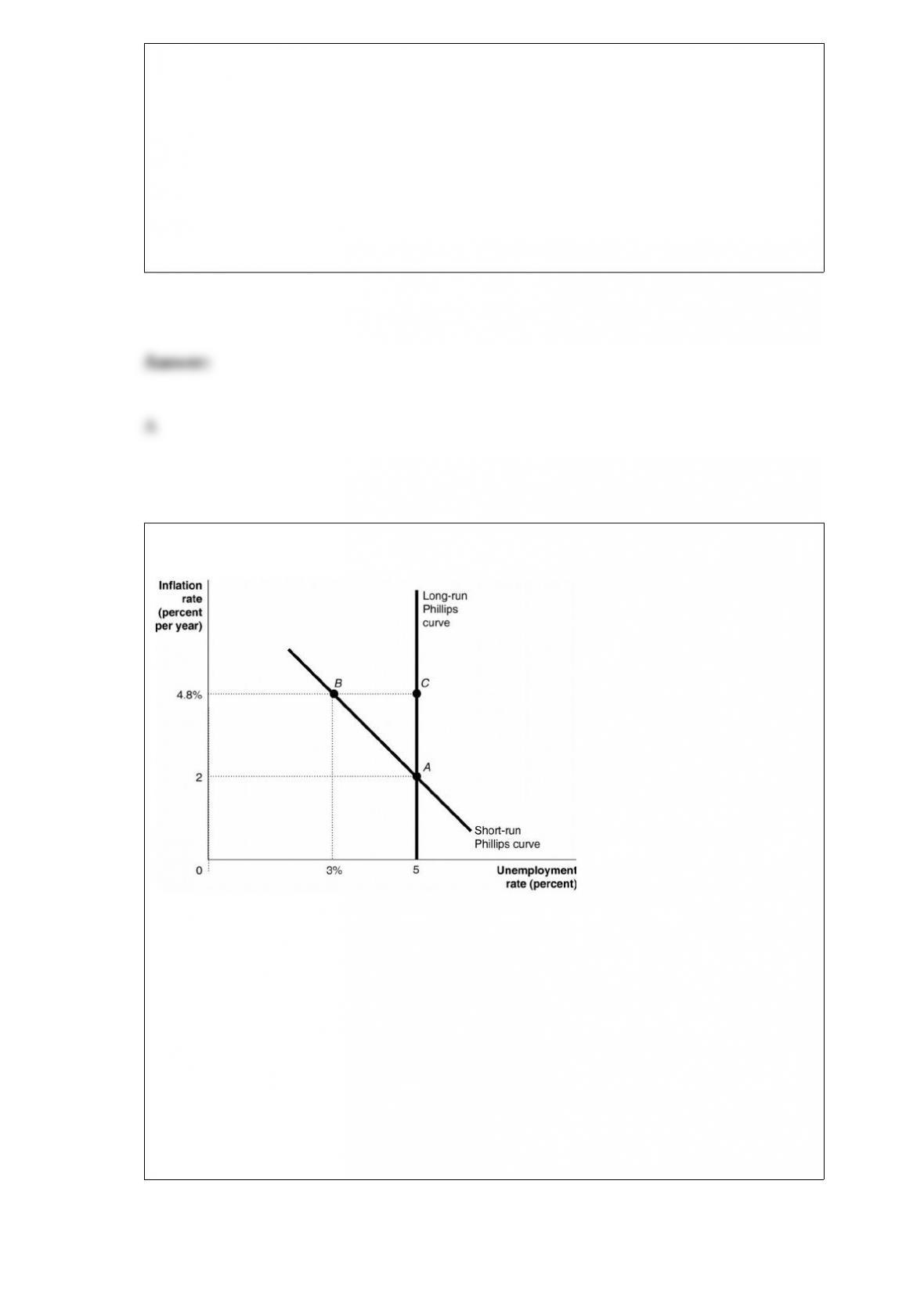
Figure 17-6
Refer to Figure 17-6. If firms and workers have adaptive expectations, an expansionary
monetary policy will cause the short-run equilibrium to move from
A) point B to point C.
B) point A to point C.
C) point A to point B.
D) point B to point A.
E) point C to point B.
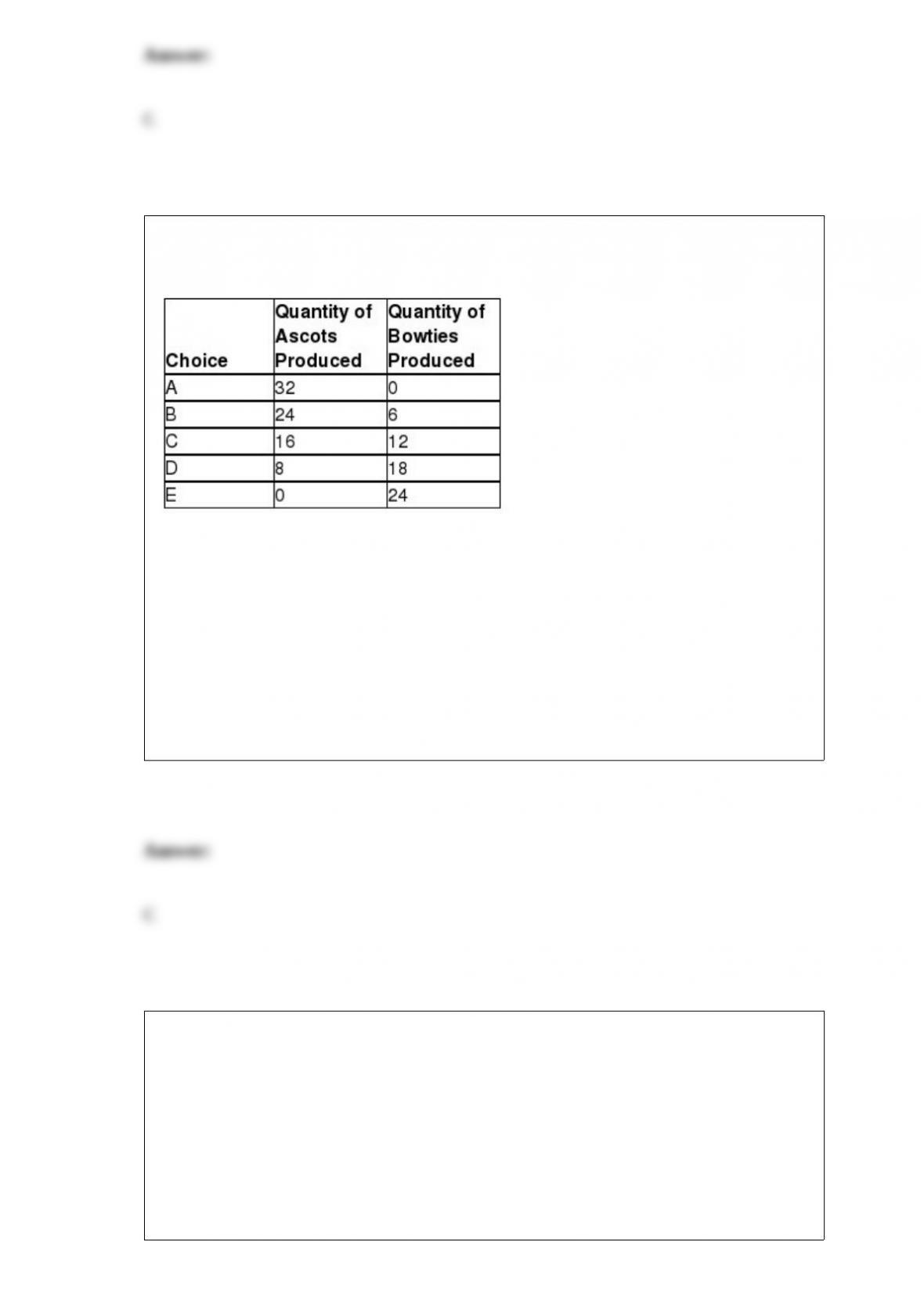
Table 2-2
Production choices for Nadia’s Neckware
Refer to Table 2-2. Assume Nadia’s Neckties only produces ascots and bowties. Nadia
faces ________ opportunity costs in the production of ascots and bowties.
A) increasing
B) decreasing
C) constant
D) negative
The cyclically adjusted budget deficit or surplus measures what the deficit or surplus
would be if the economy was
A) in a recession.
B) in an expansion.
C) at potential GDP.

D) at potential tax revenue.