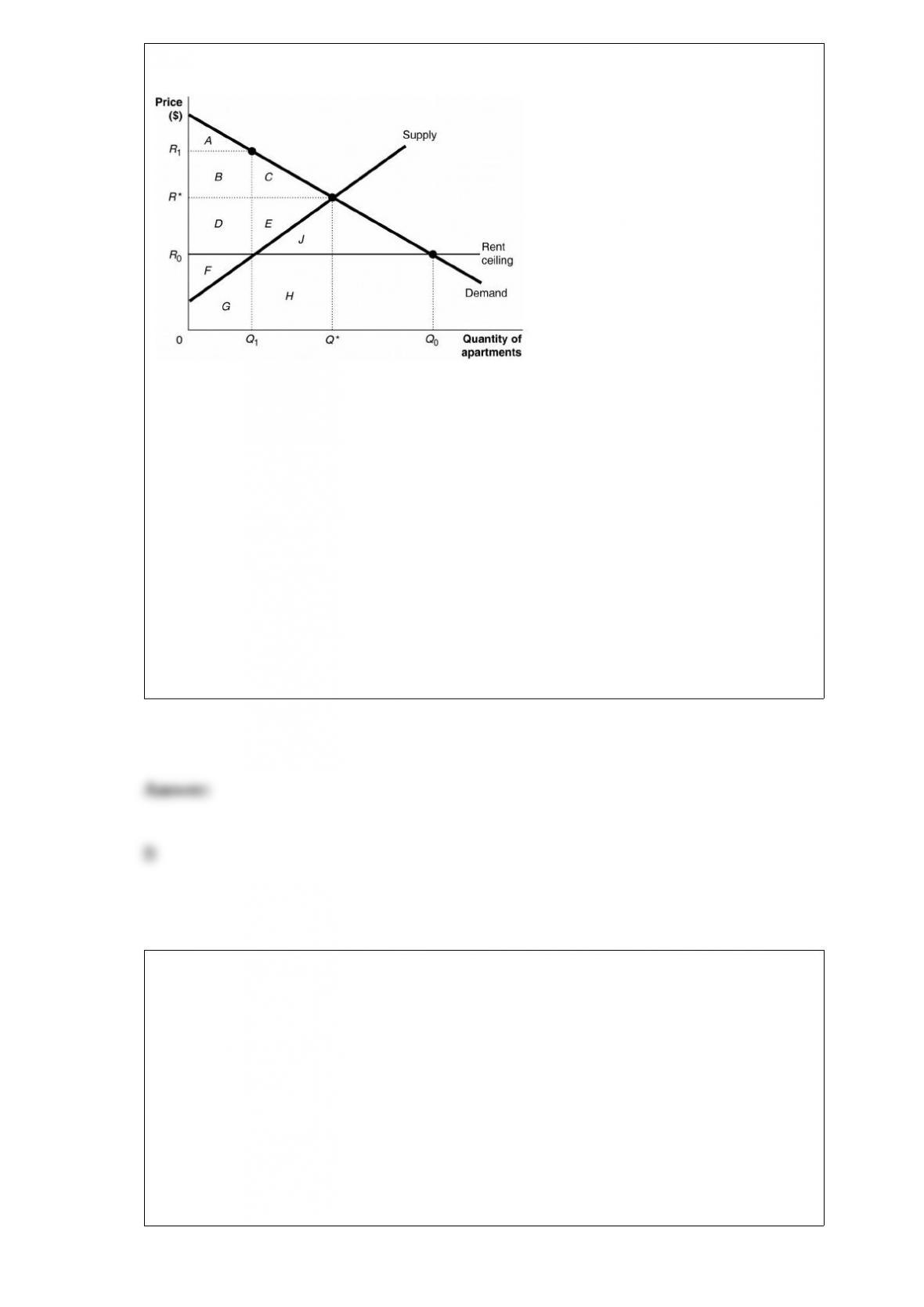
Figure 4-5
Figure 4-5 shows the market for apartments in Bay City. Recently, the government
imposed a rent ceiling at R0.
Refer to Figure 4-5. Suppose that instead of a price ceiling, the government imposed a
price floor of R1. What is the quantity of apartments demanded at the new price?
A) 0
B) Q1
C) Q*
D) Q0
What is different about buying stocks and buying bonds?
A) A stock can possibly pay dividends forever, but bonds have a fixed number of
payments.
B) Differences of opinion about a stock’s future may vary considerably but there is less
difference about a bond’s future.
C) The future growth of a stock is more uncertain than the payments of a bond.
D) All these are differences between stocks and bonds.

Which of the following equations is true in an open economy?
A) Private saving = net foreign investment + domestic investment.
B) Domestic saving = net capital flows.
C) Net exports = -Financial account balance.
D) Net exports = net foreign investment.
In a small European country, it is estimated that a $10,000 increase in capital per hour
worked will increase real GDP per hour worked by $300. Based on this information,
what is the slope of the per-worker production function in this range?
A) 0.03
B) 3.3
C) 33.3
D) 333
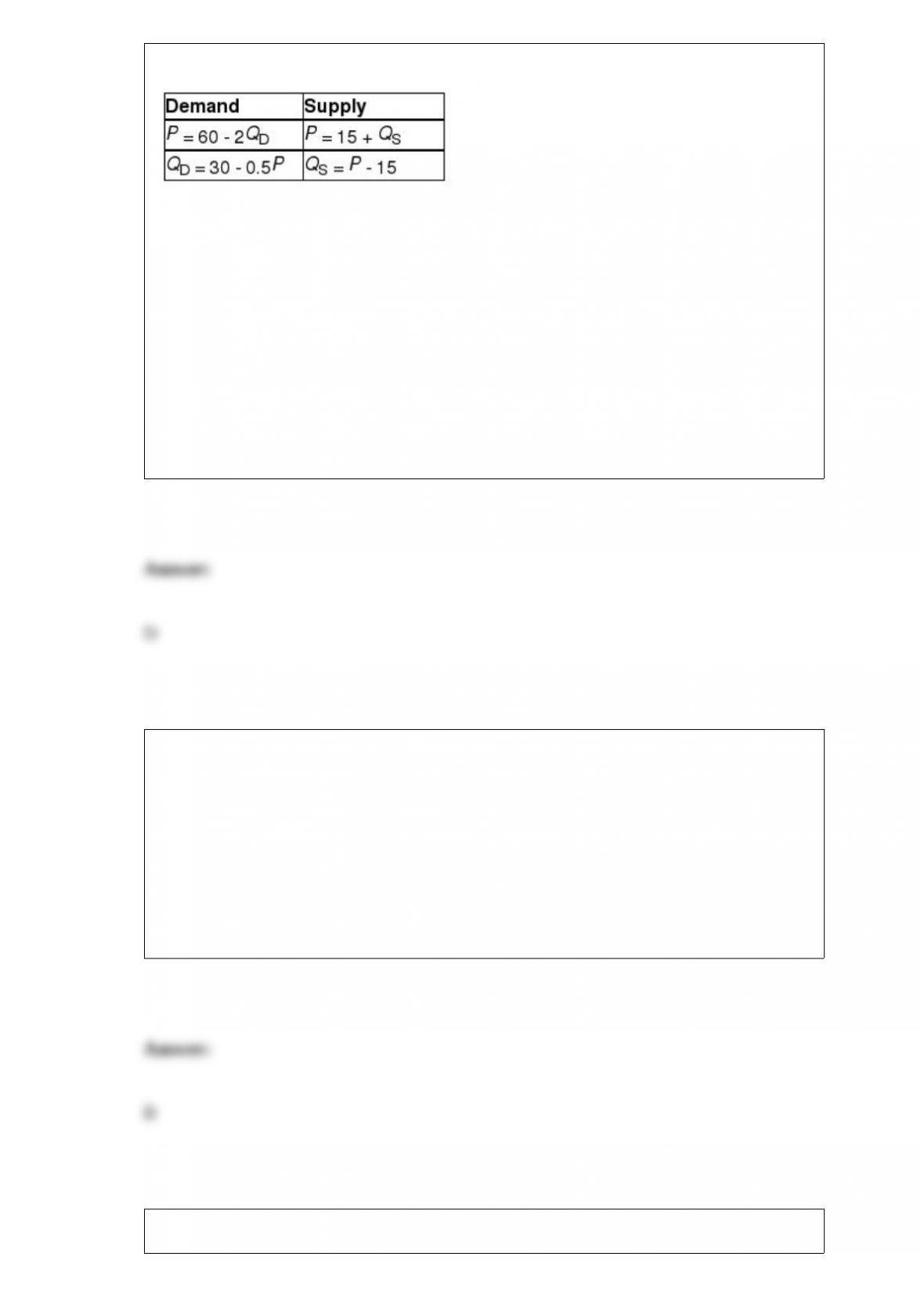
Table 4-7
Refer to Table 4-7. The equations above describe the demand and supply for Pauline’s
Pickled Pomegranates. The equilibrium price and quantity for Pauline’s Pickled
Pomegranates are $30 and 15 thousand units. What is the value of economic surplus in
this market?
A) $50 thousand
B) $112.5 thousand
C) $225 thousand
D) $337.5 thousand
An inward shift of the production possibilities frontier represents
A) positive economic growth.
B) negative economic growth.
C) a rise in the unemployment rate.
D) technological improvement.
A decision by foreign central banks to sell their holdings of U.S. Treasury bonds will
A) lower bond prices and interest rates in the United States.
B) increase bond prices and interest rates in the United States.
C) increase bond prices and lower interest rates in the United States.
D) lower bond prices and increase interest rates in the United States.
The law of demand implies, holding everything else constant, that as the price of yogurt
A) increases, the demand for yogurt will increase.
B) increases, the quantity of yogurt demanded will decrease.
C) decreases, the quantity of yogurt demanded will decrease.
D) decreases, the demand for yogurt will increase.
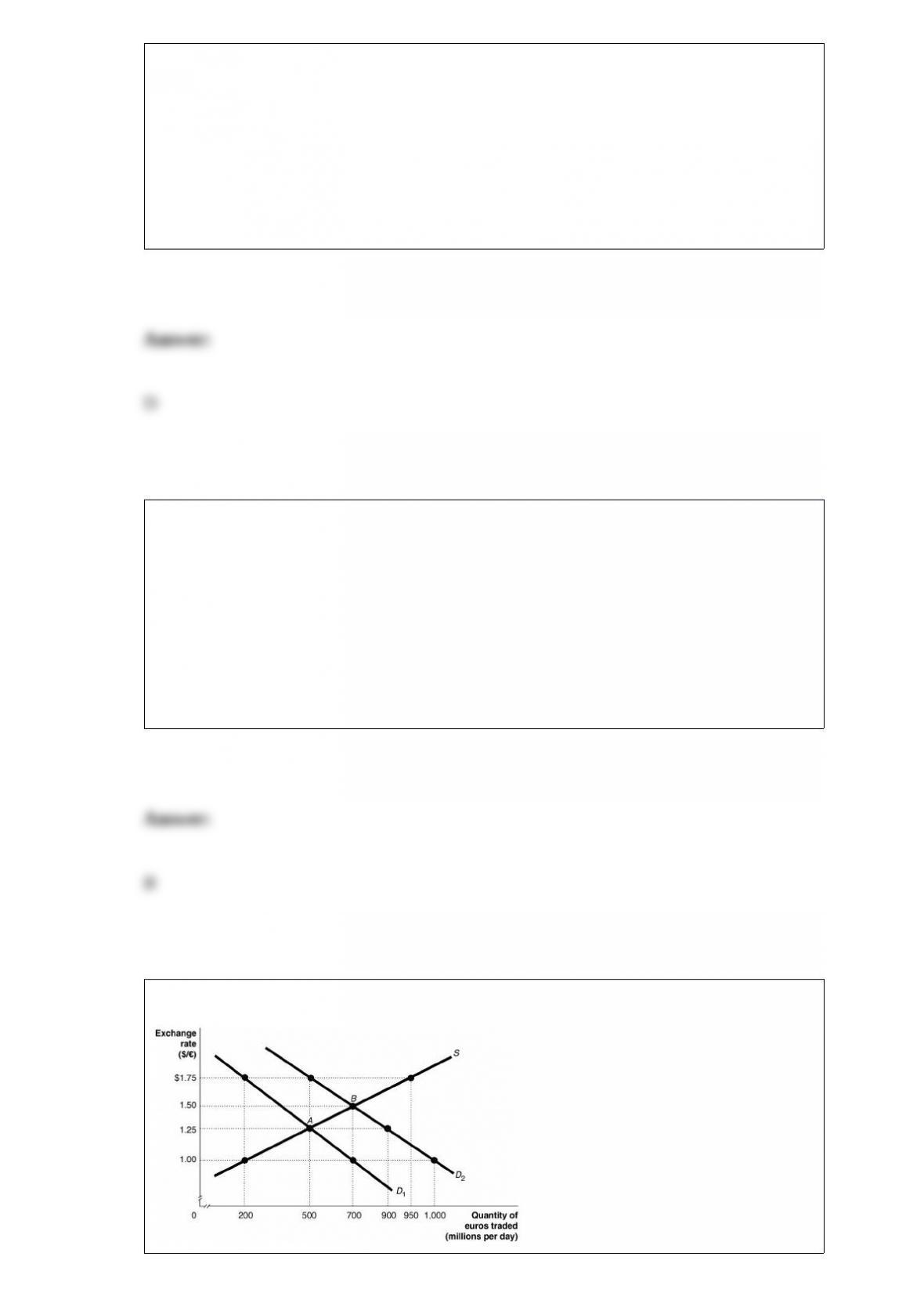
Figure 19-8

Refer to Figure 19-8. The equilibrium exchange rate is originally at A, $1.25/euro.
Suppose the European Central Bank pegs its currency at $1.00/euro. Speculators expect
that the value of the euro will rise and this shifts the demand curve for euro to D2. If the
European Central Bank abandons the peg, the equilibrium exchange rate would be
A) $1.00/euro.
B) $1.25/euro.
C) $1.50/euro.
D) $1.75/euro.
If you liquidate $3,000 of your mutual fund and transfer the funds to your checking
account, then initially, M1 will ________ and M2 will ________.
A) not change; decrease
B) increase; decrease
C) increase; not change
D) not change; not change
Scenario 1-1
Suppose a cigar manufacturer currently sells 1,500 cigars per week and makes a profit
of $3,000 per week. The plant foreman observes, “Although the last 500 cell cigars we
produced and sold increased our revenue by $7,500 and our costs by $7,000, we are
only making an overall profit of $3,000 per week so I think we need to cut back on

production.
Refer to Scenario 1-1. Using marginal analysis terminology, what is another economic
term for the incremental cost of producing the last 500 cigars?
A) marginal cost
B) operating cost
C) explicit cost
D) Any of the above terms are correct.
To compete in the automobile market, Tesla must make many strategic decisions such
as whether to introduce a new car model, how to sell and service its cars, and where to
advertise. At Tesla’s Fremont, California plant, managers must decide on the monthly
production quantities of their S and X models. In making this decision, the managers
A) face no trade-off because the Fremont plant only produces these two models of the
many Tesla models produced worldwide.
B) face a trade-off, because producing more of one model means producing less of the
others.
C) will choose to only produce the quantity of S and X models where marginal cost
equals zero.
D) will always decide on production quantities in which revenues are maximized.
According to the quantity theory of money, deflation will occur if the

A) money supply is less than real GDP.
B) money supply is more than real GDP.
C) money supply grows at a slower rate than real GDP.
D) money supply grows at a faster rate than real GDP.
During the twentieth century, the largest budget deficits as a percentage of GDP
occurred
A) during the 1990s.
B) during the 1980s.
C) during the Vietnam war.
D) during World Wars I and II.
Intel is the world’s largest semiconductor manufacturer and a major supplier of the
microprocessors and memory chips found in most personal computers. During the
recession of 2007-2009, Intel’s revenues ________ and it ________ the size of its
workforce.
A) fell; increased
B) fell; decreased
C) rose; increased
D) rose; decreased
Which of the following is true regarding the productivity slowdown in the United States
during the mid-1970s?
A) The productivity slowdown occurred despite a rising quality of labor.
B) The productivity slowdown was unique to the United States, as foreign countries
experienced unprecedented rates of growth during that time.
C) High oil prices raised the costs of doing business for markets worldwide, and
reduced output worldwide as well.
D) The move toward a “new economy” ended in the early 1970s, resulting in less
technological progress in the United States during the mid-1970s.
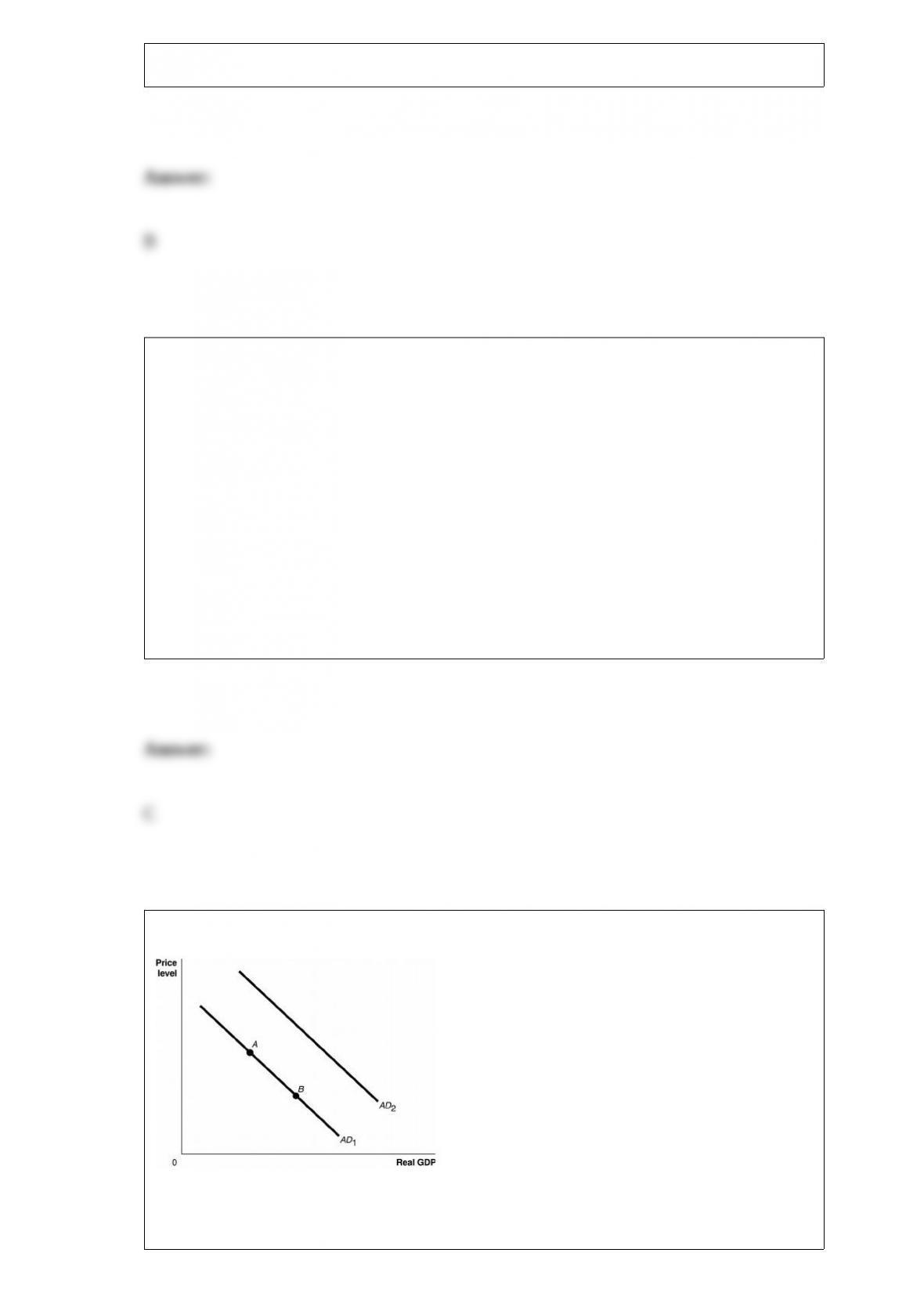
Figure 13-1
Refer to Figure 13-1. Ceteris paribus, a decrease in the price level would be
represented by a movement from

A) AD1 to AD2.
B) AD2 to AD1.
C) point A to point B.
D) point B to point A.
Which of the following would result in a trade surplus for the United States?
A) Exports of goods = $725 billion
Imports of goods = $790 billion
Exports of services = $350 billion
Imports of services = $260 billion
B) Exports of goods = $625 billion
Imports of goods = $625 billion
Exports of services = $300 billion
Imports of services = $375 billion
C) Exports of goods = $550 billion
Imports of goods = $575 billion
Exports of services = $275 billion
Imports of services = $300 billion
D) All of the above will result in a trade surplus.