
Compared to the United States, health care spending per person in other high-income
countries has been
A) growing at a slower rate.
B) growing at a faster rate.
C) growing at approximately the same rate.
D) declining at approximately the same rate.
Robert Lucas, a Nobel laureate in economics, argues that there are ________ returns to
human capital.
A) increasing
B) decreasing
C) constant
D) negative
The “Buy American” provision in the 2009 stimulus package required that stimulus
money be spent only on U.S.-made goods, effectively acting as a quota of zero imports
when stimulus money was being spent. For the U.S. steel industry, a “Buy American”
provision would create gains for all of the following except
A) U.S. steel companies.
B) U.S. taxpayers.

C) U.S. steel workers.
D) All of the above would gain from the provision.
How will contractionary monetary policy in Japan affect the demand and supply of the
yen in the foreign exchange market?
A) The demand for the yen will fall, and the supply of the yen will increase.
B) The demand for the yen will increase, and the supply of the yen will fall.
C) The demand for the yen will fall, and the supply of the yen will fall.
D) The demand for the yen will increase, and the supply of the yen will increase.
Forecasts made by White House economists and economists at the Congressional
Budget Office in 2011 projected that real GDP
A) would return to potential GDP by the end of 2011.
B) would not return to potential GDP until the first quarter of 2013.
C) would not return to potential GDP until 2016.
D) would never return to potential GDP.
Aggregate expenditure includes spending on
A) C + I + G.
B) C + I + G – NX.
C) C + I + G + NX.
D) C + I + depreciation – NX.
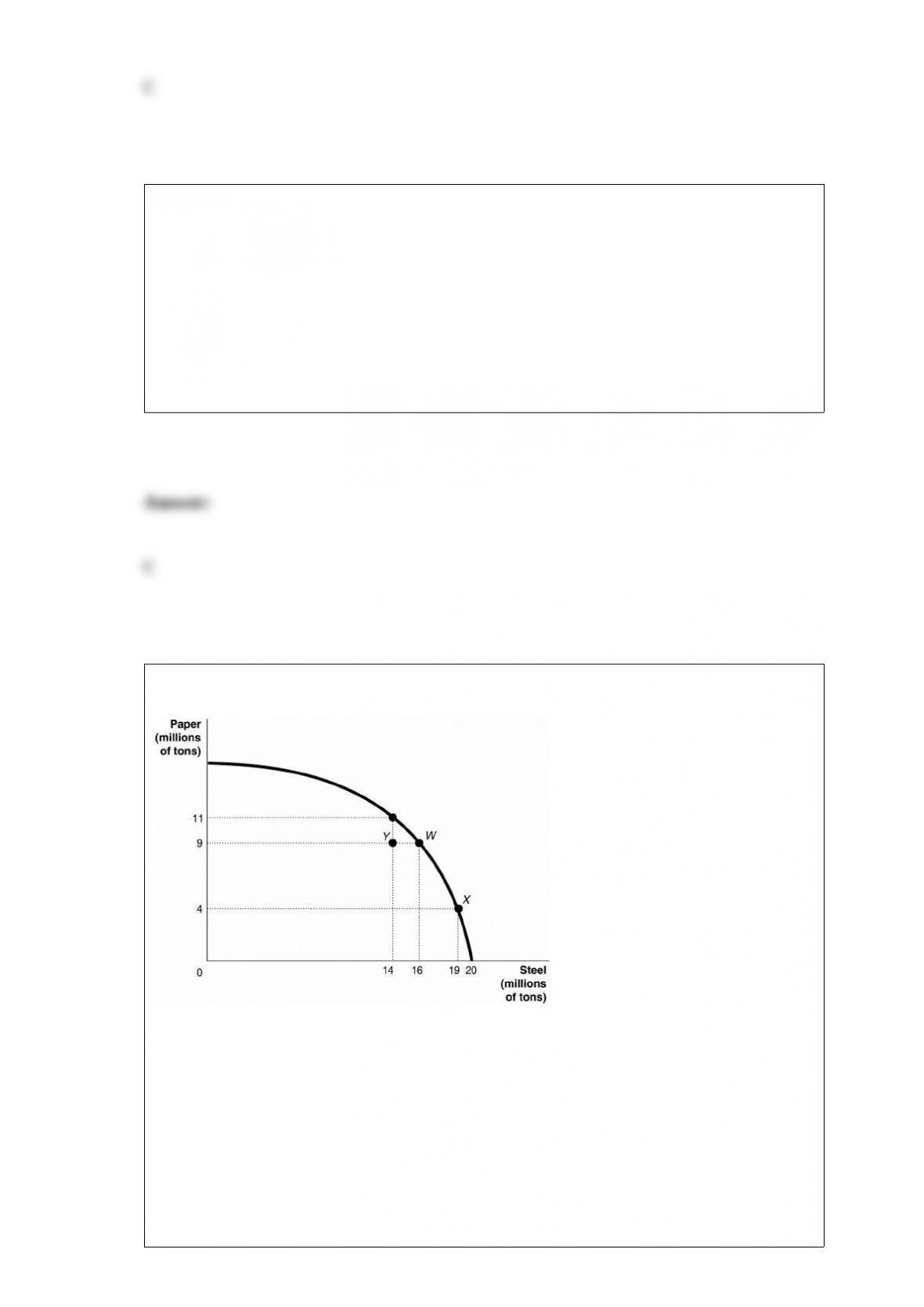
Figure 2-5
Refer to Figure 2-5. If the economy is currently producing at point X, what is the
opportunity cost of moving to point W?
A) 3 million tons of steel
B) 19 million tons of steel
C) 5 million tons of paper
D) 9 million tons of paper
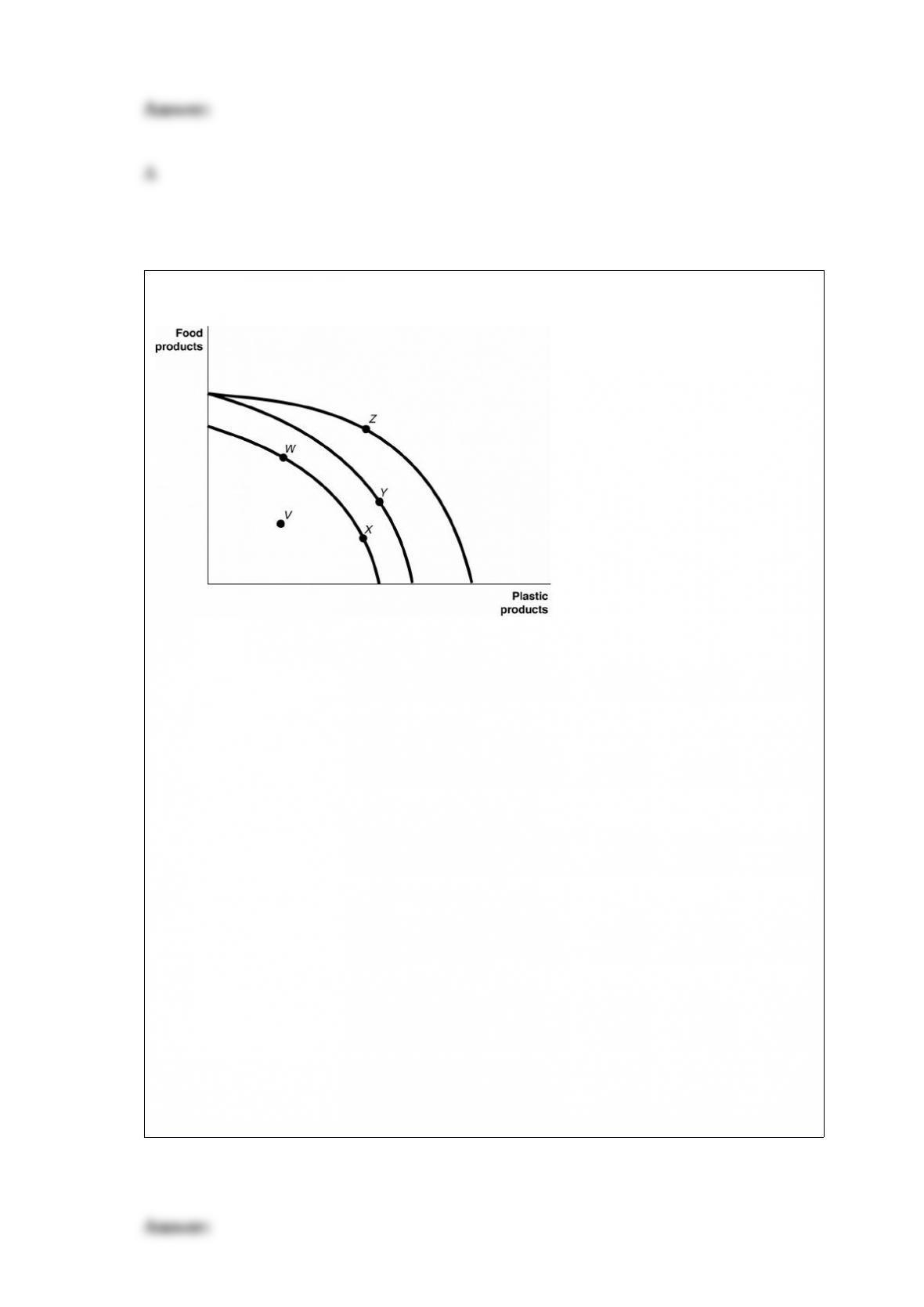
Figure 2-4
Figure 2-4 shows various points on three different production possibilities frontiers for
a nation.
Refer to Figure 2-4. Consider the following events:
a. a decrease in the unemployment rate
b. an increase in technology with respect to both food and plastic production
c. a war that kills a significant portion of a nation’s population
Which of the events listed above could cause a movement from W to Y ?
A) a, b and c
B) a and b only
C) a and c only
D) b only
E) c only

Economic growth is represented on a production possibilities frontier model by the
production possibility frontier
A) shifting outward.
B) shifting inward.
C) becoming steeper.
D) becoming flatter.
As the tax wedge associated with a given economic activity gets smaller, we would
expect
A) more of that economic activity to occur.
B) the distortions caused by taxes on that activity to be greater.
C) people to engage in less of that particular activity.
D) no change in the practice of that activity until the tax wedge ultimately disappears.
Assume that in recent years the cost of producing microbrew beer in the U.S. has
decreased largely due to technological improvements. At the same time, more and more

Americans prefer microbrew beer over wine. Which of the following best explains the
effect of these events in the microbrew beer market?
A) The supply curve has shifted to the right and the demand curve has shifted to the
left. As a result there has been a decrease in the equilibrium quantity and an uncertain
effect on the equilibrium price.
B) Both the supply and demand curves have shifted to the right. As a result, there has
been an increase in the equilibrium quantity and an uncertain effect on the equilibrium
price.
C) Both the supply and demand curves have shifted to the right. As a result, there has
been an increase in both the equilibrium price and the equilibrium quantity.
D) The supply curve has shifted to the left and the demand curve has shifted to the
right. As a result, there has been an increase in the equilibrium price and an uncertain
effect on the equilibrium quantity.
A country with no trade and no borrowing and lending relationships with other
countries is known as a(n)
A) planned economy.
B) market economy.
C) open economy.
D) closed economy.
Figure 2-5
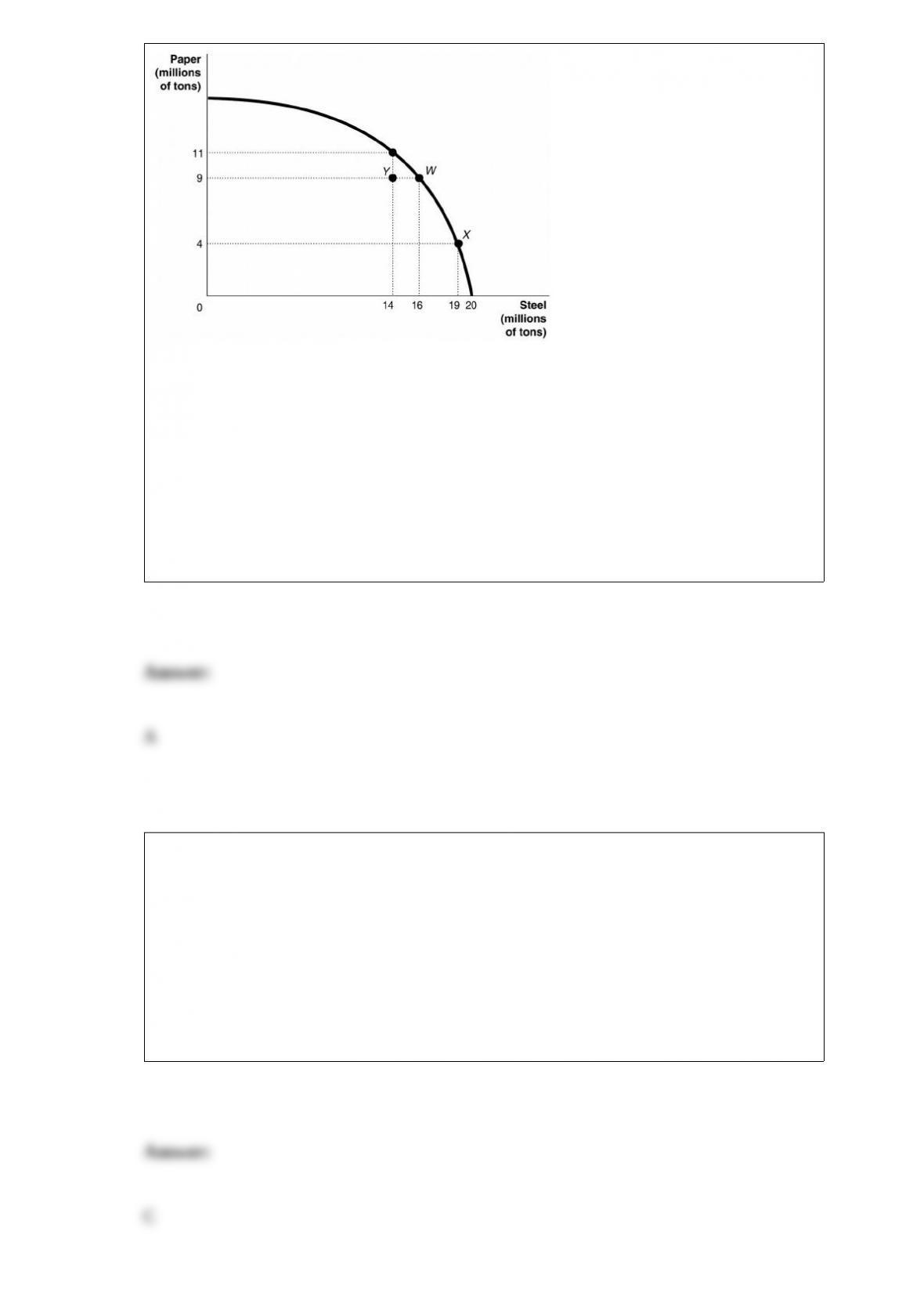
Refer to Figure 2-5. If the economy is currently producing at point W, what is the
opportunity cost of moving to point Y?
A) 2 million tons of steel
B) 14 million tons of steel
C) 2 million tons of paper
D) 9 million tons of paper
If net taxes fall by $80 billion, we would expect
A) the government deficit to fall by $80 billion.
B) household saving to rise by $80 billion.
C) household saving to rise by less than $80 billion.
D) household saving to fall by more than $80 billion.

Table 7-6
Production and
Consumption Production
Without Trade With Trade
Estonia and Morocco can produce both swords and belts. Table 7-6 shows the
production and consumption quantities without trade, and the production numbers with
trade.
Refer to Table 7-6. If the actual terms of trade are 1 belt for 1.5 swords and 70 belts are
traded, how many belts will Morocco gain compared to the “without trade” numbers?
A) 10
B) 20
C) 70
D) 80
A persistent shortage or surplus of a currency under the Bretton Woods system was
evidence of
A) failure to support the existing fixed exchange rate by central banks.
B) fundamental disequilibrium in the country’s exchange rate.
C) speculation against the currency by speculators in world exchange markets.
D) all of the above

________ are financial securities that represent partial ownership of a firm.
A) Stocks
B) Bonds
C) Treasury bills
D) Certificates of deposit
If economists forecast a decrease in aggregate expenditure, which of the following is
likely to occur?
A) GDP will rise.
B) GDP will fall.
C) Wages will rise.
D) Inventories will fall.