
The impact of Hurricane Katrina on consumers in the economy was to make them very
pessimistic about their future incomes. How does this increased pessimism affect the
aggregate demand curve?
A) This will move the economy up along a stationary aggregate demand curve.
B) This will move the economy down along a stationary aggregate demand curve.
C) This will shift the aggregate demand curve to the left.
D) This will shift the aggregate demand curve to the right.
The statement “This Dell laptop costs $1,200” illustrates which function of money?
A) medium of exchange
B) unit of account
C) store of value
D) standard of deferred payment
Which of the following would be the source of a “real” business cycle?
A) changes in technology
B) anticipated expansionary monetary policy
C) unanticipated expansionary monetary policy

D) unanticipated contractionary monetary policy
Article Summary
Although growing at only half the average rate following the seven previous
recessions, consumer spending has increased 9 percent since the end of the
2007-2009 recession, and consumer confidence has been on the rise as household
finances, the job market, and the housing market continue to improve. The
Federal Reserve projects a 3% – 3.5% growth rate for the economy in 2014, up
from the recent average of 2%. Debt payments have fallen to an average of
15.69% of after-tax income for households, the lowest level in 30 years, and lower
debt payments leave households with more to spend on consumer goods.
Source: Neil Shah, “Pocketbooks Begin to Open As Household Wealth Grows,”
Wall Street Journal, June 25, 2013.
Refer to the Article Summary. The increase in consumer spending discussed in the
article summary was due in part to an improving housing market. This reason for the
increase in consumer spending is most closely related to which of the following
variables that determine the level of consumption?
A) the interest rate
B) current disposable income
C) household wealth
D) the price level
Which of the following statements about inflation targeting is true?
A) Inflation targeting by the central banks in other countries has not typically lowered
inflation.

B) Inflation targeting would not reduce the flexibility of monetary policy to address
other policy goals.
C) Inflation targeting would not allow the central bank the flexibility to take action
against a severe recession.
D) Inflation targeting would make it easier for households and firms to form accurate
expectations of future inflation, improving their planning and the efficiency of the
economy.
In 2008, the Treasury and Federal Reserve took several actions in response to the
deepening financial crisis. One action was the Treasury’s move to have the federal
government take control of
A) the Federal Deposit Insurance Corporation (FDIC).
B) Fannie Mae and Freddie Mac.
C) JPMorgan Chase.
D) Lehman Brothers.
Which of the following would be most likely to induce Congress and the president to
conduct contractionary fiscal policy? A significant
A) decrease in oil prices.
B) decrease in real GDP.
C) increase in inflation.
D) increase in labor productivity.
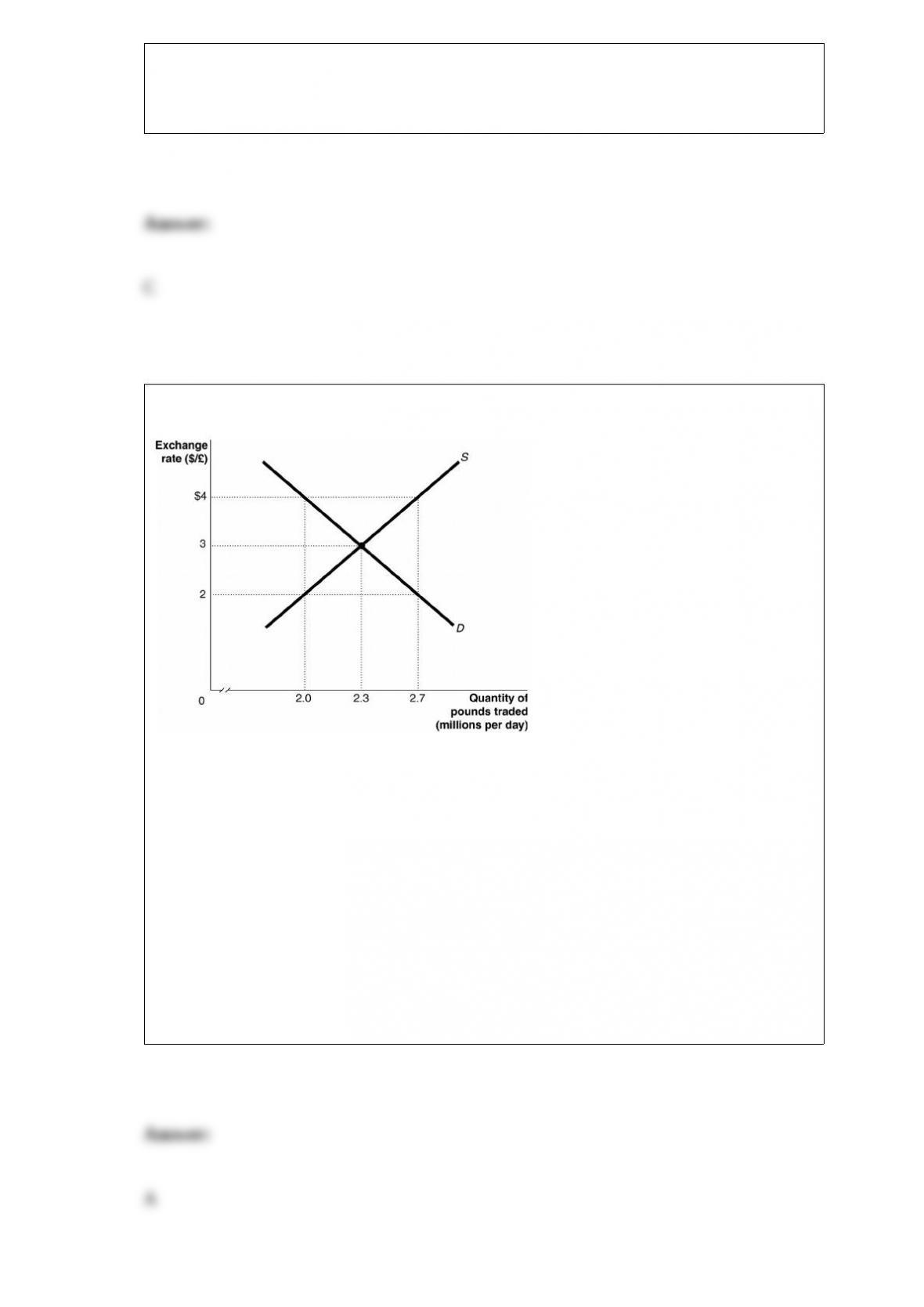
Figure 19-10
Refer to Figure 19-10. Under the Bretton Woods System of exchange rates, if the par
exchange rate was $4 per pound in the figure above, then which of the following is
true?
A) The Bank of England would have to buy 0.7 million pounds per day with dollars.
B) There is a shortage of pounds equal to 0.7 million.
C) The Bank of England would have to sell 0.7 million pounds per day in exchange for
dollars.
D) The par exchange rate is below the equilibrium rate, causing a shortage of domestic
currency.

Developing countries with low saving rates and poor levels of health and education are
likely to experience
A) high levels of foreign direct investment.
B) easy access to financial backing from banks.
C) rapid growth in household incomes.
D) low rates of growth in real GDP per capita.
The measure of production that values output using base-year prices is called
A) real GDP.
B) nominal GDP.
C) value-added GDP.
D) underground GDP.
Figure 9-1
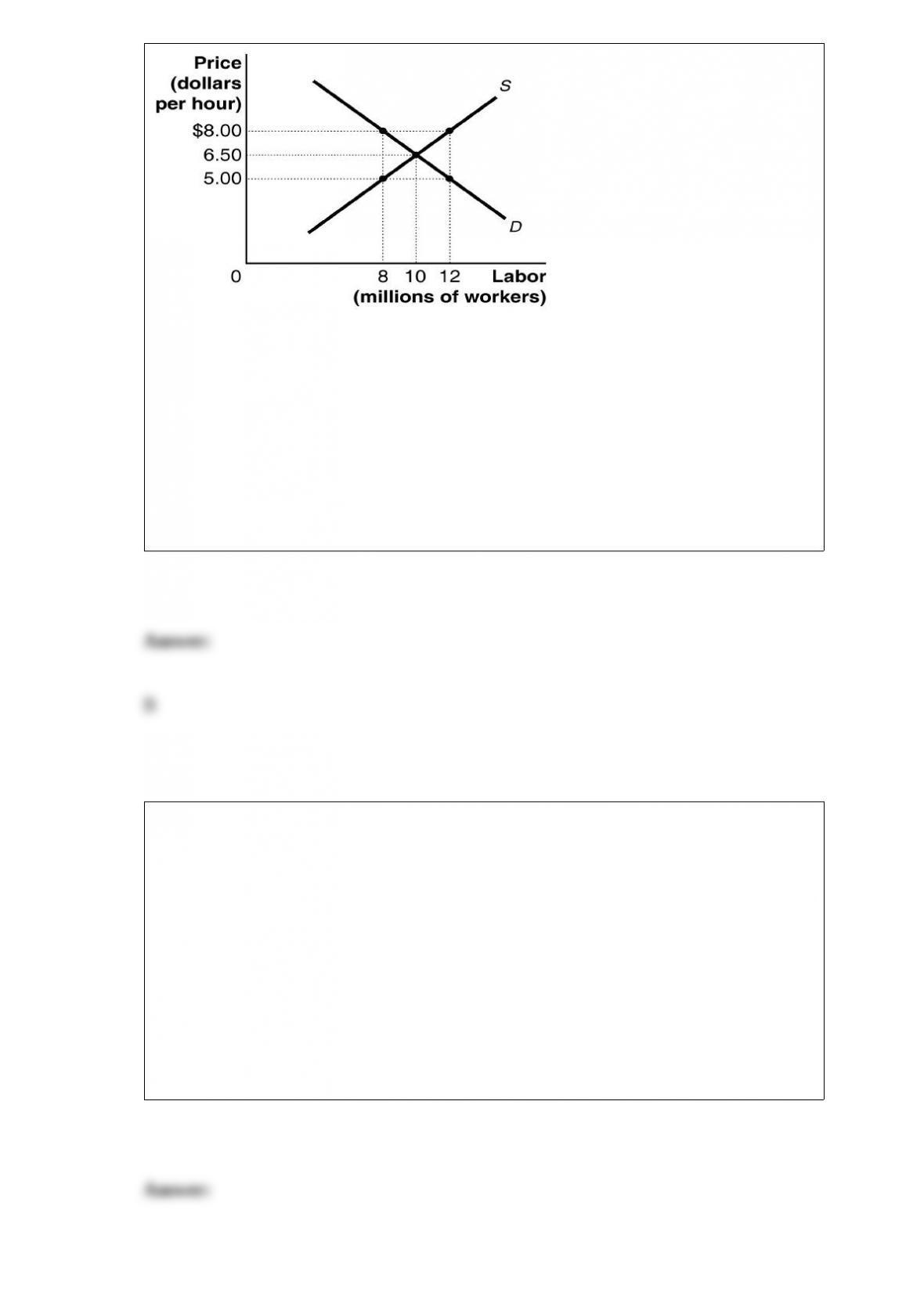
Refer to Figure 9-1. Based on the graph of the labor market above, if a minimum wage
of $8 per hour is imposed, which of the following will result?
A) The quantity of labor demanded by firms will rise.
B) The quantity of labor demanded by firms will fall.
C) The unemployment rate will fall.
D) Both A and C will occur.
The economy has gone into a recession. You have majored in computer science and,
because of the recession, have difficulty in finding a job. Should you go back to school
and get a second major?
A) Yes, the recession will ensure that you will never find a job as a programmer.
B) Yes, the recession will lower income in my field permanently.
C) No, the recession will most likely be short-lived and I can get a job after it is over.
D) No, the recession will have no impact on my ability to get a job or my future
income.