Archives
Aeronautical Engineering Chapter 1 Homework Sometimes we can develop equations and solve practical
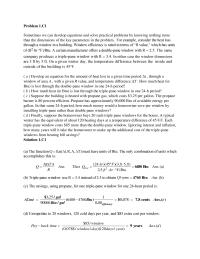
Problem 1.C1 Sometimes we can develop equations and solve practical problems by knowing nothing more than the dimensions of the key parameters in the problem. For example, consider the heat loss through a window in a building. Window efficiency is […]
Aeronautical Engineering Chapter 1 Homework the British chemist Sir Cyril Hinshelwood quipped that fluid
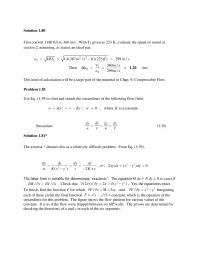
Solution 1.80 First convert 1180 ft/s to 360 m/s. With T2 given as 223 K, evaluate the speed of sound at Problem 1.81 Use Eq. (1.39) to find and sketch the streamlines of the following flow field: ; ; 0 […]
Aeronautical Engineering Chapter 1 Homework The Fluid 60c Calculate The True Fluid
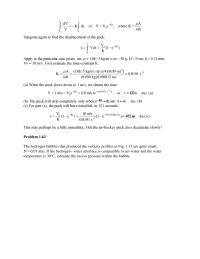
Problem 1.62 The hydrogen bubbles that produced the velocity profiles in Fig. 1.15 are quite small, D ≈ 0.01 mm. If the hydrogen– water interface is comparable to air–water and the water temperature is 30°C, estimate the excess pressure within […]
Aeronautical Engineering Chapter 1 Homework The Fluid Viscosity Then Given
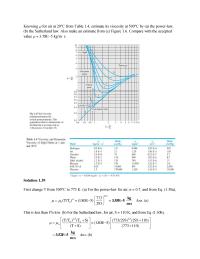
Knowing for air at 20°C from Table 1.4, estimate its viscosity at 500°C by (a) the power-law, (b) the Sutherland law. Also make an estimate from (c) Figure 1.6. Compare with the accepted value 3.58E−5 kg/m · […]
Aeronautical Engineering Chapter 1 Homework Well Yes Indeed All Terms Have Dimensions
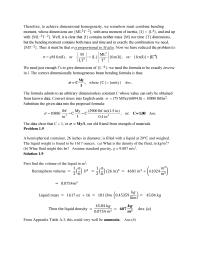
Therefore, to achieve dimensional homogeneity, we somehow must combine bending moment, whose dimensions are {ML2T–2}, with area moment of inertia, {I} = {L4}, and end up with {ML–2T–2}. Well, it is clear that {I} contains neither mass {M} nor time […]
Aeronautical Engineering Chapter 10 Homework Consider the flow in a wide channel over a bump
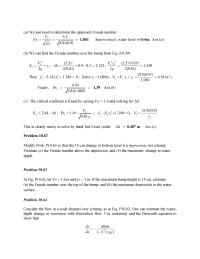
Problem 10.67 Modify Prob. P10.63 so that the 15-cm change in bottom level is a depression, not a bump. Estimate (a) the Froude number above the depression; and (b) the maximum change in water depth. Problem 10.63 In Fig. P10.62, […]
Aeronautical Engineering Chapter 10 Homework Determine the most efficient dimensions for a clay
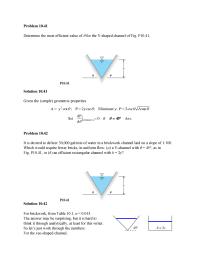
Problem 10.41 Determine the most efficient value of for the V-shaped channel of Fig. P10.41. Solution 10.41 Given the (simple) geometric properties Problem 10.42 It is desired to deliver 30,000 gal/min of water in a brickwork channel laid on […]
Aeronautical Engineering Chapter 10 Homework The Frictionless Profile Drops The Crest
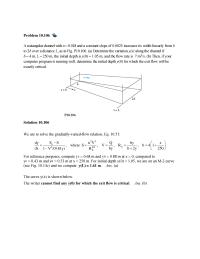
Problem 10.106 A rectangular channel with n = 0.018 and a constant slope of 0.0025 increases its width linearly from b to 2b over a distance L, as in Fig. P10.106. (a) Determine the variation y(x) along the channel if […]
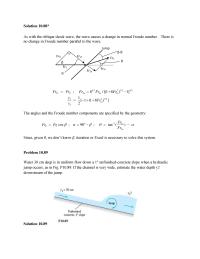
Aeronautical Engineering Chapter 10 Homework the wave causes a change in normal Froude number
Solution 10.88* As with the oblique shock wave, the wave causes a change in normal Froude number. There is no change in Froude number parallel to the wave. Problem 10.89 Water 30 cm deep is in uniform flow down a […]
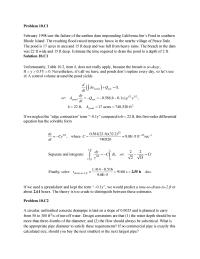
Aeronautical Engineering Chapter 10 Homework The Weir Discharge Must Equal This Flow
Problem 10.C1 February 1998 saw the failure of the earthen dam impounding California Jim’s Pond in southern Rhode Island. The resulting flood raised temporary havoc in the nearby village of Peace Dale. The pond is 17 acres in area and […]
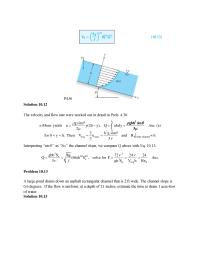
Aeronautical Engineering Chapter 10 Homework Then The Flow Rate Manning’s Formula With
Solution 10.12 The velocity and flow rate were worked out in detail in Prob. 4.36: Problem 10.13 A large pond drains down an asphalt rectangular channel that is 2 ft wide. The channel slope is 0.6 degrees. If the flow […]
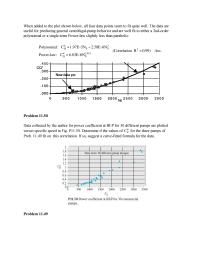
Aeronautical Engineering Chapter 11 Homework Data collected by the author for power coefficient
Problem 11.50 Data collected by the author for power coefficient at BEP for 30 different pumps are plotted versus specific speed in Fig. P11.50. Determine if the values of P * C for the three pumps of Prob. 11.49 fit […]
Aeronautical Engineering Chapter 11 Homework Estimate the best efficiency point and the maximum
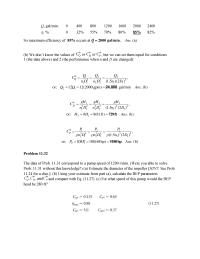
Problem 11.32 The data of Prob. 11.31 correspond to a pump speed of 1200 r/min. (Were you able to solve Prob. 11.31 without this knowledge?) (a) Estimate the diameter of the impeller [HINT: See Prob. 11.24 for a clue.]. (b) […]
Aeronautical Engineering Chapter 11 Homework Estimate the maximum discharge possible
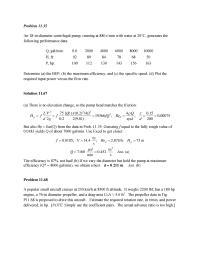
Problem 11.35 An 18-in-diameter centrifugal pump, running at 880 r/min with water at 20C, generates the following performance data: Q, gal/min: 0.0 2000 4000 6000 8000 10000 H, ft: 92 89 84 78 68 50 P, hp: 100 112 130 […]
Aeronautical Engineering Chapter 11 Homework Francis and Kaplan turbines are often provided
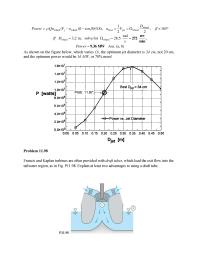
Problem 11.98 Francis and Kaplan turbines are often provided with draft tubes, which lead the exit flow into the tailwater region, as in Fig. P11.98. Explain at least two advantages to using a draft tube. wheel wheel wheel best jet […]
Aeronautical Engineering Chapter 11 Homework Kinetic And Potential Energy Changes Are Negligible
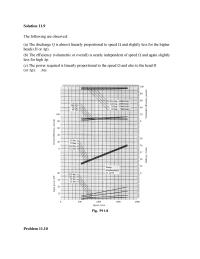
Solution 11.9 The following are observed: (a) The discharge Q is almost linearly proportional to speed and slightly less for the higher heads (H or p). Problem 11.10 (b) The efficiency (volumetric or overall) is nearly independent of speed […]
Aeronautical Engineering Chapter 11 Homework The Flow Enters About O clock And Passes
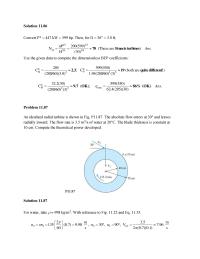
Solution 11.86 Convert P* = 447 kW = 599 hp. Then, for D = 36 = 3.0 ft, Problem 11.87 An idealized radial turbine is shown in Fig. P11.87. The absolute flow enters at 30 and leaves radially inward. The […]
Aeronautical Engineering Chapter 11 Homework What is the maximum achievable flow rate if you use
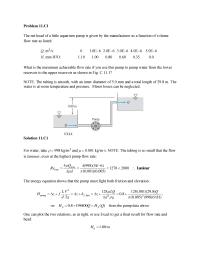
Problem 11.C1 The net head of a little aquarium pump is given by the manufacturer as a function of volume flow rate as listed: Q, m3/s: 0 1.0E−6 2.0E−6 3.0E−6 4.0E−6 5.0E−6 H, mm H2O: 1.10 1.00 0.80 0.60 0.35 […]
Aeronautical Engineering Chapter 2 Homework How does your argument change if there is seepage under the dam
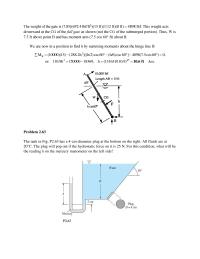
Problem 2.63 The tank in Fig. P2.63 has a 4-cm-diameter plug at the bottom on the right. All fluids are at 20°C. The plug will pop out if the hydrostatic force on it is 25 N. For this condition, what […]
Aeronautical Engineering Chapter 2 Homework If the absolute pressure at the interface between water
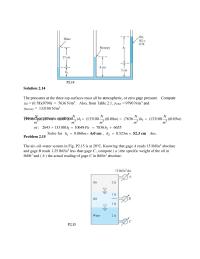
Solution 2.14 The pressures at the three top surfaces must all be atmospheric, or zero gage pressure. Compute 12 Problem 2.15 The air–oil–water system in Fig. P2.15 is at 20°C. Knowing that gage A reads 15 lbf/in2 absolute and gage […]
Aeronautical Engineering Chapter 2 Homework manometer liquid on the reservoir side does not change appreciably
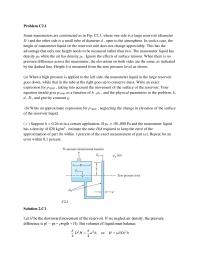
Problem C2.1 Some manometers are constructed as in Fig. C2.1, where one side is a large reservoir (diameter D ) and the other side is a small tube of diameter d , open to the atmosphere. In such a case, […]

Aeronautical Engineering Chapter 2 Homework Patients with dangerous hypertension can exhibit systolic pressures
Fig. P2.39 Problem 2.40 In Fig. P2.40, if pressure gage A reads 20 lbf/in2 absolute, find the pressure in the closed air space B. The manometer fluid is Meriam red oil, SG = 0.827 Solution 2.40 For water take γ= […]
Aeronautical Engineering Chapter 2 Homework The can weight simply equals the weight of the displaced water
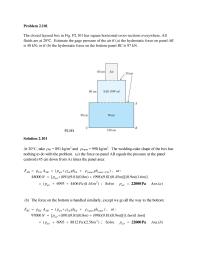
Problem 2.101 The closed layered box in Fig. P2.101 has square horizontal cross-sections everywhere. All fluids are at 20C. Estimate the gage pressure of the air if (a) the hydrostatic force on panel AB is 48 kN; or if (b) […]
Aeronautical Engineering Chapter 2 Homework The horizontal force is calculated from the vertical projection
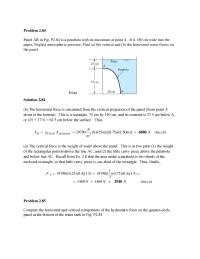
Problem 2.84 Panel AB in Fig. P2.84 is a parabola with its maximum at point A . It is 150 cm wide into the paper. Neglect atmospheric pressure. Find (a) the vertical and (b) the horizontal water forces on the […]
Aeronautical Engineering Chapter 3 Homework At what angular velocity is the maximum power delivered
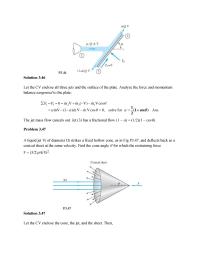
Solution 3.46 Let the CV enclose all three jets and the surface of the plate. Analyze the force and momentum balance tangential to the plate: Problem 3.47 A liquid jet Vj of diameter Dj strikes a fixed hollow cone, as […]
Aeronautical Engineering Chapter 3 Homework For a control volume around the cone
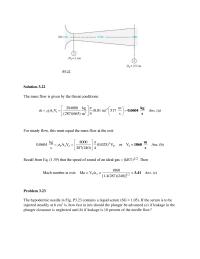
Solution 3.22 The mass flow is given by the throat conditions: Problem 3.23 The hypodermic needle in Fig. P3.23 contains a liquid serum (SG = 1.05). If the serum is to be injected steadily at 6 cm3 /s, how fast […]
Aeronautical Engineering Chapter 3 Homework the case of the liquid motion in a frictionless U-tube
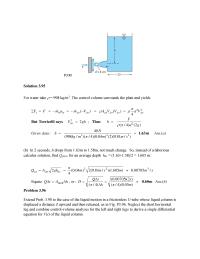
Solution 3.95 For water take = 998 kg/m3. The control volume surrounds the plate and yields Problem 3.96 Extend Prob. 3.90 to the case of the liquid motion in a frictionless U-tube whose liquid column is displaced a distance […]
Aeronautical Engineering Chapter 3 Homework Use The Reynolds Transport Theorem Find Expression
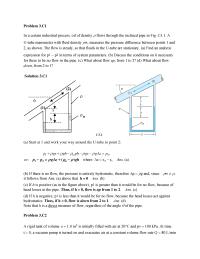
Problem 3.C1 In a certain industrial process, oil of density flows through the inclined pipe in Fig. C3.1. A U-tube manometer with fluid density m, measures the pressure difference between points 1 and 2, as shown. The flow […]
Aeronautical Engineering Chapter 3 Homework Water flows through a circular nozzle
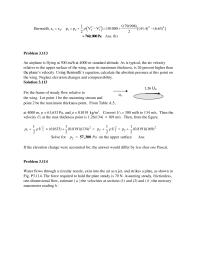
Problem 3.113 An airplane is flying at 300 mi/h at 4000 m standard altitude. As is typical, the air velocity relative to the upper surface of the wing, near its maximum thickness, is 26 percent higher than the plane’s velocity. […]
Aeronautical Engineering Chapter 3 Homework When immersed in a uniform stream
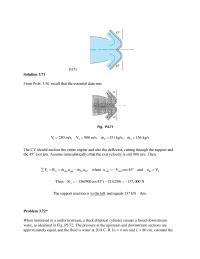
Solution 3.71 From Prob. 3.50, recall that the essential data was Problem 3.72* When immersed in a uniform stream, a thick elliptical cylinder creates a broad downstream wake, as idealized in Fig. P3.72. The pressure at the upstream and downstream […]
Aeronautical Engineering Chapter 4 Homework Integrate The Two Pressure Gradients Find The
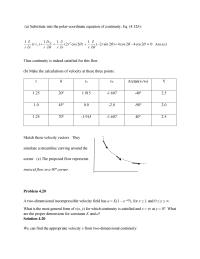
Problem 4.20 A two-dimensional incompressible velocity field has u = K(1 – e–ay), for x L and 0 y . What is the most general form of v(x, y) for which continuity is satisfied and v = […]
Aeronautical Engineering Chapter 4 Homework Oil flows steadily between two fixed plates that
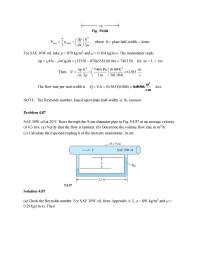
Problem 4.87 SAE 30W oil at 20°C flows through the 9-cm-diameter pipe in Fig. P4.87 at an average velocity of 4.3 m/s. (a) Verify that the flow is laminar. (b) Determine the volume flow rate in m3/h. (c) Calculate the […]
Aeronautical Engineering Chapter 4 Homework the frequency is low enough that at any given time
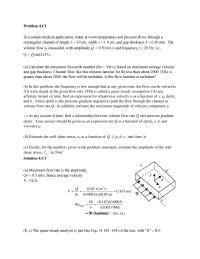
Problem 4.C1 In a certain medical application, water at room temperature and pressure flows through a rectangular channel of length L = 10 cm, width s = 1.0 cm, and gap thickness b = 0.30 mm. The volume flow is […]
Aeronautical Engineering Chapter 4 Homework What Could The Flow Represent Solution
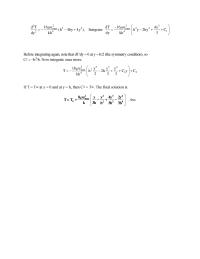
22 23 2 2 2 2 max max 1 2 4 4 16 u 16 u d T dT 4y (h 4hy 4y ), Integrate: h y 2hy C dy 3 dy kh kh − = − − […]
Aeronautical Engineering Chapter 4 Homework Water flows through a two-dimensional narrowing wedge
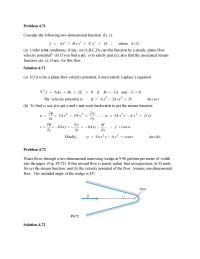
Problem 4.71 Consider the following two-dimensional function f(x, y): (a) Under what conditions, if any, on (A,B,C,D) can this function be a steady, plane-flow velocity potential? (b) If you find a (x, y) to satisfy part (a), also find […]
Aeronautical Engineering Chapter 5 Homework Its Drag Simulated long Model Pulled Tow
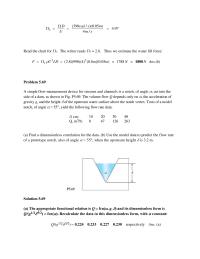
Problem 5.69 A simple flow-measurement device for streams and channels is a notch, of angle , cut into the side of a dam, as shown in Fig. P5.69. The volume flow Q depends only on , the acceleration […]
Aeronautical Engineering Chapter 5 Homework Problem When The Fluid Exiting Nozzle
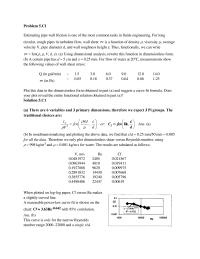
Problem 5.C1 Estimating pipe wall friction is one of the most common tasks in fluids engineering. For long circular, rough pipes in turbulent flow, wall shear w is a function of density , viscosity , average velocity […]
Aeronautical Engineering Chapter 5 Homework The Writer Chose The Following Two Use
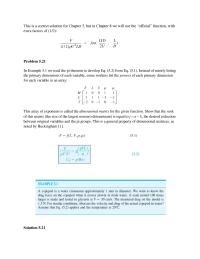
Problem 5.21 In Example 5.1 we used the pi theorem to develop Eq. (5.2) from Eq. (5.1). Instead of merely listing the primary dimensions of each variable, some workers list the powers of each primary dimension for each variable in […]
Aeronautical Engineering Chapter 5 Homework Use Only The Quantities And Nondimensionalize And
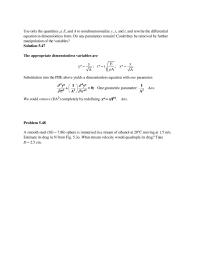
Use only the quantities , E, and A to nondimensionalize y, x, and t, and rewrite the differential equation in dimensionless form. Do any parameters remain? Could they be removed by further manipulation of the variables? Solution 5.47 The […]
Aeronautical Engineering Chapter 6 Homework A heat exchanger consists of multiple parallel-plate passages
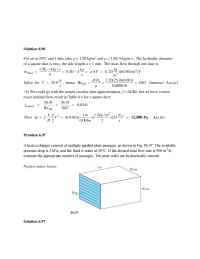
Solution 6.96 For air at 20C and 1 atm, take = 1.20 kg/m3 and = 1.8E-5 kg/m-s. The hydraulic diameter Problem 6.97 A heat exchanger consists of multiple parallel–plate passages, as shown in Fig. P6.97. The available pressure […]
Aeronautical Engineering Chapter 6 Homework For Pipe Find The Velocity And Reynolds
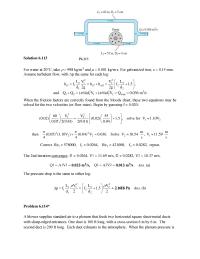
Solution 6.113 For water at 20C, take = 998 kg/m3 and = 0.001 kg/ms. For galvanized iron, = 0.15 mm. Assume turbulent flow, with p the same for each leg: Problem 6.114* A blower supplies standard air […]
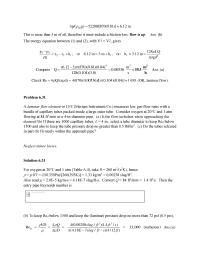
Aeronautical Engineering Chapter 6 Homework Increasing The Tube Diameter Would Lower Red
Problem 6.31 A laminar flow element or LFE (Meriam Instrument Co.) measures low gas-flow rates with a bundle of capillary tubes packed inside a large outer tube. Consider oxygen at 20C and 1 atm flowing at 84 ft3/min in a […]
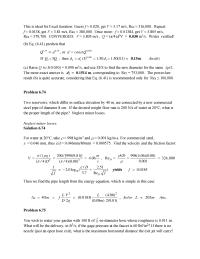
Aeronautical Engineering Chapter 6 Homework Neglect Minor Losses Problem Water
Problem 6.74 Two reservoirs, which differ in surface elevation by 40 m, are connected by a new commercial steel pipe of diameter 8 cm. If the desired weight flow rate is 200 N/s of water at 20C, what is the […]
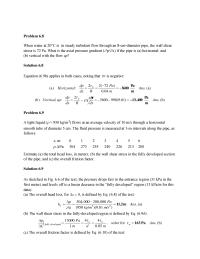
Aeronautical Engineering Chapter 6 Homework Solution Apply Steady flow Energy Patm Atm
Problem 6.8 When water at 20C is in steady turbulent flow through an 8-cm-diameter pipe, the wall shear stress is 72 Pa. What is the axial pressure gradient ( p/ x) if the pipe is (a) horizontal; and […]
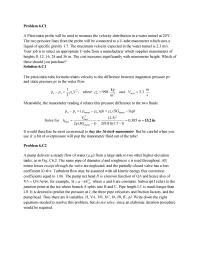
Aeronautical Engineering Chapter 6 Homework The pitot-static tube formula relates velocity
Problem 6.C1 A Pitot-static probe will be used to measure the velocity distribution in a water tunnel at 20C. The two pressure lines from the probe will be connected to a U-tube manometer which uses a liquid of specific gravity […]
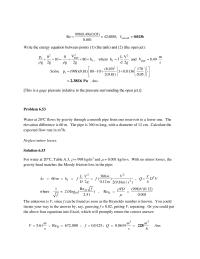
Aeronautical Engineering Chapter 6 Homework through a smooth pipe from one reservoir to a lower one
Problem 6.53 Water at 20C flows by gravity through a smooth pipe from one reservoir to a lower one. The elevation difference is 60 m. The pipe is 360 m long, with a diameter of 12 cm. Calculate the expected […]
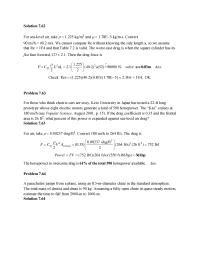
Aeronautical Engineering Chapter 7 Homework Ans Its Slight Slope But Low drag Car
Solution 7.62 For sea-level air, take = 1.225 kg/m3 and = 1.78E−5 kg/ms. Convert Problem 7.63 For those who think electric cars are sissy, Keio University in Japan has tested a 22-ft long prototype whose eight electric motors […]
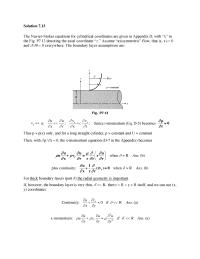
Aeronautical Engineering Chapter 7 Homework Assume Axisymmetric Flow That Is V And
Solution 7.13 The Navier-Stokes equations for cylindrical coordinates are given in Appendix D, with “x” in the Fig. P7.13 denoting the axial coordinate “z.” Assume “axisymmetric” flow, that is, v = 0 and / = 0 everywhere. […]
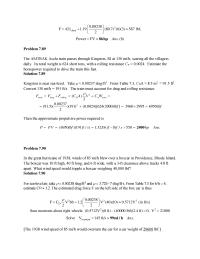
Aeronautical Engineering Chapter 7 Homework Assume Constant Rolling Resistance For Automobile Mass
Problem 7.89 The AMTRAK Acela train passes through Kingston, RI at 130 mi/h, scaring all the villagers daily. Its total weight is 624 short tons, with a rolling resistance Crr ≈ 0.0024. Estimate the horsepower required to drive the train […]
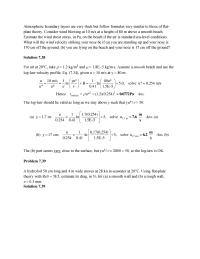
Aeronautical Engineering Chapter 7 Homework Atmospheric boundary layers are very thick
Atmospheric boundary layers are very thick but follow formulas very similar to those of flat- plate theory. Consider wind blowing at 10 m/s at a height of 80 m above a smooth beach. Estimate the wind shear stress, in Pa, […]
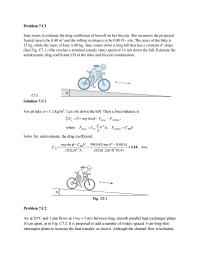
Aeronautical Engineering Chapter 7 Homework Jane wants to estimate the drag coefficient of herself
Problem 7.C1 Jane wants to estimate the drag coefficient of herself on her bicycle. She measures the projected frontal area to be 0.40 m2 and the rolling resistance to be 0.80 N · s/m. The mass of the bike is […]
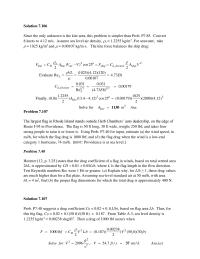
Aeronautical Engineering Chapter 7 Homework Problem The Deep Submergence Vehicle Alvin
Solution 7.106 Since the only unknown is the kite area, this problem is simpler than Prob. P7.85. Convert Problem 7.107 The largest flag in Rhode Island stands outside Herb Chambers’ auto dealership, on the edge of Route I-95 in Providence. […]
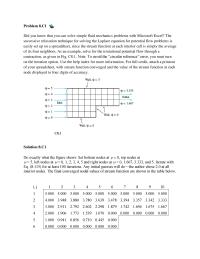
Aeronautical Engineering Chapter 8 Homework After Timesteps Sec The Tabulated Velocities Below
Problem 8.C1 Did you know that you can solve simple fluid mechanics problems with Microsoft Excel? The successive relaxation technique for solving the Laplace equation for potential flow problems is easily set up on a spreadsheet, since the stream function […]
Aeronautical Engineering Chapter 8 Homework Ans This Poisson’s Equation Looks Like The
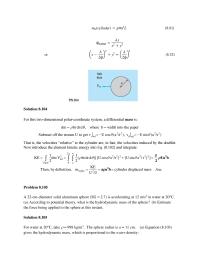
Solution 8.104 For this two-dimensional polar-coordinate system, a differential mass is: Problem 8.105 A 22-cm-diameter solid aluminum sphere (SG = 2.7) is accelerating at 12 m/s2 in water at 20C. (a) According to potential theory, what is the hydrodynamic mass […]
Aeronautical Engineering Chapter 8 Homework Assume All Lift And Drag Due The
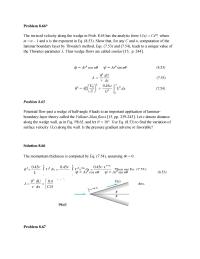
Problem 8.66* The inviscid velocity along the wedge in Prob. 8.65 has the analytic form U(x) = Cxm, where m = n − 1 and n is the exponent in Eq. (8.53). Show that, for any C and n, computation […]
Aeronautical Engineering Chapter 8 Homework Fig Had Two Rotors High And
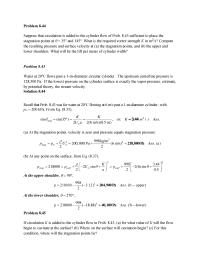
Problem 8.44 Suppose that circulation is added to the cylinder flow of Prob. 8.43 sufficient to place the stagnation points at = 35° and 145°. What is the required vortex strength K in m2/s? Compute the resulting pressure and […]
Aeronautical Engineering Chapter 8 Homework Pro b What Point The Hemisphere Should
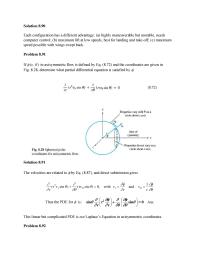
Solution 8.90 Each configuration has a different advantage: (a) highly maneuverable but unstable, needs Problem 8.91 If (r, ) in axisymmetric flow is defined by Eq. (8.72) and the coordinates are given in Fig. 8.28, determine what partial […]
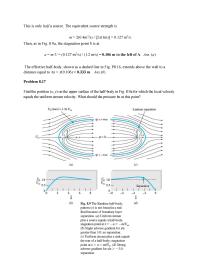
Aeronautical Engineering Chapter 8 Homework The Desired Angle Streamline Tan 1
Problem 8.17 Find the position (x, y) on the upper surface of the half-body in Fig. 8.9a for which the local velocity equals the uniform stream velocity. What should the pressure be at this point? This is only half a […]
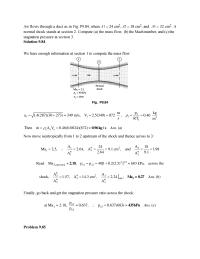
Aeronautical Engineering Chapter 9 Homework Compute The Mach Number Section
Air flows through a duct as in Fig. P9.84, where A1 = 24 cm2, A2 = 18 cm2, and A3 = 32 cm2. A normal shock stands at section 2. Compute (a) the mass flow, (b) the Mach number, and […]
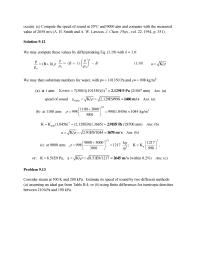
Aeronautical Engineering Chapter 9 Homework Fig Estimate The Air Velocity Assuming
ocean). (c) Compute the speed of sound at 20C and 9000 atm and compare with the measured value of 2650 m/s (A. H. Smith and A. W. Lawson, J. Chem. Phys., vol. 22, 1954, p. 351). Solution 9.12 We may […]
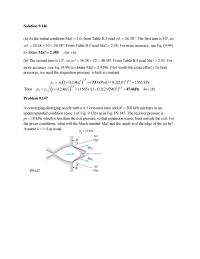
Aeronautical Engineering Chapter 9 Homework Get the Mach number in the exit and then execute
Solution 9.146 (a) At the initial condition Ma1 = 2.0, from Table B.5 read 1 = 26.38. The first turn is 10, so Problem 9.147 A converging-diverging nozzle with a 4:1 exit-area ratio and p0 = 500 kPa operates […]
Aeronautical Engineering Chapter 9 Homework Now Need The Mach Number This Section
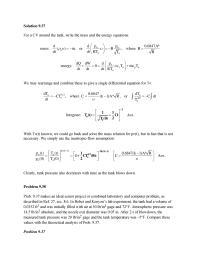
Solution 9.37 For a CV around the tank, write the mass and the energy equations: With To(t) known, we could go back and solve the mass relation for po(t), but in fact that is not necessary. We simply use the […]
Aeronautical Engineering Chapter 9 Homework Solution Check The Mach Number Choked
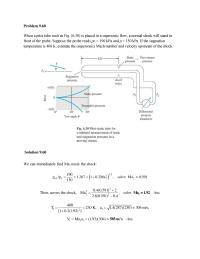
Problem 9.60 When a pitot tube such as Fig. (6.30) is placed in a supersonic flow, a normal shock will stand in front of the probe. Suppose the probe reads po = 190 kPa and p = 150 kPa. If […]
Aeronautical Engineering Chapter 9 Homework Solution Use Frictionless Heat addition Theory
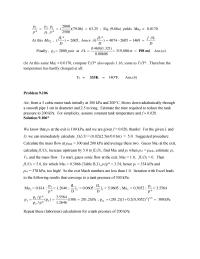
Problem 9.106 Air, from a 3 cubic meter tank initially at 300 kPa and 200C, blows down adiabatically through a smooth pipe 1 cm in diameter and 2.5 m long. Estimate the time required to reduce the tank pressure to […]
Aeronautical Engineering Chapter 9 Homework The converging–diverging nozzle sketched in Fig
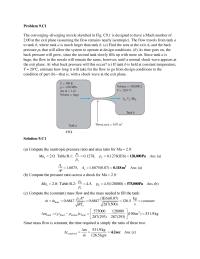
Problem 9.C1 The converging–diverging nozzle sketched in Fig. C9.1 is designed to have a Mach number of 2.00 at the exit plane (assuming the flow remains nearly isentropic). The flow travels from tank a to tank b, where tank a […]
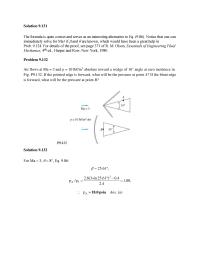
Aeronautical Engineering Chapter 9 Homework The formula is quite correct and serves as an interesting
Solution 9.131 The formula is quite correct and serves as an interesting alternative to Eq. (9.86). Notice that one can Problem 9.132 Air flows at Ma = 3 and p = 10 lbf/in2 absolute toward a wedge of 16° angle […]