Problem 7.89
The AMTRAK Acela train passes through Kingston, RI at 130 mi/h, scaring all the villagers
daily. Its total weight is 624 short tons, with a rolling resistance Crr ≈ 0.0024. Estimate the
horsepower required to drive the train this fast.
Solution 7.89
Kingston is near sea-level. Take ρ ≈ 0.00237 slug/ft3. From Table 7.3, CDA ≈ 8.5 m2 = 91.5 ft2.
Problem 7.90
In the great hurricane of 1938, winds of 85 mi/h blew over a boxcar in Providence, Rhode Island.
The boxcar was 10 ft high, 40 ft long, and 6 ft wide, with a 3-ft clearance above tracks 4.8 ft
apart. What wind speed would topple a boxcar weighing 40,000 lbf?
Solution 7.90
For sea–level air, take
= 0.00238 slug/ft3 and
= 3.72E−7 slug/fts. From Table 7.3 for b / h = 4,
estimate CD 1.2. The estimated drag force F on the left side of the box car is thus
Problem 7.91*
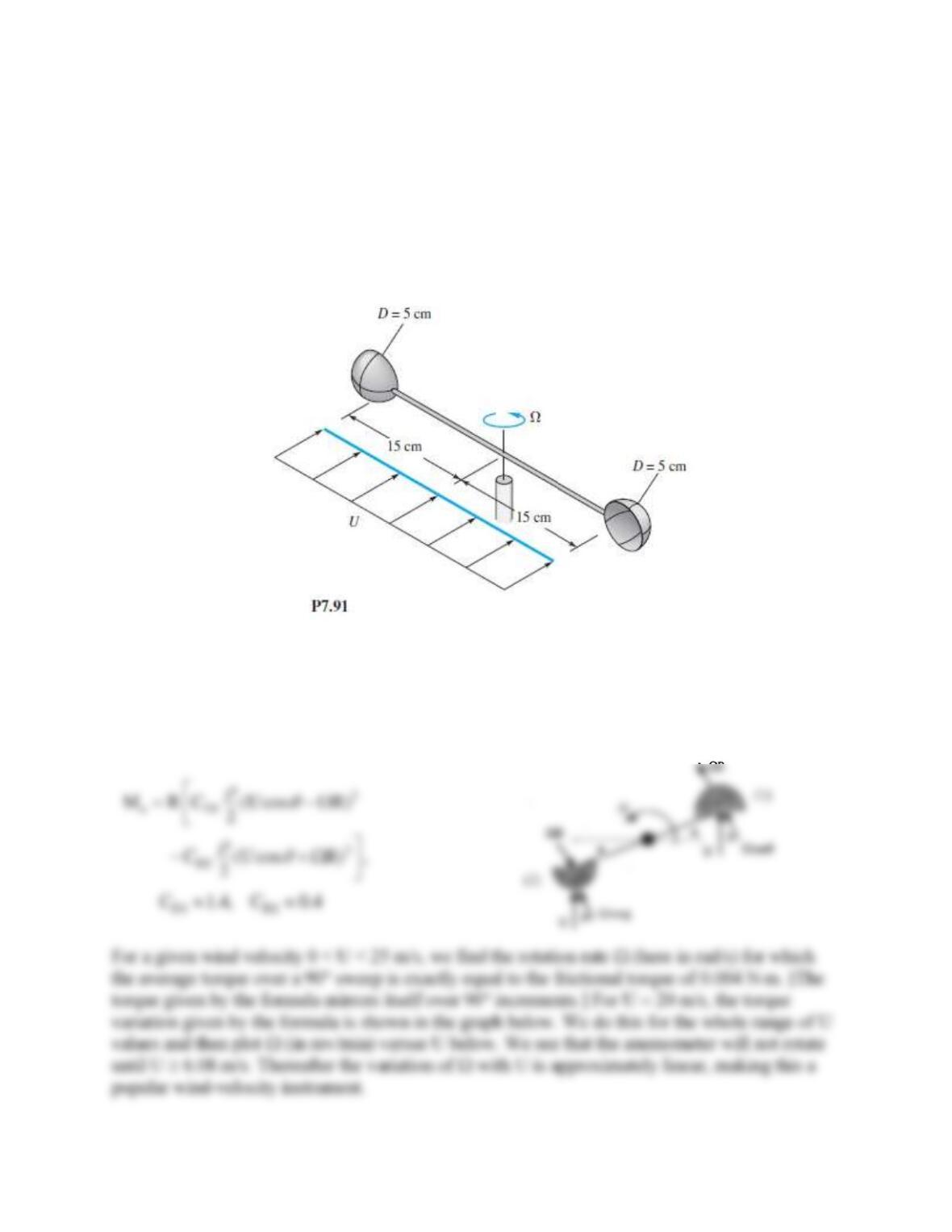
A cup anemometer uses two 5-cm-diameter hollow hemispheres connected to two 15-cm rods, as
in Fig. P7.91. Rod drag is neglected, and the central bearing has a retarding torque of 0.004 Nm.
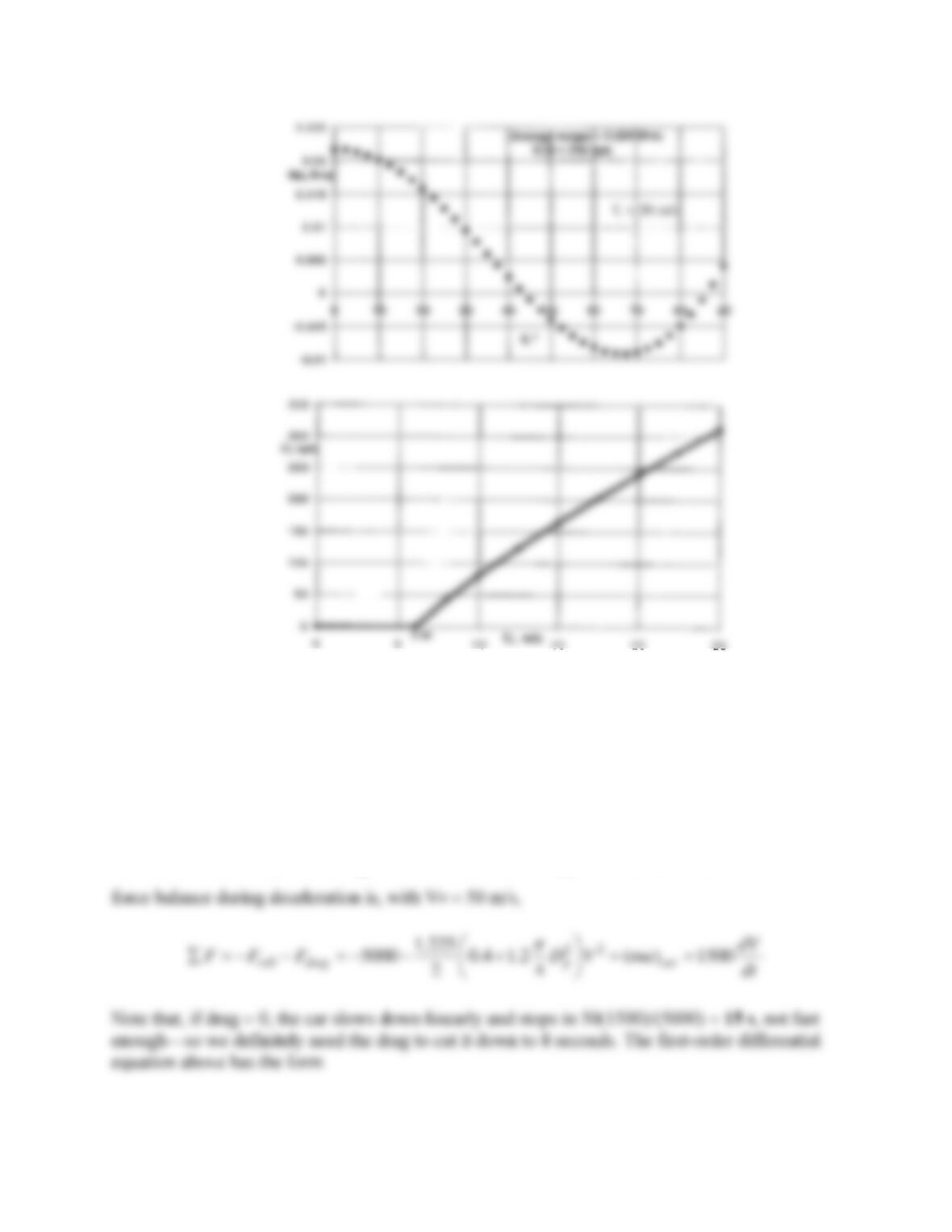
With simplifying assumptions to average out the time-varying geometry, estimate and plot
rotation rate versus wind velocity U in the range 0 < U < 25 m/s for sea-level standard air.
Solution 7.91
For sea-level air, take
= 1.225 kg/m3 and
= 1.78E−5 kg/ms. For any instantaneous angle
,
as shown, the drag forces are assumed to depend on the relative velocity normal to the cup:
Problem 7.92
A 1500-kg automobile uses its drag-area, CDA = 0.4 m2, plus brakes and a parachute, to slow
down from 50 m/s. Its brakes apply 5000 N of resistance. Assume sea-level standard air. If the
automobile must stop in 8 seconds, what diameter parachute is appropriate?
Solution 7.92*
For sea-level air take
= 1.225 kg/m3. From Table 7.3 for a parachute, read CDp 1.2. The
Problem 7.93
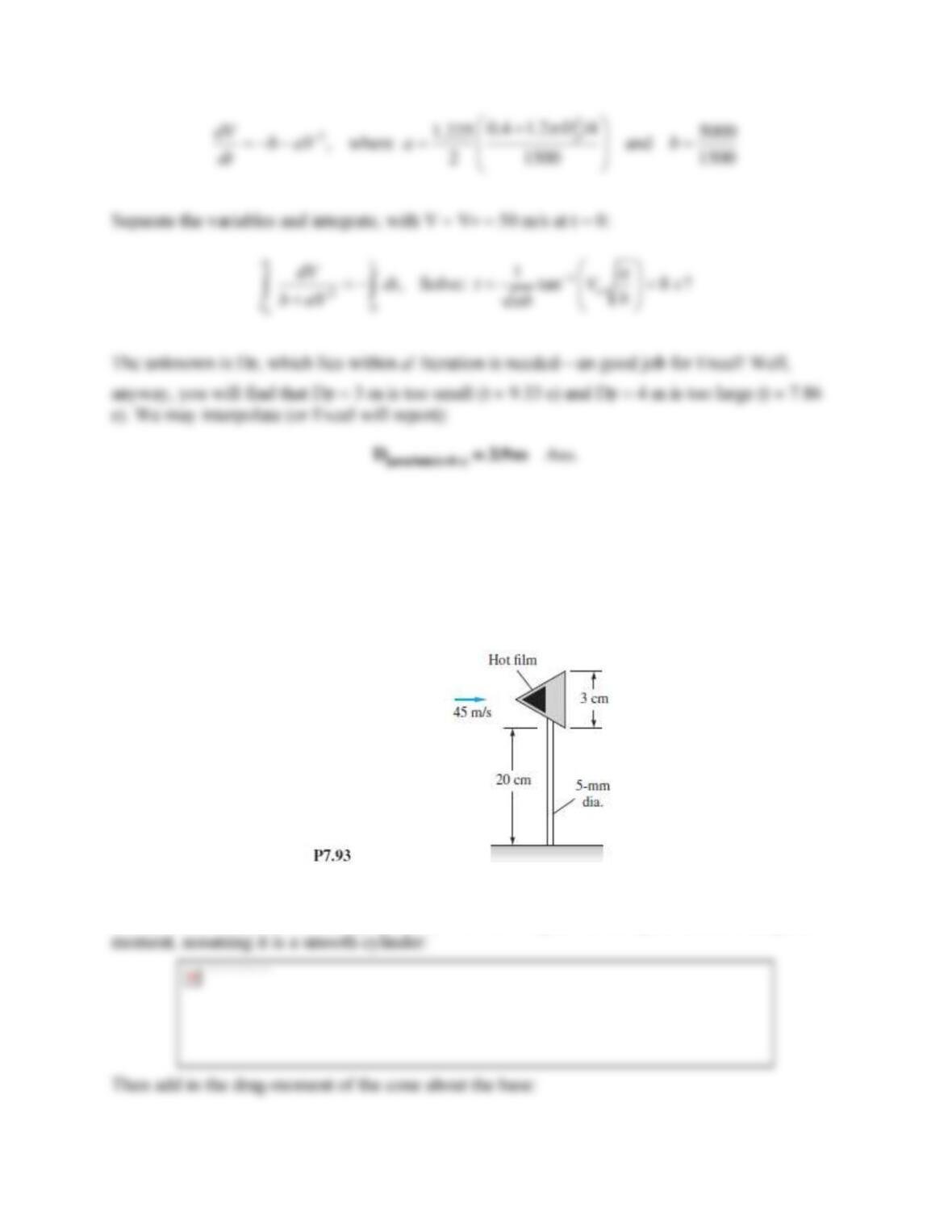
A hot-film probe is mounted on a cone-and-rod system in a sea-level airstream of 45 m/s, as in
Fig. P7.93. Estimate the maximum cone vertex angle allowable if the flow-induced bending
moment at the root of the rod is not to exceed 30 Ncm.
Solution 7.93
For sea-level air take
= 1.225 kg/m3 and
= 1.78E−5 kg/ms. First figure the rod’s drag and
Problem 7.94
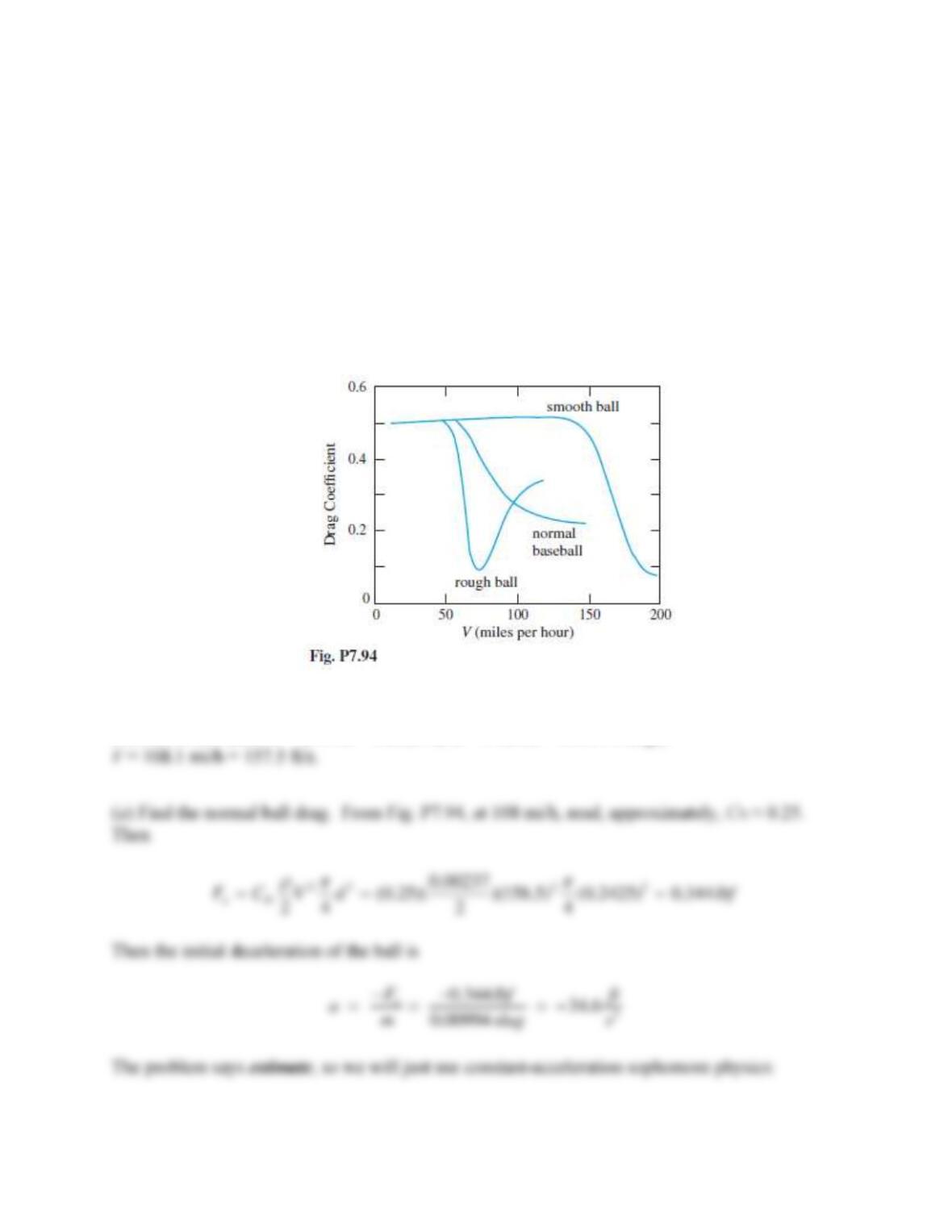
Baseball drag data from the University of Texas are shown in Fig. P7.94. A baseball weighs
approximately 5.12 ounces and has a diameter of 2.91 in. Hall-of-Famer Nolan Ryan, in a 1974
game, threw the fastest pitch ever recorded: 108.1 mi/h. If it is 60 ft from Nolan’s hand to the
catcher’s mitt, estimate the sea-level ball velocity which the catcher experiences for (a) a normal
baseball, and (b) a perfectly smooth baseball.
Solution 7.94
At sea-level, take ρ ≈ 0.00237 slug/ft3.
Convert to BG units: d = 2.91 in = 0.2425 ft, m = 5.12 oz = 0.00994 slugs,
Problem 7.95
An airplane weighing 28 kN, with a drag-area CDA = 5 m2, lands at sea level at 55 m/s and
deploys a drag parachute 3 m in diameter. No other brakes are applied. (a) How long will it take
the plane to slow down to 20 m/s? (b) How far will it have traveled in that time?
Solution 7.95
For sea-level air, take
= 1.225 kg/m3 and
= 1.78E−5 kg/ms. The analytical solution to this
Problem 7.96*
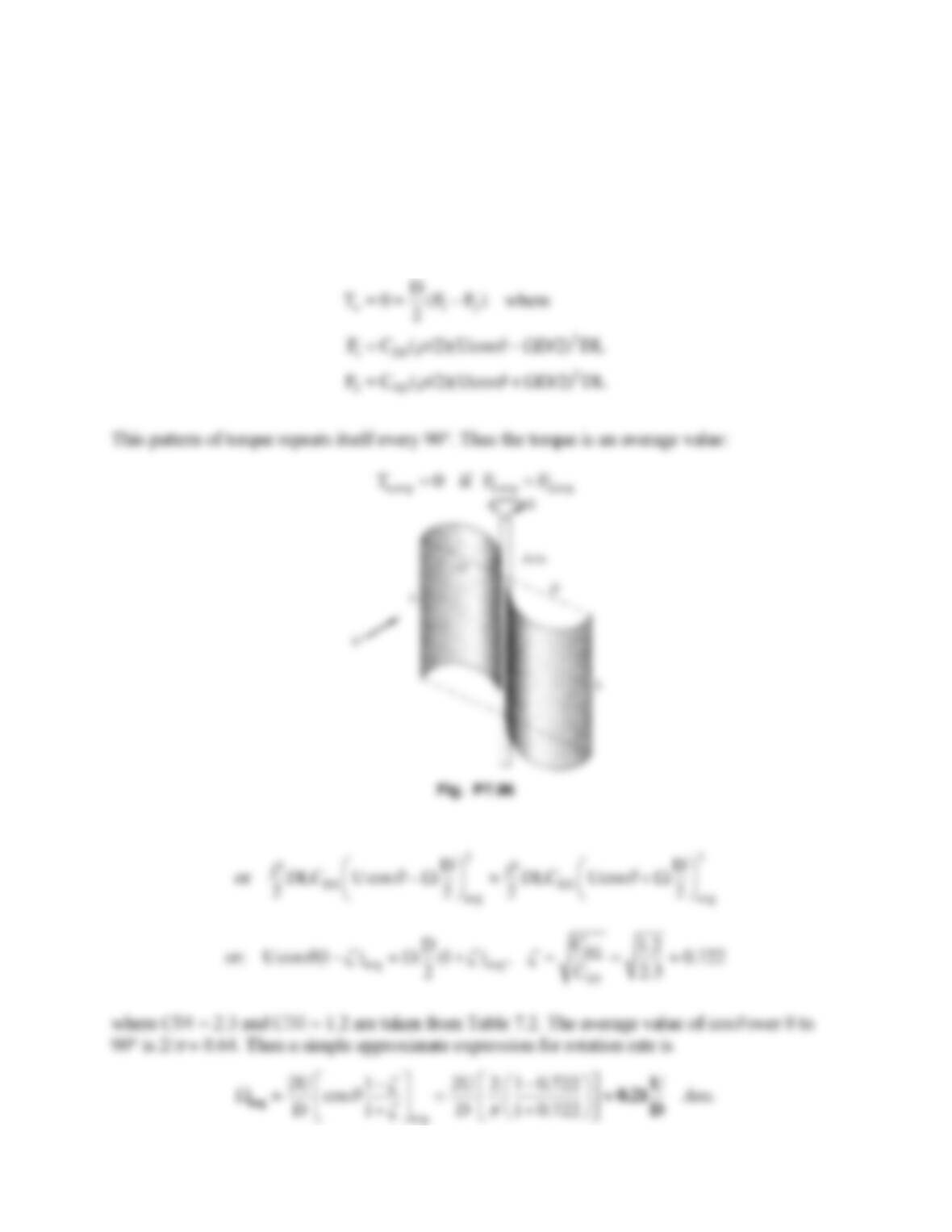
A Savonius rotor (see Fig. 6.29b) can be approximated by the two open half-tubes in Fig. P7.96
mounted on a central axis. If the drag of each tube is similar to that in Table 7.2, derive an
approximate formula for the rotation rate as a function of U, D, L, and the fluid properties
(
,
).
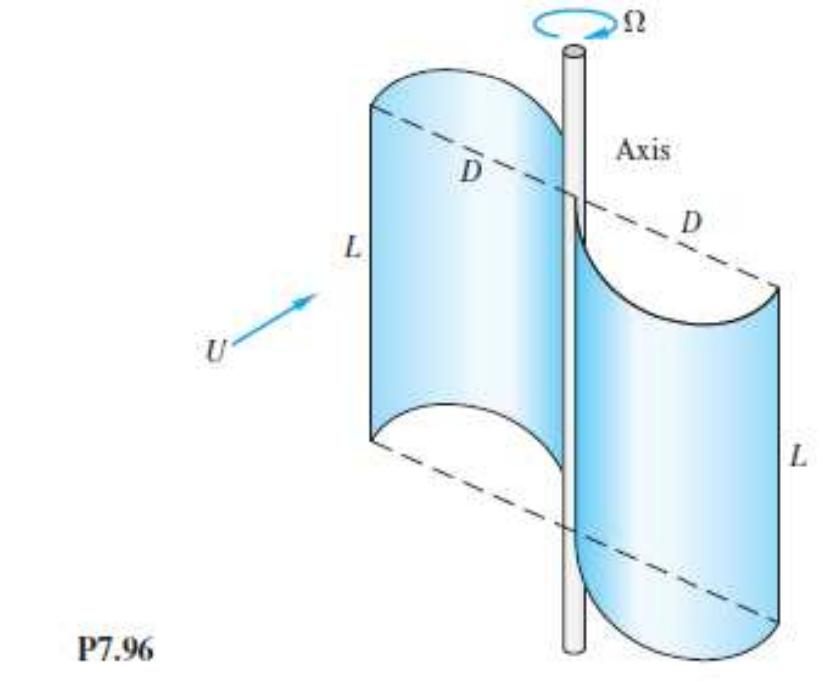
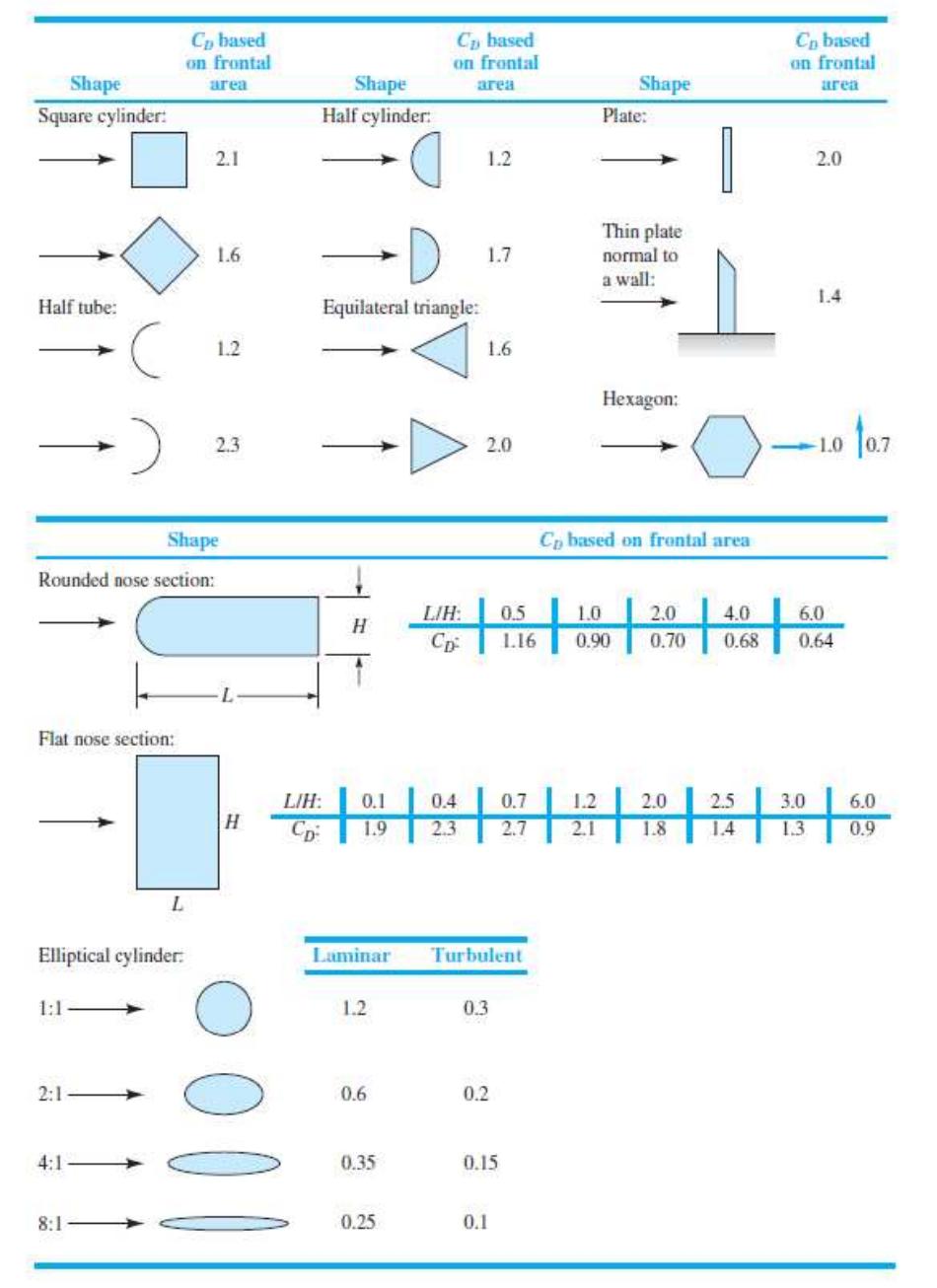
Table 7.2
Solution 7.96
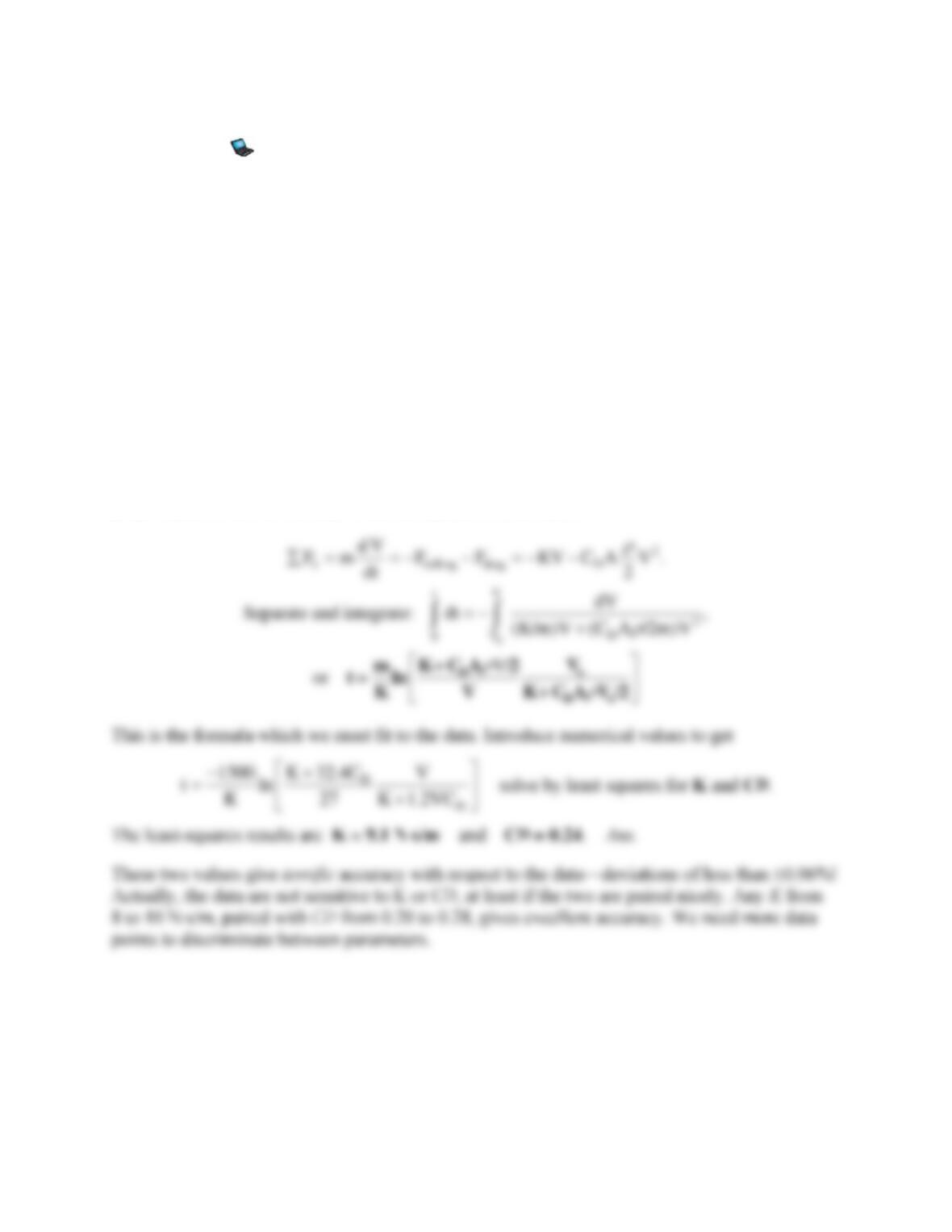
The analysis is similar to Prob. 7.91 (the cup anemometer). At any arbitrary angle as shown, the
net torque caused by the relative velocity on each half-tube is set to zero (assuming a frictionless
bearing):
Problem 7.97
A simple measurement of automobile drag can be found by an unpowered coastdown on a level
road with no wind. Assume constant rolling resistance. For an automobile of mass 1500 kg and
frontal area 2 m2, the following velocity-versus-time data are obtained during a coastdown:
t, s:
0.00
10.0
20.0
30.0
40.0
V, m/s:
27.0
24.2
21.8
19.7
17.9
Estimate (a) the rolling resistance and (b) the drag coefficient. This problem is well suited for
computer analysis but can be done by hand also.
Solution 7.97*
For air, take
= 1.2 kg/m3 and
= 1.8E−5 kg/ms. Assuming that rolling friction is linearly
proportional to the car velocity. Then the equation of motion is
Problem 7.98*
A buoyant ball of specific gravity SG < 1, dropped into water at inlet velocity Vo, will penetrate
a distance h and then pop out again, as in Fig. P7.98. (a) Make a dynamic analysis of this
problem, assuming a constant drag coefficient, and derive an expression for h as a function of
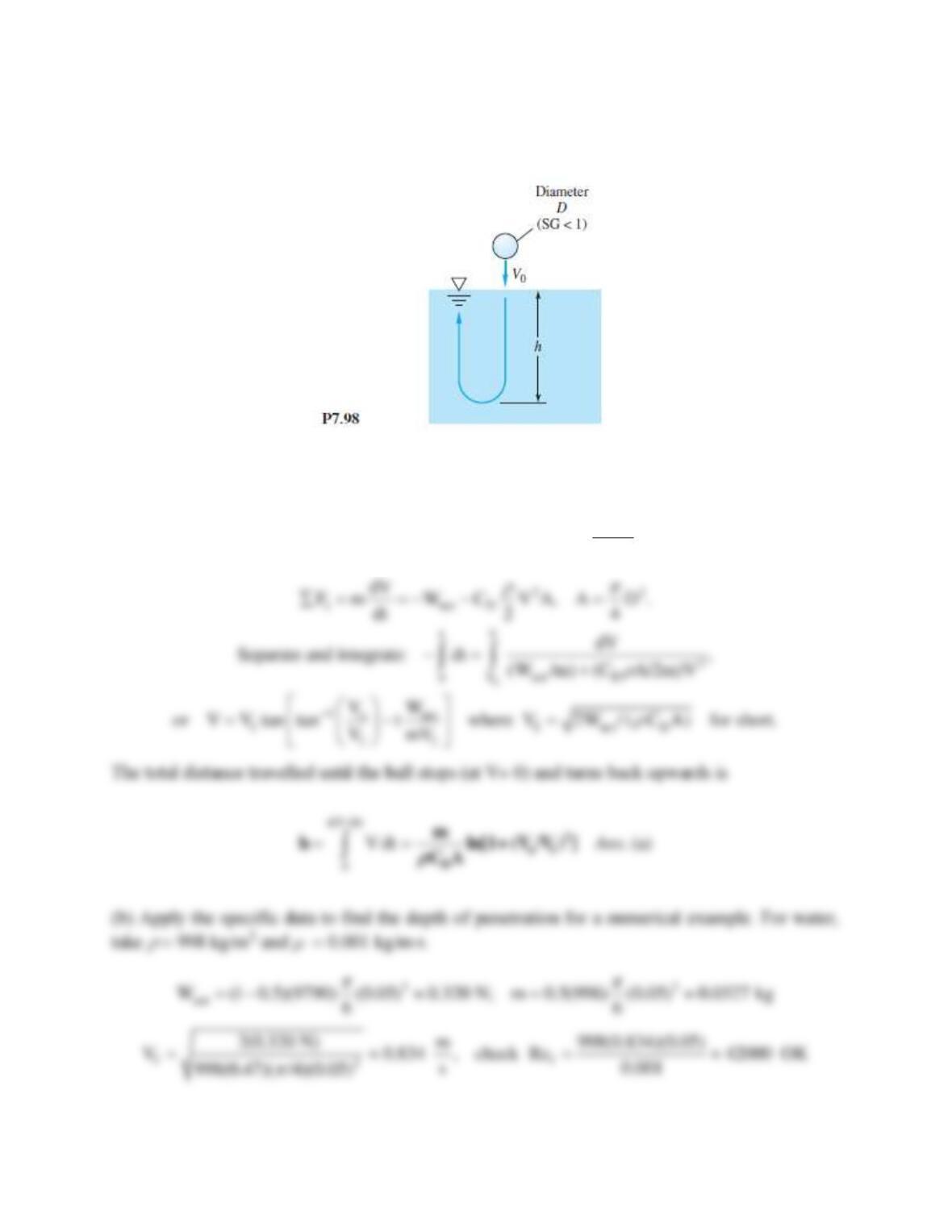
system properties. (b) How far will a 5–cm–diameter ball, with SG = 0.5 and CD ≈ 0.47,
penetrate if it enters at 10 m/s?
Solution 7.98*
The buoyant force is up, Wnet = (1 − SG)
g(
/6)D3, and with z down as shown, the equation of
motion of the ball is
Problem 7.99*
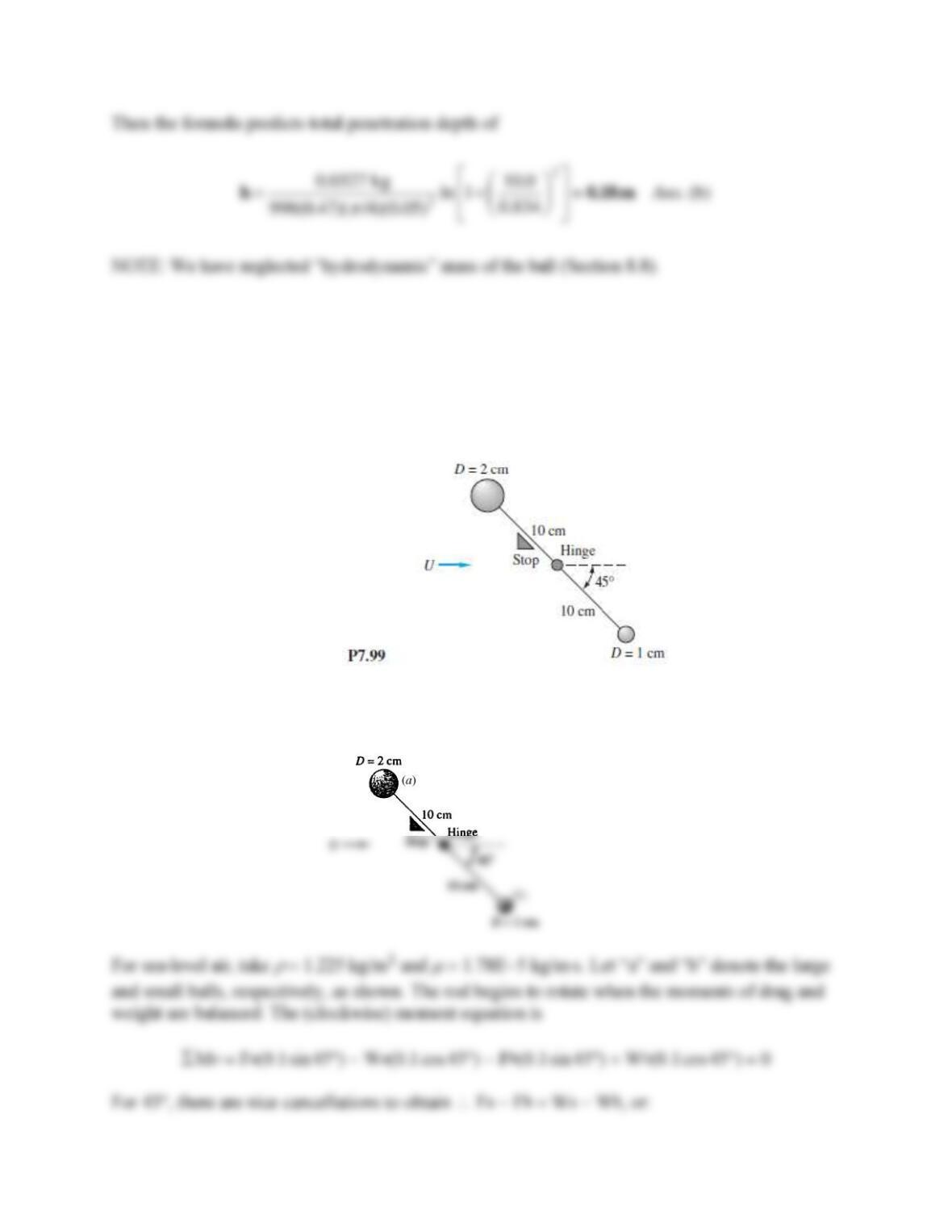
Two steel balls (SG = 7.86) are connected by a thin hinged rod of negligible weight and drag, as
shown in Fig. P7.99. A stop prevents the rod from rotating counterclockwise. Estimate the sea-
level air velocity U for which the rod will first begin to rotate clockwise.
Solution 7.99
Problem 7.100
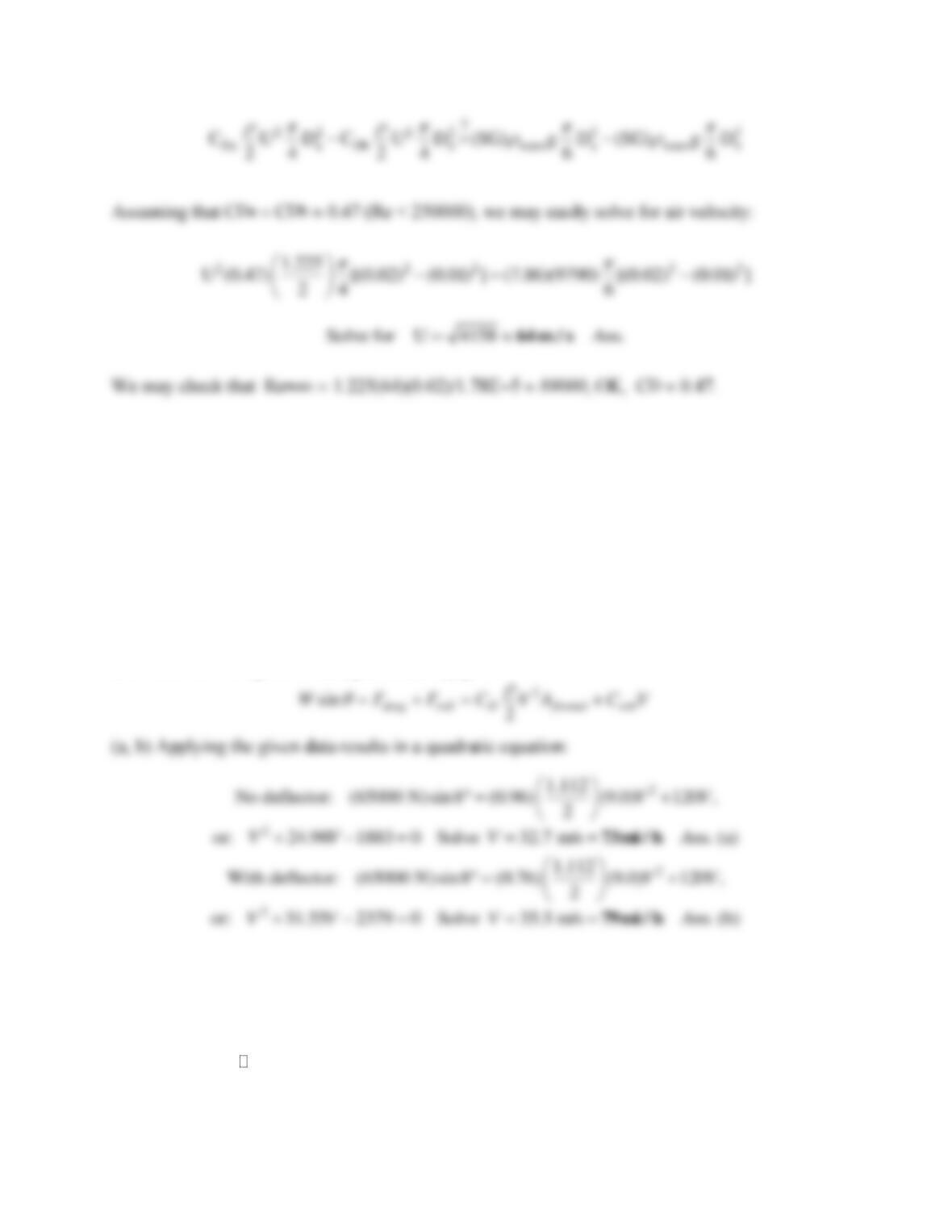
A tractor-trailer truck is coasting freely, with no brakes, down an 8 slope at 1000-m standard
altitude. Rolling resistance is 120 N for every m/s of speed. Its frontal area is 9 m2, and the
weight is 65 kN. Estimate the terminal coasting velocity, in mi/h, for (a) no deflector; and (b) a
deflector installed.
Solution 7.100
For air at 100-m altitude,
= 1.112 kg/m3. From Table 7.3, CD = 0.96 without and 0.76 with a
deflector. Summing forces along the roadway gives:
Problem 7.101
Icebergs can be driven at substantial speeds by the wind. Let the iceberg be idealized as a large,
flat cylinder,
,DL
with one-eighth of its bulk exposed, as in Fig. P7.101. Let the seawater
be at rest. If the upper and lower drag forces depend upon relative velocities between the iceberg
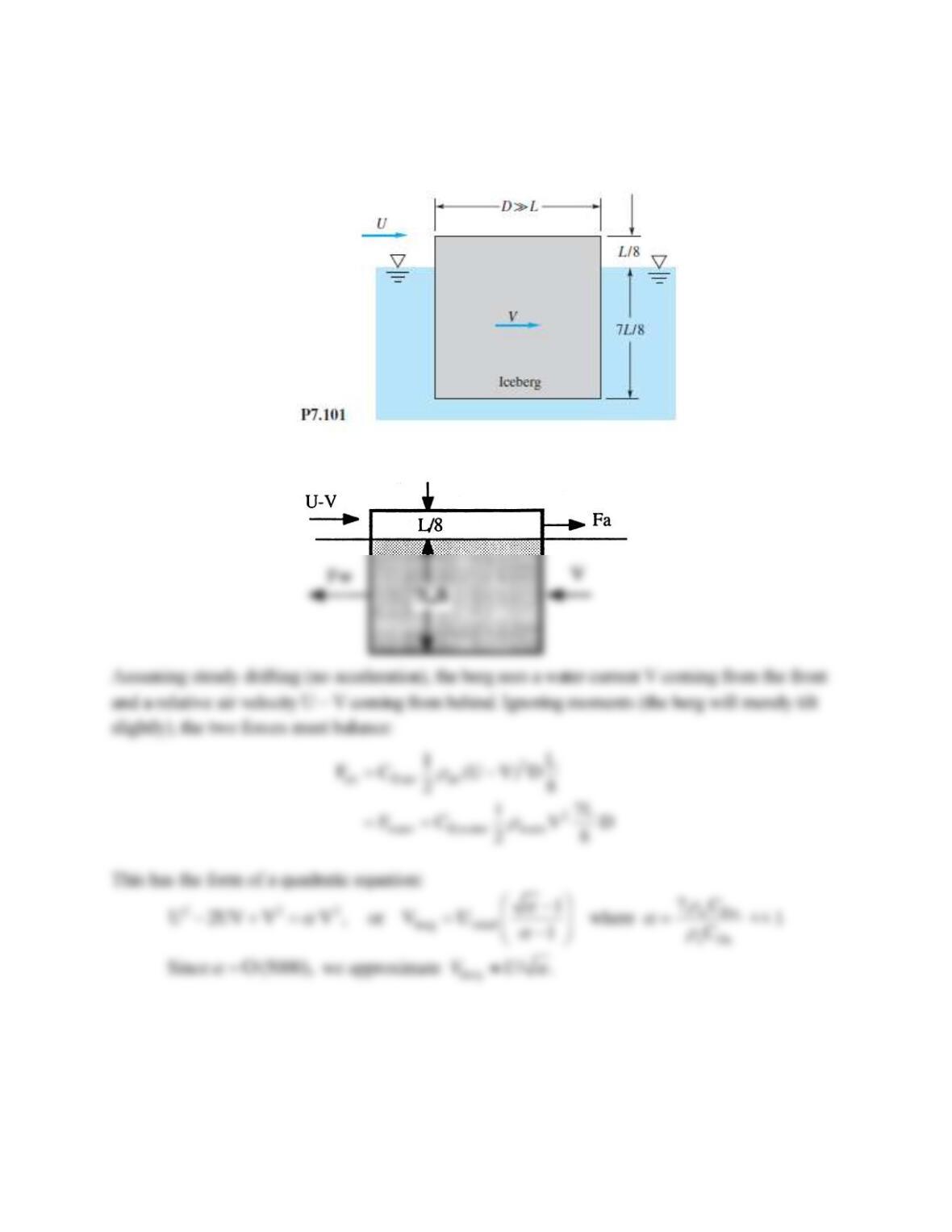
and the fluid, derive an approximate expression for the steady iceberg speed V when driven by
wind velocity U.
Solution 7.101
Problem 7.102
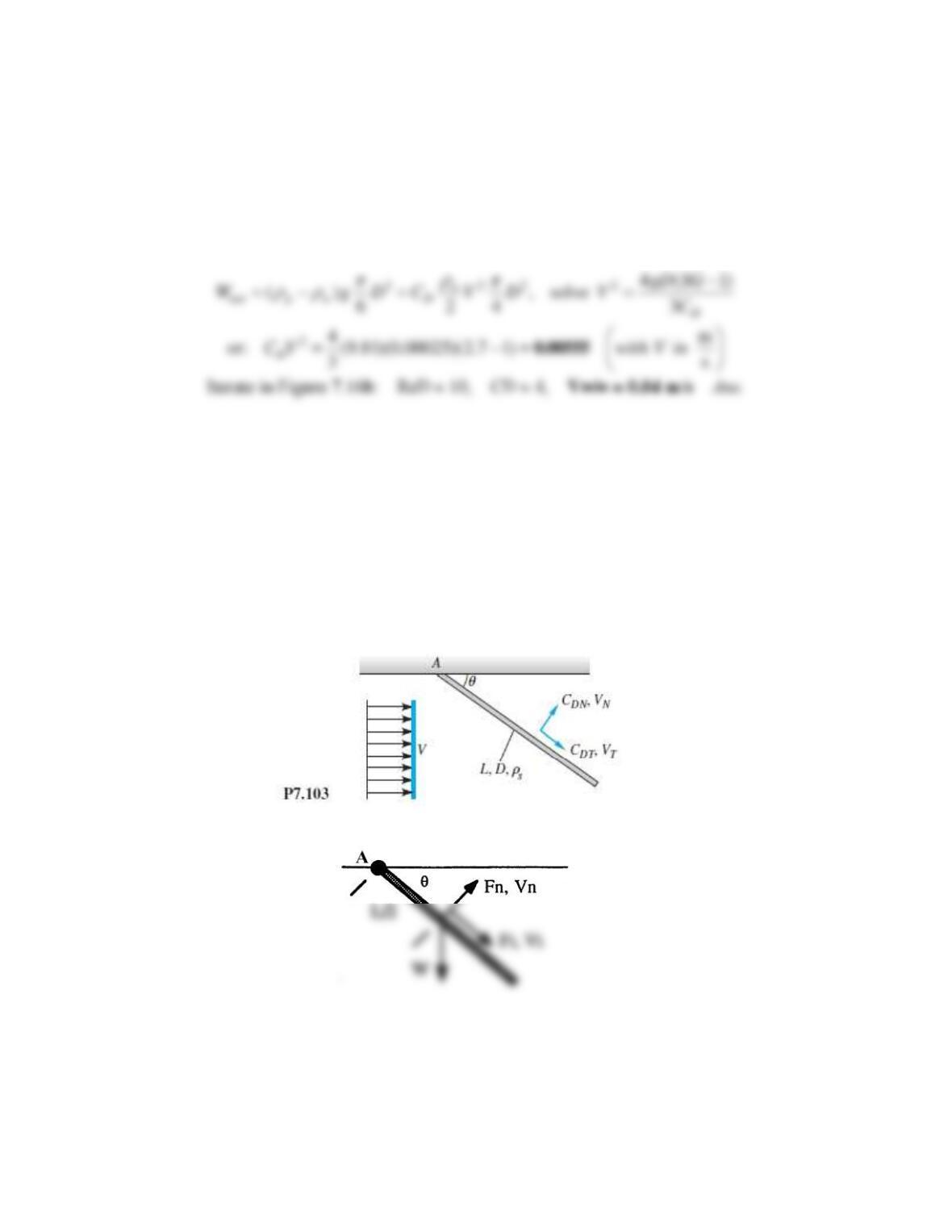
Sand particles (SG = 2.7), approximately spherical with diameters from 100 to 250
m, are introduced
into an upward-flowing stream of water at 20°C. What is the minimum water velocity that will
carry all the sand particles upward?
Solution 7.102
Clearly the largest particles need the most water speed. Set net weight = drag:
Problem 7.103
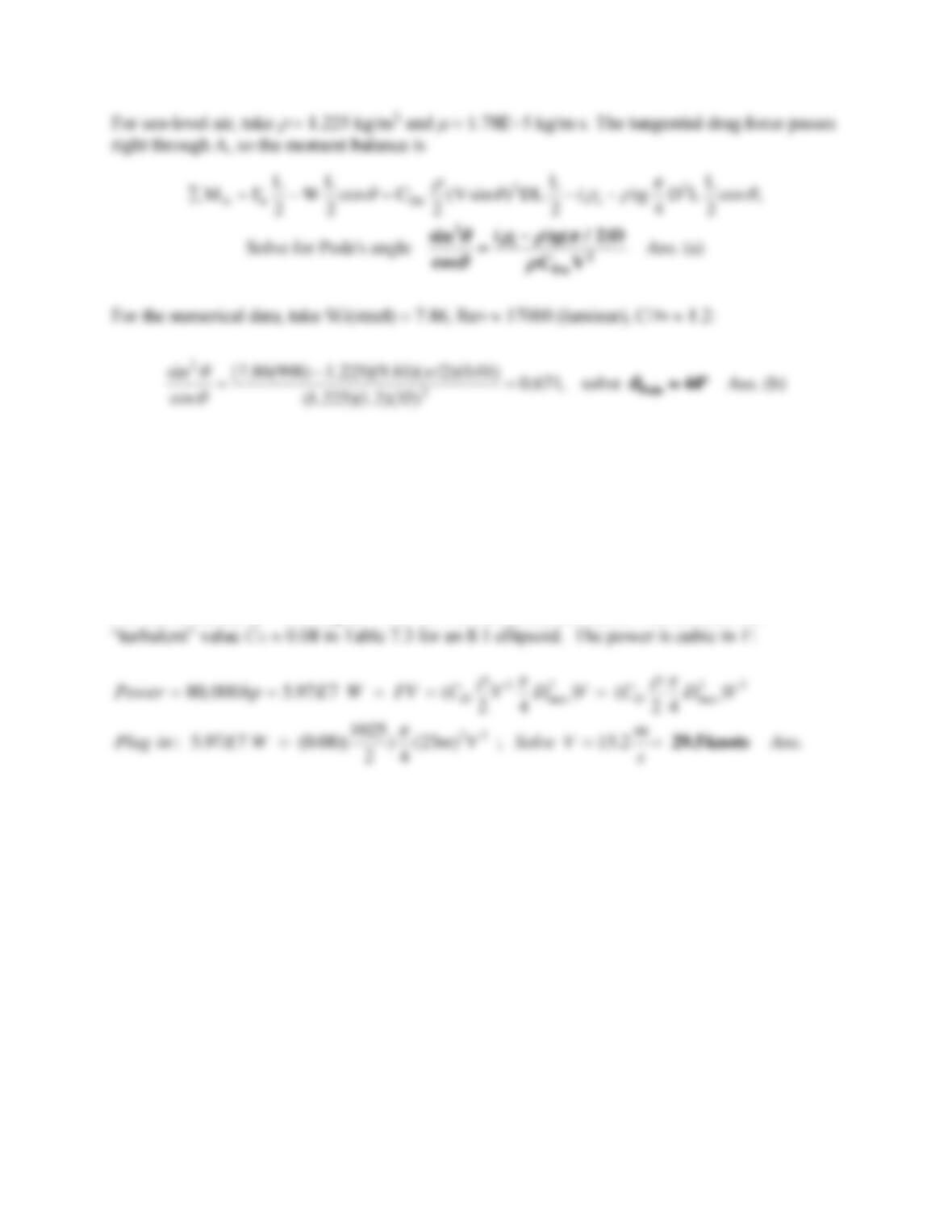
When immersed in a uniform stream V, a heavy rod hinged at A will hang at Pode’s angle
,
after an analysis by L. Pode (1951) (Fig. P7.103). Assume the cylinder has normal drag
coefficient CDn and tangential coefficient CDt, that relate the drag forces to Vn and Vt,
respectively. Derive an expression for Pode’s angle as a function of the flow and rod parameters.
Compute
for a steel rod, L = 40 cm, D = 1 cm, hanging in sea-level air at V = 35 m/s.
Solution 7.103
Problem 7.104
The Russian Typhoon-class submarine is 170 m long, with a maximum diameter of 23 m. Its
propulsor can deliver up to 80,000 hp to the seawater. Model the sub as an 8:1 ellipsoid and
estimate the maximum speed, in knots, of this ship.
Solution 7.104
For seawater, take
= 1025 kg/m3. The flow is surely turbulent (ReL > 2E9) so use the
Problem 7.105
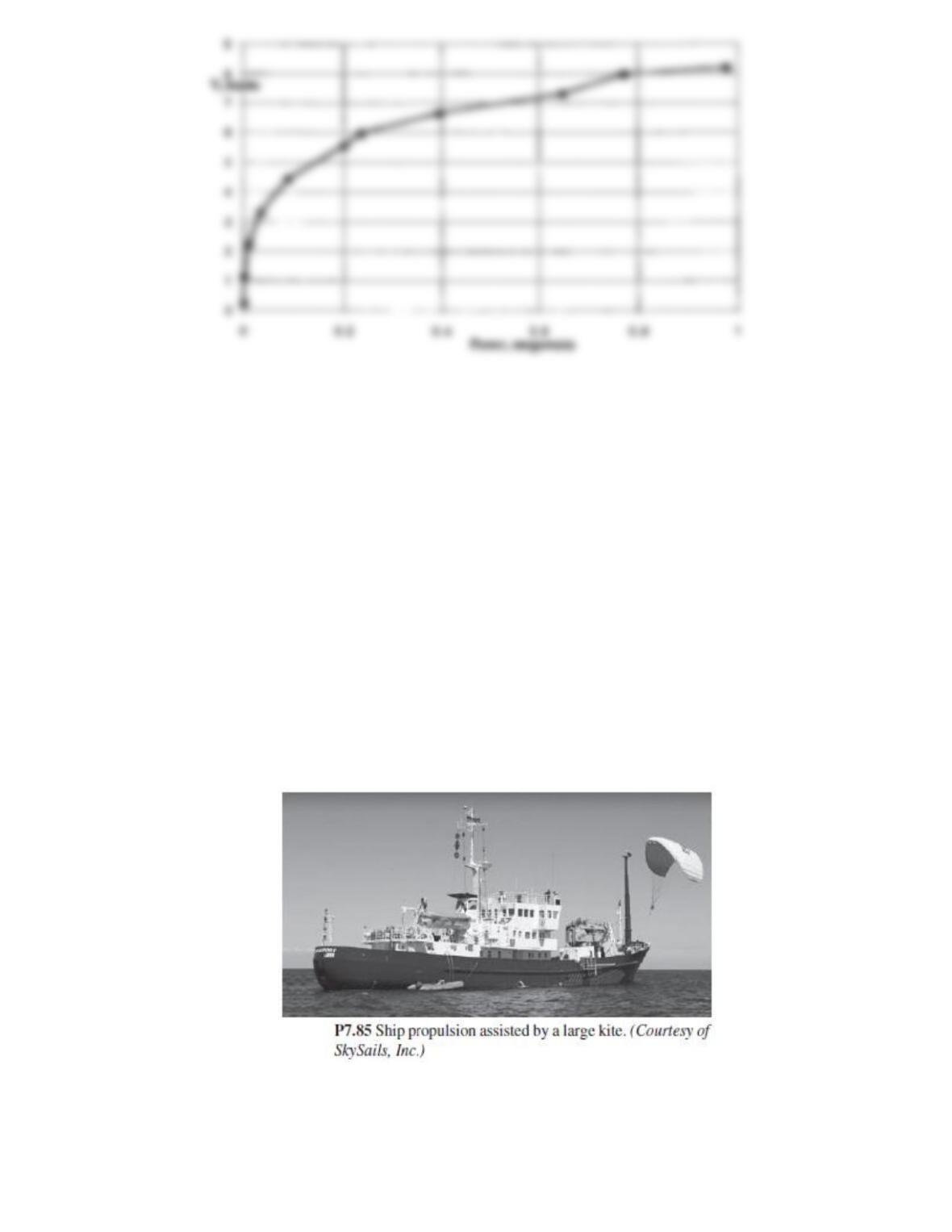
A ship 50 m long, with a wetted area of 800 m2, has the hull shape of tested in Fig. 7.19, There are
no bow or stern bulbs. Total propulsive power is 1 MW. For seawater at 20C, plot the ship’s
velocity V kn versus power P for 0 < P < 1 MW. What is the most efficient setting?
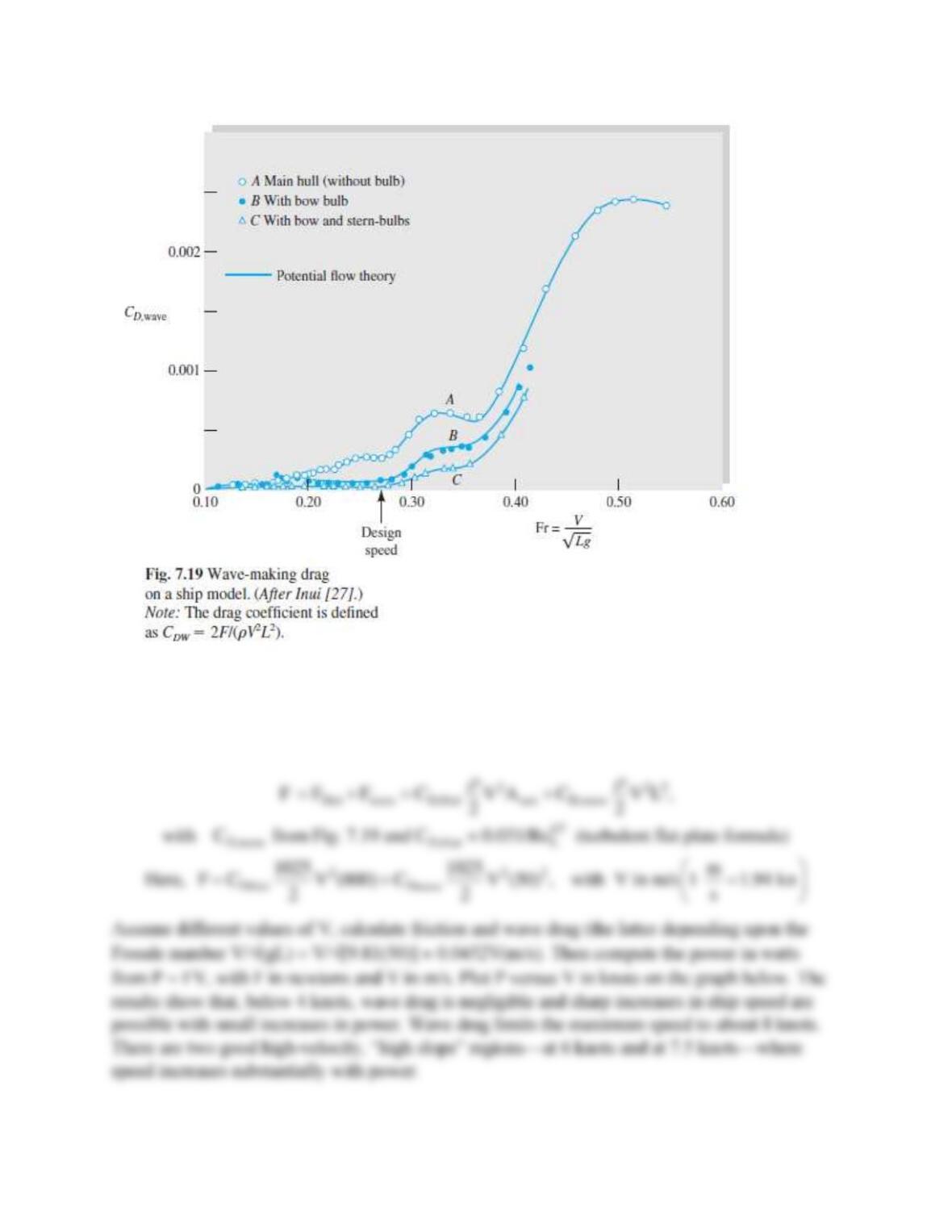
Solution 7.105
For seawater at 20C, take
= 1025 kg/m3 and
= 0.00107 kg/ms. The drag is taken to be the
sum of friction and wave drag—which are defined differently:
Problem 7.106
For the kite-assisted ship of Prob. P7.85, again neglect wave drag and let the wind velocity be
30 mi/h. Estimate the kite area that would tow the ship, unaided by the propeller, at a ship speed
of 8 knots.
Problem 7.85
In this era of expensive fossil fuels, many alternatives have been pursued. One idea from
SkySails, Inc., shown in Fig. P7.85, is the assisted propulsion of a ship by a large tethered kite.
The tow force of the kite assists the ship propeller and is said to reduce annual fuel consumption
by 10%-35%. For a typical example, let the ship be 120 m long, with a wetted area of 2800 m2.
The kite area is 330 m2 and has a force coefficient of 0.8. The kite cable makes an angle of 25
with the horizontal. Let Vwind = 30 mi/h. Neglect ship wave drag. Estimate the ship speed
(a) due to the kite only; and (b) if the propeller delivers 1,250 hp to the water. [Hint: The kite
sees the relative velocity of the wind.]