Archives: Quiz
COMU 53617
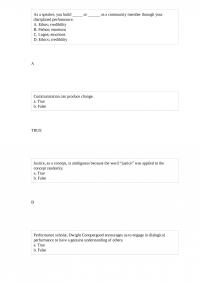
As a speaker, you build _____ or ______ as a community member through your disciplined performance. A. Ethos; credibility B. Pathos; emotions C. Logos; emotions D. Ethics; credibility Communication can produce change. a. True b. False TRUE Justice, as a […]
CAS 78688
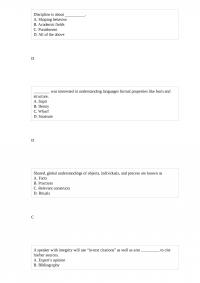
Discipline is about __________. A. Shaping behavior B. Academic fields C. Punishment D. All of the above ________ was interested in understanding languages formal properties like form and structure. A. Sapir B. Denny C. Whorf D. Saussure D Shared, global […]
STM 31478
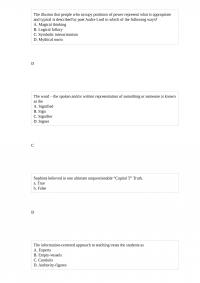
The illusion that people who occupy positions of power represent what is appropriate and typical is described by poet Audre Lord in which of the following ways? A. Magical thinking B. Logical fallacy C. Symbolic interactionism D. Mythical norm The […]
COM CM 68018
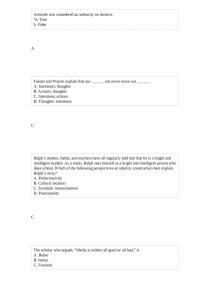
Aristotle was considered an authority on rhetoric. *a. True b. False Fassett and Warren explain that our ______ can never erase our ______. A. Intentions; thoughts B. Actions; thoughts C. Intentions; actions D. Thoughts: intentions C Ralph’s mother, father, and […]
MGT 85720
Which of the following is NOT a possible limitation to implementing cultural change of an organization? A) Cultural norms are deep-seated and may be quite resistant to change B) Successful changes in an organization’s culture typically occur over a long […]
MHR 86658
Rensis Likert refers to managers as the __________. A) Focal point B) Trend setter C) Leader D) Linking pin Which of the following is NOT a guideline that helps in developing more effective relationships with the legislature? A) Establish trust […]
EMBA 59603
Creating a clear result-oriented vision in relation to discovered potential and in relation to questions of higher purpose describes which phase of the process of appreciative inquiry? A) Discovery B) Dream C) Design D) Destiny McGregor’s suggested strategies that can […]
Management 70719
Which of the following is true in terms of social and structural connections, under some circumstances? A) Weak ties can actually facilitate creativity more than strong ties B) Strong ties promote creativity more than weak ties C) Strong ties discourage […]
BUA 19399
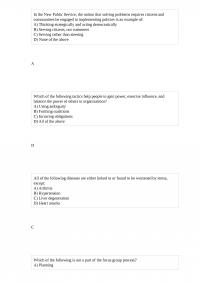
In the New Public Service, the notion that solving problems requires citizens and communities be engaged in implementing policies is an example of: A) Thinking strategically and acting democratically B) Serving citizens, not customers C) Serving rather than steering D) […]
EMBA 23480
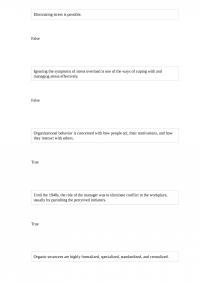
Eliminating stress is possible. Ignoring the symptoms of stress overload is one of the ways of coping with and managing stress effectively. False Organizational behavior is concerned with how people act, their motivations, and how they interact with others. True […]
MGT 94374
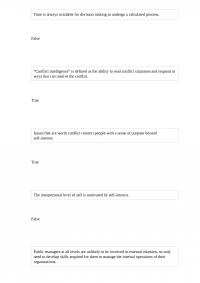
Time is always available for decision making to undergo a calculated process. “Conflict intelligence” is defined as the ability to read conflict situations and respond to ways that can resolve the conflict. True Issues that are worth conflict connect people […]
MGMT 28415
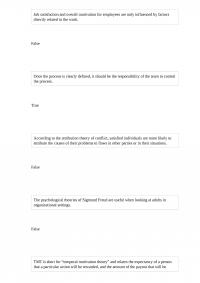
Job satisfaction and overall motivation for employees are only influenced by factors directly related to the work. Once the process is clearly defined, it should be the responsibility of the team to control the process. True According to the attribution […]
MHR 95013
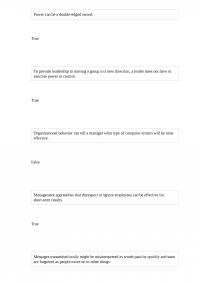
Power can be a double-edged sword. To provide leadership in moving a group in a new direction, a leader does not have to exercise power or control. True Organizational behavior can tell a manager what type of computer system will […]
MGT 29084
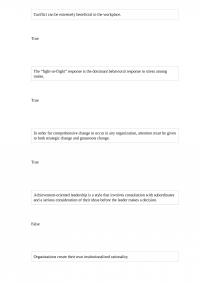
Conflict can be extremely beneficial to the workplace. The “fight-or-flight” response is the dominant behavioral response to stress among males. True In order for comprehensive change to occur in any organization, attention must be given to both strategic change and […]
BUS 32108
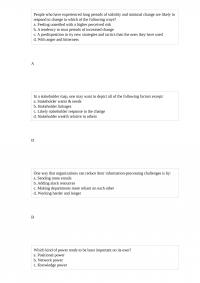
People who have experienced long periods of stability and minimal change are likely to respond to change in which of the following ways? a. Feeling unsettled with a higher perceived risk b. A tendency to trust periods of increased change […]
BUS 31115
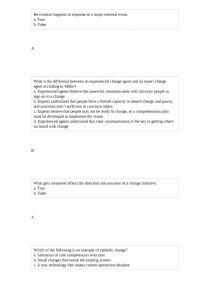
Re-creation happens in response to a major external event. a. True b. False What is the difference between an experienced change agent and an expert change agent according to Miller? a. Experienced agents believe that powerful communication will convince people […]
BUS 65741
Which is more effective at driving change: pull or push tactics? a. Push tactics are more effective because they can utilize reward-and-punishment power b. Agents should try to only use pull tactics because they appeal to higher-order purpose c. Neither […]
BUS 45514
Which of the following is not a change tool to help employees commit to a change? a. Stakeholder engagement b. Participative teams c. Using the change leader’s perspective to convince others of the change d. Bringing change initiatives to light […]
BUS 98367
What are Duck’s Five Stages of Change? a. Preparation, implementation, vacillation, flagellation, completion b. Stagnation, preparation, implementation, determination, fruition c. Configuration, centralization, fertilization, perspiration, preservation d. Anticipation, stimulation, application, determination, acclimatization When approaching a formal approval process, change agents should […]
BUS 54482
Employees don’t need to take explicit action to incite change. Organizations are constantly changing, and change opportunities will present themselves regularly. a. True b. False The reasons for change are usually clear and easily definable. a. True b. False B […]
BUS 41132
According to Duck’s model, determination describes the emotional state of leaders when they first identify the need for change. a. True b. False Anyone in the organization can hold multiple change roles throughout the change project. a. True b. False […]
BUS 18116
What factors determine organizational readiness for change? a. The number of organizational change projects done in the past b. Leadership commitment and member confidence in the leadership c. The amount of money available to incentivize employees to buy in d. […]
BUS 92192
The need for change is always clear and dramatic. As uncertainty ____________, the amount of information that needs to be processed between decision makers _______________. a. Decreases, increases b. Increases, decreases c. Increases, increases d. Increases, stays the same C […]
BUS 36660
Schein (1987) did which of the following to Lewin’s (1947) three-step model of change? A. refuted it after testing it on organization change B. expanded and elaborated each step, and redesignated the steps as overlapping stages C. reversed them D. […]
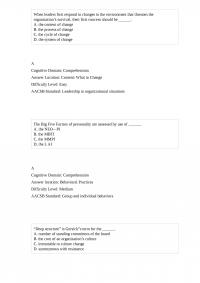
BUS 31685
When leaders first respond to changes in the environment that threaten the organization’s survival, their first concern should be ______. A. the content of change B. the process of change C. the cycle of change D. the system of change […]
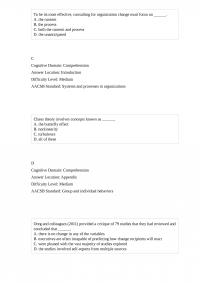
BUS 20838
To be its most effective, consulting for organization change must focus on ______. A. the content B. the process C. both the content and process D. the unanticipated Chaos theory involves concepts known as ______. A. the butterfly effect B. […]
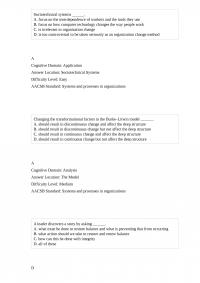
BUS 44798
Sociotechnical systems ______. A. focus on the interdependence of workers and the tools they use B. focus on how computer technology changes the way people work C. is irrelevant to organization change D. is too controversial to be taken seriously […]
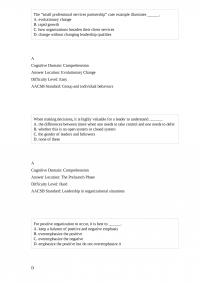
BUS 52728
The “small professional services partnership” case example illustrates ______. A. evolutionary change B. rapid growth C. how organizations broaden their client services D. change without changing leadership qualities When making decisions, it is highly valuable for a leader to understand […]
BUS 45839
The case study involving Teachers College, Columbia University, is based upon the principle of an organizations being ______. A. an open system B. organization influenced by its environment C. the context in which the changes occurring D. all of these […]
BUS 74360
The complexity of organizations can be incorporated in the organization change plan by ______. A. simplifying the organization into three levels B. incorporating into the plan the fact that interactions across organization levels are very important C. abandoning the plan […]
BUS 93292
The secret to success of the Four Habits Model was in ______. A. the execution B. applying the skills associated with each habit to each individual patient C. applying the skills in a unique manner to each patient D. all […]
BUS 46895
What was an unexpected finding of the Hawthorne studies? A. Scientific management was ineffective. B. The assumed cause-effect linkage between illumination and productivity did not exist. C. Production only increased when the lighting decreased. D. There’s no link between productivity […]
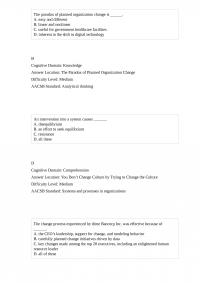
BUS 61872
The paradox of planned organization change is ______. A. easy and different B. linear and nonlinear C. useful for government healthcare facilities D. inherent in the shift to digital technology An intervention into a system causes ______. A. disequilibrium B. […]
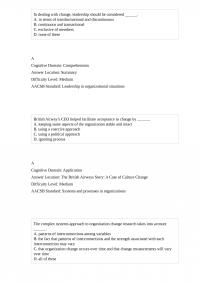
BUS 22990
In dealing with change, leadership should be considered ______. A. in terms of transformational and discontinuous B. continuous and transactional C. exclusive of members D. none of these British Airway’s CEO helped facilitate acceptance to change by ______. A. keeping […]
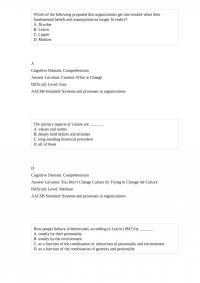
BUS 17891
Which of the following proposed that organizations get into trouble when their fundamental beliefs and assumptions no longer fit reality? A. Drucker B. Lewin C. Lippitt D. Maslow The primary aspects of culture are ______. A. values and norms B. […]
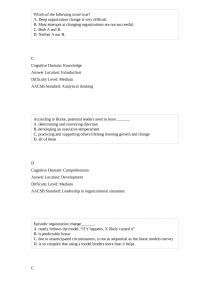
BUS 35690
Which of the following is/are true? A. Deep organization change is very difficult. B. Most attempts at changing organizations are not successful. C. Both A and B. D. Neither A nor B. According to Burke, potential leaders need to learn […]
BUS 85373
The essence of Witherspoon’s double coaching is ______. A. applying the idea that the way leaders act and the results they get begin with the way they think B. a different form of 360-degree feedback loop C. a methodology for […]
BUS 22110
The process of restoration of trust requires ______. A. motivation B. perseverance C. patience D. all of these Organizational culture change requires ______. A. system wide changes B. direct response to the external environment C. revolutionary interventions D. all of […]
BUS 47783
Communicating the need for change, initiating key activities, and dealing with resistance are part of the ______. A. prelaunch phase B. launch phase C. post launch phase D. sustaining the change Not unlike sergeants in the Army, nurses can be […]
BUS 39403
Burke recommends which of the following paradigms to help understand organization change ______. A. holistic B. living systems C. both A and B D. neither A nor B Burke strongly endorses, to ensure survival, effectiveness, and long-term success that change […]
BUS 80657
The changes at British Airways ______. A. perturbed the organization’s system B. punctuated its equilibrium C. caused leadership to question the way the organization did things D. all of these George Litwin, of the Burke—Litwin model, developed ______. A. an […]
BUS 74143
Integrating behavioral science with standard forms of management strengthen our understanding and effectiveness of organization change methodologies and processes. Taylor’s “scientific management” is based on these four principles: data gathering, worker selection and development, integration of the science and the […]
COMM 51516
The line or division between work and life is referred to as a. imaginary. b. superficial. c. a hard line. d. a boundary. How long does it usually take postgraduates to find their first jobs after college? a. 1–2 months […]
COM CM 76097
Stacy has a Facebook account and uses it as a sounding board for her frustration with her personal life and company. Which of the following statements is true? a. Stacy should only delete anything on her Facebook page that is […]
COMU 32829
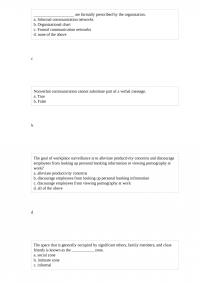
____________________ are formally prescribed by the organization. a. Informal communication networks b. Organizational chart c. Formal communication networks d. none of the above Nonverbal communication cannot substitute part of a verbal message. a. True b. False b The goal of […]
STM 73821
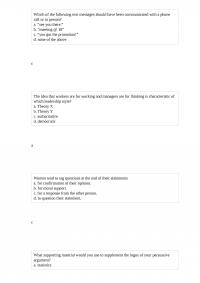
Which of the following text messages should have been communicated with a phone call or in person? a. “see you there.” b. “meeting @ 10” c. “you got the promotion!” d. none of the above The idea that workers are […]
CAS 78943
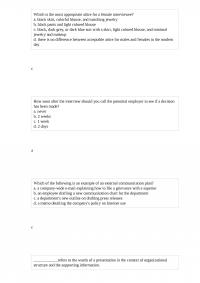
Which is the most appropriate attire for a female interviewee? a. black skirt, colorful blouse, and matching jewelry b. black pants and light colored blouse c. black, dark grey, or dark blue suit with a skirt, light colored blouse, and […]
CAS 47588
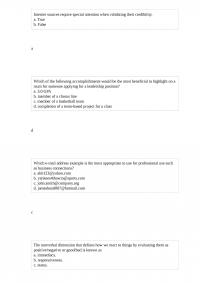
Internet sources require special attention when validating their credibility. a. True b. False Which of the following accomplishments would be the most beneficial to highlight on a rsum for someone applying for a leadership position? a. 3.0 GPA b. member […]
STM 23712
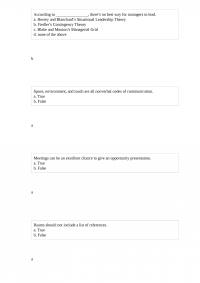
According to ________________, there’s no best way for managers to lead. a. Hersey and Blanchard’s Situational Leadership Theory b. Fiedler’s Contingency Theory c. Blake and Mouton’s Managerial Grid d. none of the above Space, environment, and touch are all nonverbal […]
STM 61642
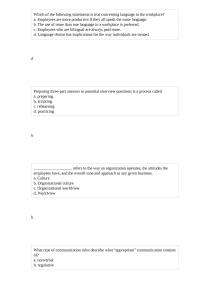
Which of the following statements is true concerning language in the workplace? a. Employees are more productive if they all speak the same language. b. The use of more than one language in a workplace is preferred. c. Employees who […]