Archives
Chapter 1 Global Outcomes: GO24) Which of the following is not a chemical
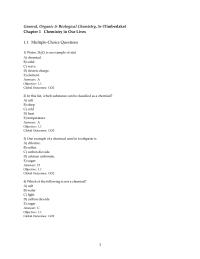
General, Organic & Biological Chemistry, 5e (Timberlake) Chapter 1 Chemistry in Our Lives 1.1 Multiple-Choice Questions 1) Water, H2O, is an example of a(n) A) chemical. B) solid. C) wave. D) electric charge. E) element. Answer: A Objective: 1.1 Global […]
Chapter 10 In the reaction of nitrogen and hydrogen to give ammonia
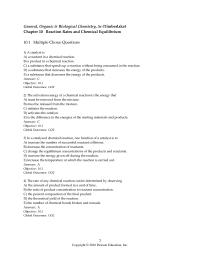
Copyright © 2016 Pearson Education, Inc. General, Organic & Biological Chemistry, 5e (Timberlake) Chapter 10 Reaction Rates and Chemical Equilibrium 10.1 Multiple Choice Questions 1) A catalyst is A) a reactant in a chemical reaction. B) a product in a […]
Chapter 11 How many moles of H2O are produced when 1 mole of Mg
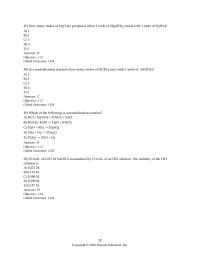
Copyright © 2016 Pearson Education, Inc. 47) How many moles of H2O are produced when 1 mole of Mg(OH)2 reacts with 1 mole of H2SO4? A) 1 B) 2 C) 3 D) 4 E) 5 Answer: B Objective: 11.7 Global […]
Chapter 11 Which of the following is correctly identified
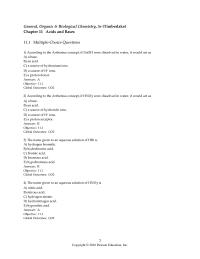
Copyright © 2016 Pearson Education, Inc. General, Organic & Biological Chemistry, 5e (Timberlake) Chapter 11 Acids and Bases 11.1 Multiple-Choice Questions 1) According to the Arrhenius concept, if NaOH were dissolved in water, it would act as A) a base. […]
Chapter 12 In a molecule with a symmetrical arrangement of polar bonds
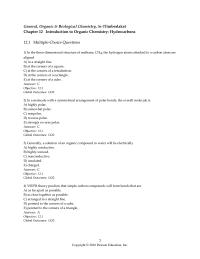
Copyright © 2016 Pearson Education, Inc. General, Organic & Biological Chemistry, 5e (Timberlake) Chapter 12 Introduction to Organic Chemistry: Hydrocarbons 12.1 Multiple-Choice Questions 1) In the three-dimensional structure of methane, CH4, the hydrogen atoms attached to a carbon atom are […]
Chapter 12 An alkyne is always a carbon compound that contains a
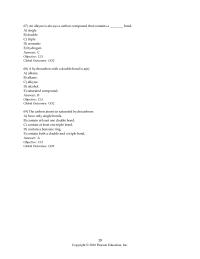
Copyright © 2016 Pearson Education, Inc. 67) An alkyne is always a carbon compound that contains a ________ bond. A) single B) double C) triple D) aromatic E) hydrogen Answer: C Objective: 12.5 Global Outcomes: GO2 68) A hydrocarbon with […]
Chapter 13 Primary alcohols can be oxidized to either aldehydes or ketones
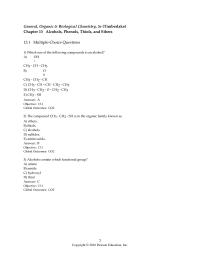
Copyright © 2016 Pearson Education, Inc. General, Organic & Biological Chemistry, 5e (Timberlake) Chapter 13 Alcohols, Phenols, Thiols, and Ethers 13.1 Multiple-Choice Questions 1) Which one of the following compounds is an alcohol? A) OH | CH3 – CH – […]
Chapter 14 Which of these compounds is the hemiacetal that forms when ethanol
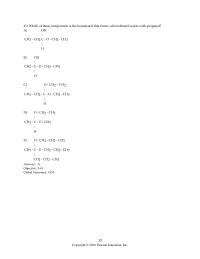
Copyright © 2016 Pearson Education, Inc. 41) Which of these compounds is the hemiacetal that forms when ethanol reacts with propanal? A) OH | CH3 – CH2 C – O – CH2 – CH3 | H B) OH | CH3 […]
Chapter 14 Which one of the following compounds is an aldehyde
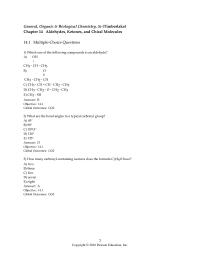
Copyright © 2016 Pearson Education, Inc. General, Organic & Biological Chemistry, 5e (Timberlake) Chapter 14 Aldehydes, Ketones, and Chiral Molecules 14.1 Multiple-Choice Questions 1) Which one of the following compounds is an aldehyde? A) OH | CH3 – CH – […]
Chapter 15 A carbohydrate that gives two molecules when it is completely
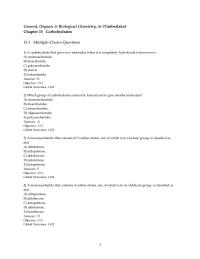
General, Organic & Biological Chemistry, 5e (Timberlake) Chapter 15 Carbohydrates 15.1 Multiple-Choice Questions 1) A carbohydrate that gives two molecules when it is completely hydrolyzed is known as a A) monosaccharide. B) disaccharide. C) polysaccharide. D) starch. E) trisaccharide. Answer: […]
Chapter 15 Hydrolysis of the disaccharide above gives the mono saccharides
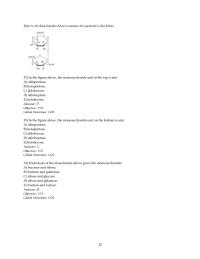
Refer to the disaccharides below to answer the question(s) that follow. 32) In the figure above, the monosaccharide unit at the top is a(n) A) aldopentose. B) ketopentose. C) aldohexose. D) aldoheptose. E) ketohexose. Answer: E Objective: 15.5 Global Outcomes: […]
Chapter 16 The reactants that will form an ester in the presence of an acid catalyst
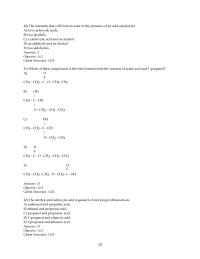
40) The reactants that will form an ester in the presence of an acid catalyst are A) two carboxylic acids. B) two alcohols. C) a carboxylic acid and an alcohol. D) an aldehyde and an alcohol. E) two aldehydes. Answer: […]
Chapter 16 They Form Dimers That Are Relatively Stable b
General, Organic & Biological Chemistry, 5e (Timberlake) Chapter 16 Carboxylic Acids and Esters 16.1 Multiple-Choice Questions 1) Which functional group is a carboxylic acid? A) – OH B) O – C – OH C) O – C – O – […]
Chapter 17 What Phospholipid Contains Fatty Acids But
37) What phospholipid contains fatty acids but NOT glycerol? A) lecithin B) glycolipid C) sphingolipid D) cephalin E) corticosteroid Answer: C Objective: 17.5 Global Outcomes: GO2 38) Which of the following compounds is a glycerolphospholipid? A) jojoba wax B) estrogen […]
Chapter 17 Which of the following is an unsaturated fatty acid
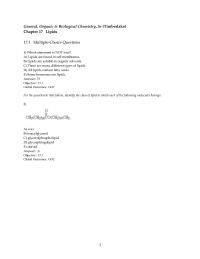
General, Organic & Biological Chemistry, 5e (Timberlake) Chapter 17 Lipids 17.1 Multiple-Choice Questions 1) Which statement is NOT true? A) Lipids are found in cell membranes. B) Lipids are soluble in organic solvents. C) There are many different types of […]
Chapter 18 When acetic acid reacts with ammonia, NH3, the reaction called
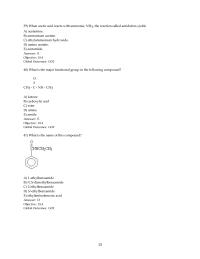
39) When acetic acid reacts with ammonia, NH3, the reaction called amidation yields A) acetamine. B) ammonium acetate. C) ethylammonium hydroxide. D) amino acetate. E) acetamide. Answer: E Objective: 18.4 Global Outcomes: GO2 40) What is the major functional group […]
Chapter 18 Which The Following Represents The Complete
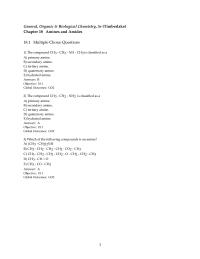
General, Organic & Biological Chemistry, 5e (Timberlake) Chapter 18 Amines and Amides 18.1 Multiple Choice Questions 1) The compound CH3 – CH2 – NH – CH3 is classified as a A) primary amine. B) secondary amine. C) tertiary amine. D) […]
Chapter 19 Which group would most likely be found in a hydrophobic area
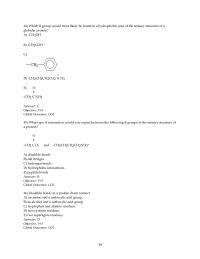
44) Which R group would most likely be found in a hydrophobic area of the tertiary structure of a globular protein? A) –CH2OH B) –CH2COO– C) D) –CH2CH2CH2CH2H3 E) O –CH2 C NH2 Answer: C Objective: 19.5 Global Outcomes: GO2 […]
Chapter 19 Which of the following is NOT a function of proteins
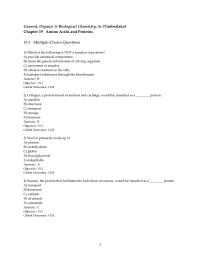
General, Organic & Biological Chemistry, 5e (Timberlake) Chapter 19 Amino Acids and Proteins 19.1 Multiple-Choice Questions 1) Which of the following is NOT a function of proteins? A) provide structural components B) stores the genetic information of a living organism […]
Chapter 2 A dose of aspirin of 5.0 mg per kilogram of body weight has been
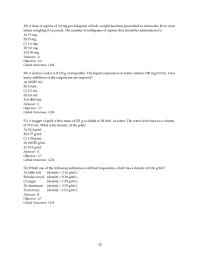
49) A dose of aspirin of 5.0 mg per kilogram of body weight has been prescribed to reduce the fever of an infant weighing 8.5 pounds. The number of milligrams of aspirin that should be administered is A) 19 mg. […]
Chapter 2 Which of the following measured numbers contains the designated CORRECT
General, Organic & Biological Chemistry, 5e (Timberlake) Chapter 2 Chemistry and Measurements 2.1 Multiple-Choice Questions 1) The metric base unit for length is the A) meter. B) inch. C) millimeter. D) kilometer. E) foot. Answer: A Objective: 2.1 Global Outcomes: […]
Chapter 20 Compared to an uncatalyzed reaction, an enzyme-catalyzed reaction
General, Organic & Biological Chemistry, 5e (Timberlake) Chapter 20 Enzymes and Vitamins 20.1 Multiple-Choice Questions 1) Compared to an uncatalyzed reaction, an enzyme-catalyzed reaction A) uses less substrate. B) produces different products. C) occurs at a faster rate. D) requires […]
Chapter 20 The names of many enzymes can be recognized by the suffix
46) The water-soluble B and C vitamins supply A) essential amino acids. B) substrates necessary for most of the reactions in the body. C) essential fatty acids. D) coenzymes required by some enzymes. E) competitive inhibitors needed to regulate enzyme […]
Chapter 21 Thymine and Guanine are a complementary base pair that forms 2 hydrogen
General, Organic & Biological Chemistry, 5e (Timberlake) Chapter 21 Nucleic Acids and Protein Synthesis 21.1 Multiple-Choice Questions 1) A ________ consists of a nitrogen-containing a base and a sugar. A) nucleoside B) base pair C) nucleotide D) complementary base E) […]
Chapter 22 Which of the following is true for prokaryotic
General, Organic & Biological Chemistry, 5e (Timberlake) Chapter 22 Metabolic Pathways for Carbohydrates 22.1 Multiple-Choice Questions 1) Which of the following is true for prokaryotic cells? A) They are more complex than eukaryotic cells. B) They are larger than eukaryotic […]
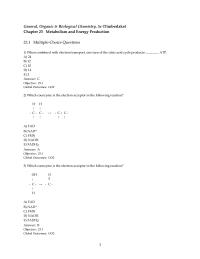
Chapter 23 When combined with electron transport, one turn of the citric acid
General, Organic & Biological Chemistry, 5e (Timberlake) Chapter 23 Metabolism and Energy Production 23.1 Multiple-Choice Questions 1) When combined with electron transport, one turn of the citric acid cycle produces ________ ATP. A) 24 B) 12 C) 10 D) 14 […]
Chapter 24 The action of pancreatic lipase on triacylglycerols produces
General, Organic & Biological Chemistry, 5e (Timberlake) Chapter 24 Metabolic Pathways for Lipids and Amino Acids 24.1 Multiple-Choice Questions 1) The digestion of fats begins in the A) mouth. B) stomach. C) small intestine. D) large intestine. E) pancreas. Answer: […]
Chapter 3 Which of the following would NOT be a physical change
General, Organic & Biological Chemistry, 5e (Timberlake) Chapter 3 Energy and Matter 3.1 Multiple-Choice Questions 1) Helium is a(n) A) compound. B) heterogeneous mixture. C) element. D) homogeneous mixture. E) electron. Answer: C Objective: 3.1 Global Outcomes: GO2 2) Air […]
Chapter 4 The primary substances of which all other things are composed
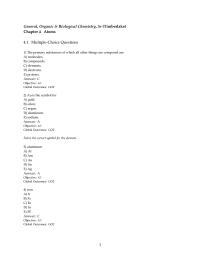
General, Organic & Biological Chemistry, 5e (Timberlake) Chapter 4 Atoms 4.1 Multiple-Choice Questions 1) The primary substances of which all other things are composed are A) molecules. B) compounds. C) elements. D) electrons. E) protons. Answer: C Objective: 4.1 Global […]
Chapter 4 What is the correct electron configuration for the lithium atom
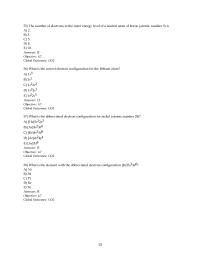
55) The number of electrons in the outer energy level of a neutral atom of boron (atomic number 5) is A) 2. B) 3. C) 5. D) 8. E) 10. Answer: B Objective: 4.7 Global Outcomes: GO2 56) What is […]
Chapter 5 What is the nuclear symbol for a radioactive isotope of copper with a mass
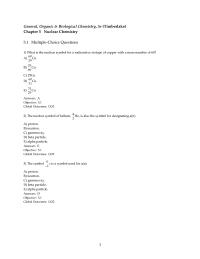
General, Organic & Biological Chemistry, 5e (Timberlake) Chapter 5 Nuclear Chemistry 5.1 Multiple-Choice Questions 1) What is the nuclear symbol for a radioactive isotope of copper with a mass number of 60? A) Cu B) Cu C) 29Cu D) Cu […]
Chapter 6 Which of the following substances contains a nonpolar covalent bond
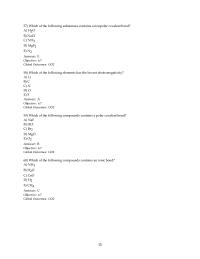
57) Which of the following substances contains a nonpolar covalent bond? A) H2O B) NaCl C) NH3 D) MgF2 E) N2 Answer: E Objective: 6.7 Global Outcomes: GO2 58) Which of the following elements has the lowest electronegativity? A) Li […]
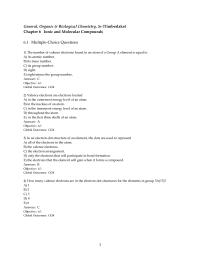
Chapter 6 The number of valence electrons found in an atom of a Group A
General, Organic & Biological Chemistry, 5e (Timberlake) Chapter 6 Ionic and Molecular Compounds 6.1 Multiple-Choice Questions 1) The number of valence electrons found in an atom of a Group A element is equal to A) its atomic number. B) its […]
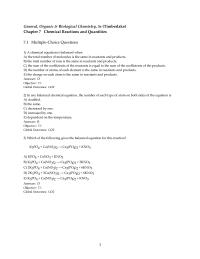
Chapter 7 the total number of molecules is the same in reactants and products
General, Organic & Biological Chemistry, 5e (Timberlake) Chapter 7 Chemical Reactions and Quantities 7.1 Multiple-Choice Questions 1) A chemical equation is balanced when A) the total number of molecules is the same in reactants and products. B) the total number […]
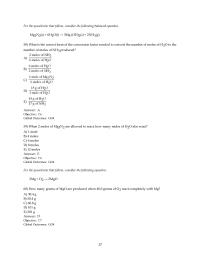
Chapter 7 What is the correct form of the conversion factor needed to convert
For the question(s) that follow, consider the following balanced equation. Mg3N2(s) + 6H2O(l) → 3Mg (OH)2(s) + 2NH3(g) 58) What is the correct form of the conversion factor needed to convert the number of moles of H2O to the number […]
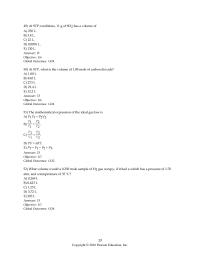
Chapter 8 The total pressure in a mixture of gases is equal to the partial pressure
Copyright © 2016 Pearson Education, Inc. 49) At STP conditions, 11 g of SO2 has a volume of A) 250 L. B) 3.8 L. C) 22 L. D) 0.0076 L. E) 130 L. Answer: B Objective: 8.6 Global Outcomes: GO4 […]
Chapter 8 Which of the following is NOT part of the kinetic theory of gases
Copyright © 2016 Pearson Education, Inc. General, Organic & Biological Chemistry, 5e (Timberlake) Chapter 8 Gases 8.1 Multiple-Choice Questions 1) Which of the following is NOT part of the kinetic theory of gases? A) A gas is composed of very […]
Chapter 9 What is the molarity of a KCl solution made by diluting
Copyright © 2016 Pearson Education, Inc. 49) What is the molarity of a KCl solution made by diluting 75.0 mL of a 0.200 M solution to a final volume of 100. mL? A) 0.267 M B) 0.150 M C) 0.200 […]
Chapter 9 When some of the sugar added to iced tea remains undissolved at the bottom
Copyright © 2016 Pearson Education, Inc. General, Organic & Biological Chemistry, 5e (Timberlake) Chapter 9 Solutions 9.1 Multiple-Choice Questions 1) The O-H bond in water is polar because A) it is an ionic bond. B) oxygen is much more electronegative […]