41) Which of these compounds is the hemiacetal that forms when ethanol reacts with propanal?
A) OH
|
CH3 – CH2 C – O – CH2 – CH3
|
H
B) OH
|
CH3 – C – O – CH2 – CH3
|
H
C) O – CH2 – CH2
|
CH3 – CH2 – C – O – CH2 – CH3
|
H
D) O – CH2 – CH3
|
CH3 – C – O – CH3
|
H
E) O – CH2 – CH2 – CH3
|
CH3 – C – O – CH2 – CH2 – CH3
|
CH2 – CH2 – CH3
42) What is the acetal formed when propanone reacts with two molecules of methanol?
A) OH
|
CH3 – C – CH3
|
CH3
B) O – CH3
|
CH3 – C – CH3
|
O – CH3
C) O – CH3
|
CH3 – CO – CH3
|
O – CH3
D) CH3
CH3
| |
CH3 – C – O – C – CH3
| |
H H
E) OH
|
CH3 – C – CH3
|
O – CH3
43) An enantiomer is
A) a stereoisomer that is not a mirror image of another molecule.
B) a stereoisomer that is a mirror image of another molecule.
C) a diastereoisomer.
D) a structural isomer.
E) a cis-trans isomer.
44) Chirality occurs when stereoisomers have mirror images that are
A) superimposable.
B) the same.
C) not superimposable.
D) not visible to one another.
E) identical.
45) How many different substituents are required on a carbon atom for it to be chiral?
A) one
B) two
C) three
D) four
E) Any number from 1 to 4; chiralty does not depend on substitution.
46) Which molecule below has stereoisomers with different biological effects?
A) carvone
B) nicotine
C) LSD
D) epinephrine
E) All of the above.
47) Chiral drugs consist of only one enantiomer. The benefits of using a pure enantiomer, rather than a
mixture, include
A) higher potency (lower total dose of drug).
B) elimination of side effects.
C) reduced chances of drug interactions.
D) All of the above.
E) None of the above.
48) Achiral compounds are those which
A) have no “handedness.”
B) have different mirror images.
C) are non-superimposable.
D) have the same formula but different structures.
E) are a racemic mixture.
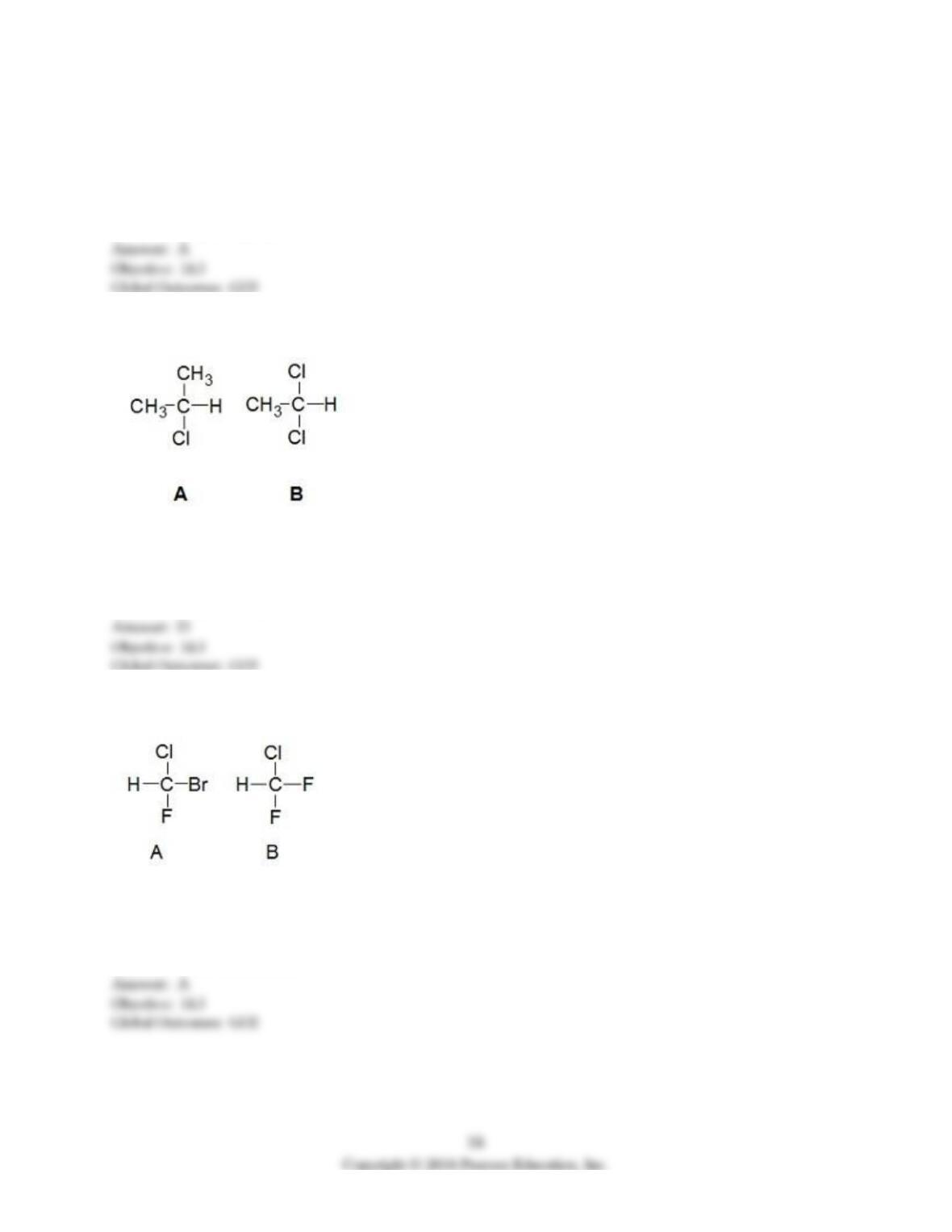
49) Use the structures below to answer:
A) A is chiral and B is achiral
B) A is achiral and B is chiral
C) both A and B are chiral
D) both A and B are achiral
50) Use the structures below to answer:
A) A is chiral and B is achiral
B) A is achiral and B is chiral
C) both A and B are chiral
D) both A and B are achiral
14.2 True/False Questions
1) All aldehydes have a carbonyl carbon bonded to at least two hydrogens.
2) Many odors from solvents, paint removers, and perfumes are derived from aldehydes or ketones.
3) In a ketone, the carbonyl group is bonded to two other carbon atoms.
4) The carbonyl group consists of a carbon-oxygen single bond, and a second bond to hydrogen.
5) The carbonyl group does not have a dipole.
6) The suffix -one indicates an aldehyde in the IUPAC system of naming.
7) The suffix –al indicates an aldehyde in the IUPAC system of naming.
8) Acetone is a three-carbon aldehyde.
9) Acetone is sometimes produced in pathological conditions such as diabetes.
10) Formaldehyde is used in solution as a germicide and preservative.
11) Excessive exposure to formaldehyde can irritate the eyes and respiratory tract.
12) A major flavor component of vanilla is an aldehyde.
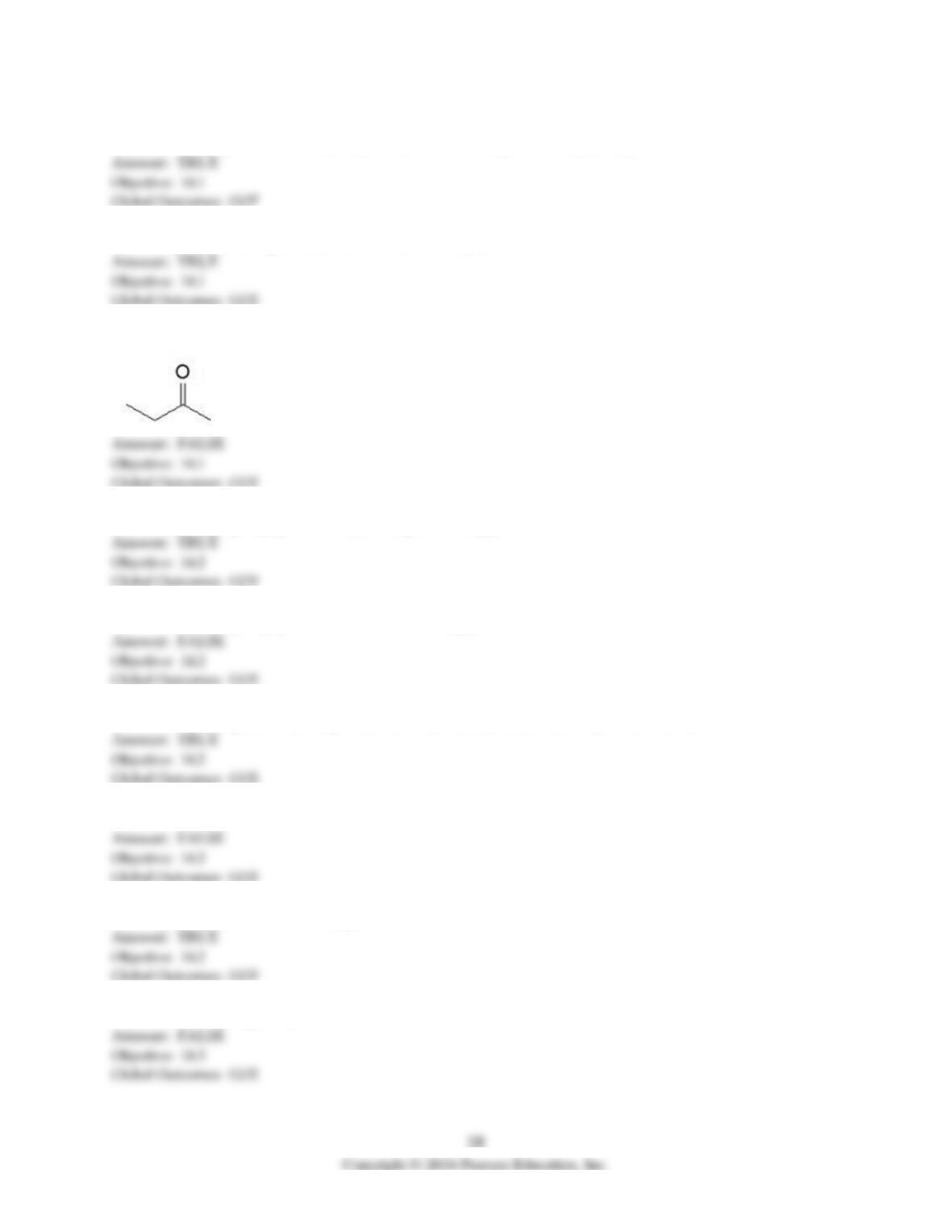
13) The name of this compound is 3-butanone.
14) The carbonyl group gives aldehydes higher boiling points than alkanes of similar mass.
15) The carbonyl group gives ketones lower boiling points than alkanes of similar mass.
16) Carbonyl compounds having fewer than four carbon atoms are very water soluble.
17) Hexanal would be soluble in water.
18) Propanal is more soluble than pentanal.
19) Acetone would give a positive Tollens’ test.
20) The Tollens’ test is used to distinguish between aldehydes and ketones.
21) Primary alcohols are oxidized to ketones.
22) Ketones are reduced to secondary alcohols.
23) Benedict’s test can be used to determine whether an α-hydroxyaldehyde functional group is present.
24) An acetal is formed from an aldehyde or ketone and one molecule of alcohol.
25) A hemiacetal has alkoxy and hydroxyl functional groups bonded to the same carbon.
26) Glucose forms a cyclic hemiacetal.
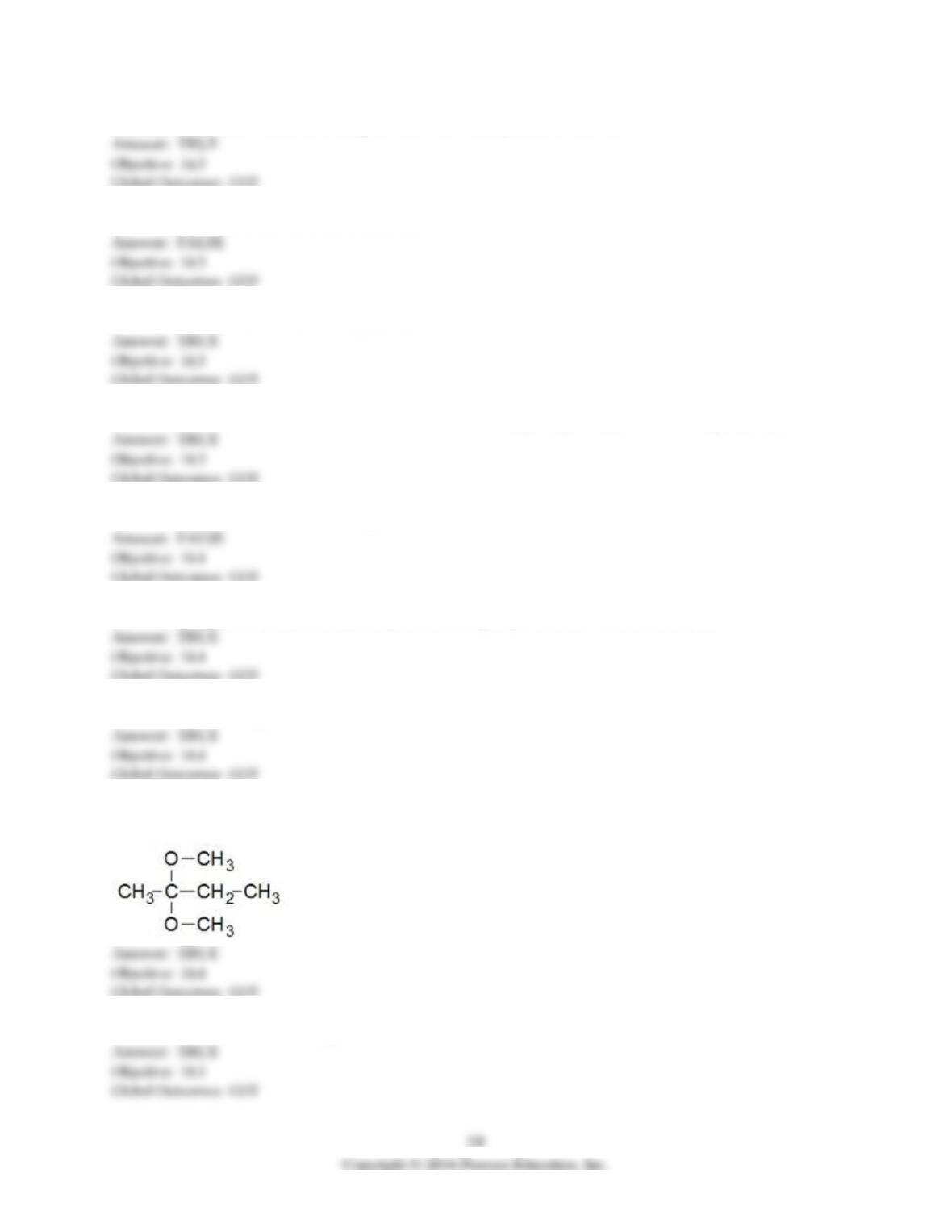
27) This compound is an acetal.
28) Enantiomers are mirror images of each other.
29) A chiral carbon atom can have fewer than four different groups bonded to it.
30) Enantiomers may have very different tastes or smells.
31) 2-butanol is a chiral molecule.
32) 1-butanol is a chiral molecule.
33) Enantiomers have superimposable mirror images.
34) The biological activity of one of a set of enantiomers may be very different from the biological activity
of the other optical isomers.
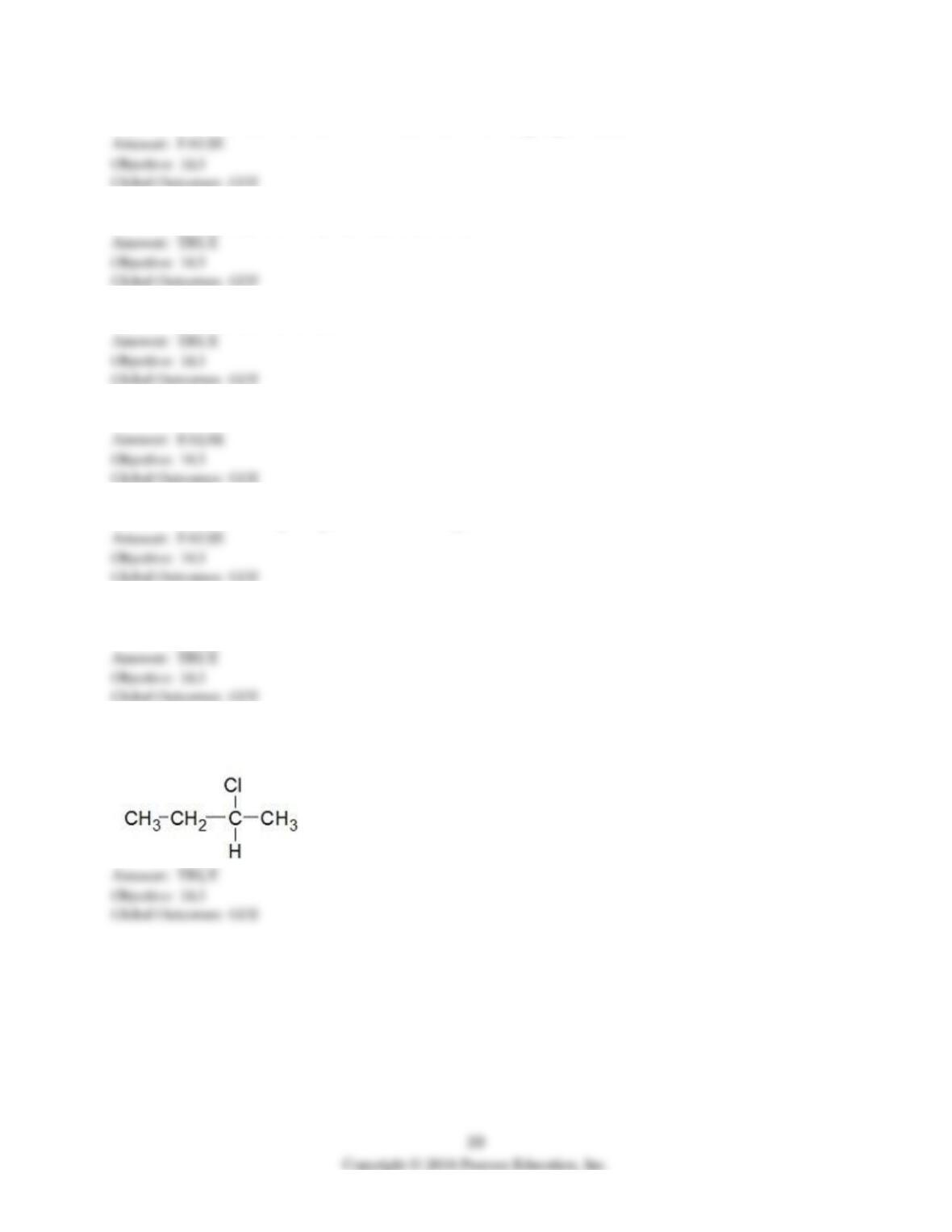
35) This compound is chiral.
21
14.3 Matching Questions
Select the correct name for the following.
A) 3-propanone
B) 1-propanone
C) diethyl ketone
D) propanal
1) O
CH3CH2 C CH2CH3
Objective: 14.1
Global Outcomes: GO2
2) O
CH3CH2 C H
Objective: 14.1
Global Outcomes: GO2
Match the structural formula with the correct functional group.
A) aldehyde
B) ether
C) ketone
3) O
CH3CH
Objective: 14.1
Global Outcomes: GO2
4) O
CH3 C CH2CH3
Objective: 14.1
Global Outcomes: GO2
5) CH3CH2OCH3
Objective: 14.1
Global Outcomes: GO2
6) O
CH3CH2 C H
Objective: 14.1
Global Outcomes: GO2
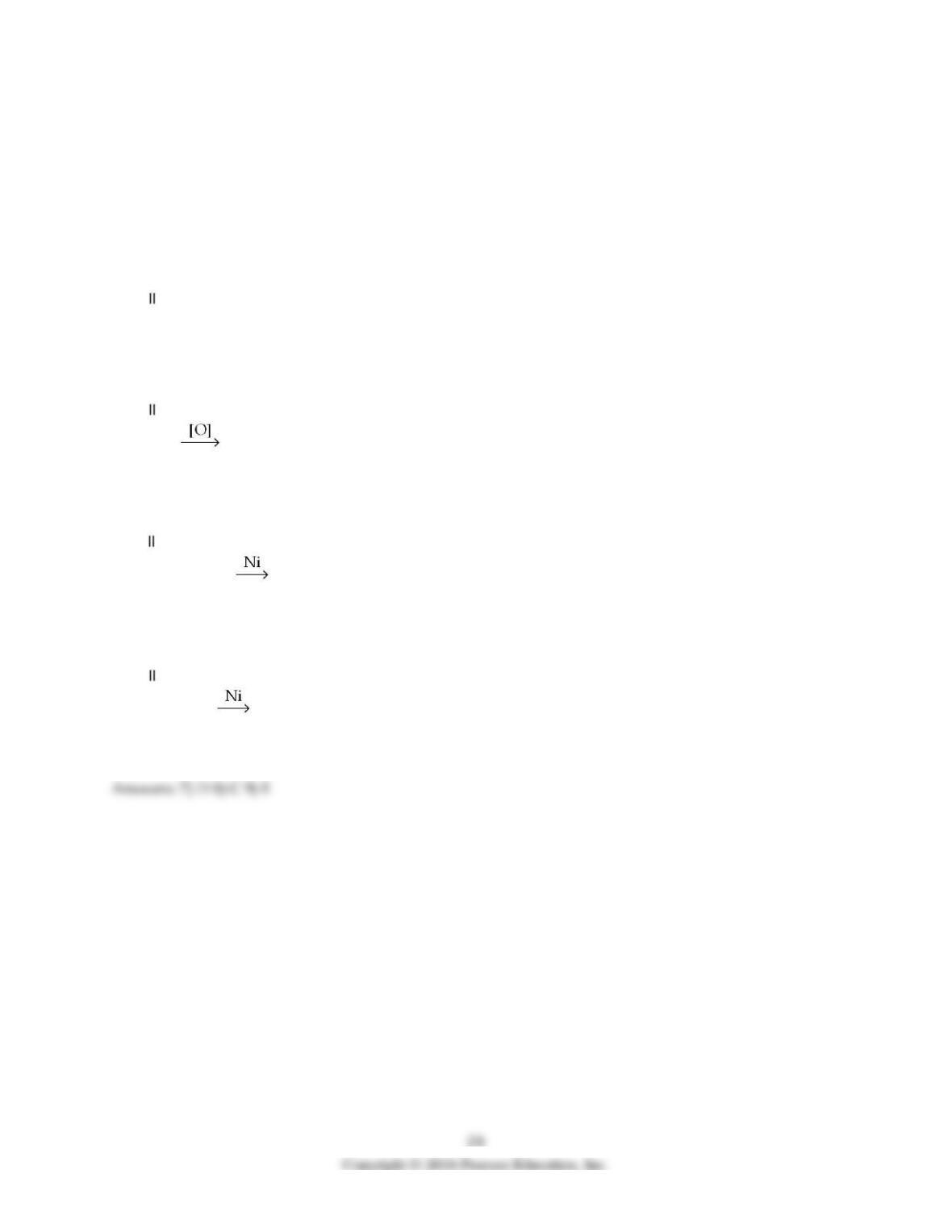
Identify the product, if any, that would form in each of the following reactions.
A) CH3CH3
B) CH3CH2CH3
C) OH
|
CH3 C HCH3
D) O
CH3 C OH
E) CH3CH2OH
7) O
CH3 C H
Objective: 14.3
Global Outcomes: GO2
8) O
CH3 C CH3 + H2
Objective: 14.3
Global Outcomes: GO2
9) O
CH3 C H + H2
Objective: 14.3
Global Outcomes: GO2