General, Organic & Biological Chemistry, 5e (Timberlake)
Chapter 7 Chemical Reactions and Quantities
7.1 Multiple-Choice Questions
1) A chemical equation is balanced when
A) the total number of molecules is the same in reactants and products.
B) the total number of ions is the same in reactants and products.
C) the sum of the coefficients of the reactants is equal to the sum of the coefficients of the products.
D) the number of atoms of each element is the same in reactants and products.
E) the charge on each atom is the same in reactants and products.
2) In any balanced chemical equation, the number of each type of atom on both sides of the equation is
A) doubled.
B) the same.
C) decreased by one.
D) increased by one.
E) dependent on the temperature.
3) Which of the following gives the balanced equation for this reaction?
K3PO4 + Ca(NO3)2 → Ca3(PO4)2 + KNO3
A) KPO4 + CaNO3 + KNO3
B) K3PO4 + Ca(NO3)2 → Ca3(PO4)2 + 3KNO3
C) 2K3PO4 + Ca(NO3)2 → Ca3(PO4)2 + 6KNO3
D) 2K3PO4 + 3Ca(NO3)2 → Ca3(PO4)2 + 6KNO3
E) K3PO4 + Ca(NO3)2 → Ca3(PO4)2 + KNO3
4) Which of the following correctly gives the best coefficients for the reaction below?
N2H4 + H2O2 → N2 + H2O
A) 1, 1, 1 ,1
B) 1, 2, 1, 4
C) 2, 4, 2, 8
D) 1, 4, 1, 4
E) 2, 4, 2, 4
5) What coefficient is placed in front of O2 to complete the balancing of the following equation?
C5H8
+ ? O2 → 5CO2 + 4H2O
A) 1
B) 3
C) 5
D) 7
E) 9
6) What is the coefficient of hydrogen, H2, when the following equation is balanced?
Al + H2SO4 → Al2(SO4)3 + ? H2
A) 1
B) 2
C) 3
D) 4
E) 5
7) In this reaction, what is the coefficient for calcium oxide?
CaO(s) + CO2(g) → CaCO3(s)
A) 1
B) 2
C) 3
D) 4
E) 5
8) In the following reaction, when the equation is correctly balanced, what is the correct coefficient for
sodium chloride?
Pb(NO3)2(aq) + NaCl(aq) → PbCl2(s) + NaNO3(aq)
A) 1
B) 2
C) 3
D) 4
E) 5
9) In the following reaction, when the equation is correctly balanced, what is the correct coefficient for
H2?
Fe(s) + HCl(aq) → FeCl3(aq) + H2(g)
A) 1
B) 2
C) 3
D) 4
E) 5
4
10) In the following reaction, when the equation is correctly balanced, what is the correct coefficient for
aluminum chloride?
Al(s) + Cl2(g) → AlCl3(s)
A) 1
B) 2
C) 3
D) 4
E) 5
Pentane (C5H12) reacts with oxygen (O2) to form carbon dioxide (CO2) and water (H2O) according to the
following reaction. Answer the question(s) that follow about this reaction.
C5H12 + ? O2 → ? CO2 + ? H2O
11) What is the coefficient for oxygen in the balanced equation?
A) 2
B) 4
C) 5
D) 6
E) 8
12) What is the coefficient for carbon dioxide in the balanced equation?
A) 2
B) 4
C) 5
D) 6
E) 8
13) What is the coefficient for water in the balanced equation?
A) 2
B) 4
C) 5
D) 6
E) 8
14) In a ________ reaction, two or more elements or compounds form one product.
A) decomposition
B) single replacement
C) dehydration
D) double replacement
E) combination
15) The following reaction takes place when an electric current is passed through water. It is an example
of a ________ reaction.
2H2O → 2H2 + O2
A) combination
B) single replacement
C) dehydration
D) decomposition
E) double replacement
16) What is the classification for this reaction?
SO3 (g) + H2O (l) → H2SO4(l)
A) decomposition
B) combination
C) replacement
D) double replacement
E) oxidation reduction
17) The reaction of carbon with oxygen to produce carbon monoxide is an example of which class of
reaction?
2C(s) + O2(g) → 2CO(g)
A) single replacement
B) double replacement
C) combination
D) catalytic
E) endothermic
18) What is the classification for this unbalanced reaction?
Fe + HCl → FeCl3 + H2
A) dehydration
B) combination
C) decomposition
D) single replacement
E) double replacement
19) The reaction of methane with oxygen to produce carbon dioxide and water is an example of which
class of reaction?
CH4(g) + 2O2(g) → CO2(g) + 2H2O(g)
A) single replacement
B) double replacement
C) combination
D) oxidation
E) endothermic
20) Which of the following is an oxidationfireduction reaction?
A) CaCl2 + Na2SO4 → CaSO4 + 2NaCl
B) KOH + HNO3 → H2O + KNO3
C) N2 + O2 → 2NO
D) AgNO3 + NaCl → AgCl + NaNO3
E) Al2(SO4)3 + 6KOH → 2Al(OH)3 + 3K2SO4
21) What is oxidized and what is reduced in the following reaction?
2Al(s) + 3Br2(g) → 2AlBr3(s)
A) Al is oxidized and Br2 is reduced.
B) AlBr3 is reduced and Br2 is oxidized.
C) Al is reduced and Br2 isoxidized.
D) AlBr3 is reduced and Al is oxidized.
E) AlBr3 is oxidized and Al is reduced.
22) Which of the following describes an oxidation reaction?
A) loss of electrons or loss of oxygen
B) loss of electrons or gain of oxygen
C) loss of electrons or gain of hydrogen
D) gain of electrons or gain of oxygen
E) gain of electrons or loss of H
23) In an oxidation-reduction reaction, the substance oxidized always
A) takes on oxygen atoms.
B) shows a loss of electrons.
C) gives up hydrogen atoms.
D) shows a gain of electrons.
E) becomes a charged species.
24) In this reaction, what is the substance oxidized?
Zn(s) + 2 HCl(aq) → ZnCl2(aq) + H2(g)
A) chlorine
B) zinc chloride
C) hydrogen
D) zinc
E) oxygen
25) In an oxidation-reduction reaction, the substance reduced always
A) takes on oxygen atoms.
B) shows a loss of electrons.
C) gives up hydrogen atoms.
D) shows a gain of electrons.
E) becomes a charged species.
26) How many moles of iron are present in 3.15 × 1024 atoms of iron?
A) 5.23 moles
B) 1.90 moles
C) 292 moles
D) 0.523 moles
E) 1.90 × 1048 moles
27) How many atoms of neon are present in 1.30 moles of neon?
A) 3.15 × 10²³
atoms
B) 4.63 × 10²³
atoms
C) 7.83 × 10²³
atoms
D) 6.02 × 10²³
atoms
E) 7.83 × 1024
atoms
28) One mole of particles of any substance contains how many particles?
A) 106
B) 3 × 10⁻¹⁰
C) 3 × 10¹⁰
D) 6.02 × 10²³
E) 6.02 × 10⁻²³
29) Avogadro’s number is the number of
A) particles in 1 mole of a substance.
B) amu in 1 mole of a substance.
C) grams in 1 mole of a substance.
D) moles in 6.02 × 10²³
grams of an element.
E) moles in 6.02 × 10²³
amu of an element.
30) How many molecules of water, H2O, are present in 75.0 g of H2O?
A) 75.0 molecules
B) 4.17 molecules
C) 7.53 × 1024 molecules
D) 2.51 × 1024
molecules
E) 5.02 × 1024
molecules
31) How many hydrogen atoms are present in 75.0 g of H2O?
A) 75.0 atoms
B) 4.17 atoms
C) 7.53 × 1024
atoms
D) 2.51 × 1024
atoms
E) 5.02 × 1024
atoms
32) The molar mass of potassium is
A) 19 g.
B) 31.0 g.
C) 6.02 × 10²³
grams.
D) 39.1 g.
E) 15g.
33) One mole of helium gas has a mass of
A) 1.00 g.
B) 2.00 g.
C) 3.00 g.
D) 4.00 g.
E) 8.00 g.
34) How many moles of water, H2O, are present in 75.0 g of H2O?
A) 4.41 moles
B) 4.16 moles
C) 75.0 moles
D) 7.50 moles
E) 1.35 × 10³ moles
35) 0.100 mole of lithium has a mass of
A) 3.00 g.
B) 0.300 g.
C) 6.94 g.
D) 0.694 g.
E) 0.700 g.
36) Calculate the molar mass of potassium chloride, KCl.
A) 74.6 g
B) 54.5 g
C) 6.74 g
D) 67.4 g
E) 19.0 g
37) What is the molar mass of copper(II) sulfate, CuSO4?
A) 16.0 g
B) 63.6 g
C) 111.6 g
D) 159.6 g
E) 319.2 g
38) Calculate the molar mass of magnesium chloride, MgCl2.
A) 24.3 g
B) 95.2 g
C) 125.9 g
D) 59.8 g
E) 70.0 g
39) What is the molar mass of sodium phosphate, Na3PO4?
A) 119 g
B) 308 g
C) 164 g
D) 226 g
E) 354 g
40) How many moles of carbon atoms are there in 0.500 mole of C2H6?
A) 0.500 moles
B) 1.00 moles
C) 3.00 moles
D) 6.02 × 10²³ moles
E) 4.00 moles
41) What is the molar mass of sucrose (C12H22O11)?
A) 29.0 g
B) 50.2 g
C) 210 g
D) 342 g
E) 182 g
42) One mole of neon atoms has a mass of
A) 6.02 × 10²³ grams.
B) 14.0 g.
C) 10.0 g.
D) 20.2 g.
E) 30.2 g.
43) The molar mass of C3H8O2 is
A) 76.0 g.
B) 60.0 g.
C) 29.0 g.
D) 69.0 g.
E) 52.0 g.
44) The molar mass of calcium hydroxide, Ca(OH)2, is
A) 58.1 g.
B) 57.1 g.
C) 74.1 g.
D) 114.2 g.
E) 38.0 g.
45) What is the molar mass of Mg3(PO4)2, a substance formerly used in medicine as an antacid?
A) 71.3 g
B) 118 g
C) 150. g
D) 214 g
E) 263 g
46) 4.00 moles of sodium have a mass of
A) 4.60 g.
B) 11.0 g.
C) 23.0 g.
D) 44.0 g.
E) 92.0 g.
47) How many moles of K2SO4 are in 15.0 g of K2SO4?
A) 0.172 moles
B) 2.61 × 10³ moles
C) 0.111 moles
D) 0.0861 moles
E) 0.119 moles
48) 3.00 moles of NO2 have a mass of
A) 138 g.
B) 46.0 g.
C) 30.0 g.
D) 90.0 g.
E) 45.0 g.
49) 1.25 moles of PbO2 have a mass of
A) 191 g.
B) 279 g.
C) 178 g.
D) 239 g.
E) 299 g.
50) How many grams of Fe2O3 are there in 0.500 mole of Fe2O3?
A) 79.9 g
B) 35.9 g
C) 63.8 g
D) 51.9 g
E) 160. g
51) How many grams of glucose (C6H12O6) are in 3.55 moles of glucose?
A) 180. g
B) 639 g
C) 103 g
D) 426 g
E) 50.7 g
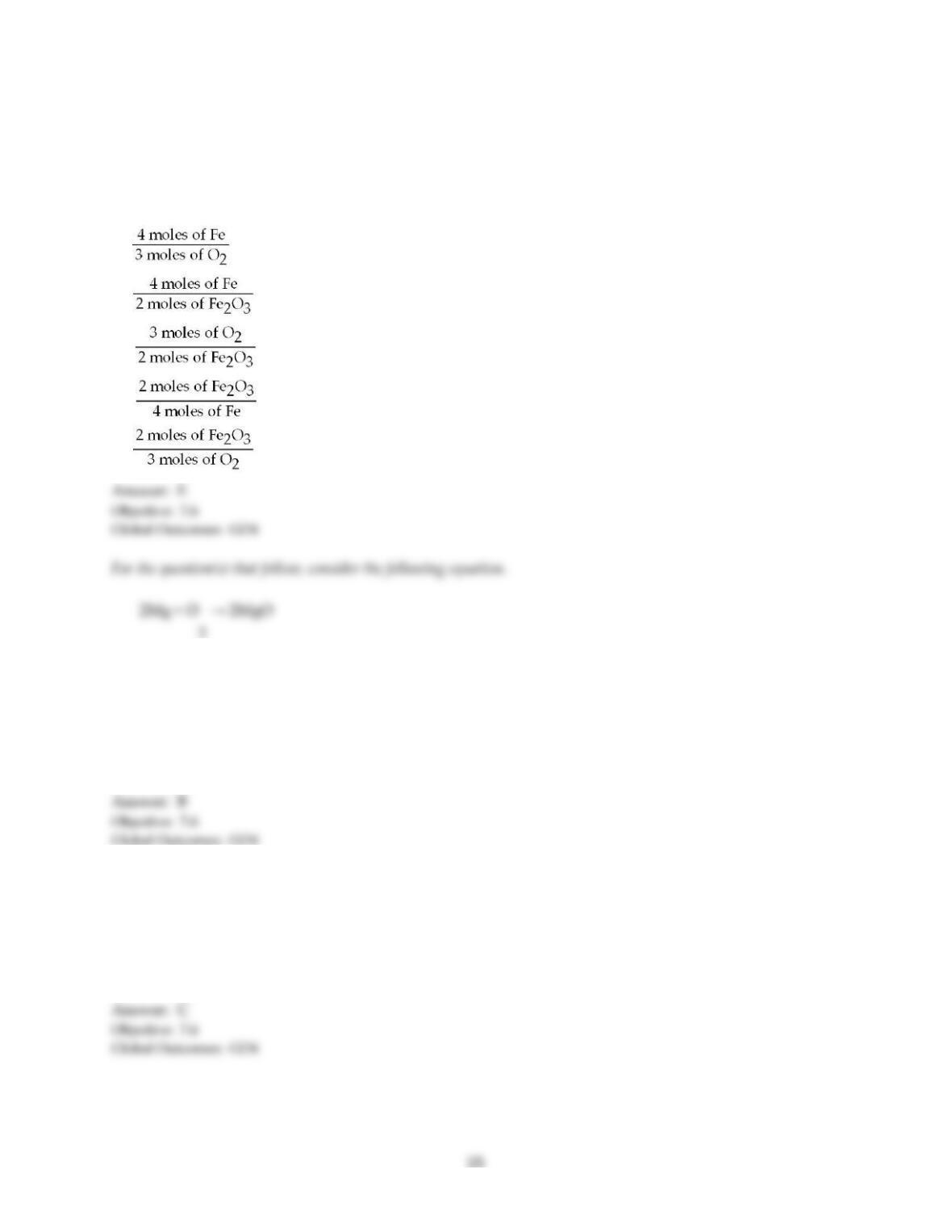
52) Given the following equation, what is the correct form of the conversion factor needed to convert the
number of moles of O2 to the number of moles of Fe2O3
produced?
4Fe(s) + 3O2 (g) → 2Fe2O3(s)
A)
B)
C)
D)
E)
53) The number of moles of oxygen gas needed to react with 4.0 moles of Mg is
A) 1.0 mole.
B) 2.0 moles.
C) 3.0 moles.
D) 4.0 moles.
E) 6.0 moles.
54) The number of moles of MgO produced when 0.20 mole of O2
reacts completely is
A) 0.10 mole.
B) 0.20 mole.
C) 0.40 mole.
D) 0.60 mole.
E) 0.80 mole.
55) How many moles of magnesium are needed to react with 0.50 mole of O2?
A) 0.50 mole
B) 1.0 moles
C) 2.0 moles
D) 3.0 moles
E) 4.0 moles
56) When 4 moles of aluminum are allowed to react with an excess of chlorine gas, Cl2, how many moles
of aluminum chloride are produced?
A) 1 mole
B) 2 moles
C) 3 moles
D) 4 moles
E) 5 moles
57) In the reaction of nitrogen gas, N2, with hydrogen gas, H2, to form ammonia gas, NH3 , how many
moles of hydrogen are needed to react with two moles of nitrogen?
A) 2 moles
B) 4 moles
C) 6 moles
D) 8 moles
E) 10 moles