General, Organic & Biological Chemistry, 5e (Timberlake)
Chapter 8 Gases
8.1 Multiple-Choice Questions
1) Which of the following is NOT part of the kinetic theory of gases?
A) A gas is composed of very small particles.
B) There is very little empty space in a gas.
C) Gas particles move rapidly.
D) Gas particles do not attract or repel one another.
E) Gas particles move faster when the temperature increases.
2) In the kinetic molecular theory of gas behavior, the assumption is made that gas molecules
A) move rapidly in random directions.
B) are attracted to each other by strong forces.
C) are close together in their container.
D) move with a kinetic energy equal to their centigrade temperature.
E) occasionally come to rest.
3) According to the kinetic theory of gases, a gas can be compressed much more than a liquid or solid
because
A) a gas is composed of very small particles.
B) the particles of a gas are very far apart.
C) gas particles move rapidly.
D) gas particles do not attract or repel one another.
E) gas particles move faster when the temperature increases.
4) According to the kinetic theory of gases, particles of a gas
A) are very large.
B) are very far apart.
C) lose their valence electrons.
D) move slowly.
E) decrease kinetic energy as temperature increases.
5) In a gas, the distance between the particles is
A) very close relative to the size of the molecules.
B) close relative to the size of the molecules.
C) fixed relative to the size of the molecules.
D) small relative to the size of the molecules.
E) very large relative to the size of the molecules.
6) In the kinetic molecular theory of gas behavior, particles of a gas tend to move ________ and collisions
between them are ________.
A) rapidly; rare
B) slowly; rare
C) rapidly; elastic
D) slowly; elastic
E) slowly; unusual
7) The force of gas particles against the walls of a container is called
A) pressure.
B) volume.
C) temperature.
D) quantity of gas.
E) density.
8) Which measurement describes the pressure of a gas?
A) 315 K
B) 1.2 g/L
C) 2.5 L
D) 725 mmHg
E) 0.45 moles
9) The unit of 1 atmosphere used to describe the pressure of a gas is equal to
A) 1 mmHg .
B) 100 mmHg.
C) 200 mmHg.
D) 600 mmHg.
E) 760 mmHg.
10) A 5.00-L tank contains helium gas at 1.50 atm. What is the pressure of the gas in mmHg?
A) 1.50 mmHg
B) 507 mmHg
C) 760 mmHg
D) 1140 mmHg
E) 7.5 mmHg
11) A 5.00-L tank contains helium gas at 1.50 atm. What is the pressure of the gas in torr?
A) 1.50 torr
B) 507 torr
C) 760 torr
D) 1140 torr
E) 7.5 torr
12) The atmospheric pressure in Denver, CO is 633 mmHg. What is this pressure in atm?
A) 1.20 atm
B) 633 atm
C) 0.833 atm
D) 1.00 atm
E) 127 atm
13) As you rise higher in Earth’s atmosphere, the atmospheric pressure
A) increases.
B) decreases.
C) remains the same.
14) The air pressure on a rainy day is usually ________ air pressure on a sunny day.
A) higher than
B) lower than
C) the same as
15) At constant temperature, a sample of helium at 760. torr in a closed container was compressed from
5.00 L to 3.00 L, with no change in moles or temperature. What was the new pressure exerted by the
helium on its container?
A) 800. torr
B) 2280 torr
C) 15.0 torr
D) 3800 torr
E) 1270 torr
16) According to Boyle’s Law, the pressure of a gas increases as the volume decreases because
A) the gas particles get bigger.
B) the kinetic energy of the gas particles increases.
C) the temperature of the gas increases.
D) the gas particles strike the walls of the container with more force.
E) the gas particles strike the walls of the container more often.
17) Which of the following correctly describes the process of inspiration (air entering the lungs)?
A) The lungs expand, causing their internal pressure to decrease.
B) The lungs expand, causing their internal pressure to increase.
C) The lungs contract, causing their internal pressure to decrease.
D) The lungs contract, causing their internal pressure to increase.
E) There is no change in the internal pressure in the lungs.
18) The volume of a gas with a pressure of 1.2 atm increases from 1.0 L to 4.0 L. What is the final pressure
of the gas, assuming no change in moles or temperature?
A) 1.2 atm
B) 0.30 atm
C) 3.3 atm
D) 4.8 atm
E) 1.0 atm
19) The volume of a gas with an initial pressure of 380 mmHg atm increases from 5.0 L to 8.0 L. What is
the final pressure of the gas,in atm, assuming no change in moles or temperature?
A) 238 atm
B) 2.4 atm
C) 0.31 atm
D) 0.80 atm
E) 8.0 atm
20) The pressure of 5.0 L of gas increases from 1.50 atm to 1240 mmHg. What is the final volume of the
gas, assuming no change in moles or temperature?
A) 4100 L
B) 5.0 L
C) 0.0060 L
D) 5.4 L
E) 4.6 L
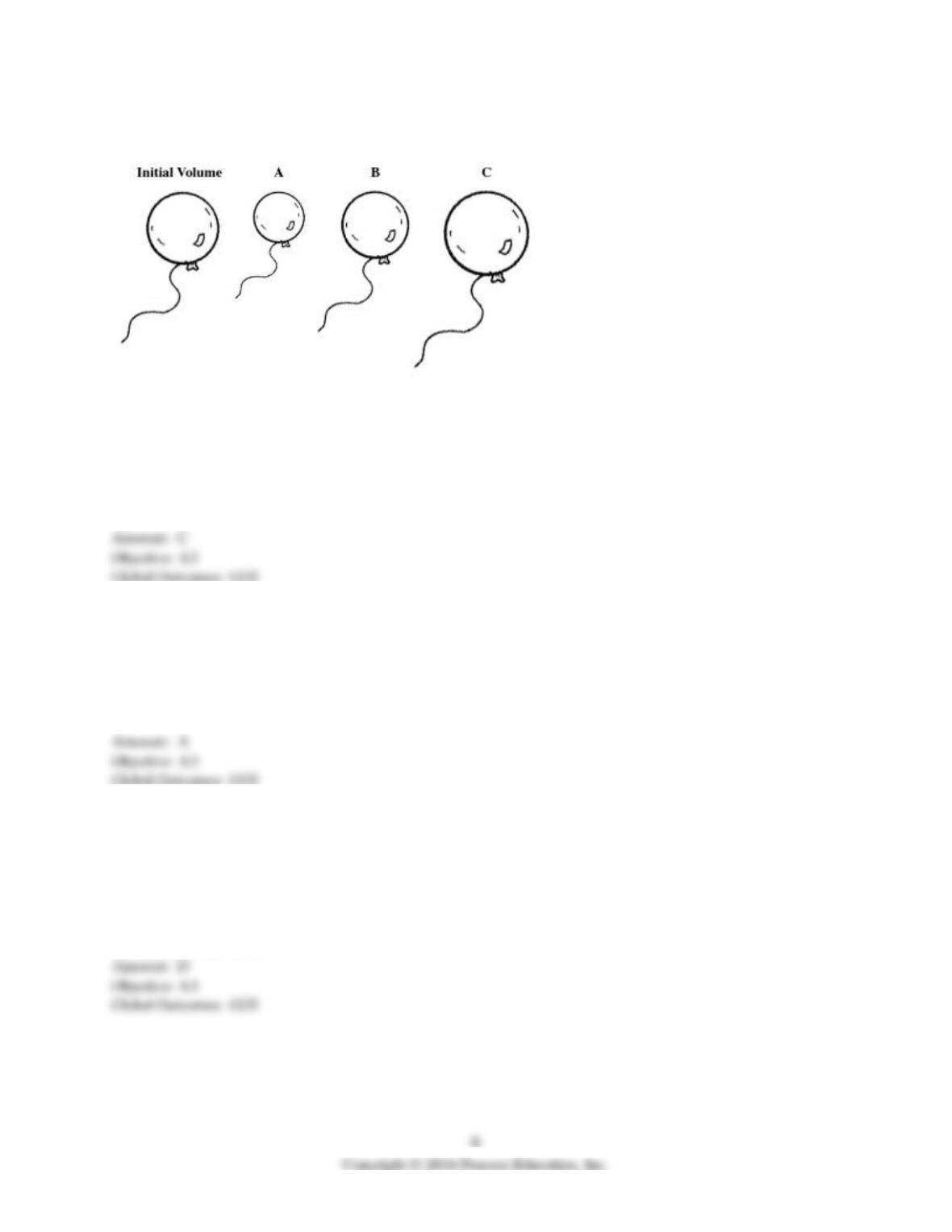
A balloon is filled with helium gas. For the question(s) that follow, select the letter of the balloon diagram that
corresponds to the given change in conditions.
21) The balloon is put into a chamber whose pressure is less than the atmospheric pressure and at
atmospheric temperature.
A) A
B) B
C) C
D) A and B
E) B and C
22) The temperature is changed from 50 °C to -150 °C at constant pressure.
A) A
B) B
C) C
D) A and B
E) B and C
23) Complete the following statement: In Charles’s Law, the volume of a gas ________ when the ________
decreases.
A) increases; temperature
B) increases; quantity of gas
C) increases; pressure
D) decreases; temperature
E) decreases; pressure
24) What unit of temperature is used in gas law calculations?
A) degrees Fahrenheit
B) degrees Celsius
C) Kelvin
D) either degrees Celsius or degrees Fahrenheit
E) either degrees Celsius or Kelvin
25) The temperature of a 500. mL sample of gas increases from 150. K to 350. K. What is the final volume
of the sample of gas, if the pressure and moles in the container is kept constant?
A) 210. mL
B) 1170 mL
C) 0.0095 mL
D) 0.0470 mL
E) 110. mL
26) The volume of a sample of gas, initially at 25 °C and 158 mL, increases to 450. mL. What is the final
temperature of the sample of gas, if the pressure in the container is kept constant?
A) 8.8 °C
B) 71 °C
C) 105 °C
D) -168 °C
E) 576 °C
27) The temperature of a 350. mL sample of gas increases from 27 °C . to 227 °C . What is the final volume
of the sample of gas, if the pressure and moles in the container is kept constant?
A) 583 mL
B) 210. mL
C) 2940 mL
D) 41.6 mL
E) 110. mL
28) As the temperature of a gas increases, the density of the gas will
A) increase.
B) decrease.
C) remain constant.
29) A gas sample in a closed, expandable container of initial volume 5.00 L was allowed to warm from
25 °C to 35 °C, at constant moles and pressure. What was its new volume?
A) 4.84 L
B) 5.17 L
C) 7.00 L
D) 3.57 L
E) 4380 L
30) A gas at 5.00 atm pressure was stored in a tank during the winter at 5.0 °C. During the summer, the
temperature in the storage area reached 40.0 °C. What was the pressure in the gas tank then?
A) 0.625 atm
B) 4.44 atm
C) 5.63 atm
D) 40.0 atm
E) 69.5 atm
31) In Gay-Lussac’s Law, the pressure of a gas increases due to an increase in temperature because
A) the molecules strike the walls of the container less often.
B) the molecules strike the walls of the container more often.
C) the molecules get bigger.
D) there is a decrease in the volume of the container.
E) there is an increase in the number of gas particles.
32) A gas contained in a steel tank has a pressure of 1.5 atm at a temperature of 320 K. What will be the
gas pressure when the temperature changes to 450 K, at constant moles and volume?
A) 1.5 atm
B) 0.94 atm
C) 0.47 atm
D) 2.1 atm
E) 1.1 atm
33) A sample of argon gas at 300. °C and 50.0 atm pressure is cooled in the same container to a
temperature of 0.00 °C. What is the new pressure?
A) 105 atm
B) 45.5 atm
C) 54.9 atm
D) 23.8 atm
E) 42.7 atm
34) A sample of helium gas at 27.0 °C and 3.60 atm pressure is cooled in the same container to a
temperature of –73.0 °C. What is the new pressure?
A) 3.12 atm
B) 2.40 atm
C) 5.40 atm
D) 2.38 atm
E) 4.15 atm
35) The boiling point of water at sea level is 100 °C. At higher altitudes, the boiling point of water will be
A) lower, because temperatures are lower.
B) lower, because the atmospheric pressure is lower.
C) higher, because the altitude is greater.
D) higher, because there are fewer water molecules in the air.
E) the same, because water always boils at 100 °C.
36) Vapor pressure can be described as
A) the temperature at which bubbles of vapor appear in a liquid.
B) the pressure exerted on the Earth by the particles in the air.
C) the temperature at which the vapor pressure of a liquid equals atmospheric pressure.
D) the pressure exerted by a gas above the surface of its liquid.
E) the pressure within the lungs during inhalation.
37) An autoclave is used to sterilize surgical equipment because
A) it allows water to boil at temperatures less than 100 °C.
B) it allows water to boil at 100 °C at pressures less than 1 atm.
C) it allows water to boil at 100 °C at pressures greater than 1 atm.
D) it allows water to boil at temperatures above 100 °C.
E) it provides very high temperatures and very low pressures.
38) When the combined gas law is rearranged to solve for V2, the following is the correct expression: V2 =
A) T2T1V1/P2P1.
B) P1V1T2/P2T1.
C) P1V1T1/P2T2.
D) P2T2/P1V1T1.
E) P1V1/T1 – P2/T2.
39) At 570. mm Hg and 25 °C, a gas sample has a volume of 2270 mL. What is the final pressure (in
mmHg) at a volume of 1250 mL and a temperature of 175 °C, if the moles are constant?
A) 1560 mmHg
B) 210. mmHg
C) 700. mmHg
D) 690. mmHg
E) 470. mmHg
40) A diver exhales a bubble with a volume of 250 mL at a pressure of 2.4 atm and a temperature of 15 °C.
What is the volume of the bubble when it reaches the surface where the pressure is 1.0 atm and the
temperature is 27 °C, if the moles are constant?
A) 580 mL
B) 630 mL
C) 100 mL
D) 110 mL
E) 1100 mL
41) A sample of nitrogen gas had a volume of 500. mL, a pressure in its closed container of 740 torr, and a
temperature of 25 °C. What was the new volume of the gas when the temperature was changed to 50 °C
and the new pressure was 760 torr, if the moles are constant?
A) 530 mL
B) 450 mL
C) 970 mL
D) 240 mL
E) 400 mL
42) At STP, what is the volume of 4.50 moles of nitrogen gas?
A) 167 L
B) 3420 L
C) 101 L
D) 60.7 L
E) 1230 L
43) At STP, how many moles of helium gas would occupy 1.00 L?
A) 2.24 moles
B) 224 moles
C) 22.4 moles
D) 0.446 moles
E) 0.0446 moles
44) At STP, what is the mass of 11.2 liters of O2 gas?
A) 16.0 g
B) 32.0 g
C) 64.0 g
D) 128 g
E) 8.00 g
45) According to Avogadro‘s law
A) the volume of a gas is inversely related to the number of moles at constant temperature and pressure.
B) the volume of a gas is inversely related to the number of moles at standard temperature and pressure.
C) the volume of a gas depends only on the temperature and pressure.
D) the volume of a gas depends only on the number of moles in the sample.
E) the volume of a gas is directly related to the number of moles at constant temperature and pressure.
46) At STP, temperature and pressure have the values of
A) 0 K and 1 atm.
B) 273 K and 1 mmHg.
C) 273 K and 760 mmHg.
D) 0 K and 760 mmHg.
E) 760 K and 273 atm.
47) How many moles of neon occupy a volume of 14.3 L at STP?
A) 36.7 moles
B) 32.0 moles
C) 6.45 moles
D) 0.638 moles
E) 1.57 moles
48) The pressure exerted by a gas on its container is directly proportional to
A) the volume of the container.
B) the mass of the individual gas molecules.
C) the centigrade temperature of the gas.
D) the number of moles of gas in the sample.
E) the Fahrenheit temperature of the gas.