General, Organic & Biological Chemistry, 5e (Timberlake)
Chapter 17 Lipids
17.1 Multiple-Choice Questions
1) Which statement is NOT true?
A) Lipids are found in cell membranes.
B) Lipids are soluble in organic solvents.
C) There are many different types of lipids.
D) All lipids contain fatty acids.
E) Some hormones are lipids.
For the question(s) that follow, identify the class of lipid to which each of the following molecules belongs.
2)
A) wax
B) triacylglycerol
C) glycerolphospholipid
D) glycosphingolipid
E) steroid
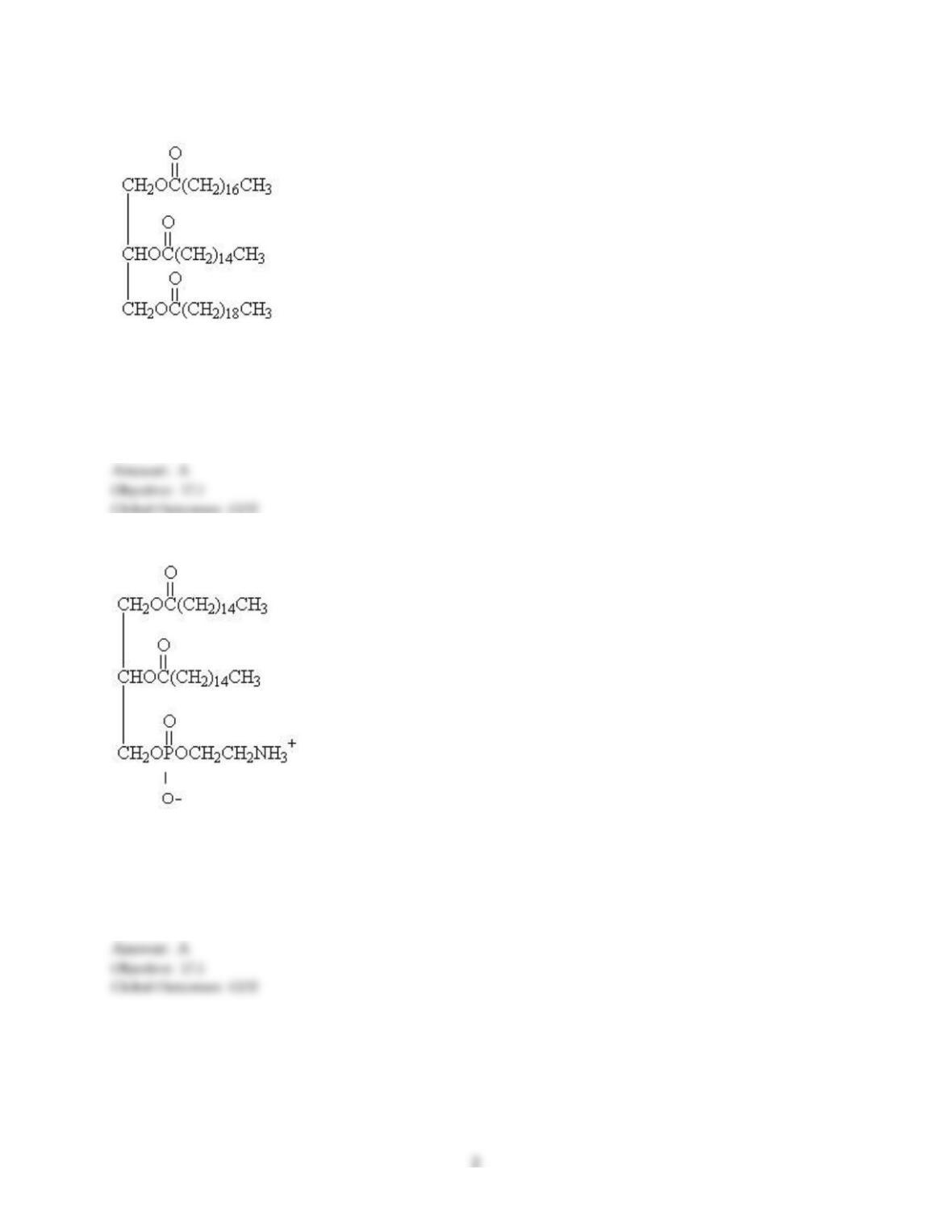
3)
A) triacylglycerol
B) wax
C) glycerolphospholipid
D) bile salt
E) steroid
4)
A) glycerophospholipid
B) triacylglycerol
C) glycosphingolipid
D) steroid
E) wax
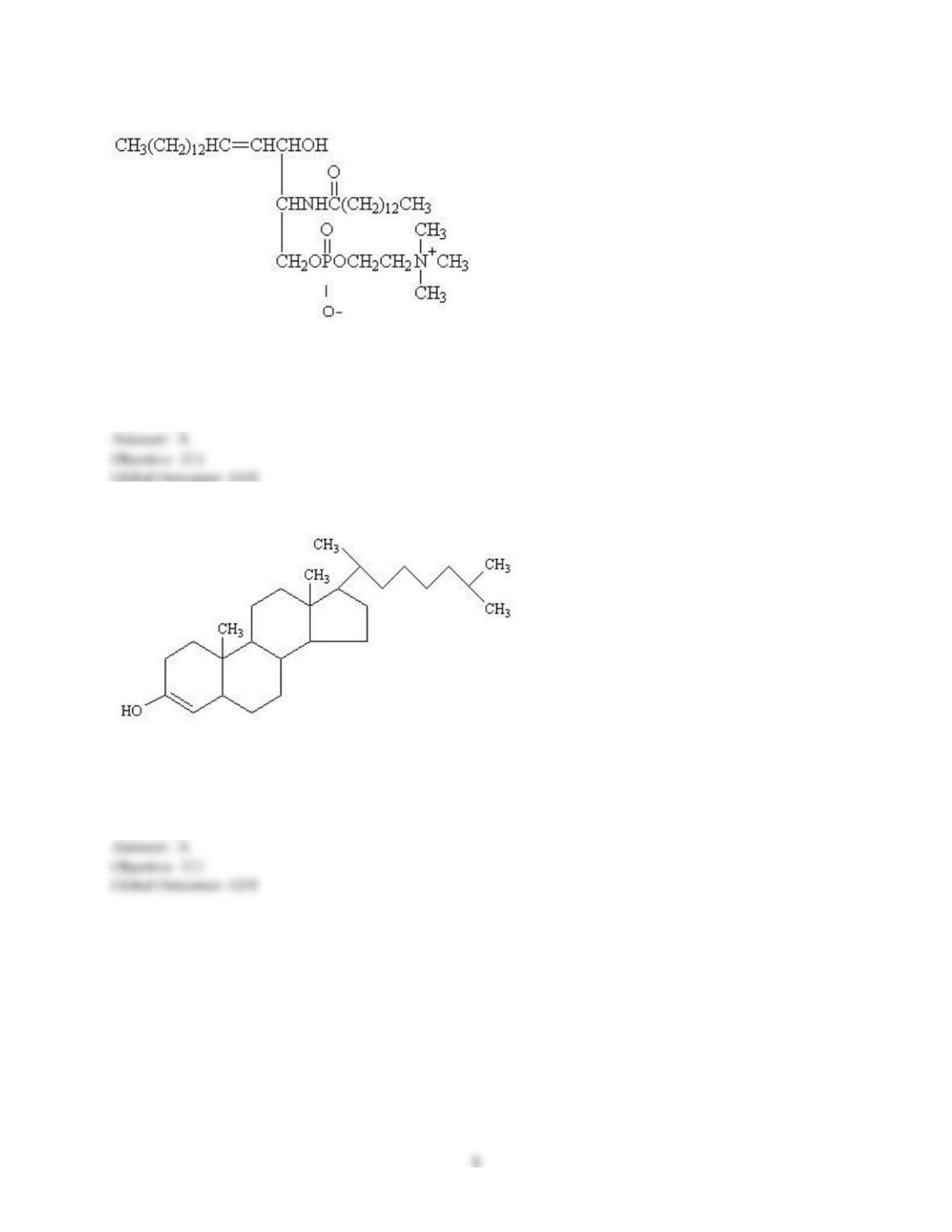
5)
A) sphingolipid
B) simple lipid
C) bile salt
D) triacylglycerol
E) prostaglandin
6)
A) steroid
B) glycerophospholipid
C) wax
D) bile salt
E) prostaglandin
7) Lipids are compounds that are soluble in
A) distilled water.
B) normal saline solution.
C) glucose solution.
D) chloroform.
E) oxygen.
8) Which of the following is NOT a function of lipids in the human body?
A) energy storage
B) insulation
C) protection
D) emulsification
E) pH regulation
9) Which of the following lipids will give no fatty acid when hydrolyzed?
A) wax
B) fat
C) phospholipid
D) glycolipid
E) cholesterol
10) Which of the following is NOT a lipid?
A) oleic acid
B) cholesterol
C) carnuba wax
D) DNA
E) lecithin
11) A polyunsaturated fatty acid contains more than one
A) carboxyl group.
B) hydroxyl group.
C) carbonyl group.
D) long carbon chain.
E) double bond.
12) Unsaturated fatty acids have lower melting points than saturated fatty acids because
A) they have fewer hydrogen atoms.
B) they have more hydrogen atoms.
C) their molecules fit closely together.
D) the cis double bonds give them an irregular shape.
E) the trans double bonds give them an irregular shape.
13) Which of the following is an unsaturated fatty acid?
A) myristic
B) oleic
C) palmitic
D) stearic
E) lauric
14) Which of the following fatty acids is a solid at room temperature?
A) palmitoleic
B) oleic
C) stearic
D) linoleic
E) linolenic
15) Compared to saturated fatty acids, unsaturated fatty acids have
A) longer carbon chains.
B) shorter carbon chains.
C) higher melting points.
D) lower melting points.
E) greater intermolecular attraction.
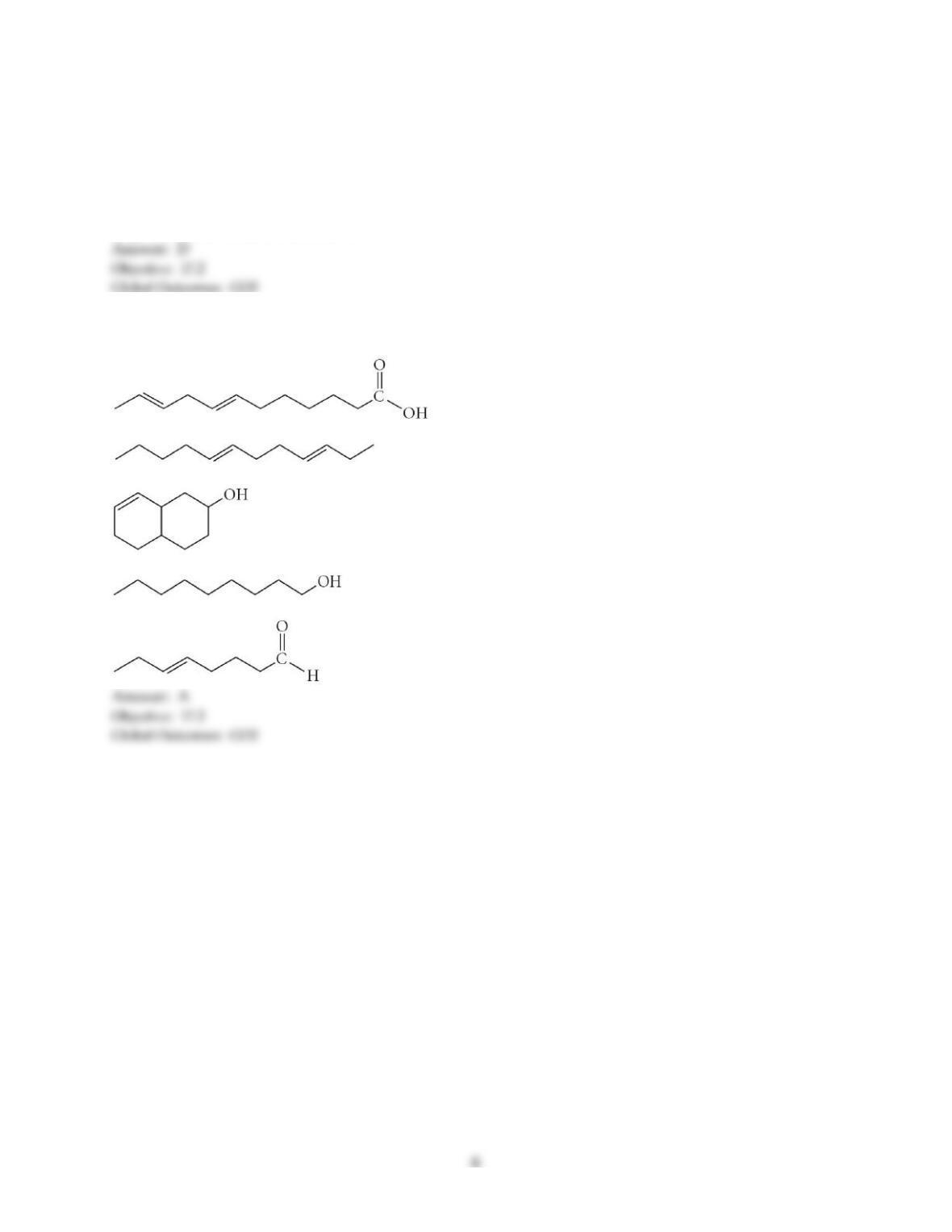
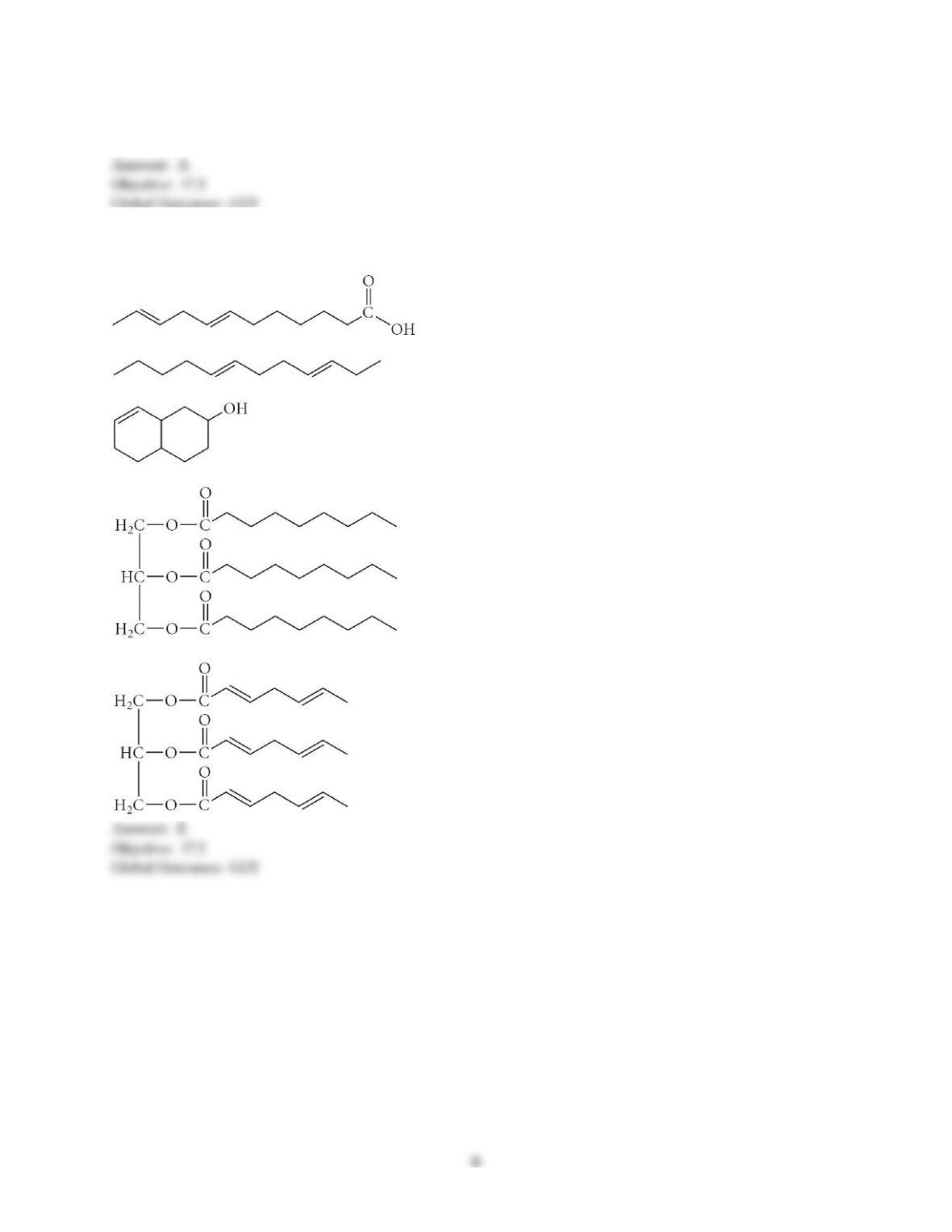
16) Choose the polyunsaturated fatty acid from the compounds below.
A)
B)
C)
D)
E)
7
17) Choose the saturated fatty acid from the compounds below.
A)
B)
C)
D)
E)
18) Which of the following is a fatty acid which is a solid at room temperature?
A)
B)
C)
D)
E)
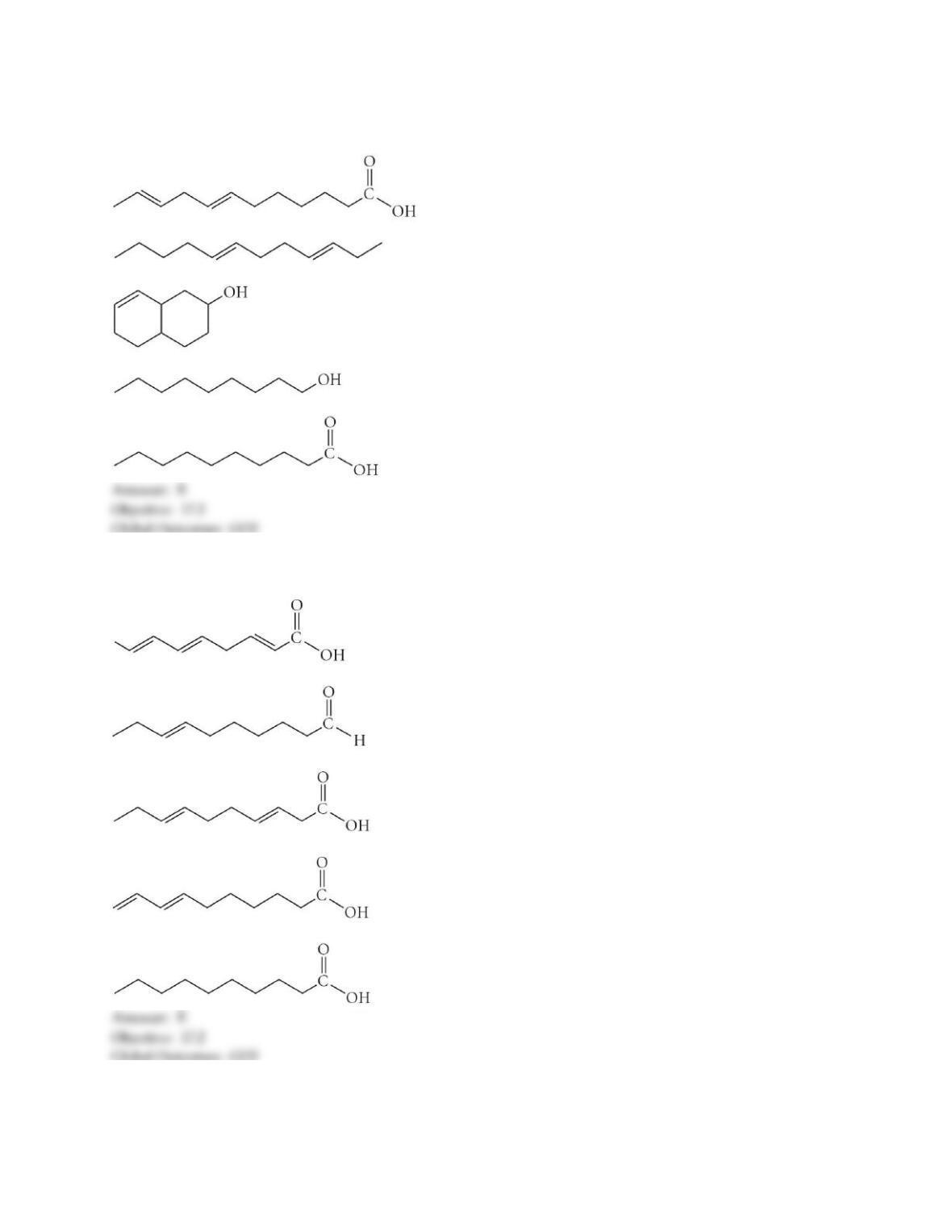
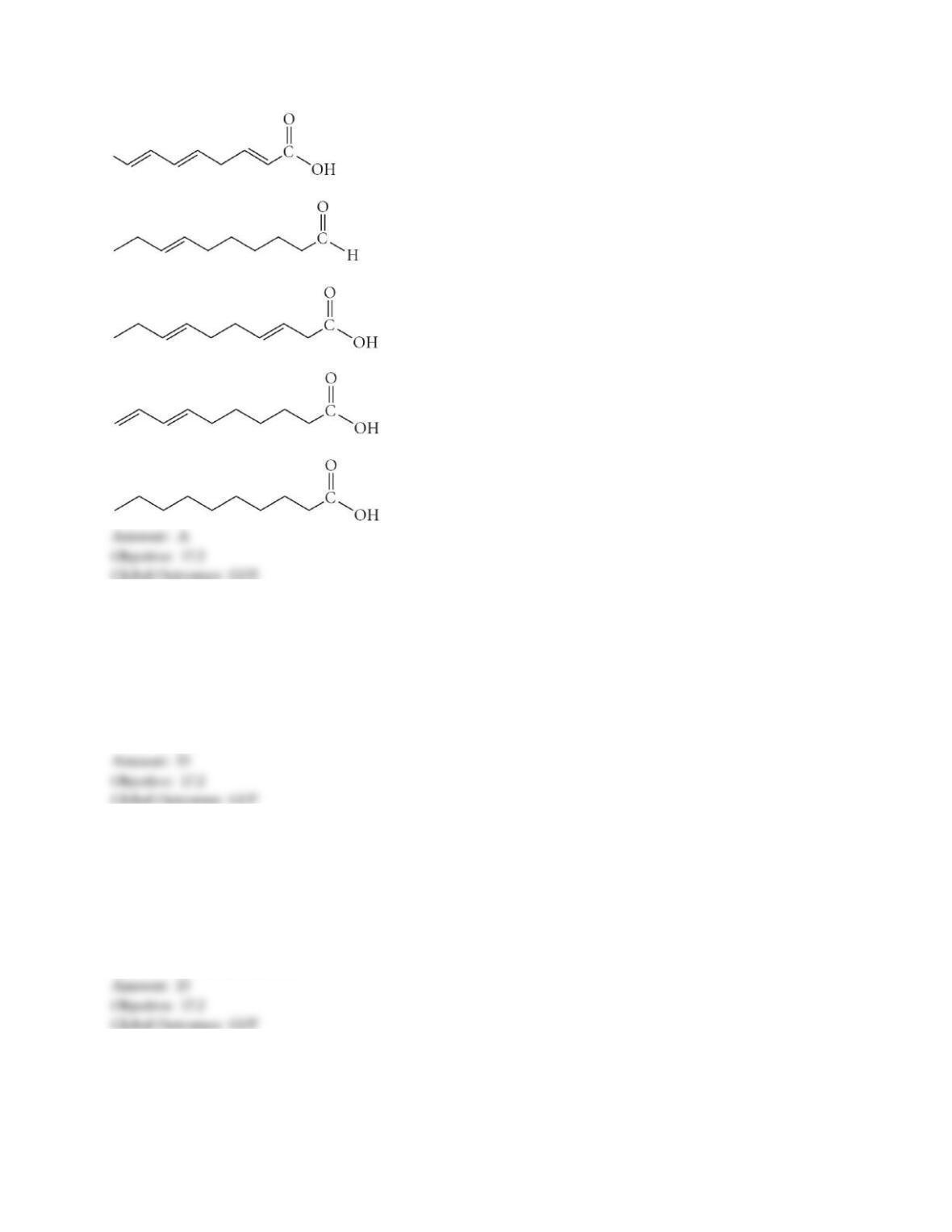
19) Which of the following fatty acids is most likely to be a liquid at room temperature?
A)
8
B)
C)
D)
E)
20) A double cheeseburger with bacon contains 640 kcal and 39 g of fat. Calculate the number of
kilocalories from fat (1 gram of fat = 9 kcal).
A) 4.3 kcal from fat
B) 39 kcal from fat
C) 71 kcal from fat
D) 350 kcal from fat
E) 640 kcal from fat
21) A double cheeseburger with bacon contains 640 kcal and 39 g of fat. Calculate the percentage of total
kilocalories due to fat (1 gram of fat = 9 kcal).
A) 0.68% of total kilocalories
B) 6.1% of total kilocalories
C) 11% of total kilocalories
D) 55% of total kilocalories
E) 100% of total kilocalories
22) Which of the following lipids will give a single molecule of fatty acid when hydrolyzed?
A) wax
B) fat
C) phospholipid
D) glycolipid
E) cholesterol
23) Choose the polyunsaturated triacylglycerol from the compounds below.
A)
B)
C)
D)
E)
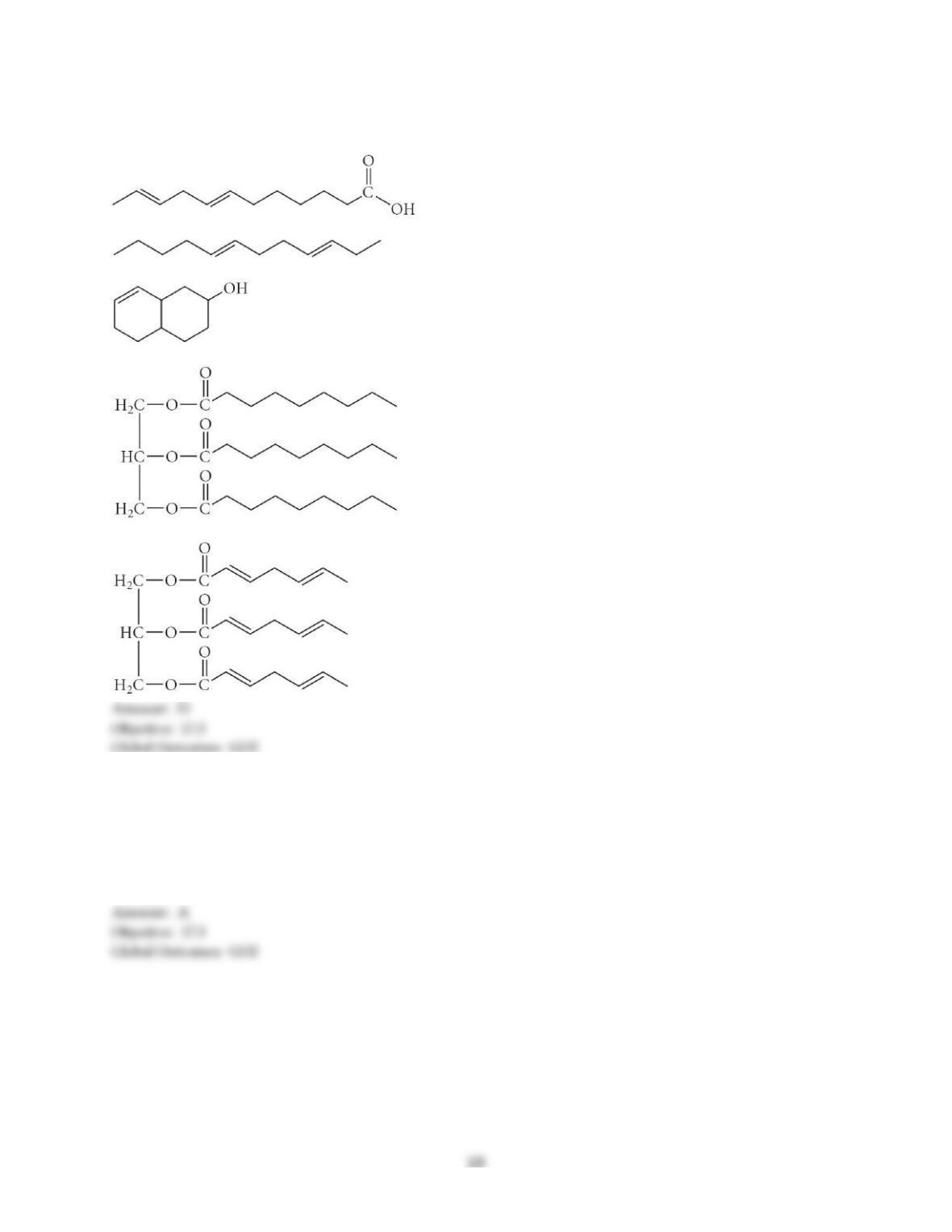
24) Choose the saturated triacylglycerol from the compounds below.
A)
B)
C)
D)
E)
25) Waxes are lipids derived from
A) a long-chain alcohol and a long-chain fatty acid.
B) glycerol and three fatty acids.
C) glycerol, fatty acids, phosphate, and an amino alcohol.
D) sphingosine, fatty acids, phosphate, and an amino alcohol.
E) terpenes and steroids.
26) A triacylglycerol that is solid at room temperature is called a(n)
A) cephalin.
B) lecithin.
C) oil.
D) wax.
E) fat.
27) Which of the following is a polyunsaturated fat?
A) triolein
B) tripalmitin
C) tristearin
D) trimyristin
E) trilinolein
28) Commercially, liquid vegetable oils are converted to solid fats such as margarine by
A) hydrogenation.
B) hydrolysis.
C) hydration.
D) oxidation.
E) saponification.
29) Margarine containing partially hydrogenated soybean oil is solid because
A) it contains only saturated fats.
B) it contains only trans fatty acids.
C) some of its double bonds have been converted to single bonds.
D) it contains only cis double bonds.
E) it contains only polyunsaturated fatty acids.
12
30) Palmitic acid is a 16 carbon acid. In a balanced equation, the products of the saponification of glyceryl
tripalmitate (tripalmitin) are
A) O
CH2 – OH + 3 CH3 – (CH2)14 – C – OH
|
CH – OH
|
CH2 – OH
B) O
CH2 – O– Na+ + 3 CH3 – (CH2)14 – C – OH
|
CH – O– Na+
|
CH2 – O– Na+
C) O
CH2 – OH + 3 CH3 – (CH2)14 – C – O– Na+
|
CHOH
|
CH2 – OH
D) O
CH2 – OH + CH3 – (CH2)14 – C – O– Na+
|
3 CHOH
|
CH2 – OH
E) O
CH2 – OH + 2 CH3 – (CH2)14 – C – O– Na+
|
CHOH O
|
CH2 – OH + CH3 – (CH2)14 – C – O– Na+
31) The products of the acid catalyzed hydrolysis of a fat are
A) the esters of fatty acids.
B) fatty acids and glycerol.
C) salts of fatty acids.
D) salts of fatty acids and glycerol.
E) phospholipids.
32) The products of the saponification of a fat are
A) the esters of fatty acids.
B) fatty acids and glycerol.
C) salts of fatty acids.
D) salts of fatty acids and glycerol.
E) phospholipids.
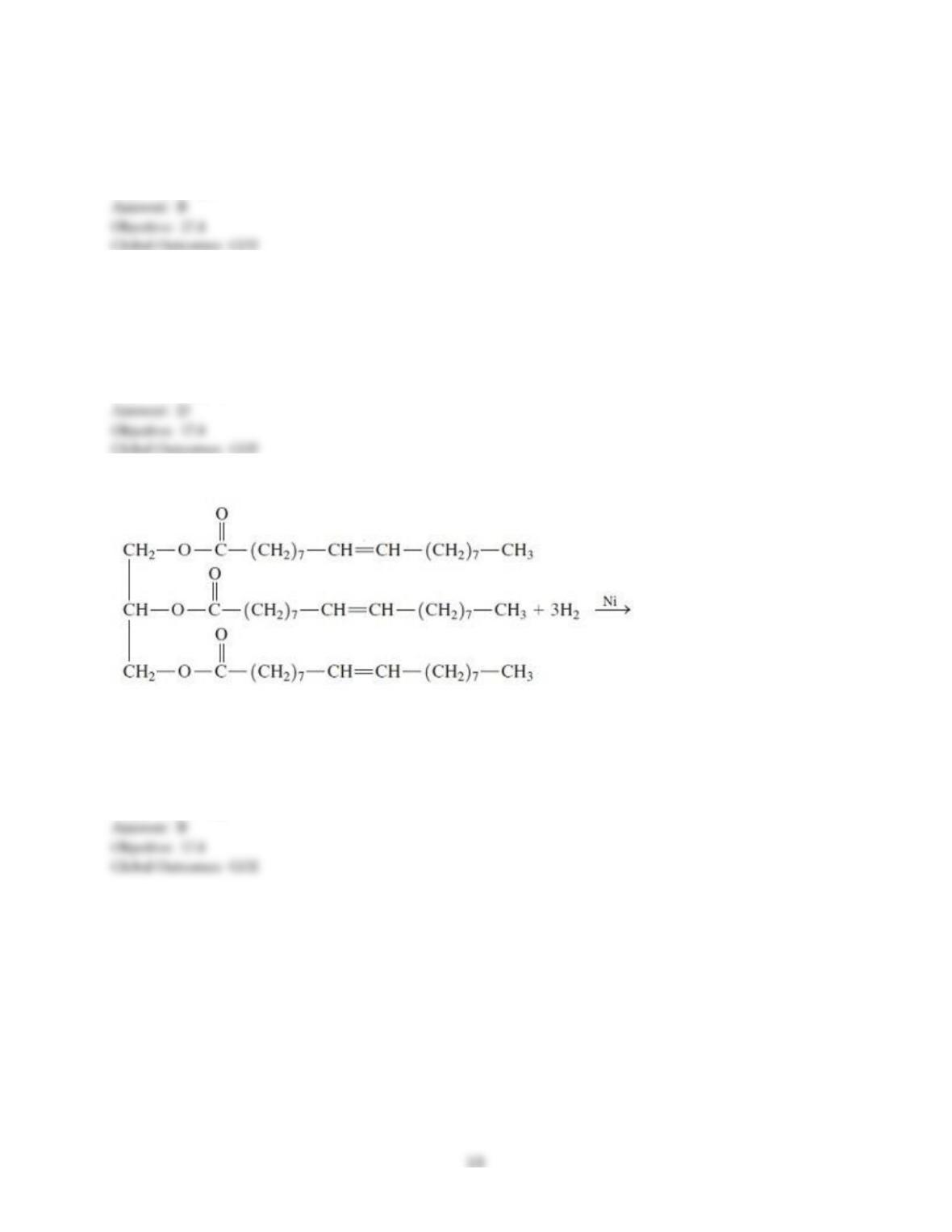
33) The products of this reaction is
A) glyceryl trioleate
B) glyceryl trisrearate
C) glyceryl tripalmitate
D) fat.
E) glyceryl tricaprate.
34) Glycerophospholipids can interact both with other lipids and water because they contain both
________ and ________.
A) single bonds; double bonds
B) polar regions; nonpolar regions
C) glycerol; sphingosine
D) saturated fatty acids; unsaturated fatty acids
E) bile salts; cholesterol
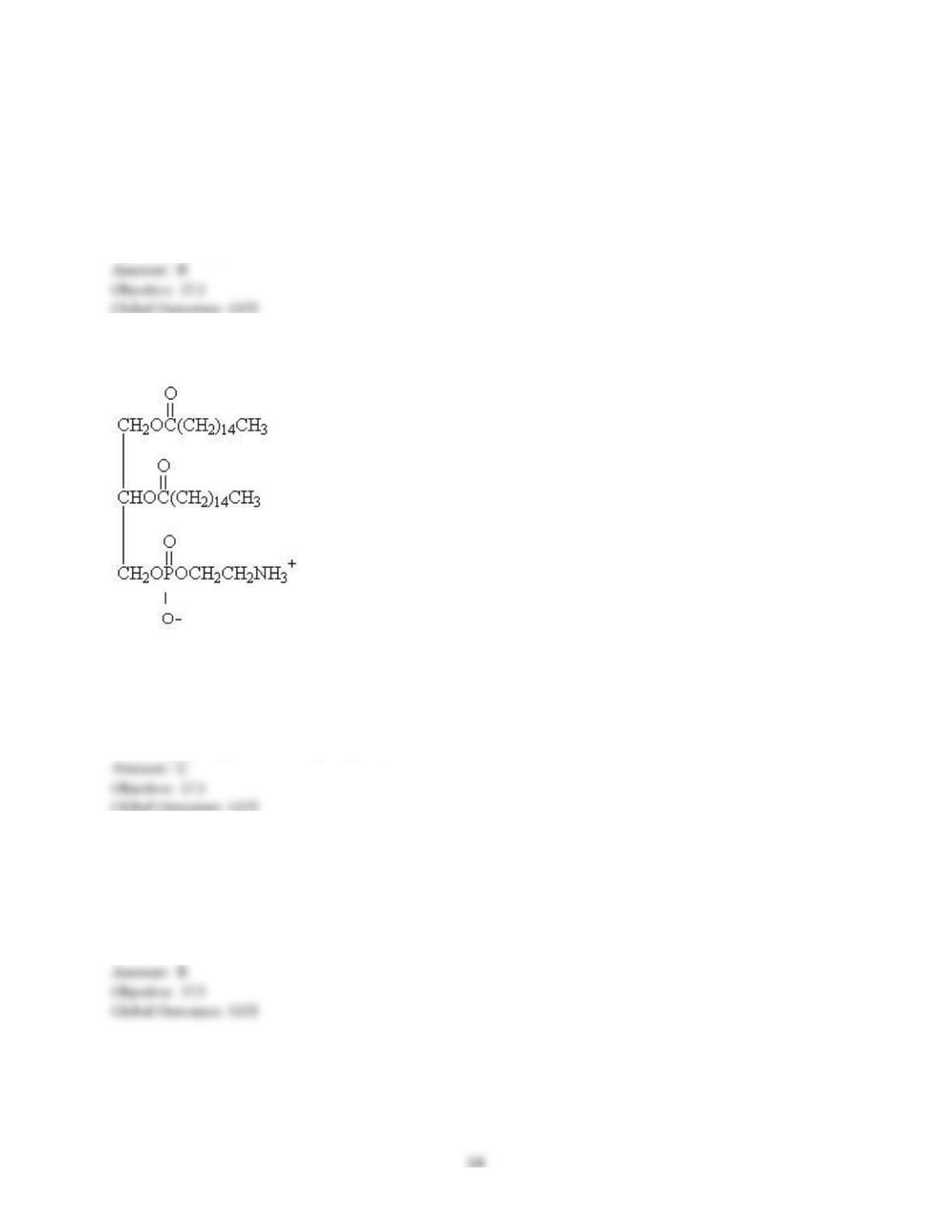
35) The components in the following glycerophospholipid are
A) sphingosine, palmitic acid, phosphate, and choline.
B) sphingosine, palmitic acid, phosphate, and serine.
C) glycerol, palmitic acid, phosphate, and ethanolamine.
D) glycerol, palmitic acid, phosphate, and galactose.
E) sphingosine, palmitic acid, phosphate, and ethanolamine.
36) In the list below, which lipid type is most soluble in water?
A) triacylglycerols
B) glycerophospholipids
C) oils
D) steroids
E) waxes